MAE378-Lecture 08
0.0(0)
Studied by 2 people Call Kai
 Learn
Learn Practice Test
 Spaced Repetition
 Match
Match Flashcards
 Knowt Play
Card Sorting
1/60

Earn XP
Description and Tags
Last updated 5:21 AM on 10/21/22
Name | Mastery | Learn | Test | Matching | Spaced | Call with Kai | Chat |
|---|
No analytics yet
Send a link to your students to track their progress
61 Terms
1
New cards
Recrystallization Recrystallization
________ is induced after a material has been cold worked to reduce strain hardening effects Induces a change in size, shape, and distribution.
2
New cards
Hypereutectoid steel
________ has between 0.8 % and 2 % of C, composed by pearlite and cementite.
3
New cards
A1
Normalizing vs. annealing In normalizing, cooling will be different in different locations Properties will vary between the surface and interior in normalized steel Lower cost of normalizing is justified if uniform properties is not critical Stress- relief anneal Reduces residual stresses in casting, welded assemblies, and cold- formed products Materials are heated to temperature below ________, held for period of time and then slow cooled.
4
New cards
CCT
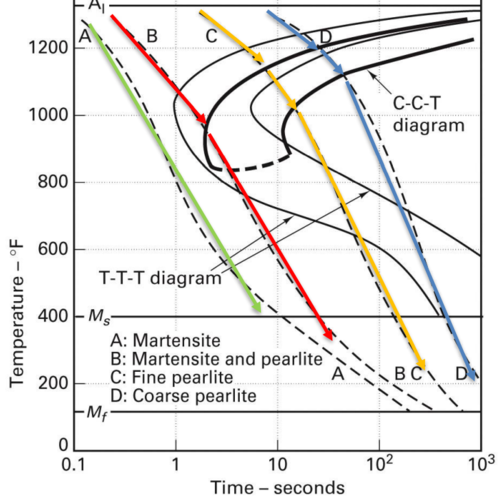
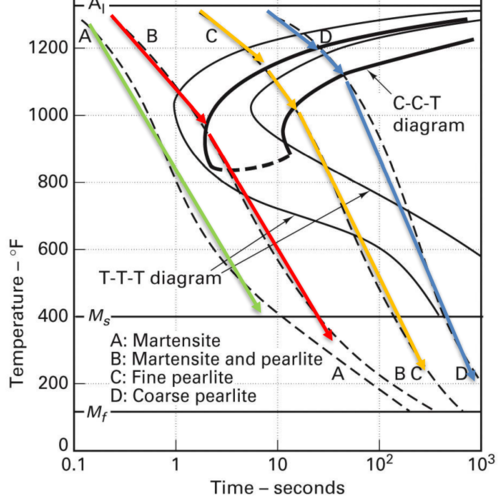
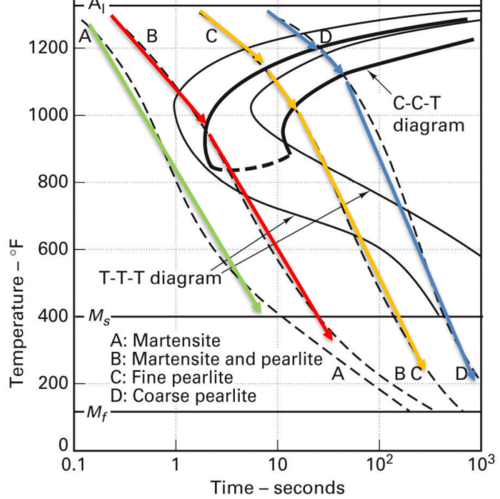
________ and TTT diagrams showed how much austenite transform in microstructure when you have different cooling rate.
5
New cards
Cementite
________: is an intermetallic compound of iron and carbon (6.67 % C and 93.3 % Fe)
6
New cards
Fe3C
Note: Martensite is formed by the rapid cooling (quenching) of the austenite form of iron at such a high rate that carbon atoms do not have time to diffuse out of the crystal structure in large enough quantities to form cementite (________)
7
New cards
fcc
Because of ________ structure has more interstitial positions, the solid solubility of austenite is much higher than ferrite.
8
New cards
BCC
Ferrite: Is a solid solution of limited amounts of carbon in iron with a body- centered cubic (________) crystal structure Austenite: Within a certain temperature range iron undergoes polymorphic transformation from ________ to fcc becoming gamma iron (austenite)
9
New cards
Martensite
________: When Austenite cool down very rapidly, carbon atoms do not have enough time to form cementite.
10
New cards
material of components
Product are usually martensite or pearlite depending on the cooling media as well as the ________.
11
New cards
α ferrite
It is composed by pearlite and ________.
12
New cards
lamellar structure
Note: Pearlite is a two- phased, ________ composed by alternating layers of cementite and α ferrite.
13
New cards
Water
________ is an effective quenching medium because of its high heat of vaporization and relatively high boiling point b.
14
New cards
Hypoeutectoid steel
________ has less than 0.8 % of C in its composition.
15
New cards
term hardenability
The ________ should not be confused with hardness, which is resistance of a materials to indentation or scratching.
16
New cards
Processing heat treatments for steel c. Heat treatments for non-ferrous materials d. Strengthening heat treatment for
Steel Non-ferrous materials Iron-Carbon Equilibrium Phase Diagram Commercial pure Iron contains 0.008% C, Steels up to 2.11% C and cast irons up to 6.67% C
17
New cards
Cementite
is an intermetallic compound of iron and carbon (6.67% C and 93.3% Fe)
18
New cards
Note
Pearlite is a two-phased, lamellar structure composed by alternating layers of cementite and α ferrite
19
New cards
Note
Martensite is formed by the rapid cooling (quenching) of the austenite form of iron at such a high rate that carbon atoms do not have time to diffuse out of the crystal structure in large enough quantities to form cementite (Fe3C)
20
New cards
Processing heat treatment for steel Annealing Annealing is a common heat treatment process may be used to
Reduce strength and hardness Removes residual stresses Improves toughness Restores ductility Refines grain size Full Annealing Hypoeutectoid steels are heated to convert the grain structure to homogenous single-phase austenite, then control cooled The cooling results in coarse pearlite with excess ferrite Results in soft and ductile steel Hypereutectoid steels undergo a similar process but the structure will be coarse pearlite with excess cementite (cooling slowly)
21
New cards
Note
If materials were to be slow cooled from all austenite region, a continues network of cementite may form in the grain boundary make the material brittle
22
New cards
Note
While full anneal produce the softest and weakest properties
23
New cards
Note
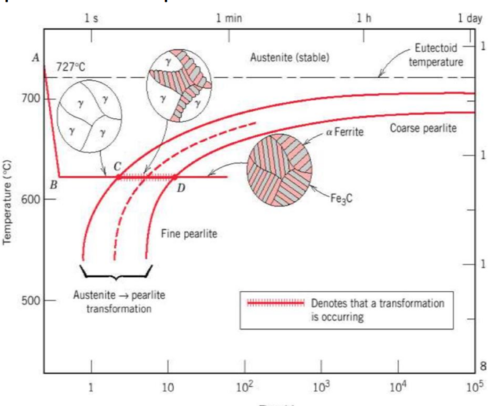
In TTT diagrams, after cooling to a transformation temp, you keep the temp constant until the transformation of austenite to the required transformation product is complete
24
New cards
Note
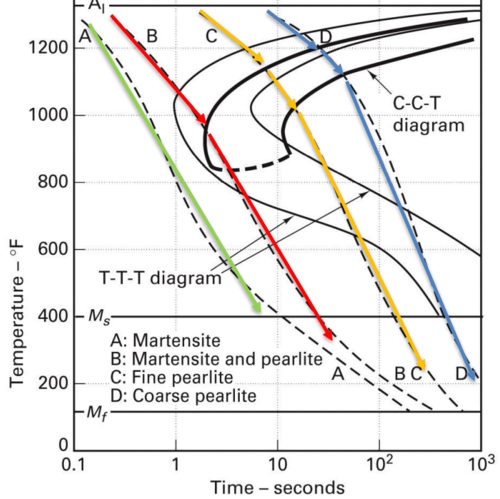
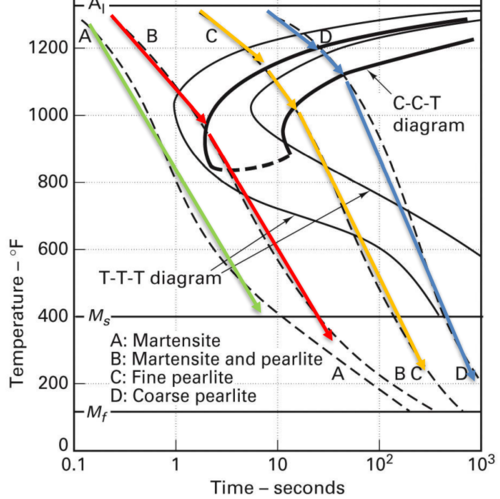
In CCT diagrams, there is continues cooling ( no holding of temp)
25
New cards
Martensite
When Austenite cool down very rapidly, carbon atoms do not have enough time to form cementite
26
New cards
Structures resulting from transformation at various temperatures Note
The highest hardness of the pearlite phase is 400 HB whereas for Martensite can achieve to 700 HB
27
New cards
Note
A round test bar 100 mm long is austnized (100 %) and then quenched directly at one end with a steam of water at 24°C
28
New cards
Iron Carbon Content
.008% Carbon
29
New cards
Steel Carbon Content
up to 2.11% Carbon
30
New cards
Cast Iron Carbon Content
up to 6.67% Carbon
31
New cards
Ferrite
phase of iron composed of solid solution of limited amounts of carbon in iron with a body-centered cubic (BCC) crystal structure
32
New cards
Austenite
phase of iron after undergoing polymorphic transformation from bcc to fcc becoming gamma iron
33
New cards
Cementite
phase of iron composed of intermetallic compound of iron and carbon
very hard and brittle
very hard and brittle
34
New cards
Hypoeutectoid
steel has less than 0.8% of C in its composition
composed of pearlite and alpha-ferrite
composed of pearlite and alpha-ferrite
35
New cards
Hypereutectoid
steel has between 0.8% and 2% C
composed of pearlite and cementite
composed of pearlite and cementite
36
New cards
Pearlite
phase of iron two-phased, lamellar structure composed by alternating layers of cementite and alpha ferrite
37
New cards
Martensite
phase of iron formed by rapid cooling (quenching) of austenite so that carbon atoms cannot diffuse out of the crystal structure
38
New cards
Heat Treatment
expression to describe the controlled heating and cooling of materials for purpose of alternating their structure and properties
39
New cards
Annealing
common heat treatment process used to
-reduce strength and hardness
-remove residual stresses
-improve toughness
-restore ductility
-refine grain size
Heating below the lower critical temperature
-reduce strength and hardness
-remove residual stresses
-improve toughness
-restore ductility
-refine grain size
Heating below the lower critical temperature
40
New cards
Full Annealing with Hypoeutectoid
steels are heated to convert grain structure to homogenous single-phase austenite, then control cooled to get coarse pearlite with excess ferrite
results in soft and ductile steel
results in soft and ductile steel
41
New cards
Full Annealing with Hypereutetoid
steels are heated to convert grain structure to and then control cooled to get coarse pearlite with excess cementite
42
New cards
Full Annealing
Heating 30-50°C above critical temperature, maintaining for a specific period of time, and then slowly cooling down the inside of the furnace
Time consuming and takes a lot of energy
Time consuming and takes a lot of energy
43
New cards
Normalizing
heating steel to a temp higher than annealing
Aim is t obtain ferrite-pearlite microstructure
More effective than annealing
Cooled in air
Results in different properties between interior and exterior of the steel
Aim is t obtain ferrite-pearlite microstructure
More effective than annealing
Cooled in air
Results in different properties between interior and exterior of the steel
44
New cards
Stress Relief Anneal
reduces residual stresses from casting, welded assemblies, and cold formed products.
Heated to below A1 and then time cooled
Heated to below A1 and then time cooled
45
New cards
Spherodizing Anneal
Applicable to steels with more than 0.5% C
Parts heated to below A1
Cementite changes from lamellar formation to alpha ferrite matrix with particles of spheroidal cementite
Parts heated to below A1
Cementite changes from lamellar formation to alpha ferrite matrix with particles of spheroidal cementite
46
New cards
Recrystallization
induced after a material has been cold worked to reduce strain hardening effects.
induces change of size, shape, and distribution
induces change of size, shape, and distribution
47
New cards
Hardenability
capability of an alloy to be hardened by heat treatment
48
New cards
Hardenability Depends On
carbon content
alloying elements present
cooling rate
austenite grain size and transformation to pearlite
alloying elements present
cooling rate
austenite grain size and transformation to pearlite
49
New cards
Time-Temperature-Transformation (TTT) Diagram
indicates a specific transformation start end end
shows percentage of transformation of austenite at a particular temp
Goal is to obtain type and portion in the curve to obtain specific propertied
shows percentage of transformation of austenite at a particular temp
Goal is to obtain type and portion in the curve to obtain specific propertied
50
New cards
Continuous Cooling Transformation (CCT) Diagram
used to represent which types of phase changes will occur in a material as it is cooled at different rates
These diagrams have no holding temp (continuous cooling)
These diagrams have no holding temp (continuous cooling)
51
New cards
A in CCT Diagram
Austenite
52
New cards
B in CCT Diagram
Bainite
53
New cards
M in CCT Diagram
Martensite
54
New cards
P in CCT Diagram
Pearlite
55
New cards
Jominy Test
Round bar splashed with water on one end that provides different cooling rates along the bar. Gives difference in properties for different cooling rates from one test
56
New cards
Quenching
submerging hot material in a liquid in order to induce rapid cooling
57
New cards
Stages of Quenching
Formation of the Vapor Jacket
Nucleate boiling phase
Conduction and convection
Nucleate boiling phase
Conduction and convection
58
New cards
Formation of the Vapor Jacket
thin gaseous layer between the metal and the liquid during cooling
59
New cards
Nucleate Boiling Phase
Produces rapid rates of cooling down to the boiling point of the quenchant
60
New cards
Conduction and Convection
Slower cooling from the boiling point to room temperature
61
New cards
Types of Quenchant (Fastest to Slowest)
Water
Brine
Water based polymer
Oil
Molten salt baths
High pressure steam quenching
Brine
Water based polymer
Oil
Molten salt baths
High pressure steam quenching