Phonetics — Exam 1
 Call Kai
 Learn
Learn Practice Test
 Spaced Repetition
 Match
Match Flashcards
 Knowt Play
1/121

There's no tags or description
Looks like no tags are added yet.
Name | Mastery | Learn | Test | Matching | Spaced | Call with Kai | Chat |
|---|
No analytics yet
Send a link to your students to track their progress
122 Terms
Phonetics
The study of the production and perception of speech sounds.
Orthographic
Conventional spellings of a language
**(Greek: ortho = correct, graphos = writing)
A language is "phonetic" when its orthographic (written) representation matches how it's pronounced.
Is English a phonetic language?
No — English uses different symbols for the same sound
(e.g., the "ee" sound is spelled differently in funny/honey/people, sheep/chic/phoenix, leap/brief, he/ceiling).
Broad transcription
Basic transcription of speech sounds — a separate symbol for each sound, one symbol per sound.
Narrow transcription
Nuanced transcription that adds phonetic detail and diacritical markings on top of broad transcription.
IPA (International Phonetic Alphabet)
A system where one symbol equals one sound.
Two-way scoring
The simplest form of scoring a speech sound: binary, correct vs. incorrect (judged against General American English/SAE using IPA).
Five-way scoring
Deletion/omission (sound isn't there)
Distortion (sound produced incorrectly)
Correct
Addition (a sound is added)
Substitution (one sound replaces another).
Hierarchy of speech production
Isolated sound → Syllable → Word → Connected speech.
Coarticulation
Anticipating the next sound in connected speech, creating efficiencies in production.
Language
a complex and dynamic system of conventional symbols used in various modes for thought and communication
an estimated 3,000-7,000 languages exist
Dialect
Differences in pronunciation, vocabulary, or grammatical construction among speakers of the same language — broader than accent (includes syntax, word choice, contractions).
Accent
narrower than dialect — differences in pronunciation only (inflection, consonant/vowel quality).
Morpheme
The minimal unit of meaning, or the smallest unit of a word that carries any semantic meaning. (Semantic = relating to meaning.)
Lexicon
The list of morphemes available in a language.
Morphemics / Morphology
The study of morphemes.
Grapheme
The minimal unit of contrastive meaning in a written language system — an orthographic symbol (e.g., a letter).
Graphemics
The study of graphemes.
Allography
The broader study of how units of language are written down.
Alphabet
A set of letters or characters used to write a language.
Allograph
A letter or combination of letters that represents the same sound
(e.g., all the different spellings of /ʃ/: shredding, sugar, precious, tissue, machine, anxious).
Phoneme
The minimal unit of contrastive meaning in a spoken language system — the smallest sound unit that carries meaning. You have to be able to hear it. One phoneme = one symbol.
Phonemics
The study of phonemes.
Phonology
The study of sound systems in language — the structure and function of sounds within a language.
Minimal pair (minimal contrastive pair)
Two words that differ by only one phoneme, where that single-sound difference changes meaning
(e.g., MOP vs. MOB — /p/ unvoiced vs. /b/ voiced).
Phonemic contrast
A phonemic contrast that is also a linguistic contrast — a change in sound that carries a change in meaning.
Articulatory phonetics
The study of the ways speech sounds are physically formed.
Acoustic phonetics
The study of the acoustic properties of speech sounds.
Clinical phonetics
The study of phonetics as applicable to disorders of speech and language; relies on accurate phonetic judgments to evaluate disorders of speech, language, and hearing that affect speech development.
Allophone
More than one representation (variant) of the same phoneme — different pronunciations of the same sound
(e.g., aspirated [pʰ] vs. unreleased [p̚] versions of /p/).
Initial
Position of a sound at the beginning of a word
Medial
Position of a sound in the middle of a word
Final
Position of a sound at the end of a word
Prevocalic
A sound that precedes a vowel.
Postvocalic
A sound that follows a vowel.
Geminate
Two identical sounds occurring adjacent to each other, often across a word boundary
(e.g., "black cat," "bookkeeper").
Syllable
A unit of speech that has a vowel at its nucleus.
Releasing
The syllable-initial position.
Arresting
The syllable-final position.
Open syllable
A syllable that ends in a vowel
Closed syllable
A syllable that ends in a consonant sound.
Phonemic transcription
Identification of sound segments that carry linguistic significance in the speaker's language; symbols are placed between virgules, / /.
Phonetic transcription
Identification of the allophonic variants in an individual speaker's pattern of sounds; symbols are placed between brackets, [ ], and may include diacritic marks.
General American English (GAE) / Standard American English (SAE)
The dialect of English this course focuses on transcribing.
Idiolect
An individual's own unique speech pattern (prosody, cadence) — distinct from a shared regional dialect.
Inductive (bottom-up) transcription
Transcribing based on what you actually hear pronounced — not how a word is spelled and not how you think it "should" sound. This is how phonetic transcription works (as opposed to top-down/deductive thinking).
IPA symbol inventory (as of 2015)
107 symbols for consonants and vowels
31 symbols for diacritic marks
19 symbols for suprasegmental qualities (length, stress, intonation).
Diacritic marks
Special marks added to phonetic symbols to identify allophonic variants (used in narrow transcription).
IPA punctuation rule
IPA transcriptions use no punctuation and no capitalization.
Three major systems of speech production
Respiratory
Laryngeal
Supralaryngeal.
Respiratory system
The lungs
rib cage
abdomen and associated muscles
function of the respiratory system
acts as a pump to push air through the larynx (for voicing) and the articulators (for speech sound shaping).
Egressive speech
produced on outgoing (exhaled) air
all English sounds are egressive.
Ingressive speech
produced on incoming (inhaled) air; rare
used in some languages (e.g., Scandinavian affirmation inhalations, French "ouais," Japanese deferential inward hiss).
Inhalation mechanics
The diaphragm contracts and moves down, pulling the lungs down to expand them — a passive process that creates a vacuum (lower air pressure), drawing air into the lungs.
Exhalation mechanics
The diaphragm relaxes and air exits the lungs; during speech this relaxation is slowed/controlled to sustain airflow for voicing.
Positive resistance (respiration for speech)
pushing air out to speak uses positive resistance (like pushing up on a bench press)
Breathing for speech vs. quiet breathing
During normal breathing, the abdominal/oblique muscles should relax and the lower torso should expand; other muscle contractions can quickly squeeze the chest cavity to force air out rapidly when loudness/emphasis is needed.
Trachea
The windpipe — a cartilage-reinforced membranous tube connecting the lungs to the larynx.
Larynx
The voicebox — a tube-shaped cartilaginous and muscular structure that provides voicing for sound and connects the trachea to the pharynx.
Myoelastic-aerodynamic theory (MEAD)
The theory that vocal fold vibration results from a combination of myoelastic (muscular/elastic tissue) properties and aerodynamic (airflow) forces.
Vocal folds
Paired sheets of muscle stretching horizontally, back to front, across the larynx (~3/4 to 1 inch in an adult male; ~1/2 to 3/4 inch in an adult female; smaller in children). Have 3-dimensional movement.
Glottis
The opening between the vocal folds.
Abduction (vocal folds)
pulled apart (during breathing); muscles relax
Adduction (vocal folds)
vocal folds brought together and contacting one another (during voicing); muscles tighten
Vocal fold valving function
Vocal folds close very tightly (beyond normal voicing) when lifting something heavy, bracing for a punch, or giving birth — a protective/bracing function.
Aspiration (clinical)
Liquid that enters the vocal fold area or passes into the lung.
Vocal fold edema
Swelling of the vocal cords — the cause of "losing your voice."
Frequency
How many cycles of a sound occur per unit time (usually one second); measured in Hertz (Hz), where 1 Hz = 1 cycle per second.
Pitch
The perceptual "highness" or "lowness" of a sound, related to its frequency — high frequency = high pitch, low frequency = low pitch.
Human hearing range
Approximately 20 Hz to 20,000 Hz; an octave = a doubling of frequency.
Fundamental frequency (f0)
The rate at which the vocal folds vibrate.
Typical adult male ≈ 125 Hz
typical adult female ≈ 250 Hz (about 2x the male voice)
newborn cry ≈ 500 Hz
**children's f0 is typically higher and varies by age.
Supralaryngeal system
Also called the pharyngeal-oral-nasal system; everything above the larynx that shapes sound — the pharynx, oral cavity, and nasal cavity.
Pharyngeal cavity (pharynx)
Passage from the oral and nasal cavities to the larynx and esophagus, located behind the mouth and nose; divided into 3 sections —
nasopharynx
oropharynx
laryngopharynx
Velopharyngeal port
The valve formed by the velum (soft palate) between the pharynx and nasal cavities.
*non-nasal sounds, the velum elevates and the pharyngeal walls contract to close the port
*nasal sounds (/m/, /n/, /ŋ/), the velum lowers and the pharyngeal walls move apart, allowing airflow into the nasal cavity. English has nasal consonants but no nasal vowels.
Articulators
Structures in the supralaryngeal system that change position to produce speech sounds:
velum
jaw
tongue**
lips
pharyngeal walls
**The tongue is the most important articulator — it shapes vowels and helps form consonants.
Non-moving (fixed) structures
(epi)glottis
hard palate
alveolar ridge
teeth
**do not move during speech, but moving articulators (especially the tongue) interact with them to produce sounds.
Jaw (mandible)
The bony structure on the lower part of the face; hinges at the temporomandibular joint (attached to the temporal bone); can also be protruded (shifted forward) or retruded (shifted backward). Its movement contributes to tongue and lower-lip movement.
Tongue
A muscular organ, supported by the jaw and the hyoid bone, attached to the skull, palate, pharynx, and epiglottis by multiple muscles; capable of complex movement with multiple sources of innervation.
Parts of the tongue — Body
The primary muscle mass of the tongue.
Parts of the tongue — Tip/Apex
The portion visible when the tongue is protruded.
Parts of the tongue — Blade
Just behind the tip; creates constriction for a small number of sounds (e.g., the first sound in SHOE) and shapes the tongue for other sounds.
Parts of the tongue — Dorsum/Back
Behind the blade; creates constriction for a few sounds (e.g., the last sound in SOCK) by contacting the soft or hard palate.
Parts of the tongue — Root
The long segment forming the front wall of the pharynx; shapes the vocal tract for vowels/consonants but does not contact anything for any English sound.
Lips (as articulators)
Contact one another, the teeth, or the tongue; shape the oral cavity. Lip protrusion lengthens the vocal tract; lip rounding forms certain sound classes (e.g., bilabial sounds).
Other fixed articulator contact points
Teeth
alveolar ridge (behind the teeth)
hard palate + soft palate (velum)
tongue (contacts teeth, alveolar ridge, hard + soft palate)
velum (restricts/allows air into the nasal cavity)
Summary of the process of phonation chain
Air is pumped by the respiratory system → forced through the laryngeal system (voiced or unvoiced, depending on whether the vocal folds vibrate) → shaped by the supralaryngeal system (pharynx and mouth structures) into the sounds of speech

step 1 in the process of phonation
inhale/inspiration (the beginning of voice)
diaphragm contracts down
pulls lungs down to expand w/ it
lower air pressure → air rushes into lungs
**main muscles: diaphragm + intercostals
exhale/expiration
diaphragm relazes & air will exit out of the lungs
**speaking delays exhalation (diaphragm slowly comes up)

step 2 in process of phonation
vocal folds adduct (come together), air passes over vocal folds → vocal folds vibrate
**this is Bernoulli’s principle in voicing

part A in step 2 of phonation (vibration cycle)
vocal folds close
air (pressure) from lungs builds up beneath vocal folds
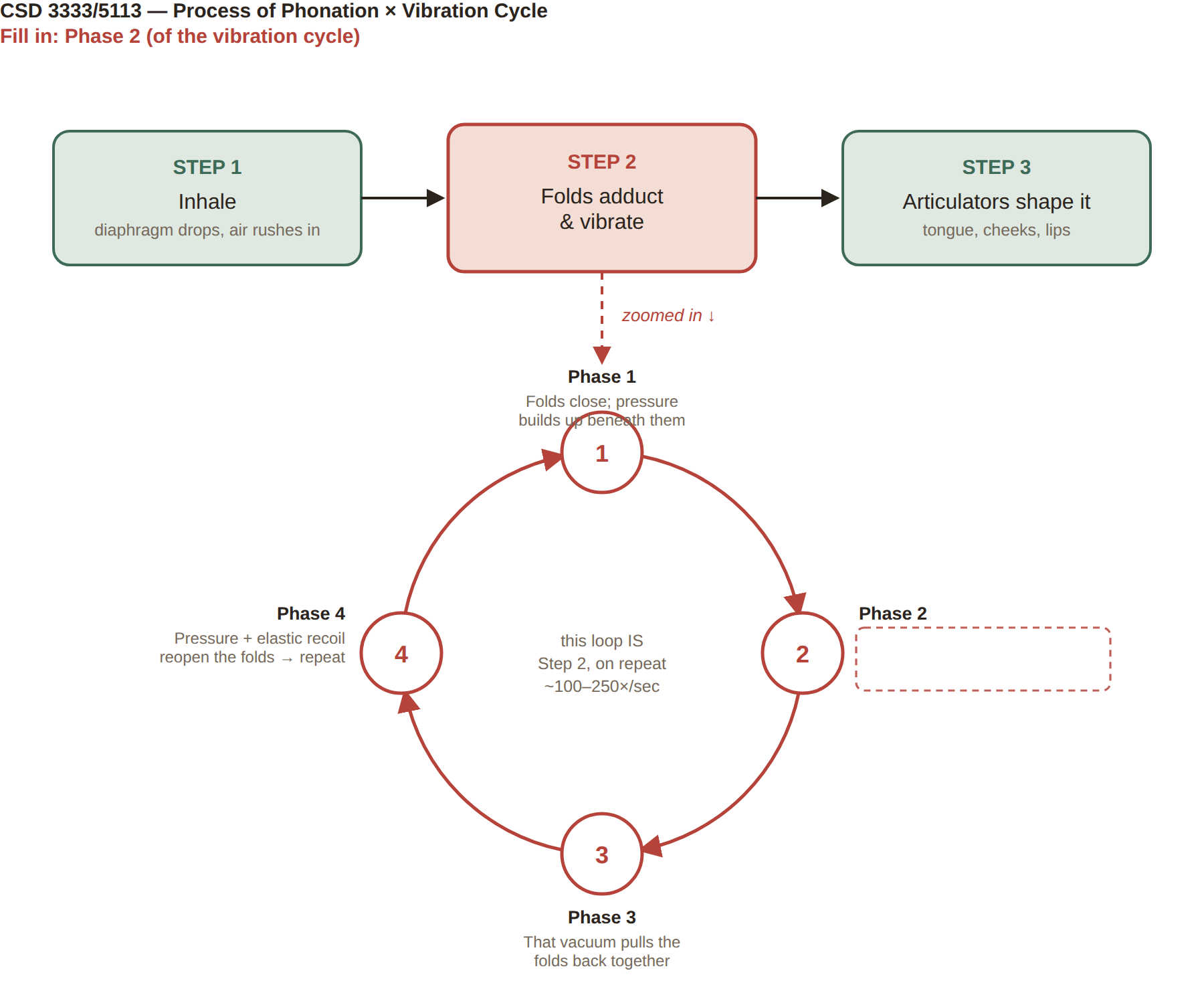
part B in step 2 of phonation (vibration cycle)
air pressure against vocal folds pushes them apart
pressure drops

part C in step 2 of phonation (vibration cycle)
airflow btwn vocal folds → vocal folds pull together → glottis closes

part D in step 2 of phonation (vibration cycle)
air pressure below vocal folds + tissue recoil = seperation of vocal folds
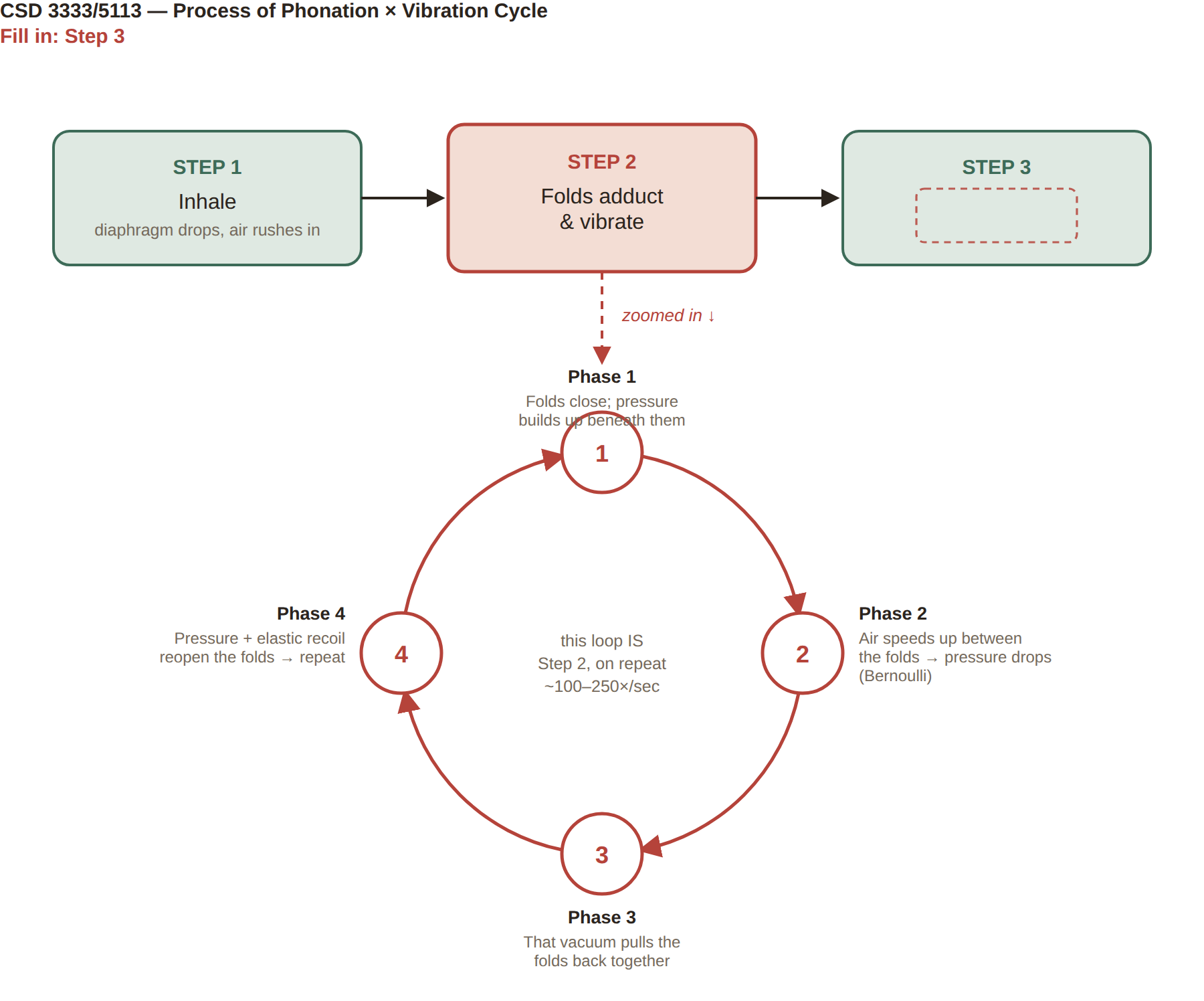
step 3 in process of phonation
vocal tract & articulators shape the larygneal tone into speech sounds
tongue
cheek
lips
how often does process of phonation take place?
once per breath group
how ofter does the vibration cycle take place?
as long as voicing continues (approx. ~100-250 times per sec)
Primary organ of phonation
The larynx.
Primary articulator for vowels and consonants
The supraglottic (supralaryngeal) structures.
Bernoulli's Principle (definition)
An increase in the speed of a fluid occurs simultaneously with a decrease in its pressure (or a decrease in its potential energy).