Quiz Fluids and Sodium Disorders
 Call Kai
 Learn
Learn Practice Test
 Spaced Repetition
 Match
Match Flashcards
 Knowt Play
1/41

There's no tags or description
Looks like no tags are added yet.
Name | Mastery | Learn | Test | Matching | Spaced | Call with Kai | Chat |
|---|
No analytics yet
Send a link to your students to track their progress
42 Terms
What percentage of body weight is total body water (TBW) in adult males and females?
In newborns?
About 60% of body weight.
An average of 80%.
How is total body water (TBW) divided between intracellular fluid (ICF) and extracellular fluid (ECF)?
2/3 is ICF and 1/3 is ECF. Ratio is 2:1.
A patient weighs 70 kg. What is their approximate TBW, ICF, and ECF?
TBW = 42 L; ICF = 28 L; ECF = 14 L.
What are the two major compartments of extracellular fluid (ECF)?
Interstitial fluid and plasma (intravascular fluid).
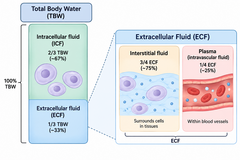
How is ECF divided between interstitial fluid and plasma (intravascular fluid)?
3/4 is interstitial fluid and 1/4 is plasma. Ratio is 3:1.
A patient presents with dehydration. What are common signs and symptoms?
Thirst, dry mucous membranes, decreased skin turgor, acute weight loss, concentrated urine, increased serum sodium, increased plasma osmolality, and CNS changes ranging from altered mental status to seizures/coma.
What cardiovascular findings can occur with dehydration?
Dizziness, orthostasis, and tachycardia.
What happens to hematocrit during dehydration?
Hematocrit increases.
Hematocrit measures the percentage of your total blood volume that is made up of red blood cells.
What severe complication can result from significant dehydration?
Hypovolemic shock, which is a life-threatening emergency where severe blood or fluid loss prevents the heart from pumping enough blood to the body.
What are common causes of dehydration?
Burns, hemorrhage, diuresis, GI losses, adrenal insufficiency, and third spacing.
What is third spacing?
Fluid leaves the normal blood vessels and becomes trapped in a space that does not effectively contribute to circulation.
What is the formula for calculated serum osmolality using conventional units?
2 × Na (mEq/L) + glucose (mg/dL)/18 + BUN (mg/dL)/2.8
What is the formula for calculated serum osmolality using SI units?
2 × Na (mmol/L) + glucose (mmol/L) + BUN (mmol/L)
What is the normal serum osmolality?
275-295 mOsm/kg.
A patient has Na = 140 mEq/L, glucose = 90 mg/dL, and BUN = 14 mg/dL. What is the calculated serum osmolality?
Is this within normal range?
2(140) + 90/18 + 14/2.8 = 290 mOsm/kg.
Pt. is in normal range.
A patient has Na = 140 mmol/L, glucose = 5 mmol/L, and urea = 5 mmol/L. What is the calculated serum osmolality?
Is this within normal range?
2(140) + 5 + 5 = 290 mOsm/kg.
Pt. is in normal range.
What are the three categories of hyponatremia based on serum osmolality?
Hypertonic, hypotonic, and isotonic hyponatremia.

A patient has low serum sodium and increased serum osmolality. What type of hyponatremia is this?
Hypertonic.
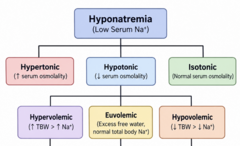
A patient has low serum sodium and decreased serum osmolality. What type of hyponatremia is this?
Hypotonic.
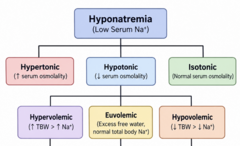
What are the three volume subcategories of hypotonic hyponatremia?
Hypervolemic = too much of BOTH, but water wins
Euvolemic = sodium is basically normal, but water increased
Hypovolemic = BOTH sodium and water are lost, but sodium is lost MORE
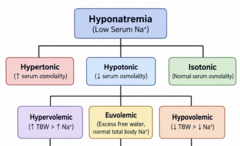
A patient has excess water and excess sodium, but the excess water is greater than the excess sodium. What type of hypotonic hyponatremia is this?
Hypervolemic.
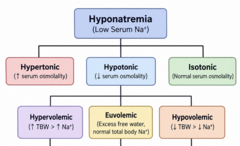
What are classic causes of hypervolemic hypotonic hyponatremia?
CHF, cirrhosis, and nephrotic syndrome.
A patient has excess free water with a normal amount of total body sodium. What type of hypotonic hyponatremia is this?
Euvolemic.

What is a classic cause of euvolemic hypotonic hyponatremia?
SIADH. (Syndrome of Inappropriate Antidiuretic Hormone Secretion)
A patient has decreased TBW and decreased sodium, but sodium loss is greater than water loss. What type of hypotonic hyponatremia is this?
Hypovolemic.

What are causes of hypovolemic hypotonic hyponatremia?
Diuretics, sweating, wound drainage, burns, vomiting/diarrhea, and hypoadrenalism.
A patient has low measured sodium but normal serum osmolality. What type of hyponatremia is this?
Isotonic.
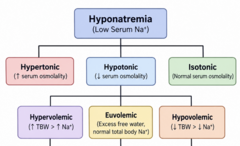
What type of hyponatremia is associated with hyperglycemia?
Hypertonic.
Glucose increases ECF osmolality, pulling water out of cells into the ECF and diluting the serum sodium concentration.

Corrected Na⁺ Formula?
Measured Na⁺ + [(Glucose − 200) / 60]
What is the normal serum sodium range?
135-145 mEq/L
A patient has glucose of 500 mg/dL and sodium of 130 mEq/L. What is the corrected sodium?
Is this within normal range?
130 + [(500 − 200) / 60]
= 135 mEq/L
Pt. is in normal range.
What are classic causes of hypernatremia?
Low water intake, respiratory/skin water losses, osmotic diuresis, diabetes insipidus, and excess hypertonic saline.
What is the most feared complication of correcting chronic hypernatremia too rapidly?
Cerebral edema, which can lead to death.
The rapid decrease in serum sodium makes the ECF less concentrated, causing water to rapidly move into brain cells and produce cerebral edema.
How many kilograms are equivalent to 1 L of water?
1 kg.
What is the formula for calculating IBW percentage?
(Actual / IBW) × 100
What is the formula for adjusted body weight (ABW)?
IBW + 0.4 × (Actual − IBW)
How many pounds are in 1 kg?
2.2 lb.
How many centimeters are in 1 inch?
2.54 cm.
What is the formula for female ideal body weight (IBW)?
Male?
45.5 kg + 2.3 kg × (inches − 60)
50 kg + 2.3 kg × (inches − 60)
If %IBW is < 120%, what do we use?
If %IBW is ≥ 120%, what do we use?
Actual body weight.
ABW.
A female patient is 5 ft 4 in tall and weighs 140 lb. Calculate her IBW. Then calculate her %IBW.
Should we use her actual weight or adjusted body weight? If we use ABW, calculate it.
IBW = 45.5 + 2.3(in-60)
45.5 + 2.3(64-60)
= 55 kg
%IBW = (actual/IBW) * 100
(63.6/55) * 100
= 115%
We use actual weight.
A male patient is 5 ft 8 in tall and weighs 250 lb. Calculate his IBW and %IBW.
Should we use his actual weight or adjusted body weight? If we use ABW, calculate it.
IBW = 50 + 2.3(in-60)
50 + 2.3(68-60)
= 68 kg
%IBW = (actual/IBW) * 100
(113.6/68) * 100
= 167%
We use adjusted body weight.
ABW = IBW + 0.4(actual-IBW)
68 + 0.4(113.6-68)
= 86 kg