Psych Chap 6 brooooooooooooo i want to sleep so bad
0.0(0)
Studied by 7 people Call Kai
 Learn
Learn Practice Test
 Spaced Repetition
 Match
Match Flashcards
 Knowt Play
Card Sorting
1/36

Earn XP
Description and Tags
Last updated 10:43 AM on 10/17/22
Name | Mastery | Learn | Test | Matching | Spaced | Call with Kai | Chat |
|---|
No analytics yet
Send a link to your students to track their progress
37 Terms
1
New cards
Learning
A relatively permanent change in behavior that is brought about by experience
2
New cards
Pavlov
A Russian physiologist who the study of classical conditioning was attributed to. (Pavlov's Dog Experiment)
3
New cards
Classical conditioning
A type of learning in which a neutral stimulus comes to elicit a response after being paired with a stimulus that naturally brings about that response
4
New cards
Neutral stimulus
A stimulus that before conditioning does not naturally bring about a response in which we are interested in. (The bell)
5
New cards
Unconditioned stimulus
A stimulus that naturally brings about a particular response without having been learned. Stimuli that lead to an automatic response. (The food)
6
New cards
Unconditioned Response
The natural innate response to the UCR that occurs automatically and needs no training. Instinctual response. (Dogs salivating to food)
7
New cards
Conditioned Response
A response that, after conditioning, follows a previously neutral stimulus (Salivation at the ringing of a bell)
8
New cards
Conditioned stimulus
A response, that after conditioning, follows a previously neutral stimulus. Classical conditioning transforms the neutral stimulus into this.
9
New cards
Extinction
When a previously conditioned response decreases in frequency and eventually disappears
10
New cards
Stimulus Generalization
If it's close enough to the oriignal stimulus, it'll set off a response.
11
New cards
Stimulus Discrimination
If the stimulus is different enough from the original stimulus it won't cause a response.
12
New cards
Spontaneous recovery
The reemergence of an extinguished conditioned response after a period of time and with no further conditioning.
13
New cards
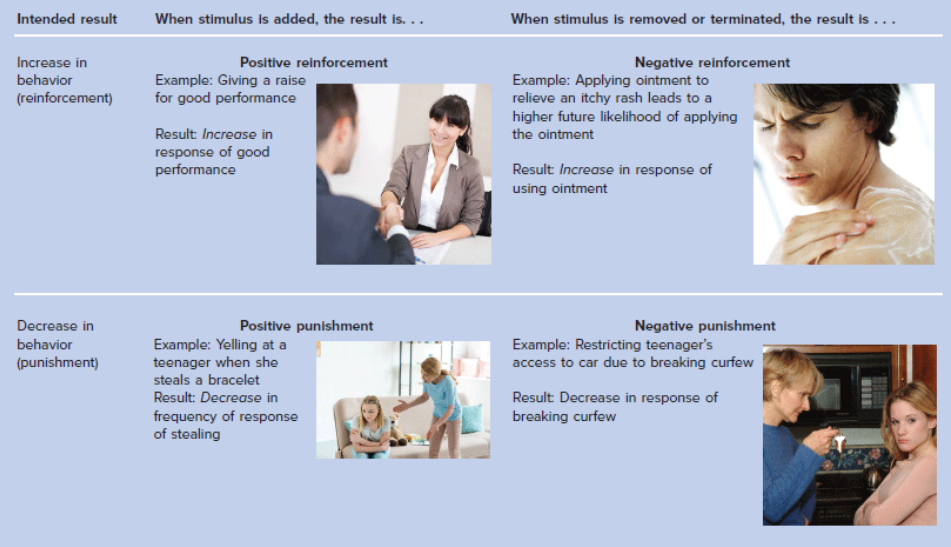
Operant conditioning
Learning in which a voluntary response is strengthened or weakened, depending on the response's favorable or unfavorable consequences.
14
New cards
Negative reinforcement
The more I do something, the more something I don't care for goes away.
15
New cards
Positive punishment
Adding something to suppress behavior (Yelling at someone for hitting you)
16
New cards
Negative punishment
Taking something you like away to suppress a behavior. (Silent treatment in a relationship.
17
New cards
Positive reinforcement
Giving you something you like to reinforce a behavior.
18
New cards
B.F Skinner & Thorndike's Law of Effect
Responses that lead to satisfying consequences are more likely to be repeated
19
New cards
Reinforcers
Any stimulus that increases the probability that a preceding behavior will occur again.
20
New cards
Experience near
Immediate reward
21
New cards
Experience far
Reward later in the future
22
New cards
Primary reinforcer
Satisfies some biological need and works naturally, regardless of a person's previous experience. (ex: food for a hungry person)
23
New cards
Secondary reinforcer
A stimulus that becomes reinforcing because of its association with a primary reinforcer (ex: money bc it allows you to buy food and shelter)
24
New cards
All reinforcement _______ behavior
increases it
25
New cards
Whatever we do, we believe that
we will feel better in the doing of it
26
New cards
Operant conditioning
27
New cards
Schedule of reinforcement
The pattern of the frequency and timing of reinforcement that follow desired behavior
28
New cards
Continuous reinforcement schedule
Behavior is reinforced every time it occurs
29
New cards
Fixed-ratio schedule
Reinforcement is given only after a specific number of responses. (ex: rats are given a food pellet every 10th time a lever is pressed.)
30
New cards
Variable-ratio schedule
The time reinforcement occurs is unpredictable and behaviors are reinforced after an average number of responses. (ex: Genshin players pulling on banners in the hopes that one of the draws will be the character they want)
31
New cards
Fixed-interval schedule
Provides reinforcement for a response only if a fixed time period has elapsed. There are typically long pauses in responding after reinforcement is provided.
32
New cards
Variable-interval schedule
The time between reinforcement varies around some average rather than being fixed. Responding occurs at a steady rate.
33
New cards
Shaping
The process of teaching a complex behavior by rewarding closer and closer approximations of the desired behavior.
34
New cards
Latent learning
Unconscious learning. New behavior is learned but not demonstrated until some incentive is provided for displaying it.
35
New cards
Cognitive learning theory
Focuses on how people think
36
New cards
Observational learning
Learning by watching the behavior of another person, or model.
37
New cards
Albert Bandura
Theorized that observation and modeling play a crucial role in how we learn.