Range of Motion
 Call Kai
 Learn
Learn Practice Test
 Spaced Repetition
 Match
Match Flashcards
 Knowt Play
1/36

There's no tags or description
Looks like no tags are added yet.
Name | Mastery | Learn | Test | Matching | Spaced | Call with Kai | Chat |
|---|
No analytics yet
Send a link to your students to track their progress
37 Terms
ROM
- the arc of motion in degrees between the beginning and end of a motion in a specific plane
types of ROM
- AROM
- Active Assisted ROM (AAROM)
- PROM
- Functional Range of Motion
AROM
- arc of motion produced by voluntarily unassisted muscle contraction
- tests the amount of movement voluntarily obtained by the pt
what does AROM provide info on
- willingness to move
- coordination
- quality of motion
- muscle strength
- joint ROM
- pain
- crepitus
if AROM is WNL & Pain-free
- no further ROM testing
limited, awkward and/or painful
- do PROM
active assisted ROM
- arc of motion produced by voluntary muscle contraction assisted by an external force
- most often performed as an intervention (exercise)
functional ROM
- amount of motion required for or the ability to perform functional activities
PROM
- arc of motion completely produced by an external force
- tests the amount of movement obtained from the pt w/o assistance from the pt
- normally, PROM is slightly greater than AROM
- determine end-feels
information from PROM
- is the motion:
- normal?
- hypomobile?
- hypermobile?
- painful?
- symmetrical?
- end-feel?
end-feels
- distinctive feeling or sensation experienced by the therapist that is the barrier to further motion; what stops the motion from going further?
- helps determine the tissue involved (dx & px)
- normal (physiological)
- abnormal (pathological)
normal end-feels
- soft: soft tissue approximation
- firm: muscle stretch, capsular stretch, ligamentous stretch
- hard: bone on bone
pathological end-feel soft
- occurs sooner or later than is usual OR in a joint that normally has a firm or hard end-feel, feels boggy
- swelling, inflammation, tumor, tissue edema, synovitis
pathological end-feel firm
- occurs sooner or later than is usual OR in a joint that normally has a soft or hard end-feel
- contracture, capsular tightness, scarring, increase muscular tone, fascial shortening
pathological end-feel hard
- occurs sooner or later than is usual OR in a joint that normally has a soft or firm end-feel
- osteophyte
- fx
- loose body
- osteochondral defect
- avascular necrosis
- chondromalacia
- OA
- myositis ossificans
pathological end feel empty
- no real end-feel because pain or apprehension prevents reaching end ROM
- PROM is limited but you feel nothing
- acute inflammation jt, bursitis, abscess, fx, psyhological
pathological end feel springy
- bouncy, rebound sensation
- meniscal tear, loose body (cartilage)
goniometry
- derived from two greek words
- goina: angle
- metron: measure
- goniometry: the measurement of angles, in particular the measurement of angle created at human joints by the bones of the body
purposes of goniometry
- identify impairments
- determine pts functional level
- develop dx, px, goals, POC
- evaluate pt's progress
types
- electrogoniometers
- gravity dependent: pendulum, fluid
- universal
parts of a goniometer
- body: center axis
- stationary arm: goes with proximal segment/ non moving
- moving arm: distal segment/moving
methods of measuring for goniometry
- 180 degree system
- all motions are from 0" towards 180 degrees at anatomical position
method of recording goniometry
- 2 number system
- "0" is the midrange
- 0 to 180 for example
for a contracture in goniometry
- start the range in the position of the contractured limb
arthrodesis
- use one number system
- example: (R) wrist fused in 45º extension
is goniometry reliable?
- generally, good to excellent for peripheral joints
- intratester > intertester
how can we improve reliability
- follow the standard testing protocol
- same position
- consistent landmarks
- PROM: should be passive & other body parts supported by exam table or PT
- method of applying force: OP should be gentle & amount of force should be applied consistently
- consider the size of the goniometer in relation to the size of the joint being measured & use the same device for successive measurement
- provide consistent instructions
- conduct same time of day, by same therapist, in same environment
normal values for ROM
- wide variation
- wrist flexion AAOS 0-80
- AMA 0-60
- green and wolf 0-73
factors that can affect ROM
- age
- sex
- limb dominance
age and ROM
- ROM tends to decrease with aging
- infants and children may demo > ROM patterns than adults
sex and ROM
- females generally demonstrate greater ROM than males, although differences vary by joint movement, and individual
limb dominance and ROM
- dominant and non-dominant limbs may have different ROM d/t habitual activities and movement demands
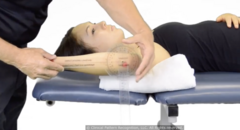
shoulder external rot. ROM
- pt is supine w/ shoulder abducted and elbow flexed to 90º
- towel under humerus to position parallel to table
- axis is at olecranon process and moving arm is at ulnar styloid process, stationary arm is perpendicular to floor
- passively ext. rot. and then bring joint back and then do with goniometer
- end feel: firm
- normal range: 0-90º
shoulder internal rotation ROM
- pt is supine, w/ shouder abd to 90º, and elbow flexed to 90º
- towel under humerus
- passively move into int. rot and then bring joint back and then do with goniometer
- axis is at olecranon, moving arm is at styloid process, stationary arm is perpendicular to floor
- end feel: firm
- normal range: 0-70º

shoulder abduction ROM
- pt is supine
- move pt through ROM, stabilize at shoulder, release from end range and redo with goniometer
- moving arm bisect condyles of elbows, axis on acromion, stationary arm is parallel to thorax
- end feel: firm
- normal range: 0-180º

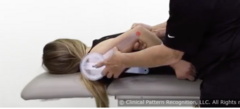
shoulder extension ROM
- pt is prone
- passively move into end range
- elbow is slightly flexed, stabilize through rib cage, and move them into extension
- axis at greater tubercle, moving arm at lateral epicondyle, stationary arm is parallel to midaxillary region
- end feel: firm
- normal range: 0-60º
shoulder flexion ROM
- pt is supine
- passively move them into end range, relax, and redo with goniometer
- axis at greater tubercle, moving arm at lateral epicondyle, stationary arm is parallel to midaxillary region
- end feel: firm
- normal range: 0-180º
