Language and Gender
 Call Kai
 Learn
Learn Practice Test
 Spaced Repetition
 Match
Match Flashcards
 Knowt Play
1/33

There's no tags or description
Looks like no tags are added yet.
Name | Mastery | Learn | Test | Matching | Spaced | Call with Kai | Chat |
|---|
No analytics yet
Send a link to your students to track their progress
34 Terms
what is an unmarked form
the ‘norm’ term
what is a marked form
a form which deviates from the ‘norm’
example of a marked and unmarked pair
actor and actress
how are marked forms created
the suffix -ess or the premodifier such as male-
what was the s*x discrimination act of 1975
it made it illegal to write a job advertisement in a way that implied people of only one sex could apply – with some exceptions (for example, for a job in a women’s prison or for an actor for a specifically gendered role)
why do some believe we should control language like this (s*x discrimination act)
language determines how we think – a concept called either ‘linguistic determinism’ or the Sapir Whorf Hypothesis
it therefore follows that if we change language to be less discriminatory, people’s thoughts and attitudes will become less discriminatory
who came up with ‘male as norm’
Dale Spender
what does ‘male as norm’ mean
using the male pronoun to refer to everyone is an example of the how ‘male’ is seen as ‘norm’
ways in which the ‘male as norm’ problem has been addressed
replacing ‘him’ with ‘him/her’ but why is him still first
replacing he or she with them
swedens gender neutral pronoun
Sweden has successfully introduced a gender neutral pronoun(‘hen’) – however, attempts to do the same in English have been unsuccessful so far
other examples of ‘male as norm’
mankind, human, ‘man’ to refer to humans
the main 3 titles
mr, miss, mrs
why do women have 2 and why are they about marital status
there is also an outdated master and ms which have certain connotations
male terms of endearment
connotations of power authority (guv, boss)
connotations of friendliness (mate, pal, buddy)
female terms of endearment
connotations of fragility (petal, angel, baby)
what is semantic derogation
the female version of a term has strong negative terms
semantic derogation examples
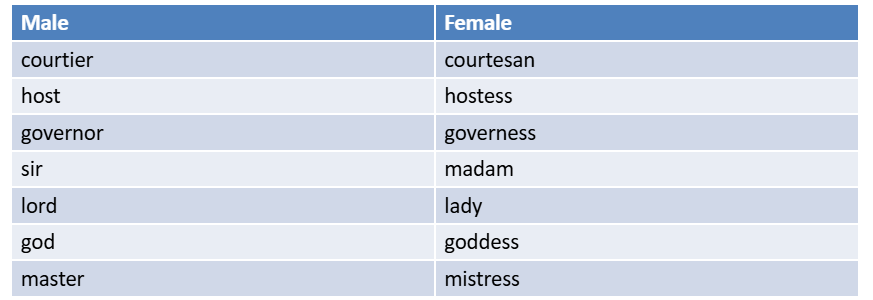
what is semantic deterioration
the meanings of some female terms has become more negative over time meanwhile the male term stay positive e.g lord/lady
making assumptions about language that do not have any scientific basis is known as…
folklinguistics
peter trudgills phonological research
he researched how men and women pronounced the ‘ing’ suffix on the end of words e.g. playing
he discovered that, across all social classes, men tended to use more non-standard pronunciation, such as “playin”
trudgills self evaluation
asking the participants whether they thought they used non standard pronunciation.
men said they used non standard pronunciation more than they actually did
women said they used non standard pronunciation less than they actually did
why were the responses like that in trudgills self evaluation
men said they were more ‘nonstandard’ than they actually were because they see more value in the ‘rebellious’ associations with non standard language (COVERT PRESTIGE)
women tend to favour ‘OVERT PRESTIGE’ – the obvious status attached to standard pronunciation, hence why they thought they were more standard than they actually were
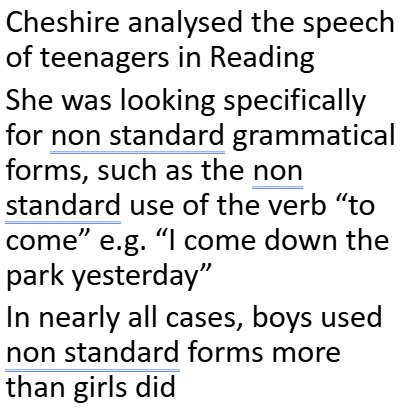
Jenny cheshires research
what was robin lakoffs