ARTH 205 - Intro to Modern Art
 Call Kai
 Learn
Learn Practice Test
 Spaced Repetition
 Match
Match Flashcards
 Knowt Play
1/37

There's no tags or description
Looks like no tags are added yet.
Name | Mastery | Learn | Test | Matching | Spaced | Call with Kai | Chat |
|---|
No analytics yet
Send a link to your students to track their progress
38 Terms
Lecture 1 - Modernism
Modernist Trinity
Authenticity, Autonomy, and Originality

Alfred Barr, Cubism and Abstract Art, 1936. Cover of exhibition catalogue, MoMA, 1936.
Linear perspective of art history
First time someone laid out different movements like this
Modernity
Refers to the ensemble of conditions that follow the Industrial Revolution and Enlightenment-era social, scientific and psychological transformations
Literal events and actions that are “modern”
Modernism
An “attitude” or cultural expression of modernity’s conditions concerned with novelty (NEW) and progress
The set of beliefs relating to modernity
Modern Art
Art that represents a modernist perspective
Really depends on what is defined as modern
Post-modernism is easy to identify, modernism less so
Arts & Crafts
Crafted arts that have a domestic purpose
Excluded from the definition of modern art that prioritizes “flatness,” since that limits modern art to painting.
Avant Garde
“Advanced Guard,” Military term meant to describe the first group sent to battle
An Avant Garde artist is an artist doing something new with art that has never really been done
Lecture 2 - Foundations of Academic Art: Neoclassicism

Anton Raphael Mengs, Parnassus, 1760-1761. Fresco, Villa Albani, Rome
Revolutionary → made statement about new art
Commissioned to decorate ceiling of room in Rome
Made like a way mural, even if on ceiling
Strictly symmetrical
Trying to break from Rococo, create new high style

Joseph-Marie Vien, The Seller of Cupids, 1763, Oil on canvas
Simplistic and minimal, like neoclassical art strived to be
Still scandalous like Rococo, actually more scandelous
Cupid showing TALLYWHACKER length with his arm
Depicts the selling of BUTTERING THE MUFFIN to rich roman ladies (scandalous!!!)
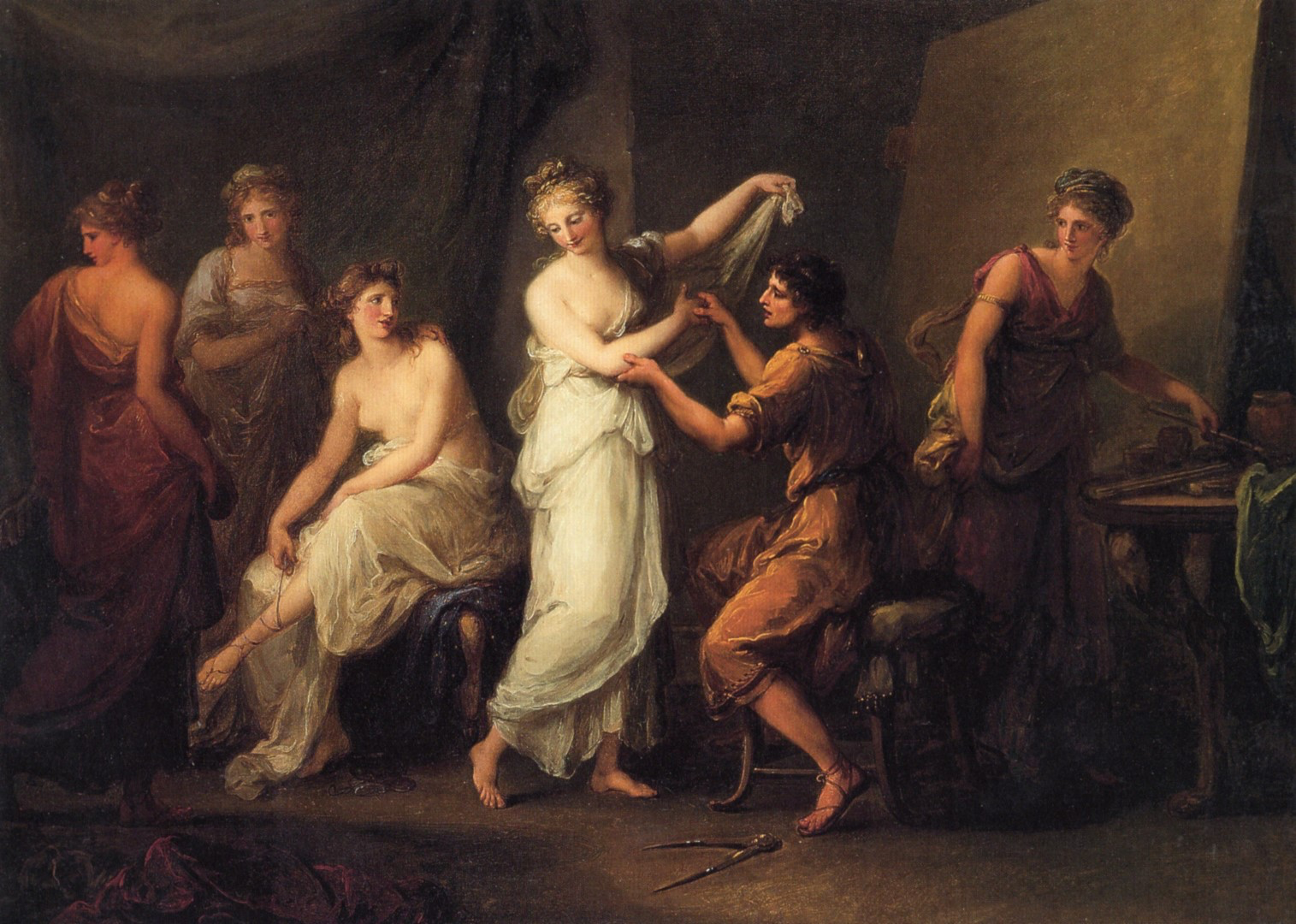
Angelica Kauffman, Zeuxis Selecting Models for his Painting of Helen of Troy, c. 1778. Oil on canvas
Idealism!!!!!!
Roman story, Zeus commissioned to paint Helen of Troy, picks 5 models and uses their best features in the painting
Shallow space like neo-classical, chiaroscuro like rococo, sfumato (fuzzy) outlines, like 16th century painting
Meant to be a bridge between rococo and neoclassical
Made specifically to be printed and used as decor for middle class families
Guilds
Professional associations for different trades, specific to each city
Not optional, had to be in guild to sell
Kind of like unions
Guild system protected artists
Regulated wages and pensions
Excluded through strict access
Women not allowed in particular guilds except for one in France
Rome Prize
Funded students trips to Rome to study the greats
Classicism
System of ideas derived from the veneration of the philosophical, literary, and artistic productions of the ancient Greeks and Romans
“Antique” School
Drawing after ancient Greek and Roman sculptures
Would take plaster casts of sculptures and study them
Did this with everything (including Trajan’s Column!)
To graduate you needed to submit a drawing of sculpture and board would judge if it was good enough
School of Life
Art academy dedicated to learning anatomy
Learned from dissections, cadavers, plaster casts, and models
Judged on how accurately you can render the human body

Johan Zoffany, The Portraits of the Academicians of the Royal Academy. ca. 1771–72, Oil on canvas
Different directors and founders of the academy
Showing why academy is important
Idealized → students aren’t wearing evening wear while drawing
DOES NOT SHOW EVERYONE
Angela Kaufmann and Mary Moser both were founders of the academy
Women were not allowed to enter modeling rooms, seen as indecent
Their portraits are on the wall to still somewhat honor them
In the corner there’s a guy who was almost not allowed bc he was with lots of women
Depicted as stabbing a mannequin of a woman’s torso with his cane
Hierarchy of genre
History painting (large, complex compositions, and needed intellect
Portraiture
Genre scenes (images of everyday life)
Landscape
Animal painting
Still-life

Elisabeth Louise Vigée Le Brun, Queen Marie-Antoinette and Her Children, 1787. Oil on Canvas
Combined styles of neoclassical and rococo
Less decoration, more minimalist and conservative
Very state sponsored, always has agenda
Acknowledging that Marie is connected to French Royalty bad past but is looking away
Children are her focus, devoted mother
Humanizing her, referring to recently deceased daughter
She is human too going through hardship
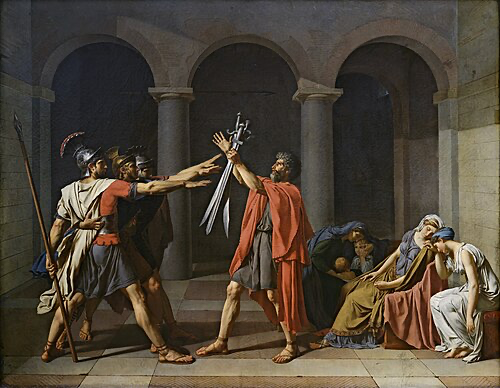
Jacques Louis David, The Oath of the Horatii, 1784. Oil on canvas
Lots of lines (straight lines show you apex of narrative)
Pyramid composition
Commissioned by King (Louis XVI)
Wants to show loyalty>family, promotes oath to France over family
Patriotism and fraternity
Still perceived as supporting revolution, focus on choosing sides kinda (Loyalty to France not a King) (since Rome was not a republic when the story took place)
HUGE painting trying to appeal to upper class who could afford painting of that size

Jacques Louis David, The Death of Marat, 1793. Oil on canvas
David is trying to make Marat a martyr
Depicted him as writing law to give money to soldier’s widows
In bath because of disability, devoted to his work despite that
Reference to the pieta, making him look like Jesus

Jacques Louis David, Cupid and Psyche, 1817. Oil on canvas
Not playing on the usual narrative
Cupid is awake, sunrise, Cupid is going to wake up Psyche rather than vise versa
Cupid is irresponsible, putting Psyche on trial on purpose
Makes references to his own history
Red, white, and blue stacked
Yellow/orange fabric reference to Napoleon Horse portrait
Metaphor, David is Psyche
Lecture 3 - The People’s Revolutions & Realism: Gustave Courbet

Gustave Courbet, A Burial at Ornans, 1849–50, oil on canvas
Friend of Baudelaire and art reflected his writing
Depicts a middle class funeral procession
Unlike previous works depicting death (David’s Death of Socrates), Courbet does not dramatize
Brings back Medieval ideas about death (the great equalizer, both the king and the pauper will die)
Men in painting represent France’s new voting population after suffrage expanded to all men

Thomas Couture, Romans of Decadence, 1847. Oil on canvas
After a night of partying everyone is sick and tired
One of the few still-energetic partiers climbed up a statue of Roman hero and mockingly offers drink
Use of classicism and romanticism to critique the new rich of the july monarchy
“Courbet’s Burial was the post-revolutionary answer to Couture’s work”
Classical symmetry combined with romantic dynamism
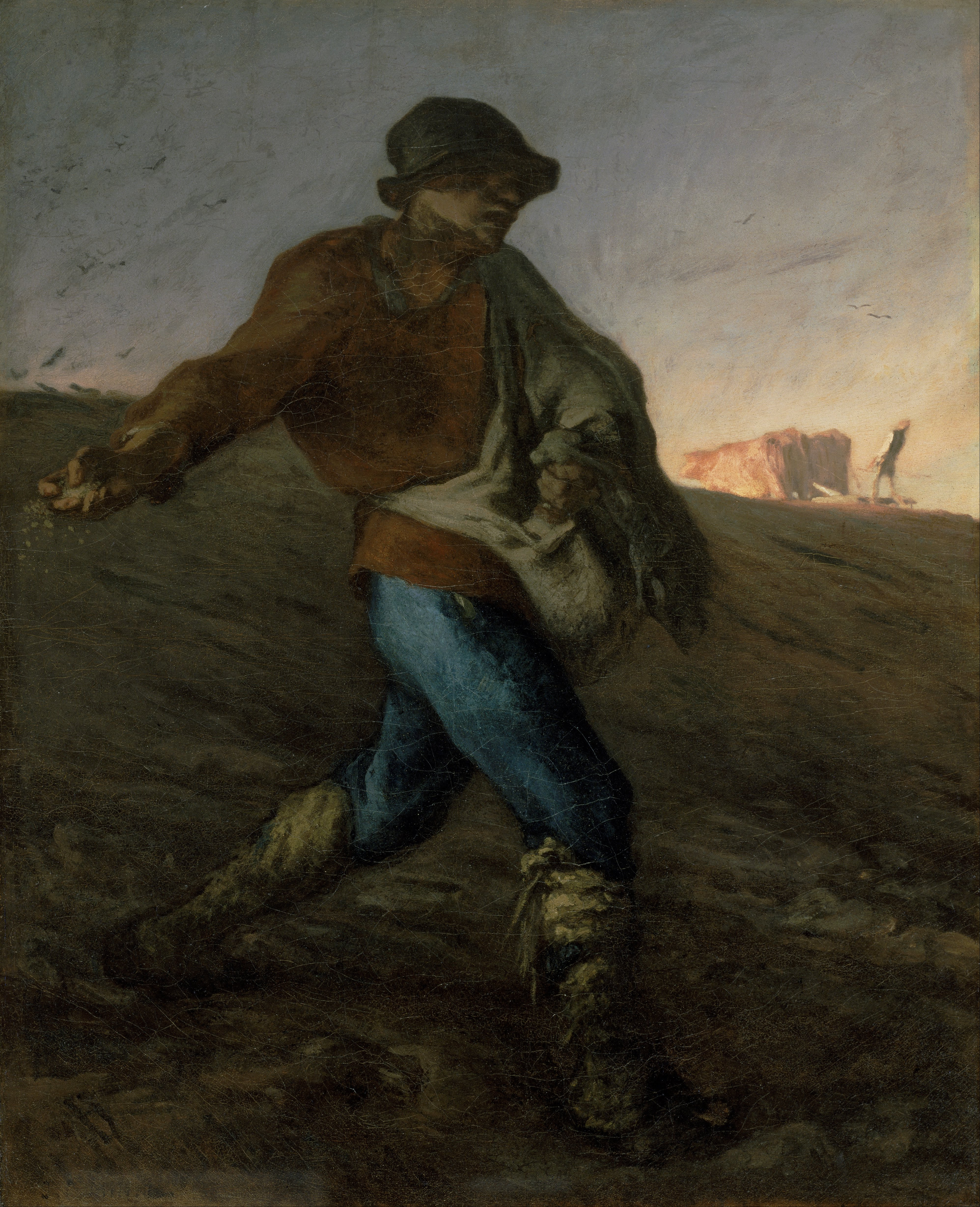
Jean-François Millet, The Sower, 1850. Oil on canvas
Peasant casting seed from cloth bag
“Anonymous” face turned away and dark
Men only valued for labour
Figure of power and respect
Not pity like stonebreakers
This and stone breakers force salons to look at french lower class
Criticized for being “socialist” and praised for having “social responsibility”
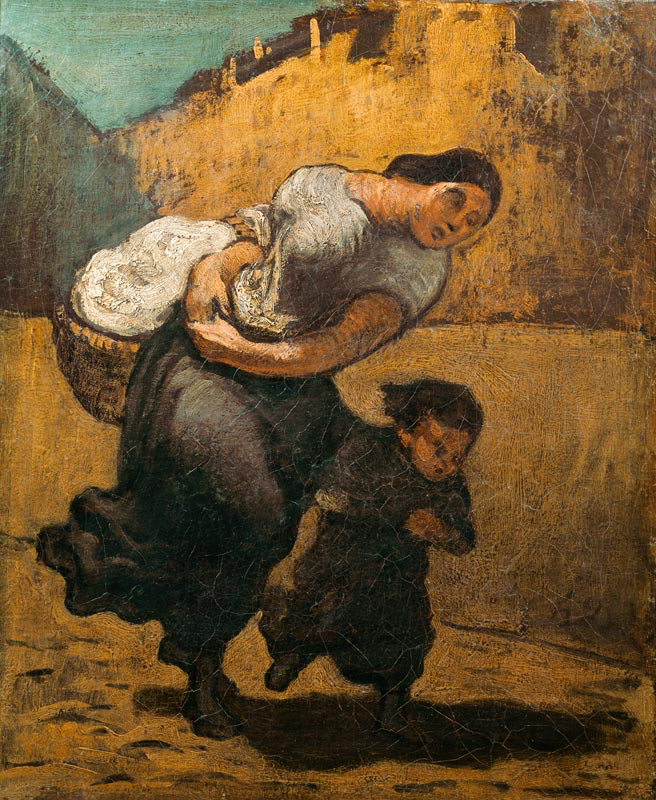
Honoré Daumier, The Heavy Burden, c. 1850–53. Oil on Canvas
Suggests poverty is inescapable through mother and child
Like stone breakers
Highly simplified
Limited palette
Exaggerated bodily forms and gestures
Suggests a tortured life

Honoré Daumier, The Fugitives, c. 1862–78, Relief in patinated plaster
Lots of refugees in this time period (from France and general Europe)
Depicts refugees trudging through desolate landscape
Shapelessness creates doom
“The Human Condition”
Designo
Line
Careful design and plan, shows skillsmanship
Lots and lots of planning
Typical of fresco, since it requires intense planning since its a difficult medium
Colore
Colour
Not working from base of drawing, straight paint on canvas
Less line work, example of dog leg in venus of urbino
Typical of oil painting, since it takes hella long to dry and can be altered a bunch after putting paint down

Theodore Géricault, The Raft of the Medusa, 1818–19. Oil on Canvas
Massive scale
Considered the first great romantic
He did not identify himself as that
Géricault was self-trained, free from the academy
Story:
Shipwreck off coast of africa, officers get lifeboat, everyone else on a raft, lifeboat is connected by rope to raft, lifeboat wasn’t going fast enough so cuts rope, raft is left stranded, raft is suffering, 10 of the original 150 men survived back to France
Big scandal
Return of Bourbon monarchy
Ship captain in charge of Medusa was not an accomplished captain, just a friend to the king
Shipwreck would’ve been avoided if captain was actually capable
Also king runs the salon again
Shows people with emotions, not just emotionless canibals
Géricault studied real corpses so he could depict shipwreck, also interviewed survivors
Still idealized, everyone is muscular even though they were starving and disfigured by sunburn
The Sublime
Edward Burke
Pleasure and pain are additive emotions
You start at neutrality, and then pleasure and pain are added
Pleasure cannot exist without pain, and vise versa
Without pleasure, you experience delight, not pain????
Something analogous of terror that is not real terror makes feeling of sublime
Dependent on proximity
Protected by paint
Essentially someone can have the feeling of the sublime from looking at something horrible in a painting because it is in the form of a painting, and you are separated from the atrocity you are looking at by the paint

Eugene Delacroix, Liberty Leading the People, 1830. Oil on canvas
Studied with Gericault
Overthrow of the monarchy (again)
Piece completed same year as the event
Marianne is female symbol of the Republic of France and revolution
Allegory
Activated allegory since she’s actually with the people in the piece
Reflected reports of women fighting with the barricades
Barricades were cobblestone ripped from ground to create walls protecting from soldiers
Pushing over barricade toward viewer
Marianne wearing cap representing freedom from slavery
Every class is represented
Feeling of sublime with dead and dying soldiers
Different type of heroism than Marat
Commitment of the civilian working as soldier because they chose to
Displaying the modernist trinity
Allegory
Embodied version of an idea
realism
Accurate rendition of something, making it look as accurate as possible
LOWERCASE “r”
Realism
The artistic movement rejecting classicism and focusing on everyday conflict
UPPERCASE “R”
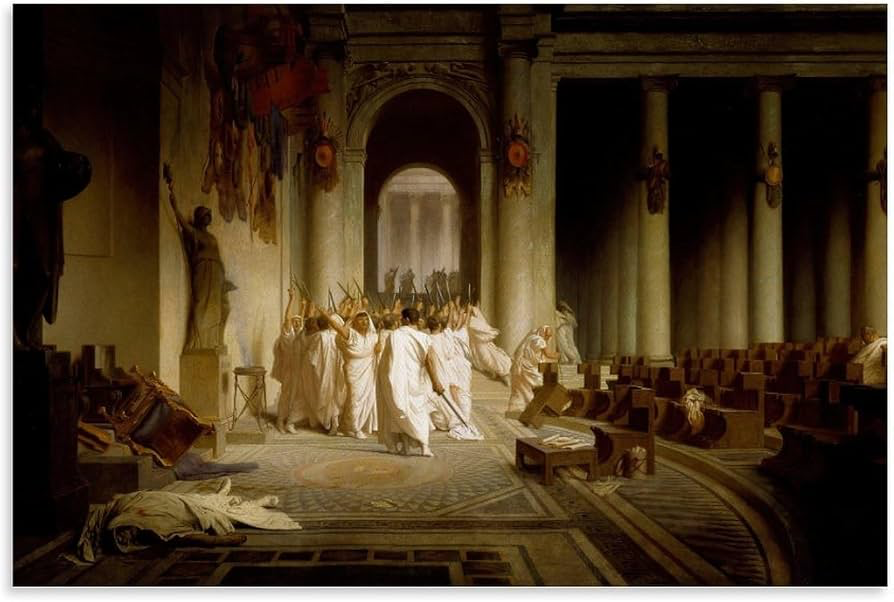
Jean-Léon Gérôme, The Death of Caesar, 1859–1867. Oil on canvas
Depicting real event
realism
Linear perspective
Realistic lighting
Tiny details part of the narrative they’re trying to show
Obviously not real because he was not alive to witness it