Bacteriology 4
 Call Kai
 Learn
Learn Practice Test
 Spaced Repetition
 Match
Match Flashcards
 Knowt Play
1/89

There's no tags or description
Looks like no tags are added yet.
Name | Mastery | Learn | Test | Matching | Spaced | Call with Kai | Chat |
|---|
No analytics yet
Send a link to your students to track their progress
90 Terms
Answer: A. Animal pathogens
Rationale:
A. Animal pathogens – ✅ Group C streptococci are primarily associated with animals, although some can cause serious human infections.
B. Intestinal parasites – ❌ They are bacteria, not parasites.
C. Fungal infections – ❌ Streptococci are bacteria.
D. Normal skin flora only – ❌ They can cause significant infections.
E. Respiratory viruses – ❌ They are Gram-positive cocci.
Group C Streptococci are primarily associated with which of the following?
A. Animal pathogens
B. Intestinal parasites
C. Fungal infections
D. Normal skin flora only
E. Respiratory viruses
Answer: C. S. dysgalactiae subsp. equisimilis
Rationale:
A. S. pyogenes – ❌ Group A Streptococcus; although it causes pharyngitis and invasive disease, it is not the Group C organism described.
B. S. agalactiae – ❌ Group B Streptococcus.
C. S. dysgalactiae subsp. equisimilis – ✅ A Group C organism capable of causing severe human infections.
D. S. pneumoniae – ❌ Not Lancefield Group C.
E. E. faecalis – ❌ Enterococcus, traditionally Group D.
Which Group C Streptococcus can cause severe pharyngitis followed by bacteremia, pneumonia, cellulitis, and abscesses?
A. S. pyogenes subsp. equisimilis
B. S. agalactiae subsp. equisimilis
C. S. dysgalactiae subsp. equisimilis
D. S. pneumoniae subsp. equisimilis
E. E. faecalis subsp. equisimilis
Answer: C. Group C
Rationale:
A. Group A – ❌ S. pyogenes also produces streptokinase, but the provided notes emphasize Group C as the main source.
B. Group B – ❌ Not the main source in the reviewer.
C. Group C – ✅ According to the provided notes, Group C is the main source of streptokinase.
D. Group D – ❌ Not the main source.
E. Group F – ❌ Associated particularly with the S. anginosus group.
Which group is considered a major source of streptokinase?
A. Group A
B. Group B
C. Group C
D. Group D
E. Group F
Answer: B. M protein
Rationale:
A. Protein A – ❌ Characteristic of S. aureus.
B. M protein – ✅ Group C and G streptococci can possess M protein, similar to GAS.
C. Coagulase – ❌ Associated with S. aureus.
D. Sialic acid capsule – ❌ Particularly important in GBS.
E. Endotoxin – ❌ Streptococci are Gram-positive and do not possess LPS endotoxin.
Which virulence factor is shared by Group C and Group G Streptococci with S. pyogenes?
A. Protein A
B. M protein
C. Coagulase
D. Capsule containing sialic acid
E. Endotoxin
Answer: B. Beta-hemolytic, bacitracin-resistant, SXT-sensitive
Rationale:
A. ❌ Does not match the Group C profile.
B. ✅ Group C is beta-hemolytic, bacitracin-resistant, and SXT-sensitive according to the notes.
C. ❌ Group C is typically beta-hemolytic.
D. ❌ Bacitracin should be resistant.
E. ❌ Incorrect hemolysis and SXT pattern.
Which hemolytic and antimicrobial susceptibility pattern is characteristic of Group C Streptococci in the provided notes?
A. Alpha-hemolytic, bacitracin-sensitive, SXT-resistant
B. Beta-hemolytic, bacitracin-resistant, SXT-sensitive
C. Gamma-hemolytic, bacitracin-sensitive, SXT-sensitive
D. Beta-hemolytic, bacitracin-sensitive, SXT-resistant
E. Gamma-hemolytic, bacitracin-resistant, SXT-resistant
Answer: A. S. anginosus
Rationale:
A. S. anginosus – ✅ Associated with Lancefield Group F and commonly associated with abscess formation.
B. S. agalactiae – ❌ Group B.
C. S. pyogenes – ❌ Group A.
D. S. bovis – ❌ Group D.
E. S. pneumoniae – ❌ Not Group F.
Group F Streptococcus is most closely associated with which organism?
A. S. anginosus
B. S. agalactiae
C. S. pyogenes
D. S. bovis
E. S. pneumoniae
Answer: A. Cellulitis
Rationale:
A. Cellulitis – ✅ S. anginosus is associated with abscesses and various pyogenic infections, including cellulitis.
B. Rheumatic fever – ❌ Classically associated with GAS.
C. Neonatal meningitis – ❌ Strongly associated with GBS.
D. Scarlet fever – ❌ Associated with GAS pyrogenic toxins.
E. Acute glomerulonephritis – ❌ A post-streptococcal complication associated with GAS.
Which condition is particularly associated with Group F S. anginosus?
A. Cellulitis
B. Rheumatic fever
C. Neonatal meningitis
D. Scarlet fever
E. Acute glomerulonephritis
Answer: A. GIT, vaginal tract, and oropharynx
Rationale:
A. GIT, vaginal tract, and oropharynx – ✅ These are recognized sites of colonization according to the provided notes.
B. Blood only – ❌ Bacteremia is a disease state, not normal flora.
C. CSF only – ❌ CSF should normally be sterile.
D. Bone marrow only – ❌ Not a normal colonization site.
E. Urinary bladder only – ❌ Not the characteristic reservoir.
Group G Streptococci may normally be found in the:
A. GIT, vaginal tract, and oropharynx
B. Blood only
C. CSF only
D. Bone marrow only
E. Urinary bladder only
Answer: C. Bile esculin test
Rationale:
A. CAMP – ❌ Primarily associated with GBS identification.
B. Coagulase – ❌ Used for differentiation of S. aureus.
C. Bile esculin – ✅ A presumptive test for Group D organisms.
D. Oxidase – ❌ Not the characteristic Group D test.
E. Indole – ❌ Not the presumptive test for Group D.
Which test is considered a presumptive test for Group D Streptococci?
A. CAMP test
B. Coagulase test
C. Bile esculin test
D. Oxidase test
E. Indole test
Answer: B. Ferric ammonium citrate
Rationale:
A. Phenol red – ❌ Used as a pH indicator in media such as MSA.
B. Ferric ammonium citrate – ✅ Reacts with esculetin produced from esculin hydrolysis, resulting in darkening.
C. Ninhydrin – ❌ Used in hippurate hydrolysis.
D. Methyl red – ❌ Used in the methyl red test.
E. Crystal violet – ❌ Not the indicator for bile esculin.
What reagent/indicator is used in bile esculin agar to detect the hydrolysis reaction?
A. Phenol red
B. Ferric ammonium citrate
C. Ninhydrin
D. Methyl red
E. Crystal violet
Answer: C. Blackening of the medium
Rationale:
A. Yellowing – ❌ Not the positive reaction.
B. Purple – ❌ Associated with positive hippurate hydrolysis using ninhydrin.
C. Blackening – ✅ Hydrolysis of esculin produces esculetin, which reacts with ferric ions to produce a dark/black complex.
D. Red ring – ❌ Not characteristic.
E. Green fluorescence – ❌ Not the reaction.
A positive bile esculin test is indicated by:
A. Yellowing of the medium
B. Purple color
C. Blackening of the medium
D. Red ring
E. Green fluorescence
Answer: B. Enterococci are salt-tolerant.
Rationale:
A. Both are bile esculin positive – ✅ True, but this does not differentiate them.
B. Enterococci are salt-tolerant – ✅ Enterococci can grow in high-salt conditions, classically 6.5% NaCl.
C. Enterococci are catalase positive – ❌ Enterococci are generally catalase-negative.
D. Non-enterococci are PYR positive – ❌ Enterococci are characteristically PYR-positive.
E. Non-enterococci grow at 10°C – ❌ Enterococci have broader growth capabilities, including growth at lower temperatures.
Which characteristic differentiates Enterococci from non-enterococcal Group D Streptococci?
A. Both are bile esculin positive.
B. Enterococci are salt-tolerant.
C. Enterococci are catalase positive.
D. Non-enterococci are PYR positive.
E. Non-enterococci grow at 10°C.
Answer: B. PYR positive
Rationale:
A. Bile esculin positive – ❌ Both groups can be positive.
B. PYR positive – ✅ Enterococci are characteristically PYR-positive, whereas the non-enterococcal Group D streptococci in the provided scheme are PYR-negative.
C. Catalase negative – ❌ Both are generally catalase-negative.
D. Gram-positive cocci – ❌ Both belong to Gram-positive cocci.
E. Beta-hemolysis in all species – ❌ Hemolytic patterns vary.
Which result is characteristic of Enterococcus species but not typical of non-enterococcal Group D Streptococci?
A. Bile esculin positive
B. PYR positive
C. Catalase negative
D. Gram-positive cocci
E. Beta-hemolysis in all species
Answer: A. Enterococcus
Rationale:
A. Enterococcus – ✅ The provided scheme lists enterococci as penicillin-resistant relative to the non-enterococcal Group D organisms.
B. Non-enterococcal Group D – ❌ Listed as penicillin-sensitive in the provided notes.
C. S. pyogenes – ❌ Penicillin is the classic drug of choice.
D. S. agalactiae – ❌ Not the distinction being tested here.
E. S. pneumoniae – ❌ Not classified as Group D.
According to the provided differential scheme, which organism is PENICILLIN RESISTANT?
A. Enterococcus
B. Non-enterococcal Group D Streptococcus
C. S. pyogenes
D. S. agalactiae
E. S. pneumoniae
Answer: B. Bile esculin +, salt tolerance +, PYR +
Rationale:
A. ❌ Opposite of the characteristic Enterococcus profile.
B. ✅ Enterococci are bile esculin positive, salt-tolerant, and PYR positive.
C. ❌ Salt tolerance and PYR are incorrect.
D. ❌ Bile esculin and PYR are incorrect.
E. ❌ Bile esculin and salt tolerance are incorrect.
Which combination BEST identifies Enterococci according to the provided differential tests?
A. Bile esculin −, salt tolerance −, PYR −
B. Bile esculin +, salt tolerance +, PYR +
C. Bile esculin +, salt tolerance −, PYR −
D. Bile esculin −, salt tolerance +, PYR −
E. Bile esculin −, salt tolerance −, PYR +
Answer: B. E. faecalis and E. faecium
Rationale:
A. ❌ These can cause infection but are less commonly isolated.
B. ✅ E. faecalis and E. faecium are the most commonly encountered clinically.
C. ❌ These are less common Enterococcus species.
D. ❌ These belong to the non-enterococcal Group D/S. bovis group.
E. ❌ These are Group A and Group B streptococci.
Which organisms are the most commonly isolated Enterococcus species from human infections?
A. E. avium and E. durans
B. E. faecalis and E. faecium
C. E. gallinarum and E. casseliflavus
D. S. bovis and S. equinus
E. S. pyogenes and S. agalactiae
Answer: A. UTI
Rationale:
A. UTI – ✅ Enterococci are important causes of nosocomial urinary tract infections, particularly in hospitalized patients and those with urinary instrumentation.
B. Scarlet fever – ❌ Caused by GAS.
C. Rheumatic fever – ❌ A post-streptococcal complication associated with GAS.
D. Diphtheria – ❌ Caused by Corynebacterium diphtheriae.
E. Pertussis – ❌ Caused by Bordetella pertussis.
Which infection is strongly associated with Enterococcus as a nosocomial pathogen?
A. UTI
B. Scarlet fever
C. Rheumatic fever
D. Diphtheria
E. Pertussis
Answer: C. Growth in 6.5% NaCl
Rationale:
A. Bile esculin positivity – ❌ Both are generally positive.
B. Gram-positive cocci – ❌ Both are Gram-positive cocci.
C. Growth in 6.5% NaCl – ✅ Enterococci can grow in 6.5% NaCl, whereas the S. bovis group is inhibited.
D. Catalase negativity – ❌ Both are generally catalase-negative.
E. Facultative anaerobic growth – ❌ Both can grow facultatively.
Which characteristic differentiates Enterococci from the S. bovis group?
A. Bile esculin positivity
B. Gram-positive cocci
C. Growth in 6.5% NaCl
D. Catalase negativity
E. Facultative anaerobic growth
Answer: B. Bile esculin +, PYR +, 6.5% NaCl +
Rationale:
A. ❌ Incorrect for Enterococcus.
B. ✅ Classic Enterococcus pattern: bile esculin +, PYR +, salt tolerance +.
C. ❌ PYR and salt tolerance are incorrect.
D. ❌ Bile esculin and salt tolerance are incorrect.
E. ❌ Bile esculin and PYR are incorrect.
Which test combination is most consistent with Enterococcus?
A. Bile esculin −, PYR −, 6.5% NaCl −
B. Bile esculin +, PYR +, 6.5% NaCl +
C. Bile esculin +, PYR −, 6.5% NaCl −
D. Bile esculin −, PYR +, 6.5% NaCl −
E. Bile esculin −, PYR −, 6.5% NaCl +
Answer: B. Resistant to penicillin, cephalosporins, and vancomycin
Rationale:
A. ❌ Enterococci commonly show reduced susceptibility to beta-lactams.
B. ✅ This matches the resistance profile listed in the provided notes.
C. ❌ Vancomycin resistance can occur.
D. ❌ Resistance is not limited to bacitracin.
E. ❌ The provided notes list resistance to multiple agents.
Board note: Actual vancomycin resistance is species/strain-dependent, so don't interpret this as meaning every Enterococcus isolate is intrinsically vancomycin-resistant.
Which statement about Enterococcus antimicrobial resistance is MOST consistent with the provided notes?
A. Always susceptible to penicillin
B. Resistant to penicillin, cephalosporins, and vancomycin
C. Always susceptible to vancomycin
D. Resistant only to bacitracin
E. Resistant only to penicillin
Answer: B. PYR
Rationale:
A. Bile esculin – ❌ Both are positive.
B. PYR – ✅ Enterococci are characteristically PYR-positive, while the S. bovis group is PYR-negative.
C. Catalase – ❌ Both are generally catalase-negative.
D. Oxidase – ❌ Not the distinguishing test.
E. Coagulase – ❌ Neither is characteristically coagulase-positive.
Which test is POSITIVE in Enterococcus but NEGATIVE in the S. bovis group?
A. Bile esculin
B. PYR
C. Catalase
D. Oxidase
E. Coagulase
Answer: B. Colon neoplasia/carcinoma
Rationale:
A. Gastric ulcer – ❌ Not the classic association.
B. Colon neoplasia/carcinoma – ✅ S. bovis group bacteremia, particularly S. gallolyticus, has a well-established association with colorectal neoplasia and warrants appropriate evaluation.
C. Pulmonary tuberculosis – ❌ Caused by Mycobacterium tuberculosis.
D. Scarlet fever – ❌ Associated with GAS.
E. Meningococcal disease – ❌ Caused by Neisseria meningitidis.
Isolation of Streptococcus bovis group from a patient's blood should raise suspicion for:
A. Gastric ulcer
B. Colon neoplasia/carcinoma
C. Pulmonary tuberculosis
D. Scarlet fever
E. Meningococcal disease
Answer: C. Growth at 45°C but not at 10°C
Rationale:
A. ❌ Incomplete.
B. ❌ Incorrect.
C. ✅ According to the provided notes, the S. bovis group grows at 45°C but not 10°C.
D. ❌ This is more consistent with Enterococcus.
E. ❌ Both can grow at 45°C according to the provided scheme.
Which growth pattern differentiates the S. bovis group from Enterococcus?
A. Growth at 45°C only
B. Growth at 10°C only
C. Growth at 45°C but not at 10°C
D. Growth at both 45°C and 10°C
E. No growth at either temperature
Answer: B. Nasopharynx and oropharynx
Rationale:
A. ❌ Not its primary normal habitat.
B. ✅ S. pneumoniae commonly colonizes the upper respiratory tract, particularly the nasopharynx.
C. ❌ Not normal skin flora.
D. ❌ The urinary bladder is normally sterile.
E. ❌ Not its characteristic reservoir.
The normal habitat of Streptococcus pneumoniae is primarily the:
A. Lower gastrointestinal tract
B. Nasopharynx and oropharynx
C. Skin
D. Urinary bladder
E. Colon only
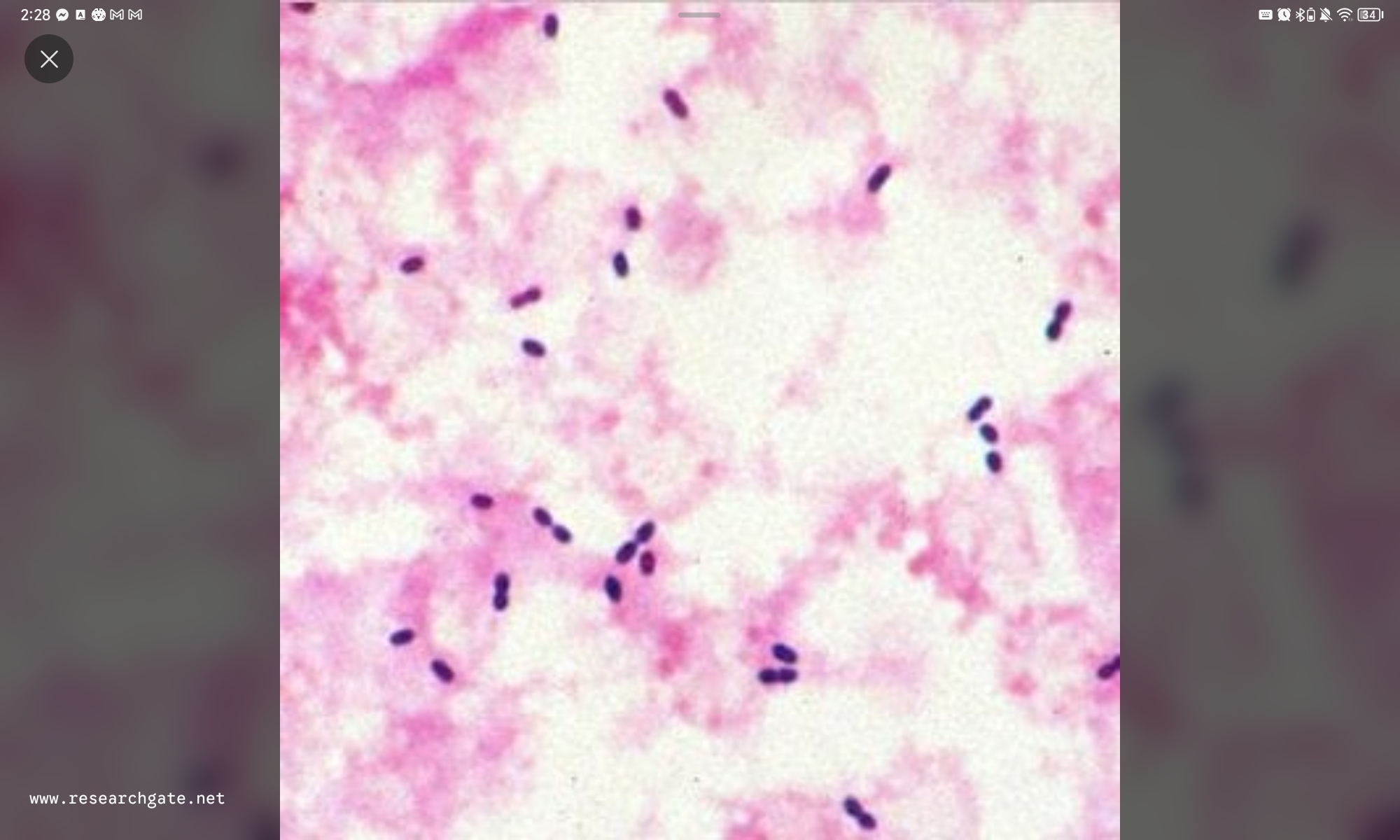
Answer: C. Gram-positive lancet-shaped diplococci
Rationale:
A. ❌ N. gonorrhoeae and N. meningitidis are Gram-negative diplococci.
B. ❌ Grape-like clusters are characteristic of Staphylococcus.
C. ✅ S. pneumoniae appears as Gram-positive, lancet-shaped diplococci.
D. ❌ Tetrads are associated with Micrococcus.
E. ❌ Pneumococcus is a Gram-positive coccus.
What is the characteristic morphology of Streptococcus pneumoniae?
A. Gram-negative diplococci
B. Gram-positive cocci in grape-like clusters
C. Gram-positive lancet-shaped diplococci
D. Gram-positive cocci in tetrads
E. Gram-negative rods
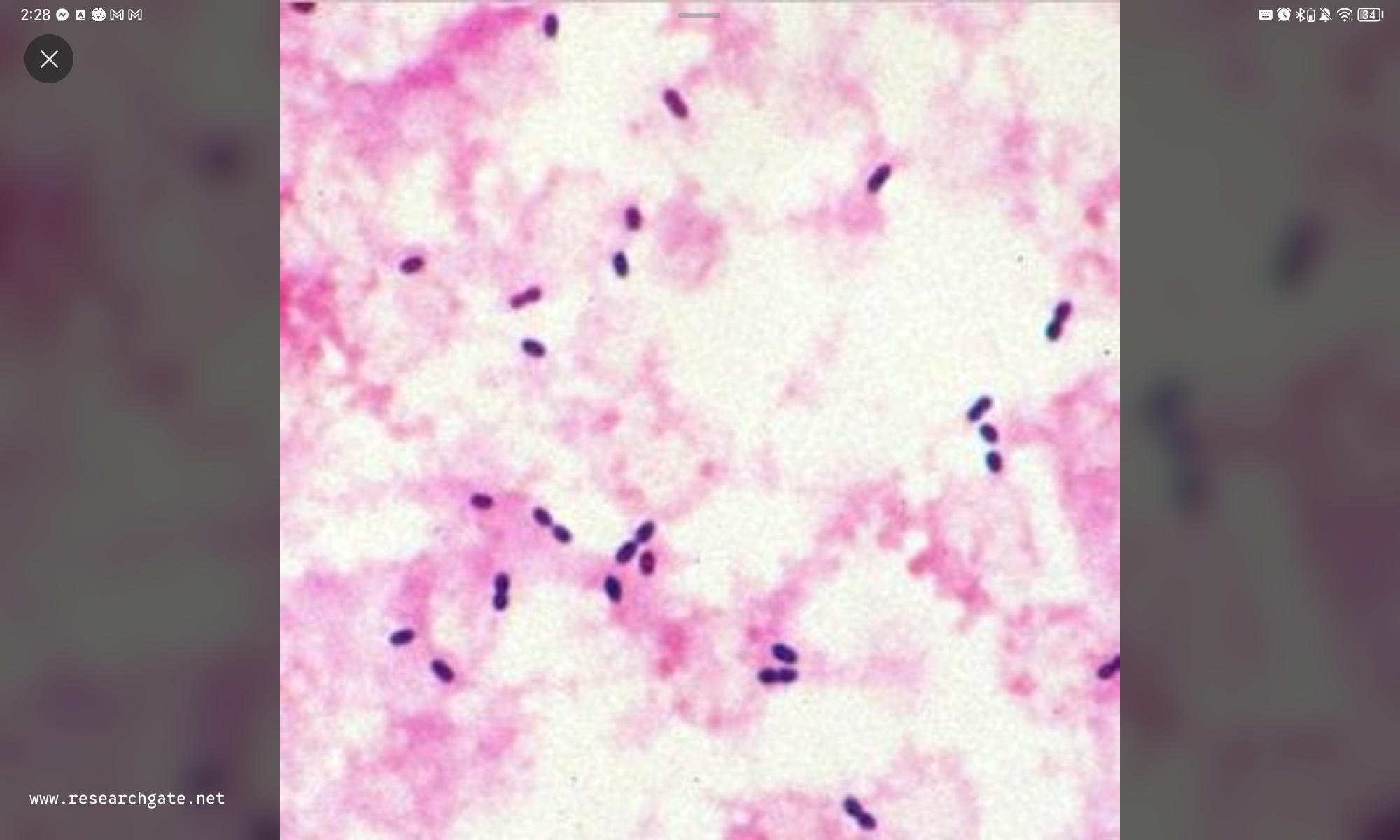
Answer: C. Oval/lancet- or bullet-shaped diplococci
Rationale:
A. ❌ Not characteristic of pneumococcus.
B. ❌ Characteristic of staphylococci.
C. ✅ Pneumococci are classically oval or lancet-shaped diplococci, sometimes described as bullet-shaped.
D. ❌ Describes neither pneumococcus nor its morphology.
E. ❌ Comma-shaped morphology is associated with organisms such as Vibrio.
Which description BEST matches the morphology of S. pneumoniae?
A. Square packets of cocci
B. Grape-like clusters
C. Oval/lancet- or bullet-shaped diplococci
D. Long chains of rectangular bacilli
E. Curved comma-shaped rods
Answer: B. It is a facultative anaerobe.
Rationale:
A. Strict anaerobe – ❌ Pneumococcus can grow in the presence of oxygen.
B. Facultative anaerobe – ✅ Correct.
C. ❌ It is extracellular and can grow on appropriate culture media.
D. ❌ It is Gram-positive.
E. ❌ It is a coccus, not a spirochete.
Which statement regarding S. pneumoniae is correct?
A. It is a strict anaerobe.
B. It is a facultative anaerobe.
C. It is an obligate intracellular organism.
D. It is a Gram-negative organism.
E. It is a spirochete.
Answer: B. C carbohydrate
Rationale:
A. M protein – ❌ Major virulence factor of GAS.
B. C carbohydrate – ✅ The pneumococcal cell wall contains C substance, related to the C carbohydrate used in Lancefield classification.
C. Protein A – ❌ Associated with S. aureus.
D. Lipid A – ❌ Component of Gram-negative LPS.
E. O antigen – ❌ Associated with Gram-negative LPS.
The C substance found in the cell wall of S. pneumoniae is similar to which component of Lancefield-classified streptococci?
A. M protein
B. C carbohydrate
C. Protein A
D. Lipid A
E. O antigen
Answer: C. Polysaccharide capsule
Rationale:
A. M protein – ❌ Major virulence factor of S. pyogenes.
B. Protein A – ❌ Virulence factor of S. aureus.
C. Polysaccharide capsule – ✅ The capsule is the major virulence factor of pneumococcus because it inhibits phagocytosis.
D. Coagulase – ❌ Associated with S. aureus.
E. Streptokinase – ❌ Associated with certain streptococci, especially GAS.
Which is the MAJOR virulence factor of Streptococcus pneumoniae?
A. M protein
B. Protein A
C. Polysaccharide capsule
D. Coagulase
E. Streptokinase
Answer: C. Polysaccharide capsule + IgA protease + neuraminidase
Rationale:
A. ❌ Protein A and coagulase are associated with S. aureus.
B. ❌ M protein and streptokinase are important GAS-associated factors.
C. ✅ Pneumococcus possesses a polysaccharide capsule, IgA protease, neuraminidase, hemolysin, and other factors contributing to pathogenicity.
D. ❌ CAMP factor and hippurate hydrolysis are associated with GBS.
E. ❌ LPS/endotoxin is characteristic of Gram-negative bacteria.
Which combination correctly matches S. pneumoniae with its virulence factors?
A. Protein A + coagulase + IgA protease
B. M protein + streptokinase + neuraminidase
C. Polysaccharide capsule + IgA protease + neuraminidase
D. CAMP factor + hippuricase + IgA protease + neuraminidase
E. Lipopolysaccharide + endotoxin+ neuraminidase
Answer: C. 5–10% CO₂
Rationale:
A. 0% CO₂ – ❌ Pneumococcus grows better in increased CO₂.
B. 1–2% CO₂ – ❌ Insufficient according to the provided notes.
C. 5–10% CO₂ – ✅ S. pneumoniae is capnophilic and requires/enhanced growth with approximately 5–10% CO₂.
D. 20–30% CO₂ – ❌ Excessive compared with the usual requirement.
E. Strict anaerobic conditions – ❌ Pneumococcus is a facultative anaerobe.
What atmospheric condition is required for optimal growth of Streptococcus pneumoniae?
A. 0% CO₂
B. 1–2% CO₂
C. 5–10% CO₂
D. 20–30% CO₂
E. Strict anaerobic conditions
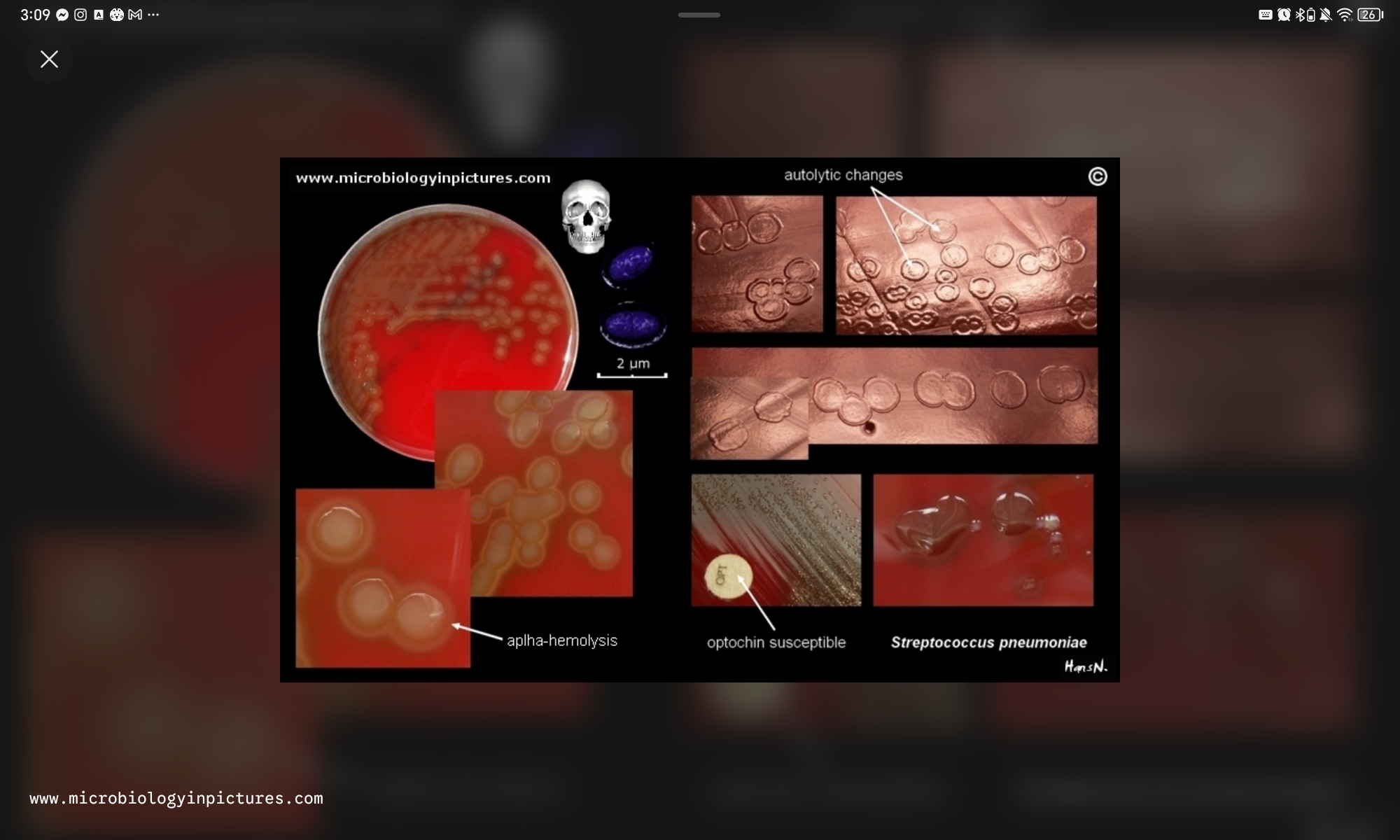
Answer: B. Dome-shaped
Rationale:
A. Nail-head/crater-like – ❌ Characteristic of older colonies.
B. Dome-shaped – ✅ Young colonies are elevated and dome-shaped.
C. Grape-like clusters – ❌ Refers to microscopic arrangement of staphylococci.
D. Swarming – ❌ Characteristic of Proteus.
E. Black colonies – ❌ Not characteristic of pneumococcus.
Which colony morphology is characteristic of young S. pneumoniae colonies after approximately 24 hours?
A. Nail-head/crater-like
B. Dome-shaped
C. Grape-like clusters
D. Swarming colonies
E. Black colonies
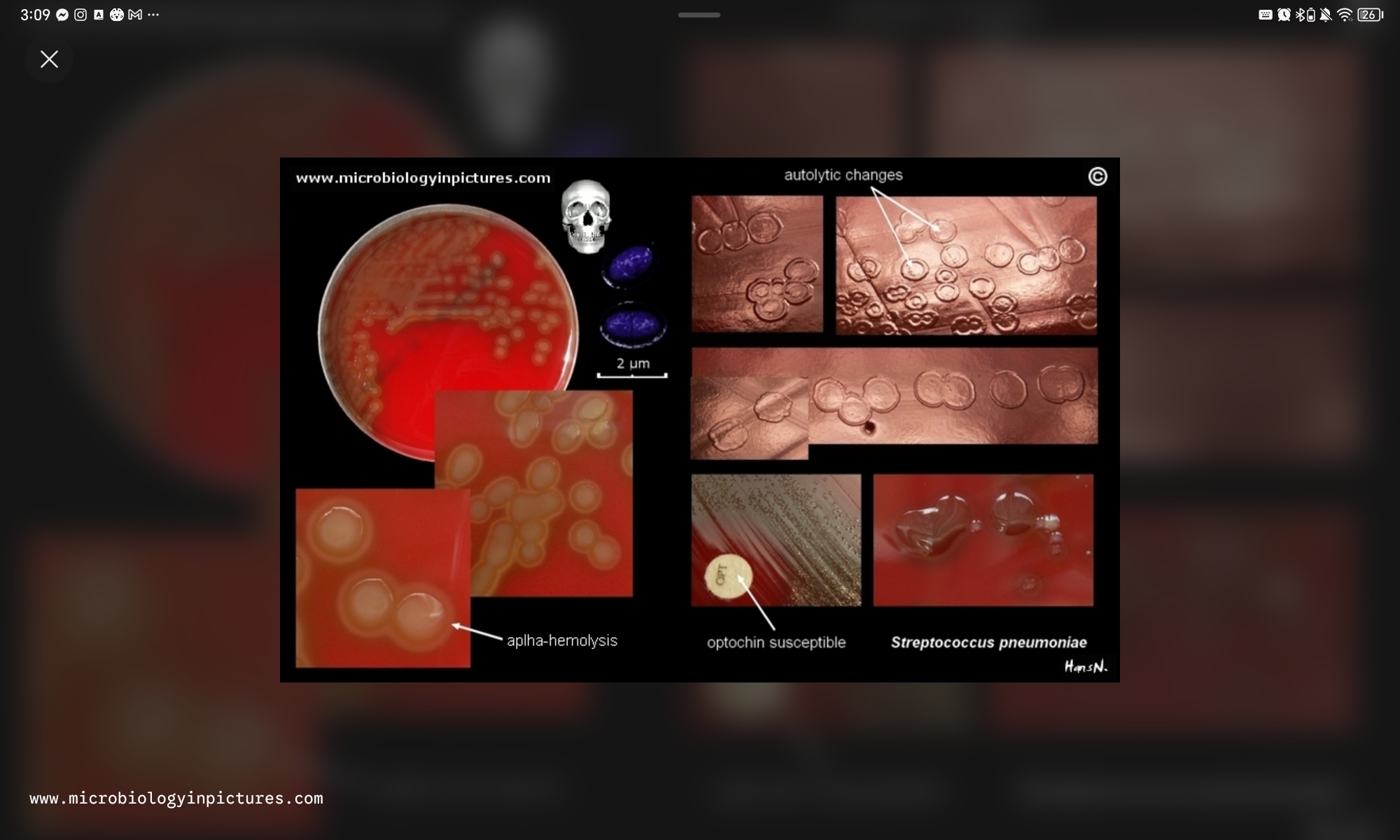
Answer: B. Nail-head/crater-like
Rationale:
A. Dome-shaped – ❌ More characteristic of young colonies.
B. Nail-head/crater-like – ✅ Older colonies develop a depressed center, producing the classic crater-like/nail-head appearance.
C. ❌ Does not describe the characteristic aging change.
D. ❌ Not the characteristic pneumococcal appearance.
E. ❌ Swarming is not characteristic.
What appearance is typically observed in older S. pneumoniae colonies after approximately 48 hours?
A. Dome-shaped
B. Nail-head/crater-like
C. Mucoid and convex only
D. Metallic green
E. Swarming
Answer: C. Alpha hemolysis
Rationale:
A. Beta – ❌ Complete clearing is not the characteristic pneumococcal reaction.
B. Gamma – ❌ Gamma means no hemolysis.
C. Alpha – ✅ Pneumococcus produces alpha-hemolytic colonies.
D. ❌ Not the characteristic pattern.
E. ❌ Pneumococcus grows on appropriate blood agar.
Which hemolytic pattern does S. pneumoniae demonstrate on blood agar?
A. Beta hemolysis
B. Gamma hemolysis
C. Alpha hemolysis
D. Double-zone hemolysis
E. No growth
Answer: B. Bile solubility
Rationale:
A. Optochin – ❌ Primarily a presumptive identification test.
B. Bile solubility – ✅ A positive bile-solubility test supports identification of S. pneumoniae and differentiates it from Viridans streptococci.
C. CAMP – ❌ Used for presumptive identification of GBS.
D. PYR – ❌ Useful for organisms such as Group A Streptococcus and Enterococcus.
E. Bacitracin – ❌ Traditionally used in differentiation of GAS from other beta-hemolytic streptococci.
Which test is considered CONFIRMATORY for differentiating pneumococcus from Viridans streptococci?
A. Optochin susceptibility
B. Bile solubility
C. CAMP test
D. PYR test
E. Bacitracin susceptibility
Answer: B. 10% sodium deoxycholate
Rationale:
A. 3% H₂O₂ – ❌ Used in the catalase test.
B. 10% sodium deoxycholate – ✅ Used for the bile solubility test on solid media according to the provided notes.
C. 1% phenol red – ❌ pH indicator used in media such as MSA.
D. Bacitracin – ❌ Used as an antimicrobial susceptibility test.
E. 6.5% NaCl – ❌ Used to demonstrate salt tolerance, particularly for Enterococcus.
What reagent is used for the bile solubility test on a blood agar plate?
A. 3% hydrogen peroxide
B. 10% sodium deoxycholate
C. 1% phenol red
D. 0.04-unit bacitracin
E. 6.5% sodium chloride
Answer: C. Lysis/clearing of the medium around the colonies
Rationale:
A. Increased turbidity – ❌ A negative broth reaction remains turbid.
B. Blackening – ❌ Characteristic of bile esculin.
C. Lysis/clearing – ✅ Pneumococcal colonies undergo lysis in the presence of bile salts, producing clearing.
D. Purple – ❌ Associated with positive hippurate hydrolysis.
E. Arrowhead hemolysis – ❌ Characteristic of the CAMP test for GBS.
What is a POSITIVE bile solubility test for S. pneumoniae?
A. Increased turbidity around the colonies
B. Blackening of the agar around the colonies
C. Lysis/clearing of the medium around the colonies
D. Purple color around the colonies
E. Arrowhead hemolysis
Answer: B. Optochin susceptibility
Rationale:
A. Bile solubility – ❌ Considered confirmatory in the provided notes.
B. Optochin susceptibility – ✅ Used to presumptively differentiate pneumococcus from other alpha-hemolytic streptococci.
C. CAMP – ❌ Used for GBS.
D. Hippurate hydrolysis – ❌ Also associated with GBS identification.
E. Coagulase – ❌ Used for identification of S. aureus.
Which test is used as a PRESUMPTIVE identification test for S. pneumoniae?
A. Bile solubility
B. Optochin susceptibility
C. CAMP
D. Hippurate hydrolysis
E. Coagulase
Answer: A. Ethylenehydrocupreine hydrochloride
Rationale:
A. Ethylenehydrocupreine hydrochloride – ✅ Chemical name of optochin.
B. Sodium deoxycholate – ❌ Used in bile solubility testing.
C. Tetramethyl-p-phenylenediamine – ❌ Used in oxidase-related testing.
D. Ninhydrin – ❌ Used in hippurate hydrolysis.
E. Ferric ammonium citrate – ❌ Used in bile esculin medium.
The chemical name of optochin is:
A. Ethylenehydrocupreine hydrochloride
B. Sodium deoxycholate
C. Tetramethyl-p-phenylenediamine
D. Ninhydrin
E. Ferric ammonium citrate
Answer: C. >14 mm
Rationale:
A. ≥5 mm – ❌ Too small based on the provided criterion.
B. ≥10 mm – ❌ The notes specify >14 mm for the 10-µg disk.
C. >14 mm – ✅ Indicates susceptibility according to the provided notes.
D. >30 mm – ❌ An unnecessarily high cutoff.
E. 1 mm – ❌ Indicates resistance rather than susceptibility.
According to the provided notes, a pneumococcal isolate is considered optochin susceptible when the zone of inhibition is:
A. ≥5 mm
B. ≥10 mm
C. >14 mm
D. >30 mm
E. Exactly 1 mm
Answer: C. Capsular swelling test
Rationale:
A. Bile solubility – ❌ Detects bile-induced autolysis.
B. Optochin – ❌ Detects susceptibility to optochin.
C. Capsular swelling test – ✅ Demonstrates the pneumococcal capsule through an antigen-antibody reaction.
D. CAMP – ❌ Used for GBS.
E. PYR – ❌ Not a capsule test.
Which test detects the capsule of S. pneumoniae through a visible swelling reaction?
A. Bile solubility
B. Optochin test
C. Capsular swelling test
D. CAMP test
E. PYR test
Answer: D. All of the above
Rationale:
A. CSF – ✅ Important for suspected pneumococcal meningitis.
B. Blood – ✅ Useful in bacteremia and invasive pneumococcal disease.
C. Sputum – ✅ Useful in pneumococcal pneumonia.
D. All of the above – ✅ All are listed as appropriate specimens in the provided notes.
Which specimen is appropriate for laboratory diagnosis of invasive S. pneumoniae infection?
A. CSF
B. Blood
C. Sputum
D. All of the above
Answer: A. Adult bacterial meningitis
Rationale:
A. Adult bacterial meningitis – ✅ Pneumococcus is a major cause of bacterial meningitis in adults.
B. ❌ Not a fungal organism.
C. ❌ Pneumococcus causes bacterial disease.
D. ❌ Not a parasite.
E. ❌ Tuberculous meningitis is caused by M. tuberculosis.
Streptococcus pneumoniae is an important cause of which type of meningitis?
A. Adult bacterial meningitis
B. Neonatal fungal meningitis
C. Viral meningitis
D. Parasitic meningitis
E. Tuberculous meningitis

Answer: A. Otitis media
Rationale:
A. Otitis media – ✅ S. pneumoniae is a major bacterial cause of acute otitis media.
B. Scarlet fever – ❌ Caused by GAS.
C. Rheumatic fever – ❌ Post-GAS complication.
D. Diphtheria – ❌ Caused by C. diphtheriae.
E. Tetanus – ❌ Caused by C. tetani.
Which disease is S. pneumoniae a major cause of, particularly in children?
A. Otitis media
B. Scarlet fever
C. Rheumatic fever
D. Diphtheria
E. Tetanus
Answer: C. Streptococcus pneumoniae
Rationale:
A. S. agalactiae – ❌ More strongly associated with neonatal sepsis and meningitis.
B. S. pyogenes – ❌ Associated with pharyngitis, scarlet fever, and skin infections.
C. S. pneumoniae – ✅ Classic cause of lobar pneumonia, traditionally associated with rusty-colored sputum.
D. E. faecalis – ❌ More commonly associated with UTIs and other healthcare-associated infections.
E. S. epidermidis – ❌ Associated with prosthetic-device infections and bacteremia
A patient with pneumococcal lobar pneumonia produces characteristic rusty-colored sputum. Which organism is most likely responsible?
A. Streptococcus agalactiae
B. Streptococcus pyogenes
C. Streptococcus pneumoniae
D. Enterococcus faecalis
E. Staphylococcus epidermidis
Answer: C. Optochin susceptibility
Rationale:
A. Catalase – ❌ Both are catalase-negative.
B. Coagulase – ❌ Used primarily to identify S. aureus.
C. Optochin – ✅ S. pneumoniae is susceptible, while Viridans streptococci are resistant.
D. CAMP – ❌ Primarily used for S. agalactiae.
E. Oxidase – ❌ Not the key test for this differentiation.
Which test BEST differentiates Streptococcus pneumoniae from Viridans streptococci?
A. Catalase test
B. Coagulase test
C. Optochin susceptibility
D. CAMP test
E. Oxidase test
Answer: D. S. pneumoniae
Rationale:
A. S. mutans – ❌ Viridans; typically optochin-resistant.
B. S. mitis – ❌ Viridans; optochin-resistant.
C. S. salivarius – ❌ Viridans; optochin-resistant.
D. S. pneumoniae – ✅ Alpha-hemolytic and optochin-sensitive.
E. S. sanguinis – ❌ Viridans; optochin-resistant.
An alpha-hemolytic isolate is optochin susceptible. Which organism is MOST likely?
A. S. mutans
B. S. mitis
C. S. salivarius
D. S. pneumoniae
E. S. sanguinis
Answer: E. S. pneumoniae
Rationale:
A. S. mitis – ❌ Viridans streptococcus; bile-insoluble.
B. S. mutans – ❌ Viridans; bile-insoluble.
C. S. salivarius – ❌ Viridans; bile-insoluble.
D. S. sanguinis – ❌ Viridans; bile-insoluble.
E. S. pneumoniae – ✅ Characteristically bile soluble.
Which organism is BILE SOLUBLE?
A. S. mitis
B. S. mutans
C. S. salivarius
D. S. sanguinis
E. S. pneumoniae
Answer: C. Inulin
Rationale:
A. Lactose – ❌ Not the specific differentiating carbohydrate in the provided notes.
B. Glucose – ❌ Not the characteristic differentiating test.
C. Inulin – ✅ S. pneumoniae is inulin-positive, while Viridans streptococci are listed as negative.
D. Mannitol – ❌ Not the key differential test here.
E. Sucrose – ❌ Not the distinguishing carbohydrate in this scheme.
Which carbohydrate is characteristically fermented by S. pneumoniae but not by Viridans streptococci in the provided differential scheme?
A. Lactose
B. Glucose
C. Inulin
D. Mannitol
E. Sucrose
Answer: B. Optochin S, bile soluble, inulin +
Rationale:
A. ❌ This is characteristic of Viridans.
B. ✅ Classic pneumococcal pattern: optochin sensitive + bile soluble + inulin positive.
C. ❌ Viridans are bile-insoluble.
D. ❌ Pneumococcus is bile-soluble and inulin-positive.
E. ❌ Inulin positivity does not fit the provided Viridans pattern.
Which result pattern is MOST consistent with Streptococcus pneumoniae?
A. Optochin R, bile insoluble, inulin −
B. Optochin S, bile soluble, inulin +
C. Optochin R, bile soluble, inulin −
D. Optochin S, bile insoluble, inulin −
E. Optochin R, bile insoluble, inulin +
Answer: B. Capsule
Rationale:
A. M protein – ❌ Important virulence factor of S. pyogenes.
B. Capsule – ✅ The Quellung reaction demonstrates capsular swelling of S. pneumoniae.
C. Protein A – ❌ Associated with S. aureus.
D. C carbohydrate – ❌ Although pneumococcus contains C substance, Quellung specifically demonstrates the capsule.
E. Flagellum – ❌ Streptococci are nonmotile.
The Neufeld-Quellung reaction is used to demonstrate the:
A. M protein
B. Capsule
C. Protein A
D. Cell wall C carbohydrate
E. Flagellum
Answer: D. S. pneumoniae
Rationale:
A. S. mitis – ❌ Viridans streptococcus; negative in the provided scheme.
B. S. mutans – ❌ Viridans; negative.
C. S. salivarius – ❌ Viridans; negative.
D. S. pneumoniae – ✅ Encapsulated pneumococcus produces a positive Quellung reaction.
E. S. sanguinis – ❌ Viridans; negative.
Which organism is POSITIVE for the Neufeld-Quellung reaction?
A. S. mitis
B. S. mutans
C. S. salivarius
D. S. pneumoniae
E. S. sanguinis
Answer: A. Alpha-prime streptococci
Rationale:
A. Alpha-prime streptococci – ✅ Viridans streptococci are commonly described as alpha-prime/variable alpha-hemolytic organisms.
B. Beta-hemolytic – ❌ Not their typical pattern.
C. Gamma-hemolytic staphylococci – ❌ Wrong organism and classification.
D. Lancefield Group A – ❌ Viridans generally lack Lancefield group antigens.
E. Gram-negative diplococci – ❌ They are Gram-positive cocci.
Viridans streptococci are commonly described as:
A. Alpha-prime streptococci
B. Beta-hemolytic streptococci
C. Gamma-hemolytic staphylococci
D. Lancefield Group A streptococci
E. Gram-negative diplococci
Answer: E. They are not classified under Lancefield groups.
Rationale:
A. Group A – ❌ GAS includes S. pyogenes.
B. Group B – ❌ GBS is S. agalactiae.
C. Group D – ❌ Group D includes Enterococci and the S. bovis group.
D. Group G – ❌ Some beta-hemolytic streptococci belong to Group G.
E. Not classified – ✅ Viridans streptococci lack Lancefield group antigens.
Which statement BEST describes the Lancefield classification of Viridans streptococci?
A. They are Group A.
B. They are Group B.
C. They are Group D.
D. They are Group G.
E. They are not classified under Lancefield groups.
Answer: B. Subacute bacterial endocarditis
Rationale:
A. Neonatal meningitis – ❌ Strongly associated with GBS.
B. Subacute bacterial endocarditis – ✅ Viridans streptococci are classic causes of subacute bacterial endocarditis (SBE), particularly after dental procedures or in damaged valves.
C. Scarlet fever – ❌ Caused by GAS.
D. Gas gangrene – ❌ Usually associated with Clostridium species.
E. Acute otitis media – ❌ S. pneumoniae is a major cause.
Viridans streptococci are the most common cause of:
A. Neonatal meningitis
B. Subacute bacterial endocarditis
C. Scarlet fever
D. Gas gangrene
E. Acute otitis media
Answer: C. S. mutans
Rationale:
A. S. mitis – ❌ Part of oral flora but not the classic dental-caries organism.
B. S. salivarius – ❌ Oral commensal, especially associated with the tongue.
C. S. mutans – ✅ Major organism associated with dental caries and plaque.
D. S. constellatus – ❌ Part of the S. anginosus group.
E. S. intermedius – ❌ More associated with abscess formation.
Which Viridans species is strongly associated with dental caries and dental plaque?
A. S. mitis
B. S. salivarius
C. S. mutans
D. S. constellatus
E. S. intermedius
Answer: B. Attachment to tooth surfaces
Rationale:
A. Capsule degradation – ❌ Not their primary role.
B. Attachment to tooth surfaces – ✅ Glucans and dextrans promote adherence to dental surfaces, contributing to plaque formation.
C. RBC destruction – ❌ Not the main function.
D. Fibrin degradation – ❌ Associated with fibrinolytic enzymes such as streptokinase.
E. DNA degradation – ❌ Associated with DNases/streptodornase.
Viridans streptococci produce glucans and dextrans that primarily promote:
A. Capsule degradation
B. Attachment to tooth surfaces
C. RBC destruction
D. Fibrin degradation
E. DNA degradation
Answer: D. S. sanguinis
Rationale:
A. S. mutans – ❌ Mainly associated with dental caries, although oral streptococci can contribute to endocarditis.
B. S. pyogenes – ❌ Causes pharyngitis and post-streptococcal complications.
C. S. pneumoniae – ❌ Major respiratory pathogen.
D. S. sanguinis – ✅ A Viridans streptococcus classically associated with subacute bacterial endocarditis.
E. S. agalactiae – ❌ Associated with neonatal disease and invasive infections.
A patient with a history of rheumatic heart disease develops subacute bacterial endocarditis. Which organism is MOST likely?
A. S. mutans
B. S. pyogenes
C. S. pneumoniae
D. S. sanguinis
E. S. agalactiae
Answer: B. Optochin resistant, bile insoluble
Rationale:
A. ❌ Characteristic of S. pneumoniae.
B. ✅ Viridans streptococci are optochin-resistant and bile-insoluble.
C. ❌ Incorrect optochin result.
D. ❌ Incorrect bile reaction.
E. ❌ Streptococci are catalase-negative.
Which laboratory profile is MOST consistent with Viridans streptococci?
A. Optochin sensitive, bile soluble
B. Optochin resistant, bile insoluble
C. Optochin sensitive, bile insoluble
D. Optochin resistant, bile soluble
E. Optochin sensitive, catalase positive
Answer: C. S. intermedius — abscess formation
Rationale:
A. S. mutans — neonatal meningitis – ❌ S. mutans is strongly associated with dental caries.
B. S. sanguinis — dental caries only – ❌ S. sanguinis is an important cause of subacute endocarditis.
C. S. intermedius — abscess formation – ✅ S. intermedius belongs to the S. anginosus group, which is associated with pyogenic infections and abscesses.
D. S. pneumoniae — optochin resistant – ❌ Pneumococcus is optochin susceptible.
E. S. salivarius — Lancefield Group A – ❌ Viridans streptococci lack Lancefield group antigens.
Which combination is CORRECTLY matched?
A. S. mutans — neonatal meningitis
B. S. sanguinis — dental caries only
C. S. intermedius — abscess formation
D. S. pneumoniae — optochin resistant
E. S. salivarius — Lancefield Group A
Answer: B. Pyridoxal-requiring streptococci
Rationale:
A. Pyruvate-requiring – ❌ Not the characteristic requirement.
B. Pyridoxal-requiring – ✅ Nutritionally variant streptococci require vitamin B6/pyridoxal for growth.
C. Riboflavin-requiring – ❌ Not the key nutritional requirement.
D. Lactose-requiring – ❌ Incorrect.
E. Iron-requiring – ❌ Incorrect.
Nutritionally variant streptococci are also known as:
A. Pyruvate-requiring streptococci
B. Pyridoxal-requiring streptococci
C. Riboflavin-requiring streptococci
D. Lactose-requiring streptococci
E. Iron-requiring streptococci
Answer: A. Abiotrophia and Granulicatella
Rationale:
A. ✅ Abiotrophia and Granulicatella are nutritionally variant streptococci.
B. ❌ Enterococci and Pediococcus are different genera.
C. ❌ Both are catalase-positive organisms.
D. ❌ These are other Gram-positive catalase-negative organisms.
E. ❌ These are conventional streptococcal pathogens.
Which organisms are classified as Nutritionally Variant Streptococci (NVS)?
A. Abiotrophia and Granulicatella
B. Enterococcus and Pediococcus
C. Staphylococcus and Micrococcus
D. Lactococcus and Leuconostoc
E. S. pneumoniae and S. pyogenes
Answer: C. Vitamin B6
Rationale:
A. B1 – ❌ Not the characteristic requirement.
B. B2 – ❌ Not the characteristic requirement.
C. B6 – ✅ NVS require pyridoxal (vitamin B6).
D. B12 – ❌ Not the key requirement.
E. Vitamin K – ❌ Not the characteristic requirement.
Nutritionally variant streptococci require which vitamin for growth?
A. Vitamin B1
B. Vitamin B2
C. Vitamin B6
D. Vitamin B12
E. Vitamin K
Answer: B. They grow around S. aureus colonies that provide pyridoxal.
Rationale:
A. ❌ Yeasts can provide some growth factors, but this is not the classic explanation.
B. ✅ S. aureus can produce/provide pyridoxal, allowing NVS to grow as satellite colonies around it.
C. ❌ E. coli can provide growth factors but is not the classic satelliting organism.
D. ❌ Their requirement is nutritional, not oxygen-dependent satellitism.
E. ❌ Enterococcus is not the classic source of satelliting growth.
Why are Nutritionally Variant Streptococci called “satelliting streptococci”?
A. They grow only around fungal colonies.
B. They grow around S. aureus colonies that provide pyridoxal.
C. They grow only around E. coli.
D. They require oxygen supplied by neighboring bacteria.
E. They grow only around Enterococcus colonies.
Answer: A. S. adjacens and S. defectivus
Rationale:
A. ✅ These are historical names associated with nutritionally variant streptococci, now placed in Abiotrophia/Granulicatella.
B. ❌ These are Viridans streptococci.
C. ❌ These belong to the Group D/S. bovis group.
D. ❌ Groups A and B.
E. ❌ Viridans streptococci.
Which pair represents the former names associated with Abiotrophia?
A. S. adjacens and S. defectivus
B. S. mutans and S. mitis
C. S. bovis and S. equinus
D. S. pyogenes and S. agalactiae
E. S. sanguinis and S. salivarius
Answer: A. Cysteine/thiol compounds
Rationale:
A. Cysteine/thiol compounds – ✅ NVS are described as thiol-requiring streptococci and may require cysteine or pyridoxal-containing supplementation.
B. Sodium chloride – ❌ Not their primary nutritional requirement.
C. Bile salts – ❌ Not required for growth.
D. Hemoglobin – ❌ Not their characteristic growth requirement.
E. Urea – ❌ Not their characteristic requirement.
Which substance is particularly required by Nutritionally Variant Streptococci?
A. Cysteine/thiol compounds
B. Sodium chloride
C. Bile salts
D. Hemoglobin
E. Urea
Answer: A. S. aureus
Rationale:
A. S. aureus – ✅ A classic pyridoxal-producing organism that permits satelliting growth of NVS.
B. S. pneumoniae – ❌ Not the classic helper organism.
C. S. pyogenes – ❌ Not the classic source of pyridoxal in this test.
D. S. mutans – ❌ Not the classic helper organism.
E. S. agalactiae – ❌ Not the classic source.
Which organism can provide pyridoxal and support satelliting growth of Nutritionally Variant Streptococci?
A. S. aureus
B. S. pneumoniae
C. S. pyogenes
D. S. mutans
E. S. agalactiae
Answer: A. Leuconostoc
Rationale:
A. Leuconostoc – ✅ Listed among pyridoxal-producing organisms.
B. S. pneumoniae – ❌ Not listed in the provided group.
C. S. pyogenes – ❌ Not listed.
D. S. mutans – ❌ Not listed.
E. S. mitis – ❌ Not listed.
Which of the following is listed as a pyridoxal-producing bacterium?
A. Leuconostoc
B. S. pneumoniae
C. S. pyogenes
D. S. mutans
E. S. mitis
Answer: A. Pediococcus, Leuconostoc, Aerococcus, Lactococcus, Rothia
Rationale:
A. ✅ These are included in the provided list of Gram-positive, catalase-negative organisms.
B. ❌ Most listed organisms are catalase-positive.
C. ❌ These are Gram-negative organisms.
D. ❌ These are Gram-negative rods.
E. ❌ These are fungi.
Which group includes other Gram-positive, catalase-negative organisms that may be encountered in clinical specimens?
A. Pediococcus, Leuconostoc, Aerococcus, Lactococcus, Rothia
B. Staphylococcus, Micrococcus, Bacillus, Corynebacterium
C. Neisseria, Moraxella, Acinetobacter, Pseudomonas
D. Enterobacter, Klebsiella, Serratia, Proteus
E. Candida, Cryptococcus, Aspergillus, Mucor
Answer: A. Pediococcus and Leuconostoc
Rationale:
A. Pediococcus and Leuconostoc – ✅ Both are notable for intrinsic vancomycin resistance.
B. ❌ Not the characteristic pattern.
C. ❌ Not intrinsically vancomycin-resistant.
D. ❌ Viridans organisms are not characterized by intrinsic vancomycin resistance.
E. ❌ Not the characteristic pattern.
Which organisms are characteristically VANCOMYCIN-RESISTANT among the organisms listed in the provided notes?
A. Pediococcus and Leuconostoc
B. S. pneumoniae and S. mutans
C. S. pyogenes and S. agalactiae
D. S. mitis and S. sanguinis
E. S. salivarius and S. intermedius
Answer: C. Bile esculin
Rationale:
A. PYR – ❌ Both are listed as PYR-negative.
B. LAP – ❌ Pediococcus is positive, while Leuconostoc is negative.
C. Bile esculin – ✅ Both are listed as positive.
D. Catalase – ❌ Both are catalase-negative.
E. MRS broth – ❌ The provided table shows Pediococcus negative and Leuconostoc positive.
Which test is POSITIVE for both Pediococcus and Leuconostoc according to the provided table?
A. PYR
B. LAP
C. Bile esculin
D. Catalase
E. MRS broth only
Answer: B. Pediococcus
Rationale:
A. Leuconostoc – ❌ LAP-negative and MRS-positive in the provided table.
B. Pediococcus – ✅ LAP +, MRS broth −.
C. Enterococcus – ❌ Not the organism described in this comparison.
D. Lactococcus – ❌ Not the listed profile.
E. Aerococcus – ❌ Not the listed profil
Which organism is LAP POSITIVE and MRS broth NEGATIVE according to the provided table?
A. Leuconostoc
B. Pediococcus
C. Enterococcus
D. Lactococcus
E. Aerococcus
Answer: B. Leuconostoc
Rationale:
A. Pediococcus – ❌ LAP-positive and MRS-negative.
B. Leuconostoc – ✅ LAP −, MRS broth + according to the provided table.
C. Enterococcus faecalis – ❌ Does not fit the specific table.
D. Aerococcus – ❌ Not the listed profile.
E. Rothia – ❌ Not the listed profile.
Which organism is LAP NEGATIVE but MRS broth POSITIVE?
A. Pediococcus
B. Leuconostoc
C. Enterococcus faecalis
D. Aerococcus
E. Rothia
Answer: B. Vancomycin resistant, bile esculin positive, PYR negative, LAP positive
Rationale:
A. ❌ Pediococcus is listed as vancomycin-resistant.
B. ✅ Correct profile from the provided table.
C. ❌ Bile esculin and LAP are incorrect.
D. ❌ Vancomycin and PYR results are incorrect.
E. ❌ Pediococcus is catalase-negative and PYR-negative.
Which characteristic combination BEST describes Pediococcus?
A. Vancomycin susceptible, PYR positive, LAP negative
B. Vancomycin resistant, bile esculin positive, PYR negative, LAP positive
C. Vancomycin resistant, bile esculin negative, PYR positive, LAP negative
D. Vancomycin susceptible, bile esculin positive, PYR positive
E. Vancomycin resistant, catalase positive, PYR positive
Answer: B. Nutritionally Variant Streptococci
Rationale:
A. S. pneumoniae – ❌ Does not characteristically require pyridoxal for growth.
B. Nutritionally Variant Streptococci – ✅ Satellite growth around S. aureus is a classic clue because S. aureus provides pyridoxal needed by NVS.
C. S. pyogenes – ❌ Does not characteristically show this pyridoxal-dependent satelliting phenomenon.
D. S. mutans – ❌ A Viridans streptococcus associated with dental caries.
E. S. bovis group – ❌ Group D non-enterococcus; does not show classic pyridoxal-dependent satelliting.
A Gram-positive, catalase-negative isolate demonstrates satellite growth around S. aureus colonies. Which organism/group should be suspected?
A. S. pneumoniae
B. Nutritionally Variant Streptococci
C. S. pyogenes
D. S. mutans
E. S. bovis group
Answer: B. Taxo A (bacitracin) test
Rationale:
A. CAMP – ❌ Used primarily to identify S. agalactiae.
B. Taxo A – ✅ Bacitracin susceptibility is a traditional presumptive test for S. pyogenes; a zone of inhibition supports identification.
C. Bile esculin – ❌ Used mainly for Group D organisms.
D. Optochin – ❌ Used to differentiate S. pneumoniae from Viridans streptococci.
E. LAP – ❌ Useful in differentiating certain Gram-positive cocci, including Pediococcus/Leuconostoc in the provided scheme.
Which test is commonly used to differentiate Streptococcus pyogenes from other beta-hemolytic streptococci?
A. CAMP test
B. Taxo A (bacitracin) test
C. Bile esculin test
D. Optochin test
E. LAP test
Answer: C. S. pyogenes
Rationale:
A. S. agalactiae – ❌ Group B is generally bacitracin-resistant.
B. S. pneumoniae – ❌ Alpha-hemolytic and identified using optochin/bile solubility.
C. S. pyogenes – ✅ Classically bacitracin susceptible, producing the characteristic zone.
D. S. bovis – ❌ Group D organism; bacitracin is not its primary identification test.
E. S. faecalis – ❌ Enterococcus; not identified by bacitracin susceptibility.
A beta-hemolytic streptococcus produces a zone of inhibition greater than 6 mm around a 0.04-unit bacitracin disk. What is the MOST likely identification?
A. S. agalactiae
B. S. pneumoniae
C. S. pyogenes
D. S. bovis
E. S. faecalis
Answer: A. PYR
Rationale:
A. PYR – ✅ PYR is more specific than bacitracin for S. pyogenes in the provided scheme and is also positive in Enterococcus.
B. CAMP – ❌ Characteristic test for S. agalactiae.
C. Hippurate – ❌ S. agalactiae is positive; S. pyogenes is negative.
D. Bile esculin – ❌ Primarily associated with Group D.
E. Optochin – ❌ Used for S. pneumoniae.
Which test is considered MORE SPECIFIC than bacitracin for identifying S. pyogenes?
A. PYR
B. CAMP
C. Hippurate hydrolysis
D. Bile esculin
E. Optochin
Answer: C. Enterococcus
Rationale:
A. S. agalactiae – ❌ PYR-negative.
B. S. pneumoniae – ❌ Not characteristically PYR-positive.
C. Enterococcus – ✅ Enterococci are PYR-positive.
D. Viridans streptococci – ❌ Not the characteristic PYR-positive group.
E. S. bovis – ❌ PYR-negative.
A PYR-positive streptococcus is being evaluated. Which organism is also characteristically PYR-positive?
A. S. agalactiae
B. S. pneumoniae
C. Enterococcus
D. Viridans streptococci
E. S. bovis
Answer: C. p-Dimethylaminocinnamaldehyde
Rationale:
A. Ninhydrin – ❌ Used in the hippurate hydrolysis test.
B. Ferric ammonium citrate – ❌ Indicator in bile esculin.
C. p-Dimethylaminocinnamaldehyde – ✅ PYR reagent; a positive reaction produces red.
D. Sodium desoxycholate – ❌ Used in bile solubility testing.
E. Hydrogen peroxide – ❌ Used for catalase testing.
Which reagent is used to detect a positive PYR reaction?
A. Ninhydrin
B. Ferric ammonium citrate
C. p-Dimethylaminocinnamaldehyde
D. Sodium desoxycholate
E. Hydrogen peroxide
Answer: B. S. agalactiae
Rationale:
A. S. pyogenes – ❌ Does not produce the characteristic CAMP-positive arrowhead.
B. S. agalactiae – ✅ CAMP-positive; produces an arrowhead/bow-tie zone of enhanced beta-hemolysis next to beta-hemolytic S. aureus.
C. S. pneumoniae – ❌ Alpha-hemolytic.
D. S. mutans – ❌ Viridans streptococcus.
E. Enterococcus – ❌ CAMP is not the classic identification test.
A beta-hemolytic streptococcus produces an arrowhead-shaped zone of enhanced hemolysis adjacent to S. aureus. Which organism is MOST likely?
A. S. pyogenes
B. S. agalactiae
C. S. pneumoniae
D. S. mutans
E. Enterococcus
Answer: A. S. agalactiae (+), S. pyogenes (−)
Rationale:
A. ✅ Correct. GBS produces hippuricase, resulting in a positive hippurate test.
B. ❌ Reversed.
C. ❌ S. pyogenes is negative.
D. ❌ S. agalactiae is positive.
E. ❌ S. pneumoniae is not the characteristic organism tested here.
Which combination is CORRECT regarding hippurate hydrolysis?
A. S. agalactiae (+), S. pyogenes (−)
B. S. agalactiae (−), S. pyogenes (+)
C. Both positive
D. Both negative
E. Only S. pneumoniae is positive
Answer: B. Ninhydrin
Rationale:
A. Phenol red – ❌ Used as an indicator in media such as MSA.
B. Ninhydrin – ✅ Detects the glycine produced from hippurate hydrolysis, producing a purple reaction.
C. Methyl green – ❌ Used in certain DNase methods.
D. Ferric ammonium citrate – ❌ Used in bile esculin.
E. p-Dimethylaminocinnamaldehyde – ❌ Used for PYR.
Which indicator produces a positive reaction in the hippurate hydrolysis test?
A. Phenol red
B. Ninhydrin
C. Methyl green
D. Ferric ammonium citrate
E. p-Dimethylaminocinnamaldehyde
Answer: C. Enterococcus
Rationale:
A. S. pyogenes – ❌ Bile esculin-negative.
B. S. agalactiae – ❌ Not a Group D organism.
C. Enterococcus – ✅ Group D organisms are bile-esculin positive.
D. S. pneumoniae – ❌ Identified by bile solubility, which is different from bile esculin.
E. S. mitis – ❌ Viridans; bile-esculin negative.
Which organism is MOST likely to be positive for bile esculin?
A. S. pyogenes
B. S. agalactiae
C. Enterococcus
D. S. pneumoniae
E. S. mitis
Answer: C. Ferric ammonium citrate
Rationale:
A. Phenol red – ❌ Not the bile esculin indicator.
B. Ninhydrin – ❌ Hippurate test reagent.
C. Ferric ammonium citrate – ✅ Reacts with esculetin to produce blackening.
D. Sodium desoxycholate – ❌ Used for bile solubility.
E. p-Dimethylaminocinnamaldehyde – ❌ PYR reagent.
In the bile esculin test, what causes the medium to turn black?
A. Phenol red
B. Ninhydrin
C. Ferric ammonium citrate
D. Sodium desoxycholate
E. p-Dimethylaminocinnamaldehyde
Answer: A. Zone of inhibition >14 mm
Rationale:
A. >14 mm – ✅ S. pneumoniae is optochin susceptible, with the provided cutoff of >14 mm.
B. <6 mm – ❌ Not the provided pneumococcal cutoff.
C. No zone – ❌ Suggests resistance.
D. 0 mm – ❌ Indicates no susceptibility.
E. Beta-hemolysis – ❌ Pneumococcus is alpha-hemolytic.
Which result BEST supports identification of S. pneumoniae using Taxo P?
A. Zone of inhibition >14 mm
B. Zone of inhibition <6 mm
C. No zone of inhibition
D. Zone of inhibition exactly 0 mm
E. Beta-hemolytic zone >20 mm
Answer: B. S. mitis
Rationale:
A. S. pneumoniae – ❌ Optochin susceptible.
B. S. mitis – ✅ Viridans streptococci are generally optochin-resistant.
C. S. pyogenes – ❌ Optochin is not its primary identification test.
D. S. agalactiae – ❌ Not differentiated using Taxo P.
E. Enterococcus – ❌ Not the relevant optochin comparison.
Which organism is expected to be OPT0CHIN-RESISTANT?
A. S. pneumoniae
B. S. mitis
C. S. pyogenes
D. S. agalactiae
E. Enterococcus
Answer: D. Lysis of colonies
Rationale:
A. Blackening – ❌ Bile esculin reaction.
B. Purple – ❌ Hippurate hydrolysis.
C. Arrowhead hemolysis – ❌ CAMP test.
D. Lysis of colonies – ✅ Pneumococci are bile soluble, causing colony lysis.
E. Red – ❌ PYR-positive reaction.
A suspected pneumococcus is tested using sodium desoxycholate on a blood agar plate. What indicates a POSITIVE bile solubility test?
A. Blackening of the medium
B. Purple color
C. Arrowhead hemolysis
D. Lysis of colonies
E. Red color
Answer: C. Pediococcus
Rationale:
A. S. pneumoniae – ❌ Not intrinsically characterized by vancomycin resistance.
B. Viridans streptococci – ❌ Listed as vancomycin-susceptible in the provided summary.
C. Pediococcus – ✅ Characteristically vancomycin-resistant.
D. S. pyogenes – ❌ Not characteristically vancomycin-resistant.
E. S. agalactiae – ❌ Not characteristically vancomycin-resistant.
Which organism is characteristically VANCOMYCIN-RESISTANT according to the provided summary?
A. S. pneumoniae
B. Viridans streptococci
C. Pediococcus
D. S. pyogenes
E. S. agalactiae
Answer: C. Leuconostoc — LAP (−), MRS (+)
Rationale:
A. ❌ Leuconostoc is LAP-negative in the provided scheme.
B. ❌ Pediococcus is LAP-positive, MRS-negative.
C. ✅ Correct: Leuconostoc = LAP−, MRS+.
D. ❌ Pediococcus is LAP-positive.
E. ❌ E. faecalis is listed as LAP-positive.
Which combination is CORRECT?
A. Leuconostoc — LAP (+), MRS (+)
B. Pediococcus — LAP (−), MRS (+)
C. Leuconostoc — LAP (−), MRS (+)
D. Pediococcus — LAP (−), MRS (−)
E. E. faecalis — LAP (−), MRS (+)