Summarized Org Chem 2
 Call Kai
 Learn
Learn Practice Test
 Spaced Repetition
 Match
Match Flashcards
 Knowt Play
1/38

There's no tags or description
Looks like no tags are added yet.
Name | Mastery | Learn | Test | Matching | Spaced | Call with Kai | Chat |
|---|
No analytics yet
Send a link to your students to track their progress
39 Terms
A functional group is a specific arrangement of atoms (e.g., carbon-carbon double bonds in alkenes) that is the primary site of chemical reactivity and determines many physical properties. Organic compounds are grouped into families based on the presence of these functional groups
What is a functional group and how are organic compounds grouped into families?
Saturated Hydrocarbons: Contain only carbon-carbon single bonds (e.g., alkanes) and have the maximum number of hydrogen atoms per carbon.
Unsaturated Hydrocarbons: Contain double bonds, triple bonds, or aromatic rings (e.g., alkenes, alkynes, aromatics). They have fewer than the maximum number of hydrogens per carbon and can react with H2 to become saturated
Define saturated and unsaturated hydrocarbons, including their structural differences and reactivity.
_____ Hydrocarbons: Contain only carbon-carbon single bonds (e.g., alkanes) and have the maximum number of hydrogen atoms per carbon.
_____ Hydrocarbons: Contain double bonds, triple bonds, or aromatic rings (e.g., alkenes, alkynes, aromatics). They have fewer than the maximum number of hydrogens per carbon and can react with H2 to become saturated
Principal Sources: Natural gas and petroleum.
Physical State: Smaller alkanes (C1 to C4) are gases at room temperature.
What are the principal sources and room-temperature physical states of small alkanes?
Occurrences: Major component of natural gas, component of atmospheric gases on many planets, and produced by methanogens in mud, sewage, and cows' stomachs.
Structure: Single tetrahedral carbon bound to four hydrogens
What are the key natural occurrences and industrial applications of Methane (CH4)?
Ethene: Major industrial feedstock used to produce ethanol, ethylene oxide, and polyethylene.
Propene : Used to make polypropylene and serves as the starting material for acetone.
Compare the industrial importance and uses of Ethene (ethylene) and Propene (propylene).
____ : Major industrial feedstock used to produce ethanol, ethylene oxide, and polyethylene.
_____ : Used to make polypropylene and serves as the starting material for acetone.
Ethyne (acetylene): Used in welding torches because it burns at very high temperatures.
Capillin: A naturally occurring antifungal agent.
Ethinyl estradiol: A synthetic estrogen used in oral contraceptives.
(Bonus) Dactylyne: A marine natural product containing an alkyne group.
Name three biologically significant or practical alkynes mentioned in the text and their functions.
____: Used in welding torches because it burns at very high temperatures.
____: A naturally occurring antifungal agent.
____: A synthetic estrogen used in oral contraceptives.
____: A marine natural product containing an alkyne group.
Kekulé Structure: Proposed a six-membered ring with alternating single and double carbon-carbon bonds.
Actual Structure: Benzene has no discrete single or double bonds. All six carbon-carbon bonds are identical in length (1.38 A˚), intermediate between a single and double bond. Resonance theory describes benzene as a hybrid of two equivalent Kekulé structures, often represented by a hexagon with a circle inside.
How does Kekulé's structure of benzene differ from its actual resonance hybrid structure?
____: Proposed a six-membered ring with alternating single and double carbon-carbon bonds.
____: Benzene has no discrete single or double bonds. All six carbon-carbon bonds are identical in length (1.38 A˚), intermediate between a single and double bond. Resonance theory describes benzene as a hybrid of two equivalent Kekulé structures, often represented by a hexagon with a circle inside.
Every carbon in benzene is sp2 hybridized and possesses an unhybridized p orbital. Rather than overlapping pairwise, each p orbital continuously overlaps with the p orbitals on both adjacent carbons above and below the ring plane. This creates a continuous bonding molecular orbital where all 6 π electrons are fully delocalized across the six-membered ring
Explain the molecular orbital description of benzene's delocalized π system.

A polar covalent bond occurs when two bonded atoms have differing electronegativities, causing the more electronegative atom to draw electron density toward itself (δ−) and leaving the less electronegative atom with a partial positive charge (δ+). It is depicted by a dipole arrow pointing toward the negative end, with a crossed tail at the positive end (+→).
What causes a polar covalent bond, and how is its dipole represented graphically?
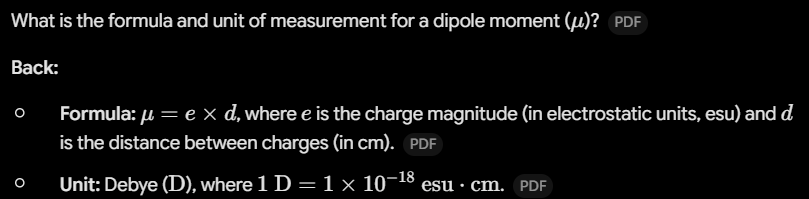
Formula: μ=e×d, where $e$ is the charge magnitude (in electrostatic units, esu) and $d$ is the distance between charges (in cm).
Unit: Debye (D), where 1 D=1×10⁻¹⁸ esu⋅cm
What is the formula and unit of measurement for a dipole moment (μ)?

An MEP visualizes electron density distribution across a molecule's van der Waals surface:
Red Regions: Electron-rich (δ−); attract positively charged species.
Blue Regions: Electron-poor (δ+); attract negatively charged species.
What is a Map of Electrostatic Potential (MEP) and what do the red and blue regions indicate?
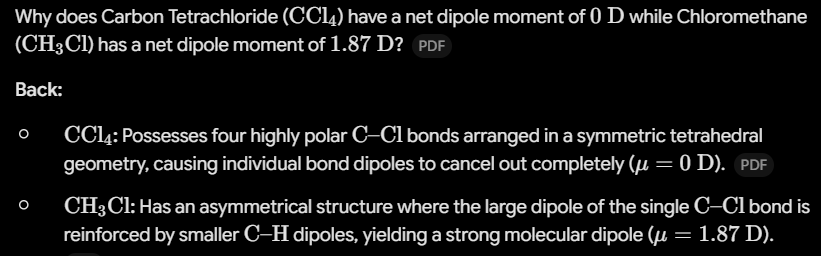
CCl4: Possesses four highly polar C–Cl bonds arranged in a symmetric tetrahedral geometry, causing individual bond dipoles to cancel out completely (μ=0 D).
CH3Cl: Has an asymmetrical structure where the large dipole of the single C–Cl bond is reinforced by smaller C–H dipoles, yielding a strong molecular dipole (μ=1.87 D)
Why does Carbon Tetrachloride (CCl4) have a net dipole moment of 0 D while Chloromethane (CH3Cl) has a net dipole moment of 1.87 D?

Unshared lone pairs on electronegative atoms (oxygen and nitrogen) contribute significantly to electron density directionality, combining with bond dipoles to produce large net dipole moments (H2O=1.85 D, NH3=1.47 D)
How do unshared electron pairs influence molecular dipole moments in H2O and NH3?

cis-1,2-dichloroethene: Both C–Cl bond dipoles point to the same side and reinforce each other (μ=1.90 D), giving it higher boiling point (60∘C) and melting point (−80∘C).
trans-1,2-dichloroethene: The opposing C–Cl bond dipoles cancel each other out (μ=0 D), lowering the boiling point (48∘C) and melting point (−50∘C)
Compare the dipole moments, melting points, and boiling points of cis-1,2-dichloroethene and trans-1,2-dichloroethene
What is an alkyl group, what is its general symbol, and how are methyl, ethyl, and propyl groups abbreviated?
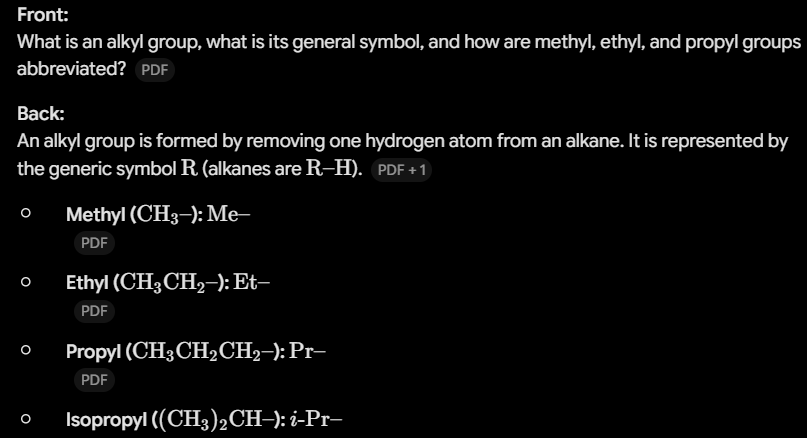
n alkyl group is formed by removing one hydrogen atom from an alkane. It is represented by the generic symbol R (alkanes are R–H).
Methyl (CH3–): Me–
Ethyl (CH3CH2–): Et–
Propyl (CH3CH2CH2–): Pr–
Isopropyl ((CH3)2CH–): i-Pr–
What is an alkyl group, what is its general symbol, and how are methyl, ethyl, and propyl groups abbreviated?

Phenyl Group: A benzene ring with one hydrogen removed (C6H5–, Ph–, or Ar–).
Benzyl Group: Toluene with one methyl hydrogen removed (C6H5CH2– or Bn–).
Define Phenyl and Benzyl groups and provide their chemical symbol representations.
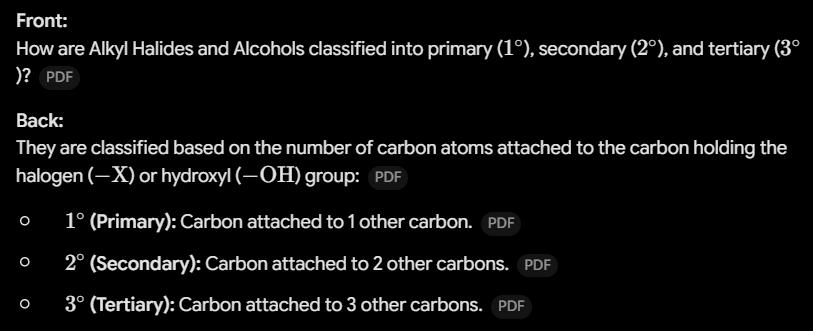
They are classified based on the number of carbon atoms attached to the carbon holding the halogen (−X) or hydroxyl (−OH) group:
1∘ (Primary): Carbon attached to 1 other carbon.
2∘ (Secondary): Carbon attached to 2 other carbons.
3∘ (Tertiary): Carbon attached to 3 other carbons
How are Alkyl Halides and Alcohols classified into primary (1∘), secondary (2∘), and tertiary (3∘)?

General Structure: R–O–R or R–O–R’ (organic derivatives of water where both hydrogens are replaced by alkyl/aryl groups).
Bond Angle: The C–O–C bond angle (e.g., 110∘ in dimethyl ether) is close to the tetrahedral angle (109.5∘), slightly larger than water's 105∘.
What is the general structure of Ethers and how does their oxygen bond angle compare to water?

Amines are organic derivatives of ammonia (NH3) and are classified by the number of alkyl groups attached directly to the nitrogen atom:
1∘ Amine: R–NH2 (1 alkyl group)
2∘ Amine: R2NH (2 alkyl groups)
3∘ Amine: R3N (3 alkyl groups)
How are primary (1∘), secondary (2∘), and tertiary (3∘) Amines classified?

Both contain the carbonyl group (C=O), where the carbon is sp2 hybridized and trigonal planar (≈120∘ bond angles):
Aldehyde: Carbonyl carbon is bonded to at least one hydrogen (RCHO or HCHO).
Ketone: Carbonyl carbon is bonded to two organic carbon groups (RCOR’).
Distinguish between Aldehydes and Ketones in terms of carbonyl group attachments and hybridization.

All three contain a carbonyl group bonded to an electronegative atom:
Carboxylic Acid: Carbonyl attached to hydroxyl group (−COOH or −CO2H).
Ester: Carbonyl attached to alkoxyl group (−COOR’ or −CO2R’).
Amide: Carbonyl attached to an amine/nitrogen group (−CONH2, −CONHR, or −CONR2).
Compare the general chemical structures of Carboxylic Acids, Esters, and Amides.
Functional Group: Cyano group (−C≡N:), consisting of a carbon triply bonded to nitrogen.
Geometry: Linear around the cyano carbon
What functional group defines a Nitrile and what is its geometry?
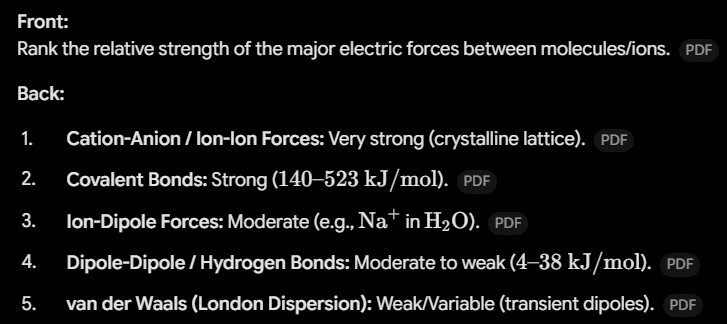
Cation-Anion / Ion-Ion Forces: Very strong (crystalline lattice).
Covalent Bonds: Strong (140–523 kJ/mol).
Ion-Dipole Forces: Moderate (e.g., Na+ in H2O).
Dipole-Dipole / Hydrogen Bonds: Moderate to weak (4–38 kJ/mol).
van der Waals (London Dispersion): Weak/Variable (transient dipoles)
Rank the relative strength of the major electric forces between molecules/ions.

A hydrogen bond requires a hydrogen atom covalently bonded to a strongly electronegative atom (O, N, or F) interacting with an unshared electron pair on another strongly electronegative atom (O, N, or F).
What structural criteria are required for intermolecular Hydrogen Bonding?

Ethanol molecules form strong intermolecular hydrogen bonds through their −OH groups, requiring high thermal energy to break apart. Dimethyl ether lacks O–H bonds and relies on much weaker dipole-dipole interactions.
Why does Ethanol (CH3CH2OH) boil at +78.5∘C while its isomer Dimethyl Ether (CH3OCH3) boils at −24.9∘C?

Symmetrical molecules pack more efficiently into a crystalline lattice, resulting in significantly higher melting points.
Butyl alcohol (linear): mp=−90∘C
tert-Butyl alcohol (compact/spherical): mp=+25∘C
How does molecular symmetry impact the melting point of constitutional isomers (e.g., butyl alcohol vs. tert-butyl alcohol)?
Polarizability: The ability of an atom's electron cloud to distort in response to a changing electric field.
Effect of Size: Larger atoms with loosely held outer-shell electrons (e.g., Iodine vs. Fluorine) are more polarizable, creating stronger transient dipoles and stronger van der Waals attractions.
Define Polarizability and explain how atomic size affects van der Waals interactions

Polar solvents dissolve polar/ionic solutes via dipole-dipole or ion-dipole interactions.
A compound is considered water-soluble if ≥3 g dissolves in 100 mL of H2O.
Rule of Thumb: One hydrophilic group (−OH) can solubilize up to 3 carbons completely, and up to 5 carbons partially. Long carbon chains (e.g., decyl alcohol) are hydrophobic and overwhelm the hydrophilic group.
Explain the rule "Like Dissolves Like" in terms of water dissolution and hydrophobic/hydrophilic balance.
Infrared radiation is absorbed by covalent bonds when the radiation frequency matches the natural resonant vibrational frequency of the bond (acting like a spring). This absorbed energy causes the bonds to undergo faster stretching or bending vibrations.
What physical phenomenon causes absorption peaks in Infrared (IR) Spectroscopy?
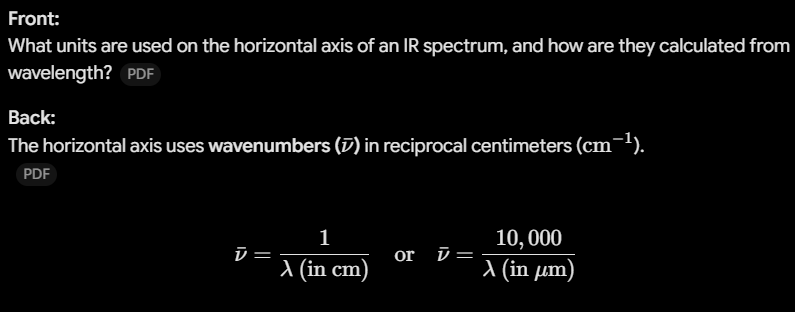
The horizontal axis uses wavenumbers (νˉ) in reciprocal centimeters (cm−1).
What units are used on the horizontal axis of an IR spectrum, and how are they calculated from wavelength?

Atomic Mass: Bonds with lighter atoms (e.g., C–H) vibrate faster and absorb at higher wavenumbers than heavier atoms.
Bond Strength: Stiffer, stronger bonds vibrate at higher frequencies:
Triple bonds (C≡C, C≡N): 2100–2260 cm−1
Double bonds (C=C, C=O): 1620–1780 cm−1
Single bonds: <1500\text{ cm}^{-1}
How do atomic mass and bond strength affect vibrational frequencies in IR spectroscopy?
BOND STRENGTH
Triple bonds: 2100-2260 cm^-1
Double bonds: 16020-1780 cm^-1
Single bonds: <1500 cm^-1
Triple bonds
Double bonds
Single bonds

sp3 C–H (Alkanes): 2800–3000 cm−1
sp2 C–H (Alkenes/Aromatics): 3000–3100 cm−1 (≈3080 cm−1 for alkenes, ≈3030 cm−1 for aromatics)
sp C–H (Alkynes): ≈3300 cm−1
What are the characteristic IR absorption ranges for C–H stretching at sp3, sp2, and sp hybridized carbon centers?
Sp3: 2800-3000 cm^-1
Sp2: 3000-3100^-1 (approx 3080 cm^-1 for alkenes, approx 3030 cm^-1 for aromatics)
Sp: approx 3300 cm ^-1
IR absorption ranges for C-H
Sp3
Sp2
Sp

Carbonyl groups present a strong peak between 1630–1780 cm−1:
Aldehydes: 1690–1740 cm−1
Ketones: 1680–1750 cm−1
Carboxylic Acids: 1710–1780 cm−1
Esters: 1735–1750 cm−1
Amides: 1630–1690 cm−1
Summarize the key IR absorption bands for Carbonyl (C=O) functional groups.
Aldehydes: 1690-1740 cm-1
Ketones: 1680-1750 cm-1
Caboxylic acids: 1710-1780 cm-1
Esters: 1735-1750 cm-1
Amides: 1630-1690 cm-1
IR absorption bands for Carbonyl
Aldehydes:
Ketones:
Caboxylic acids
Esters
Amides
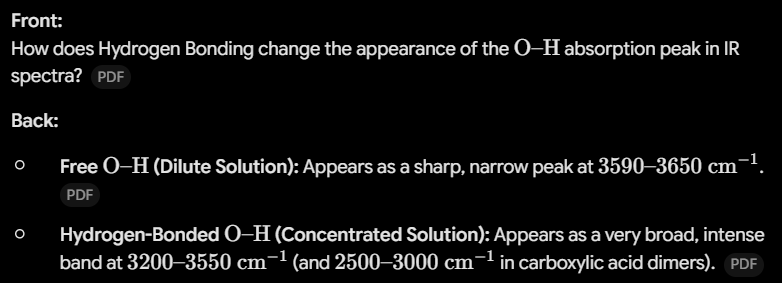
Free O–H (Dilute Solution): Appears as a sharp, narrow peak at 3590–3650 cm−1.
Hydrogen-Bonded O–H (Concentrated Solution): Appears as a very broad, intense band at 3200–3550 cm−1 (and 2500–3000 cm−1 in carboxylic acid dimers).
How does Hydrogen Bonding change the appearance of the O–H absorption peak in IR spectra?

In the N-H stretching region (3300-3500 cm-1)
1’ Amine : shows two peaks
2’ Amine: Show one peak
3’ Amine: Show no peak in this region (no N-H bonds)
How can primary (1∘), secondary (2∘), and tertiary (3∘) Amines be distinguished in the IR spectrum?