Cytopenias and Cytosis
 Call Kai
 Learn
Learn Practice Test
 Spaced Repetition
 Match
Match Flashcards
 Knowt Play
1/91

There's no tags or description
Looks like no tags are added yet.
Name | Mastery | Learn | Test | Matching | Spaced | Call with Kai | Chat |
|---|
No analytics yet
Send a link to your students to track their progress
92 Terms
What are the types of normal hemoglobin?
Hgb A: 2 alpha and 2 beta chains
Hgb A2: 2 alpha and 2 delta chains
Hgb F: 2 alpha and 2 gamma chains
What are the abnormal forms of hemoglobin?
Hgb S: Beta chain mutation
Hgb C, E, D: beta chain mutation
Hgb H: alpha chain mutation (thalassemia)
What causes anemia related to decreased Hgb and Hct?
1) Reduced production of RBCs
2) Increased destruction of RBCs
3) Loss of RBCs
What are the symptoms of decreased oxygenation?
exertional dyspnea, dyspnea at rest, fatigue, lethargy, confusion
What are the symptoms of decreased volume?
fatigue, cramps, postural dizziness, syncope
What are the physical exam findings of anemia?
pallor, tachycardia, bounding pulses, smooth tongue, hepatosplenomegaly
What labs are obtained to identify anemia?
Hemoglobin, hematocrit, RBC, MCV, MCHC, RDW
What are the anemia classification in males?
- Hct < 41%
- Hgb < 13.5 g/dL
What are the anemia classification in females?
- Hct < 36%
- Hgb < 12 g/dL
What are the characteristics of microcytic anemia (MCV
iron deficiency, thalassemia, anemia of chronic disease, lead poisoning
What are the symptoms of iron deficiency anemia?
fatigability, tachycardia, palpitations, koilonychia, esophageal webs, Pica (eating ice, clay, dirt)
What are the laboratory findings of iron deficiency anemia?
- abnormally low ferritin
- increased TIBC
- hypochromic microcytic cells (low MCV and MCHC)
- anisocytosis (increased RDW)
- increased platelets
What is the detectable level of lead poisoning?
3.5mcg/dL
What are the systemic effects of lead poisoning?
CNS with decreased IQ, Heme synthesis, Renal injury
What are the characteristics of normocytic anemia (MCV 80-100)?
anemia of chronic disease, acute bleeding, iron deficiency (early)
What are the associated conditions of normocytic anemias?
HIV, IBD, CHF, COPD, renal failure, and acute blood loss
What are the characteristics of macrocytic anemia (MCV >100)?
Megaloblastic anemia, liver disease, hypothyroidism
What is megaloblastic anemia?
Type of macrocytic anemia from inhibition of DNA synthesis during RBC production → leads to cell growth without division
What is pernicious anemia?
A type of megaloblastic anemia caused by vitamin B12 deficiency due to lack of intrinsic factor.
When does vitamin B12 deficiency manifest?
> 3 years after absorption ceases
What is the cause of vitamin B12 deficiency?
dietary deficiency, pernicious anemia, H. pylori infection, pancreatic insufficiency
What medications can cause vitamin B12 deficiency?
PPIs (≥ 1 year) and Metformin (at least 3 years)
What are the symptoms of vitamin B12 deficiency?
glossitis, anorexia, pale, paresthesias, decreased vibration and position sense
What are the laboratory findings of vitamin B12 deficiency?
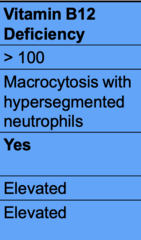
MCV >100 fL, Neutrophils hypersegmented, reduced reticulocytes, elevated MMA (confirmatory)
What is the most common cause of folate deficiency?
inadequate dietary intake; body stores can last 2-3 months
What are the other risk factors for folate deficiency?
decreased absorption (celiac, crohn's), increased requirement (pregnancy, malignancy), dialysis, methotrexate, sulfa drugs, alcohol use disorder
What are the laboratory findings of folate deficiency?
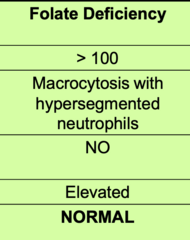
MCV > 100, folate < 2, hypersegmented neutrophils, elevated homocysteine level (confirmatory)
What are the intrinsic causes of hemolytic anemia?
hemoglobinopathies, hereditary spherocytosis, G6DP deficiency, pyruvate kinase deficency
What are the extrinsic causes of hemolytic anemia?
Immune, mechanical, infectious or metabolic/oxidant means
What are the symptoms of hemolytic anemia?
fatigue, weakness, SOB, jaundice, dark urine +/- angina
What are the laboratory findings of hemolytic anemia?
- low haptoglobin levels
- increased LDH
- increased indirect bilirubin
- direct coombs//antiglobulin test (positive in immune causes)
What is "warm" autoimmune hemolytic anemia?
IgG antibodies active at body temperature that can be primary or secondary
What is "cold" autoimmune hemolytic anemia?
IgM antibodies most efficient in the cold with individuals >60 years of age
What is the treatment of autoimmune hemolytic anemia?
corticosteroids, prophylactic folic acid, rituximab (warm), EPO +/- splenectomy
What is the most common hemoglobinopathy?
Thalassemia
What is Thalassemia?
Hereditary disorder characterized by reduction in the synthesis of globin chains (alpha or beta)
What are the four forms of alpha-thalassemia?
4 genes - normal
3 genes - silent
2 genes - α thalassemia minor
1 gene - hemoglobin H
0 genes - α thalassemia major hydrops fetalis (fatal)
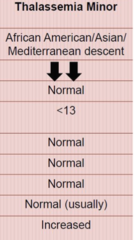
What are the lab findings with Alpha-Thalassemia Minor?
mild anemia, low MCV (65-75), microcytes, hypochromia, target cells, normal Hgb electrophoresis
What are the lab findings with Hemoglobin H disease?
marked hemolytic anemia, low MCV, elevated reticulocytes, positive hemoglobin electrophoresis (Hgb H)
What is hydrops fetalis?
Loss of all four alpha globin genes causing severe anemia during fetal development that is incompatible with a live birth
What is Beta-Thalassemia?
Mutations result in either reduced expression (beta+) or complete absence of expression (beta0) around 6-12 months of age
What are the signs of Beta-Thalassemia?
pallor, jaundice, dark urine, Chipmunk facies, HSM, high output heart failure, failure to thrive, infection
What are the laboratory findings of Beta-Thalassemia Major?
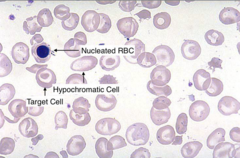
Hgb < 10, severe poikilocytosis, hypochromia, microcytosis, target cells, basophilic stippling
What are the laboratory findings of Beta-Thalassemia minor?
Hbg >10, MCV low (55-75), positive hemoglobin electrophoresis (Hgb A2 and F)
What is sickle cell anemia?
Autosomal recessive disorder leading to Hgb S expression and chronic hemolytic anemia
What are the symptoms of sickle cell anemia?
jaundice, acute painful episodes (bones and chest), splenomegaly
What are the laboratory findings of sickle cell anemia?
- abnormal hemoglobin electrophoresis (HbSS or HbAS)
- chronic hemolytic anemia
- elevated WBC
- thrombocytosis
- high indirect bilirubin
What is seen on peripheral blood smear in sickle cell anemia?
"sickle shaped" RBC and Howell-Jolly bodies (small round remnants of nuclear material)
What is the management of sickle cell disease?
infection and complication control, pain prevention (Hydroxyurea and L-glutamine), stem cell transplant
What is hereditary spherocytosis?
Variants in genes that encode proteins of the red blood cell (RBC) membrane and cytoskeleton leading to sphrerocytic TBC shape
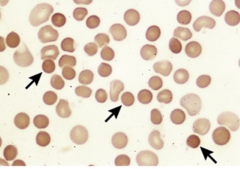
What are the lab findings of hereditary spherocytosis?
- MCHC ≥ 36 g/dL
- increased RDW
- increased LDH, indirect bilirubin, and reticulocytes
- decreased haptoglobin
What are the confirmatory tests for hereditary spherocytosis?
- EMA binding
- Osmotic fragility
- Osmotic gradient ektacytometry
What are the supportive measures for hereditary spherocytosis?
hyperbilirubinemia (phototherapy), folic acid, erythropoietin, +/- transfusions and splenectomy
What is Glucose-6-Phosphate Dehydrogenase (G6PD) Deficiency?
X-linked recessive disorder causing episodic hemolysis in response to oxidative stress
What are the risk factors of G6PD deficiency?
Kurdish Jews, Mediterranean, African, Asian
What are the symptoms of G6PD deficiency?
usually healthy unless severe in which can present as chronic hemolytic anemia (jaundice, dark urine, weakness)
What are the laboratory findings of G6PD deficiency?
reticulocytosis, increased indirect bilirubin, "bite" cells, Heinz bodies
What medications are considered unsafe in moderate to severe G6PD deficiency?
anti-infectives, dapsone, nitrofurantoin, primaquine
What chemicals and foods are considered unsafe in moderate to severe G6PD deficiency?
Aniline dyes, npathalane (mothballs), henna compounds, Fava beans
What is Pyruvate Kinase Deficiency?
Autosomal recessive red blood cell (RBC) enzyme disorder causing chronic hemolysis
What are the risk factors for Pyruvate Kinase Deficiency?
Northern European, Pennsylvania Amish, FLDS at the Utah/AZ border
What is the most common presentation of Pyruvate Kinase Deficiency?
chronic hemolytic anemia from birth leading to ulcers, osteoporosis, pulm HTN, liver cirrhosis
What are the lab findings of Pyruvate Kinase Deficiency?
- low Hgb and Hct
- increased reticulocytes
- increased indirect bilirubin
- increased LDH
- Negative Coombs/DAT
- increased ferritin
What is the management of pyruvate kinase deficiency before birth?
intrauterine transfusion (IUT)
What is the management of pyruvate kinase deficiency in the neonatal period?
phototherapy or exchange transfusion
What is the management of infancy through adulthood?
RBC transfusion, folic acid, Miapivat, splenectomy, iron chelation, stem cell transplant
What is paroxysmal nocturnal hemoglobinuria?
rare, acquired disorder of stem cells leading to complement mediated hemolysis
What are the symptoms of paroxysmal nocturnal hemoglobinuria?
fatigue, dyspnea, hemoglobinuria, abd pain, ED, chest pain, thrombosis (Budd Chiari), bone marrow dysfunction (aplastic anemia)
What diagnostic is specific to Paroxysmal Nocturnal Hemaglobinuria?
Flow cytometry: identifies specific missing proteins on RBC surface
What is the treatment of symptomatic PNH without severe bone marrow failure?
Ravulizumab, a C5 complement inhibitor (C5i)
What is the treatment of symptomatic PNH with severe bone marrow failure?
Allogeneic hematopoietic cell transplantation (HCT)
What is aplastic anemia?
Caused by hematopoietic stem cell failure and pancytopenia
What are the risk factors of aplastic anemia?
chemotherapy, antibiotics, benzene, insecticides, parvovirus, EBV, HIV, radiation, pregnancy
What are the symptoms of aplastic anemia?
fatigue, palpitations, recurrent infections, gingival bleeding, epistaxis, petechiae, purpura
How is aplastic anemia diagnosed?
bone marrow biopsy
What is the diagnostic criteria for severe aplastic anemia?
At least two of the following:
- neutrophils
What is relative polycythemia?
due to decreased plasma volume (dehydration) elevated with normal RBC mass
What is is primary Polycythemia vera?
bone marrow disorder with elevated Hct, increased RBC mass, and decreased EPO
What is is secondary Polycythemia vera?
Due to increased erythropoietin production. Tissue hypoxia is major cause (COPD and living at High altitude
What is a common mutation in polycythemia vera?
JAK2 mutation positivity
What are the symptoms of polycythemia vera?
HA, dizziness, tinnitus, blurred vision, angina, claudication, Aquagenic pruritic
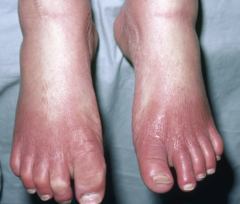
What are the physical exam findings of polycythemia vera?
engorged retinal veins, thrombosis, splenomegaly, erythromelalgia, gout
What is the major criteria for polycythemia vera?
- increased hemoglobin, hematocrit, and red cell volume
- erythroid, granulocytic, and megakaryocytic proliferation with pleomorphic, mature megakaryocytes
- JAK2 mutation
What is the minor criteria for polycythemia vera?
Serum erythropoietin level below the reference range for normal
How many of the major or minor criteria must be met for polycythemia vera diagnosis?
all 3 major criteria or 2 major and the minor criterion
What is the management of polycythemia vera?
- phlebotomy to Hct < 45%
- Daily baby ASA
- Hydroxyurea
- interferon-alpha or busulfan
- JAK2 inhibitor
What is hereditary hemochromatosis?
Mutation on HFE Gene on chromosome 6 most commonly C282Y
What is the pathogenesis of hereditary hemochromatosis?
Low hepcidin allows ferroportin to pull excess iron into plasma
What is the presentation of hereditary hemochromatosis?
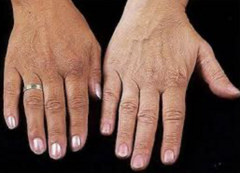
skin bronzing, liver deposition on MRI, cardiomyopathy, hypogonadism, hypothyroidism, arthritis, HCC, diabetes
What is the work up for hereditary hemochromatosis?
1) Tsat (serum Fe/TIBC x 100) elevation >45-50%
2) Ferritin > 300 (M) or > 200 (F)
3) HFE testing
What are the complications of hereditary hemochromatosis?
Liver damage (Ferritin >1000), fibrosis (ETOH and Hep C), Yersinia, Vibrio Vulnificus, Porphyria Cutanea Tarda
What is the treatment of hereditary hemochromatosis?
phlebotomy and low dose HCQ