Motion
 Call Kai
 Learn
Learn Practice Test
 Spaced Repetition
 Match
Match Flashcards
1/39

Earn XP
Description and Tags
S8P3
Name | Mastery | Learn | Test | Matching | Spaced | Call with Kai | Chat |
|---|
No analytics yet
Send a link to your students to track their progress
40 Terms
Motion
The act of changing position or location. In physics, it refers to the object's change in its place over time, relative to a reference point.
speed
is the rate at which an object moves, typically measured as distance traveled per unit of time. distance divided by time.
velocity
is the speed of an object in a given direction, combining both magnitude and direction into its measurement. It differs from speed as it specifies the object's trajectory.
position
is the location of an object at a given moment, defined in relation to a reference point or frame of reference.
displacement
is the vector quantity that describes the change in position of an object. It is defined as the shortest straight-line distance from the initial position to the final position, along with the direction of that line.
distance-time graph
is a graphical representation showing the relationship between the distance traveled by an object and the time taken to cover that distance. The slope of the line on the graph indicates the object's speed.
velocity-time graph
is a graphical representation that illustrates how an object's velocity changes over time. The slope of the line indicates the object's acceleration, while the area under the curve represents the displacement.
Average Speed
The total distance divided by the total time it takes to travel.
Acceleration
When an object speeds up, slows down, or changes direction.
Deceleration
When an object slows down (negative acceleration).
Constant Speed
Moving the same distance each second; not speeding up or slowing down.
Graph of Motion
A picture that shows how distance and time or speed and time change.
Force
A push or pull on an object.
Balanced Forces
When forces are equal and opposite, so there is no change in motion.
Unbalanced Forces
When one force is stronger than another, causing a change in motion.
Friction
A force that slows down motion when two surfaces rub together.
Gravity
The force that pulls objects toward each other (like Earth pulling things down).
Inertia
The tendency of an object to keep doing what it’s already doing (stay still or keep moving).
Mass
How much matter is in an object; how “heavy” something feels.
Newton (N)
The unit used to measure force.
Net Force
The total force acting on an object after all forces are added or subtracted.
Direction
The line or path along which something moves.
Newton’s First Law (Law of Inertia)
An object will not move or stop moving unless a force acts on it.
Newton’s Second Law
A bigger force makes an object speed up more, but a heavier object needs more force to move. (F = ma)
Newton’s Third Law
For every action, there is an equal and opposite reaction.
Proportional
When one thing changes, another changes in a predictable way (e.g., more force → more acceleration).
Acceleration (revisit)
The rate at which velocity changes; how quickly something speeds up or slows down.
Inertia (revisit)
Objects resist changes in motion; more mass = more inertia.
Resistance
Any force that slows motion, like air resistance or friction.
Momentum
How hard it is to stop something that’s moving; depends on mass and velocity.
Motion Graph
A visual way to show how speed, time, and acceleration relate.
Applied Force
A push or pull directly caused by a person or another object.
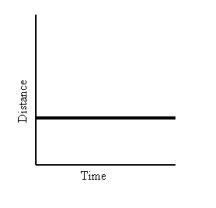
D/T No change in distance- is not moving
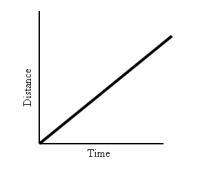
D/T Line with slope- represents constant speed the steeper the slope the faster the movement
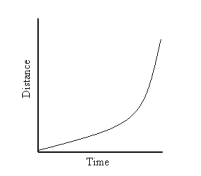
D/T Curved line upwards shows acceleration
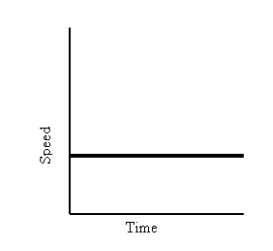
S/T horozonal line is constant speed
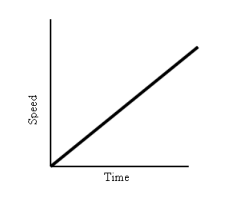
S/T positive slope- line slanted up is acceleration
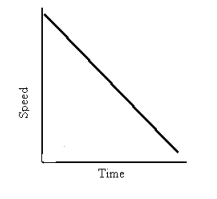
S/T negative slope- slanted line going down is deceleration or negative acceleration
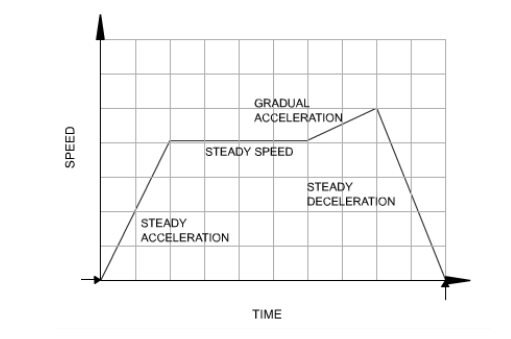
Speed over Time Graph!!!- KNOW WHAT THESE LINES MEAN
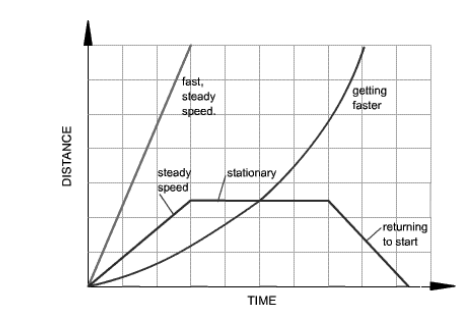
Distance over Time graph- KNOW WHAT THESE LINES MEAN