Fingerprints
 Studied by 0 people
 Call Kai
 Learn
Learn Practice Test
 Spaced Repetition
 Match
Match Flashcards
 Knowt Play
1/18

There's no tags or description
Looks like no tags are added yet.
Name | Mastery | Learn | Test | Matching | Spaced |
|---|
No study sessions yet.
19 Terms
Fingerprints
Refer to the unique patterns formed by ridges on the surface of a finger, which can be used for identification purposes in forensic science.
Your fingers, toes, feet, palms, and lips are covered with small ridges that are raised portions of the skin, arranged in connected units
Ridges help grip objects
Formation of Fingerprints
Fingerprints begin forming near the 10th week of pregnancy, when the fetus is about 3 inches long.
In a fetus, the basal layer cells grow faster than the layers above or below it, so it collapses and folds to form intricate shapes.
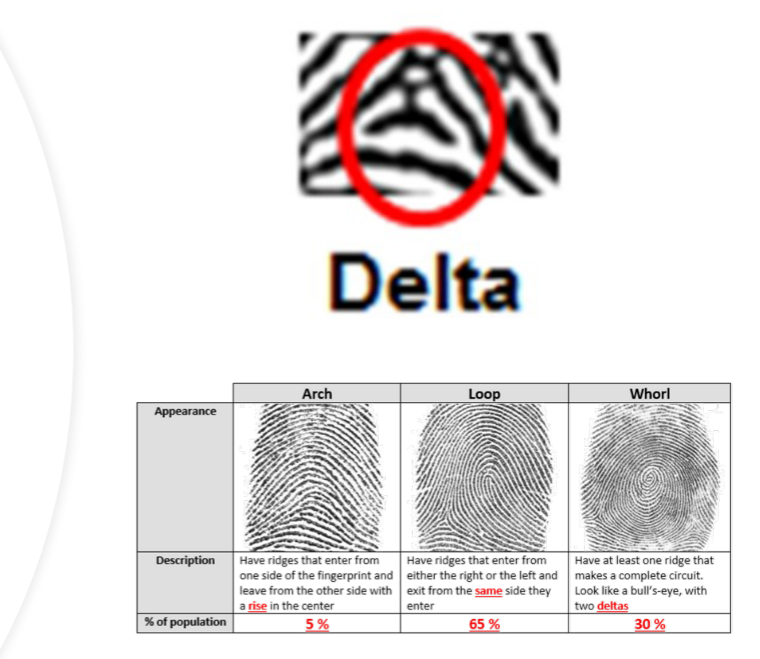
Fingerprint Patterns
Two things a forensic examiner looks for on a fingerprint are the presence of a core and deltas.
The core is the center of a loop or whorl.
A triangular region located near a loop is called a delta.
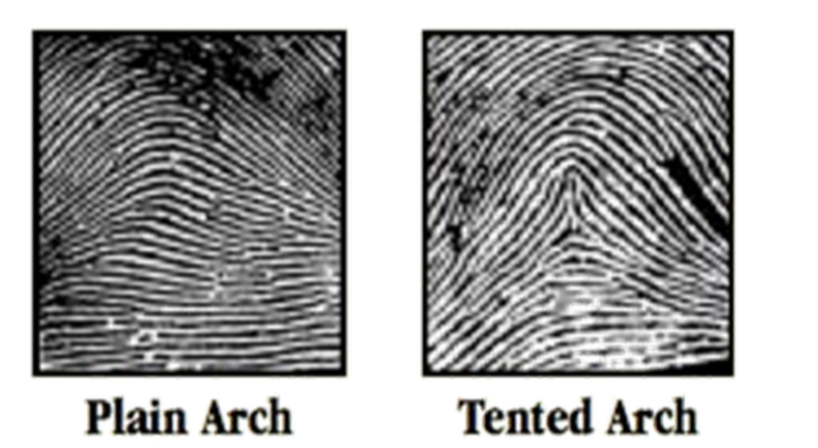
Arch Patterns
Have ridges that enter from one side of the fingerprint and leave from the other side with a rise in the center. 5% of the population have arch patterns.
Types of arches:
•Plain arch – ridges enter on one side and exit on the other side.
•Tented arch – has a spike in the center.
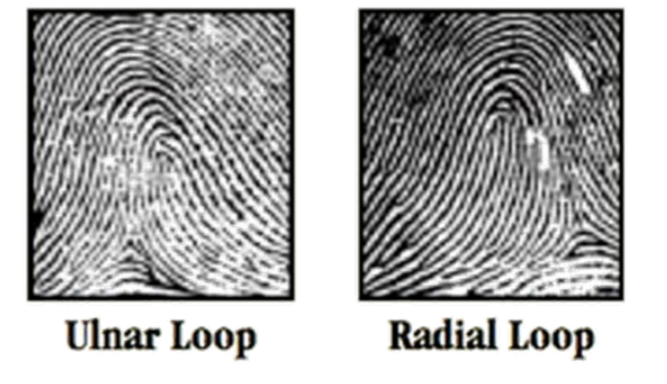
Loop Patterns
Have ridges that enter from either the right or the left and exit from the same side they enter. 65% of the population have loop patterns.
Types of loops: these patterns are named for their positions related to the radius and ulna bones:
• Radial loop – loop opens toward the left or the radial bone.
• Ulnar loop – loop opens toward the right or the ulna bone.
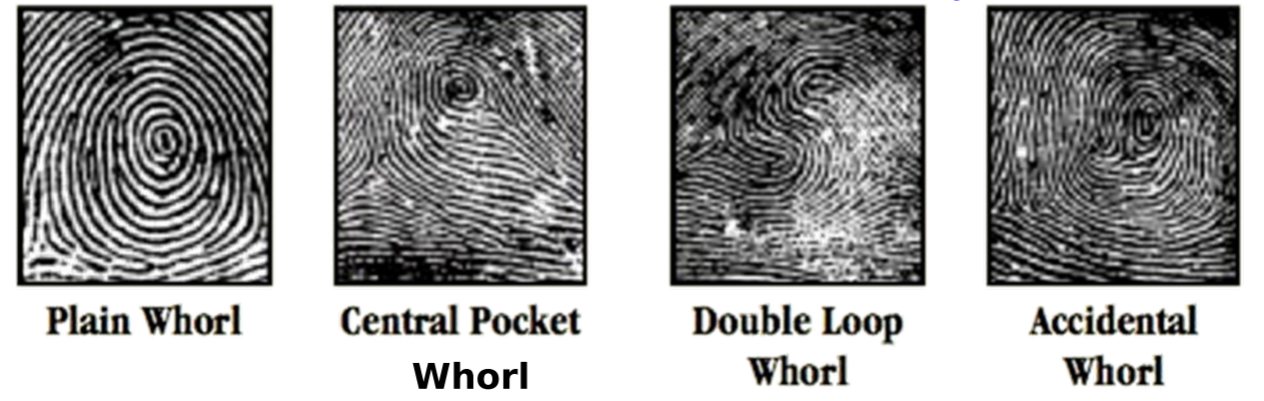
Whorl Patterns
Have at least one ridge that makes a complete circuit. Looks like a bull’s-eye, with two deltas. 30% of the population have whorl patterns.
Types of whorls:
• Plain whorl
• Central pocket whorl
• Double loop whorl – made up of any two loops combined into one print.
• Accidental whorl – does not clearly fall under any of the other categories.
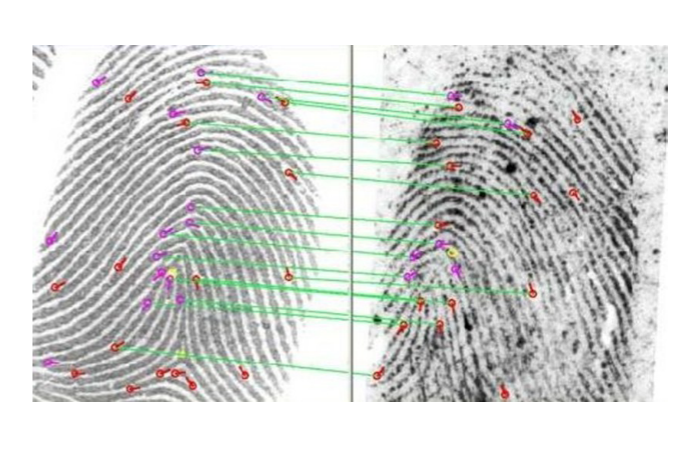
Minutiae
Every individual, including identical twins, has a unique fingerprint resulting from unique ridge patterns called minutiae (because the details are so minute or small).
Minutiae are points where print ridges come together or end; they are considered to be the “uniqueness” of an individual.
FBI has found that no two individuals have more than 8 common minutiae.
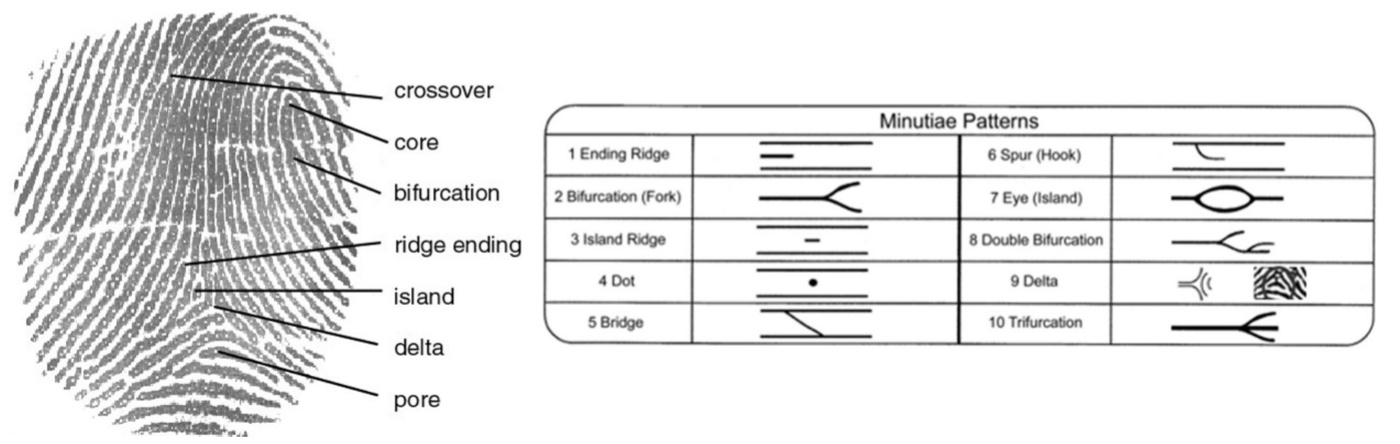
Minutiae Patterns
Three Possible Conclusions:
• Match = Identification
• No match = Exclusion
• Not enough info = Inconclusive
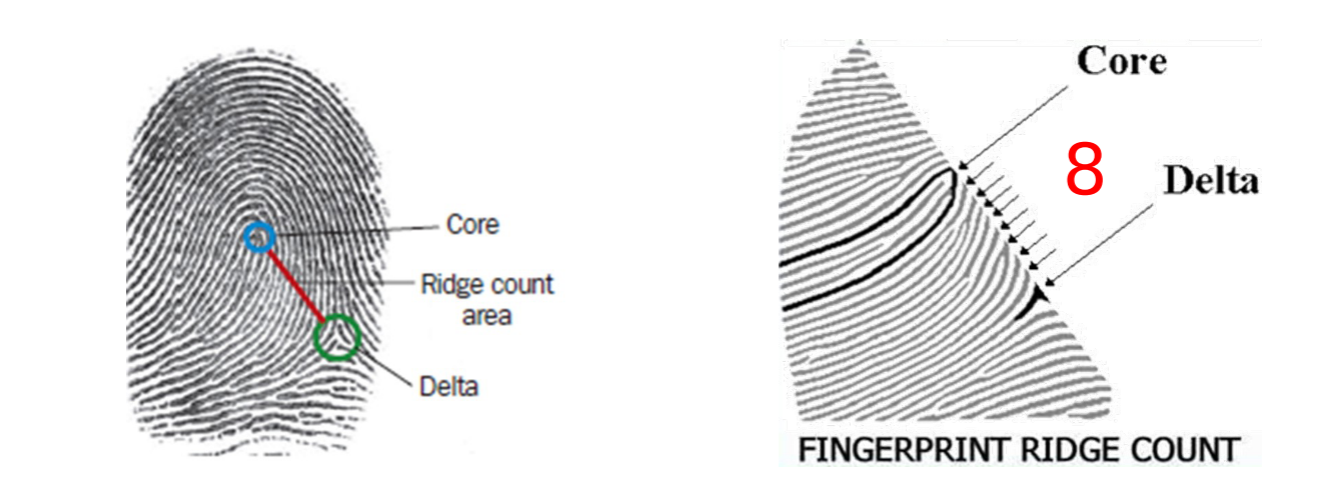
Ridge Count
To take a ridge count, an imaginary line is drawn form the center of the core to the edge of the delta and intersecting ridges are counted.
Three Types of Print Identitification
Patent fingerprints – or visible prints, are left on a smooth surface when blood, ink, paint, grease or other liquid comes in contact with the hands and is then transferred to that surface.
Plastic fingerprints- actual indentation left in some soft material such as clay, putty, or wax.
Latent fingerprints – caused by the transfer of oils and other body secretions onto a surface (not visible to the naked eye)
Ninhydrin
A chemical that bonds with the amino acids in fingerprints and will produce a blue or purple color.
It is used to life prints from surfaces such as paper and cardboard.
Cyanoacrylate Vapor
The cyanoacrylate fuming method (or super glue method) is a procedure that is used to develop latent fingerprints on a variety of objects such as any household items (plastic, metal, glass and skin).
Reacts with aminos acids and produces a white print.
Silver Nitrate
Reacts to the salt deposits in sweat.
It is used to lift prints from surfaces such as wood or Styrofoam.
Produces a black or red-brown print under UV light.
Iodine Fuming
Used to lift prints from surfaces such as paper, cardboard, or unpainted surfaces. Iodine combines with carbohydrates within the latent print.
Produces a brownish print that fades quickly; must be photographed or sprayed with a starch solution.
Toxic to inhale or ingest.
Preservation of Fingerprint Evidence
Investigators should always wear gloves and avoid handling evidence as much as possible.
Touch as little as possible, and then only in areas least likely to contain identifiable latent prints, such as rough surfaces.
Precautions should be taken when marking evidence so not to damage or destroy potential latent fingerprints.
Papers and documents containing latent prints should be placed individually in a cellophane or manila envelope.
Fundamental Principles of Fingerprints
A fingerprint is an individual characteristic; no two people have identical ridge patterns.
A fingerprint pattern remains unchanged during a person’s lifetime. However, a print may change due to permanent scars or skin disease.
Fingerprint Analysis History and Future
Beginning in the 1880s, Sir Francis Galton and Sir E.R. Henry developed the classification system for fingerprints that is still in use today in the United States and Europe (Galton-Henry Method).
AFIS
In 1999, the FBI developed the Automated Fingerprint Identification System (AFIS), which provides digital, automated fingerprint searches, latent searches, electronic storage of fingerprint photo files, and the electronic exchange of fingerprints and test results.
AFIS contains over 50+ million fingerprint records. To use AFIS, an unknown print is scanned and entered into the computer.
The computer searches the AFIS system and produces a list of file prints that match closest to the search print (takes approx. 2 hours).
Latent Fingerprints
Latent fingerprints are not visible to the naked eye but can be made visible by using chemicals.
To dust for fingerprints, dust surfaces with a fine carbon powder to make a fingerprint more visible.
Tape can then be used to life and preserve the fingerprint.
Metal or magnetic powders can also be used to lift fingerprints.