Enzymology 1-3
 Call Kai
 Learn
Learn Practice Test
 Spaced Repetition
 Match
Match Flashcards
 Knowt Play
1/65

There's no tags or description
Looks like no tags are added yet.
Name | Mastery | Learn | Test | Matching | Spaced | Call with Kai | Chat |
|---|
No analytics yet
Send a link to your students to track their progress
66 Terms
Enzymes
Biological catalysts, primarily proteins that increase rates of chemical reaction w/o being consumed in the process
except: ribozymes(catalytic RNA)
Possess a region known as an active site where the substrate binds—resulting in a product
Catalytic power
A characteristic feature of an enzyme which specifies its ability to accelerate the rxn rate of noncatalyzed reaction as much as 1026
Specificity
A characteristic feature of an enzyme which demonstrates it extreme selectivity to the substances it interacts with and the rxn it catalyzes
Regulation
A characteristic feature of an enzyme which allows it to be regulated (increased or decreased) so that the rate of product formation responds to cellular needs
Oxidoreductase
Type of enzyme which catalyzes oxidation-reduction reactions
Oxidoreductase
What type of enzyme is this: dehydrogenase
Oxidoreductase
What type of enzyme is this: oxidase
Oxidoreductase
What type of enzyme is this: reductase
Oxidoreductase
What type of enzyme is this: catalase
Oxidoreductase
What type of enzyme is this: peroxidase
oxido-reductase
What type of enzyme is this: oxygenase
transferase
What type of enzyme is this: transfer of glucosyl
transferase
What type of enzyme is this: transfer of methyl
transferase
What type of enzyme is this: transfer phosphoryl groups
Hydrolase
What type of enzyme is this: Urease
Hydrolase
What type of enzyme is this: Phosphatase
Hydrolase
What type of enzyme is this: lipase
Hydrolase
What type of enzyme is this: peptidase
lyase
What type of enzyme is this: Decarboxylase
Lyase
What type of enzyme is this: dehydratases
Lyase
What type of enzyme is this: aldolases
isomerase
What type of enzyme is this: mutase
isomerase
What type of enzyme is this: epimerase
transferase
Type of enzyme which catalyzes transfer of moieties
hydrolase
Type of enzyme which catalyzes cleavage of bonds(by addition of water)
Lyase
Type of enzyme which catalyzes cleavage of bonds (i.e C—C, C—S, C—N bonds)
Isomerase
Type of enzyme which catalyzes the rearrangement of optical or geometric isomers
Ligase
Formation of bonds between two molecules coupled to hydrolysis of high-energy phosphates
ligase
What type of enzyme is this: carboxylase
ligase
What type of enzyme is this: synthetase
Active site
A special cleft or crevice that provides the environment where substrate binds and catalysis occurs
Is able to bind through weak forces—hydrogen bonds, ionic bonds and van der waals interaction
Cofactor
Metal ions or organic molecules (nonprotein moiety) that participate directly in substrate binding or catalysis
Coenzyme
Organic molecules that participate directly in substrate binding or catalysis
Usually, vitamins or vitamin derivatives
Extend the mechanistic capabilities of an enzyme
Metal-activated enzyme
Enzymes that require a metal ion factor
Metallo-enzyme
Metal ions that serve as prosthetic groups
Prosthetic Group
Permanently associated with the enzyme
Cosubstrate
Transiently associated with the enzyme
Free Enzyme
The structure of the active site is formed by the folding of the protein, which is the complementary to the structure of the substrate
Enzyme-substrate complex
Amino acid side chains and non-protein components participate in substrate binding
Transition-state complex
The enzyme stabilizes the high unstable transition-state intermediate by binding to the substrate, to not return to starting reactants, but not too strong in order not to form product. Substrates are NOT consumed in the process but it can be modified during the rxn
Note that it will always return to its original form
Original Enzyme
Products are released and enzymes could attach to another substrate to repeat the process
Lock and Key Model
Proposed by German Chemist Emil Fischer
Enzymes resemble a lock and its particular substrate the key
Implied that enzymes are rigid, falling to account for the dynamic changes that accompany catalytic transformations
Induced Fit Model
States that an enzymes active site is not rigid, preformed shape but a flexible one that changes shape to fit the substrate
Binding of a substrate to the enzyme induces a conformational change that is analogous to placing a hand in a glove
This occurs in the active site for the enzyme to accommodate the substrate—resulting in better fit and enhanced catalytic activity
Catalysis by proximity and orientation
Substrate molecules must come within bond-forming distance in order to interact
Substrates should be organized in a specific orientation wherein the reactants are close together within the active site
Increase in proximity of reactants> increase collision frequency > faster rate of rxn
Acid-base catalysis
Ionizable functional groups of the amino acyl side chanins contirbutes to catalysis by acting as acids and bases in the active side
Functional groups can act as acids/bases
Acceleration of rxn is achieved by the catalytic transfer of a proton
Catalysis by bond strain
Enzymes bind substrates in a conformation that weakens the bond targeted for cleavage through physical distortion and electric polarization
Covalent Catalysis
Involves the formation of a transient covalent bond between enzyme and one or more substrate. The modified enzyme becomes a reactant but would eventually return to its original state
Participating residues on the enzyme are cysteine or serine and occasionally histidine
Often follows a pingpong mechanism
Ribozymes
Enzymes that satisfy the enzymatic criteria but most act in RNA processing
It is part of a ribosome which acts as the catalytic core composed of ribosomal RNA which joins amino acids to form proteins
Large rRNA that catalyzes the peptidyl transferase reaction
The formation of peptide bonds during the translation of proteins
Kinetics
General study of chemical reaction rates
Enzyme kinetics
The study of how the rates of enzyme-catalyzed chemical reactions are affected by changing the reaction conditions
Transition State
A state where the molecules have the energy necessary to achieve a reactive condition
It is the highest energy point along the reaction pathway
However, due to its high energy and instability, it has a fleeting existence and is the least probable configuration for molecules to adopt at any given time
Can revert back to its reactant
Initial state
The state of average free energy of molecule A
Final state
The state of average free energy of molecule P
Free energy change or Gibbs free energy
Difference between the average free energy of the energies of the product and reactants for the given reaction; typically describes the direction the reaction will tend to proceed
Negative value(-)
Rxn is favored from left to right
Spontaneous
Independent of the mechanism
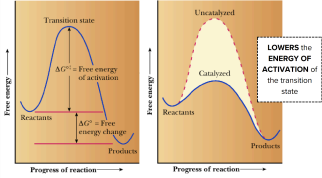
Energy of Activation
Energy required to initiate the reaction
Energy required ot raise the ave. energy of 1 mol of reactant (at a given temperature) to transition-state energy
The higher the activation energy, the slower the reaction

Temperature, Hydrogen Ion Concentration and Substrate Concentration
Factors affecting the rates of enzyme catalysis
High Temperature
Factor leads to heat energy to disrupt noncovalent interaction that 3D structures of proteins > loss of activity from the denaturation of enzymes
High Hydrogen Ion Concentration
Factor which is caused when pH extremes can denature enzymes as the structure of catalytically active protein molecules depend on the ionic character of the amino acid chain
Pepsin
A gastric digestive enzyme that is maximally active at pH 2
Chymotrypsin
A digestive enzyme produced in the pancreas that operates at an optimal pH of 7
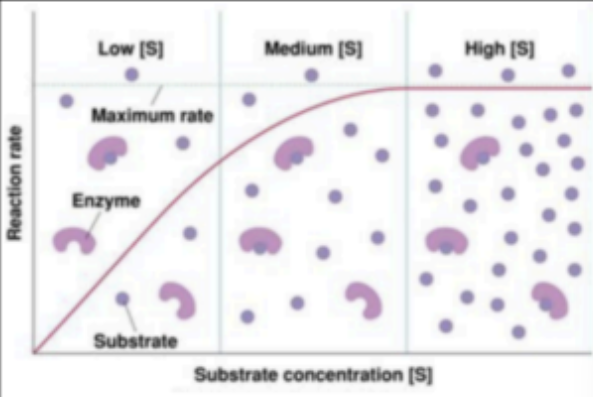
Vmax
Maximum value of the reaction rate
Also indicates that all the enzymes are saturated
All enzymes are saturated
The vmax indicates…
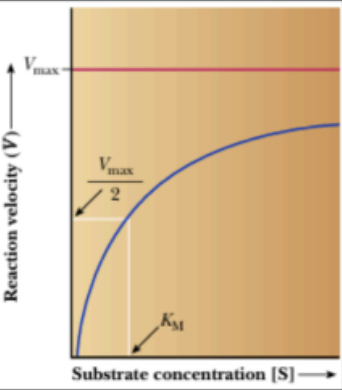
Michaelis-Menten
Describes how reaction velocity varies with substrate concentration and is hyperbolic in shape
