Lecture 3: Proteins and Biological Macromolecules
 Call Kai
 Learn
Learn Practice Test
 Spaced Repetition
 Match
Match Flashcards
 Knowt Play
1/24

Earn XP
Description and Tags
Comprehensive vocabulary flashcards covering basic chemical principles, functional groups, monomers, polymers, and the four levels of protein structure.
Name | Mastery | Learn | Test | Matching | Spaced | Call with Kai | Chat |
|---|
No analytics yet
Send a link to your students to track their progress
25 Terms
Hydrophilic Molecules
Ions and polar molecules that readily dissolve in water by interacting with water's partial charges through hydrogen bonding.
Hydrophobic Molecules
Uncharged and nonpolar compounds, such as hydrocarbons, that do not dissolve in water.
Amino Group
A functional group (-NH2 or -NH3+) belonging to amines that acts as a base by attracting a proton in solution.
Carboxyl Group
A functional group (-COOH or -COO−) belonging to carboxylic acids that acts as an acid by losing a proton in solution.
Carbonyl Group
A functional group (-C=O) found in aldehydes and ketones that reacts with specific compounds to produce larger molecules.
Hydroxyl Group
A highly polar functional group (-OH) found in alcohols that increases solubility through hydrogen bonding with water.
Phosphate Group
A functional group (-PO42−) found in organic phosphates that stores large amounts of chemical energy when linked together.
Sulfhydryl Group
A functional group (-SH) found in thiols that can form covalent disulfide (S-S) bonds to stabilize protein structure.
Monomer
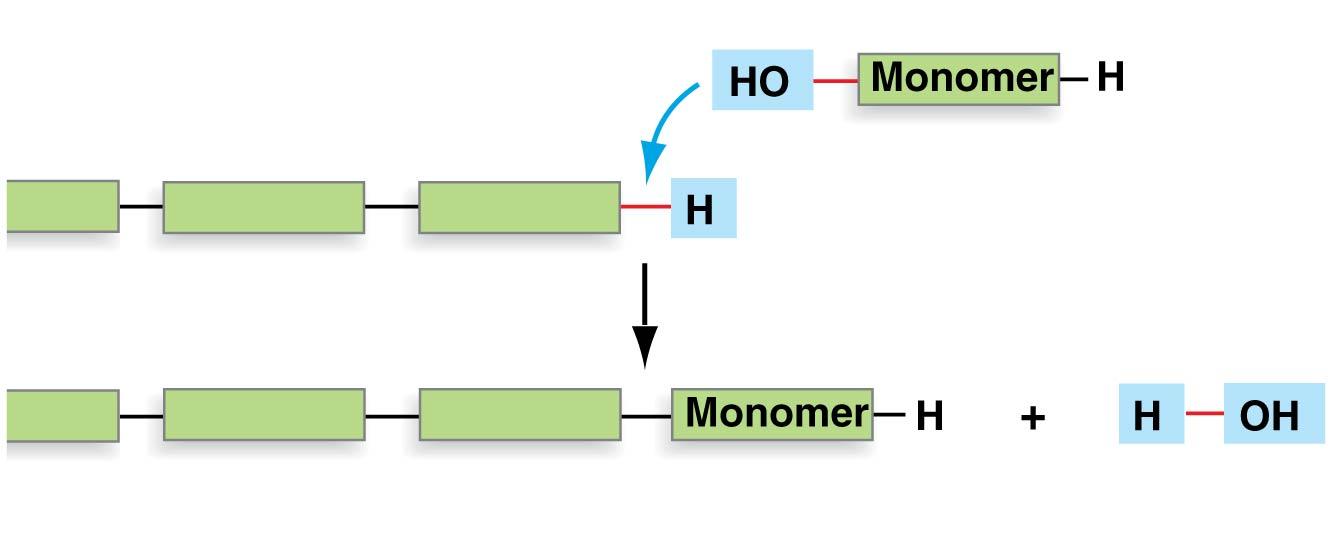
A small individual molecular unit, such as an amino acid, nucleotide, or simple sugar, that can link with others to form polymers.
Polymer
A large structure composed of many repeating monomer units joined together through polymerization.
Condensation Reaction
An energy-requiring reaction (also known as dehydration) that polymerizes monomers together by releasing a water molecule.
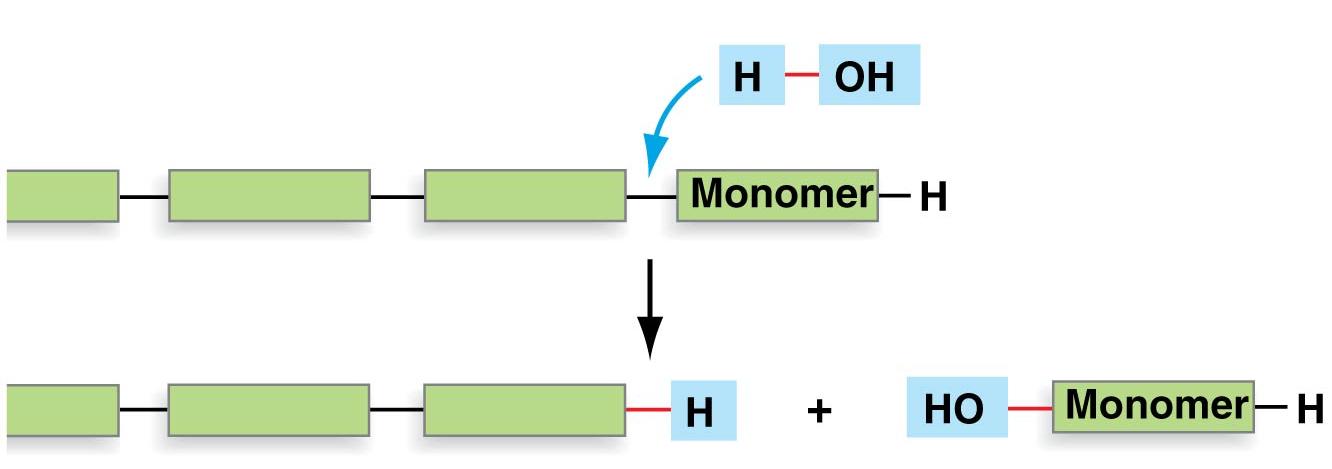
Hydrolysis
A chemical reaction that breaks polymers apart into monomers by adding a water molecule.
Amino Acid
A molecular building block of proteins consisting of a central carbon bonded to a hydrogen atom, an amino group, a carboxyl group, and a variable side chain (R-group).
Nonpolar Side Chains
Hydrophobic amino acid R-groups that lack charged or highly electronegative atoms, do not form hydrogen bonds, and coalesce in water.
Polar Side Chains
Hydrophilic amino acid R-groups containing partial charges that readily form hydrogen bonds and dissolve in water.
Peptide Bond
A covalent bond formed between the carboxyl group of one amino acid and the amino group of another during protein synthesis.

Polypeptide
A continuous chain of amino acids linked together by peptide bonds.
N-terminus
The starting end of a polypeptide chain that features a free amino group.
C-terminus
The trailing end of a polypeptide chain that features a free carboxyl group.
Primary Structure
The unique sequence of amino acids in a polypeptide, stabilized entirely by covalent peptide bonds.
Secondary Structure
Local structural folds, such as α-helices and β-pleated sheets, formed by hydrogen bonding between backbone amino and carbonyl groups.

Tertiary Structure
The overall three-dimensional shape of a single polypeptide, stabilized by interactions among R-groups or between R-groups and the peptide backbone.
Quaternary Structure
The complex protein shape produced by the assembly and interaction of two or more individual polypeptide subunits.
Denaturation
The unfolding of a protein caused by extreme temperature, pH changes, or chemical agents, resulting in loss of biological function.
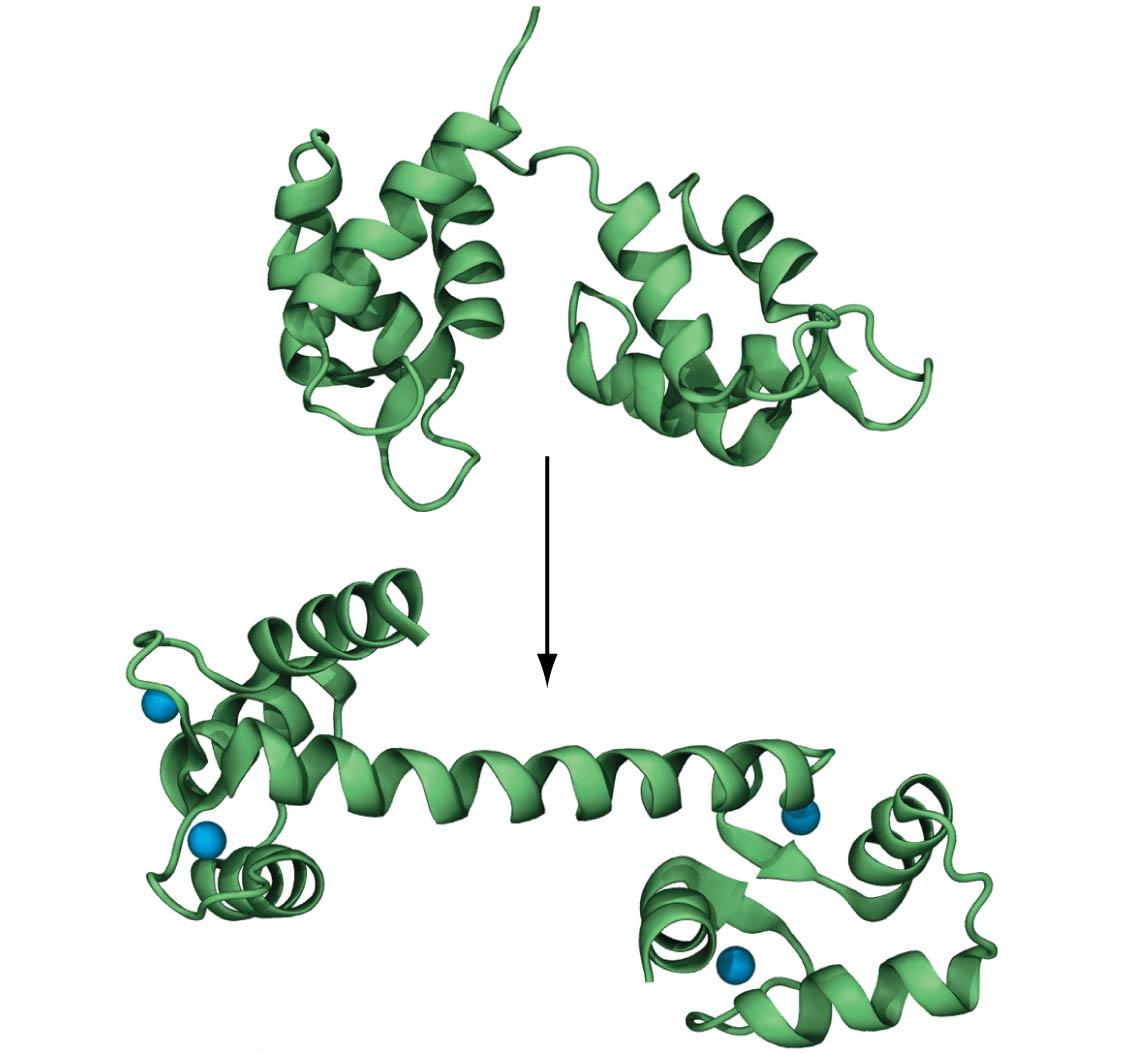
Calmodulin
A regulatory protein that transitions from a disordered, inactive shape to an ordered, active form upon binding calcium ions.