lecture 2 - neurons, glial, and the nervous system
 Call Kai
 Learn
Learn Practice Test
 Spaced Repetition
 Match
Match Flashcards
 Knowt Play
1/49

There's no tags or description
Looks like no tags are added yet.
Name | Mastery | Learn | Test | Matching | Spaced | Call with Kai | Chat |
|---|
No analytics yet
Send a link to your students to track their progress
50 Terms
central nervous system
brain and spinal cord
peripheral nervous system
neurons outside brain and spinal cord
can a single cell span both CNS and PNS?
yes (sensory neurons for example)
soma
somatic nervous system
(PNS) sensation and control of skeletal muscles
autonomic nervous systme
(PNS) “automatically” controls state of being
sympathetic division
(PNS - ANS) ACTIVATED - Arousal, fight or flight, energy expenditure, increased heart rate
parasympathetic nervous system
(PNS - ANS) - DEACTIVATED - relaxation, digestion, slow heart rate (rest and digest)
meninges
a series of protective layers that surround the brain and spinal cord
cerebrospinal fluid
a fluid that is found within the meninges layers, cushioning the brain inside the skull
dura mater
DURABLE - tough outer layer of the meninges
arachnoid mater
SPIDERWEBS - middle layer of the meninges containing cerebrospinal fluid and vasculature (blood vessels)
pia mater
tight and thin lower layer of the meninges that hug the brain and spinal cord
what word describes the presence of the cerebral blood supply?
redundant
how is blood supplied to the brain?
through internal carotid arteries and vertebral arteries
blood brain barriers
a special type of capillary, a layer of cells that surround the blood vessels in the brain - protects the brain from changing the content of the blood and from foreign substances while permitting other substances to enter.
what part of the blood brain barrier cells actually make the BBB to be important barriers?
the lipid bilayer that makes up the cell membrane, determining solubility and the entrance of specific substances
gray matter
neurons (the cell bodies)
white matter
the axons of neurons
nucleus (in CNS) and ganglion (in PNS)
a dense cluster of neurons
ventricles
fluid filled cavities where metabolic byproducts accumulate and drain into venous circulation
tracts
axon bundles in the CNS
nerves
axon bundles in PNS
cerebral cortex
most “evolved” portion of human brain
sensory, movement execution, planning, cognition, learning functions
cortex folds, increaisng nervous area (more neurons)
gyrus (p. gyri)
ridges in surface of cerebral cortex
sulcus (p. sulci)
valleys in surface of cerebral cortex
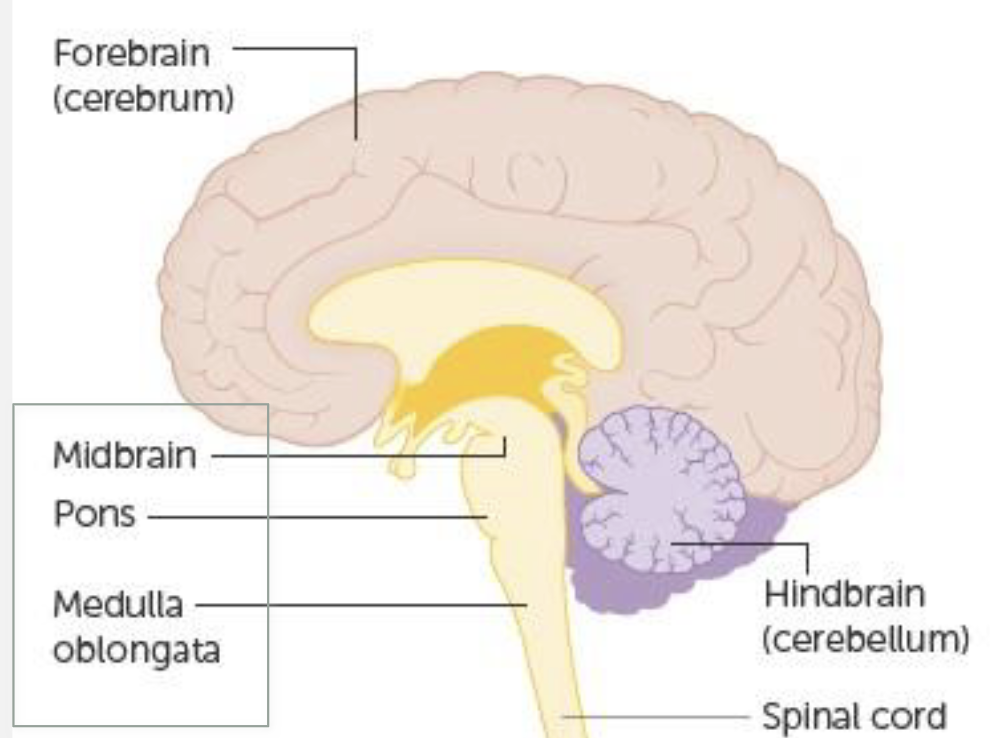
brainstem
continuous with the spinal cord, evolutionary “oldest” parts of brain, controls automaic and vital functions (respiration and heartrate)
Top to bottom parts = midbrain, pons, medulla oblongata

hindbrain/cerebellum
critical in regulation of fine movement, coordination, timing of movements, and postural control.
has its own cortex (cerebellum cortex) containing Purkinje cells, whose activity changes when we learn how to time and make movements
corpus callosum
connects the left and right hemispheres of the brain
thalamus
RELAY - interacts with the cortex, relaying/gating input and output signals/dynamics
hypothalamus
(below thalamus) - SURVIVAL - controls survival functions, like eating, drinking, body temperature, and fear
anatomical refrencing (medial, lateral, dorsal, ventral, anterior, posterior)

glial cells
support cells of nervous system, do not span great distances, not as much dynamic activity as neurons
nutrient transporting, neurotransmitter trafficking, myelination, responding to injury
myelination
insulation on actions, increasing speed of signal conduction
mac
macroglia
larger glial cells
astrocytes
macroglia involved with nutritive function, metabolism, neurotransmission, removes dead neurons
oligodenrocytes
macroglia that create myelin sheath on CNS axons
schwann cells
myelinate PNS axons
microglia
smaller glial cells that mobilized after injury, infection, or disease, helping to clean up
neurons
a polarized cell (voltage difference between extracellular fluid and intracellular fluid) that translate input signals, whether chemical, mechanical, radiant, etc. into electrical signals, processing the information
soma
neuron cell body, contains the cellular machinery/organelles
dendrites
the receiving end of the neuron, often many in number
axon
the sending end of the neuron, typically only one, but can be short or long in length
efferent neuron
carries information out
afferent neuron
brings information in
multipolar neuron
many dendrites (at least 2 major branches) and one axon, common in cortex
unipolar/monopolar neuron
axon branching in two directions, acts as dendrite + axon, common in peripheral sensory neurons
bipolar neuron
one dendrite and one axon, also common in sensory systems