Voice Disorder Anatomy Exam 1
 Call Kai
 Learn
Learn Practice Test
 Spaced Repetition
 Match
Match Flashcards
 Knowt Play
1/62

There's no tags or description
Looks like no tags are added yet.
Name | Mastery | Learn | Test | Matching | Spaced | Call with Kai | Chat |
|---|
No analytics yet
Send a link to your students to track their progress
63 Terms
What is the subsystem of voice and speech production?
Respiratory system
Name the two tracts in the respiratory system
Upper Respiratory system; Nasal cavity, pharynx and larynx
Lower Respiratory system: Trachea, Bronchi, Lungs
How does the respiratory system assist with voice production?
Air rises to the VF, pressure builds up and when the pressure reaches a certain level the VF opens up
How much H20 is needed for normal voicing?
4-6 cm
What is checking action and the relevance to speech production?
Allows to maintain constant airflow and pressure during speech by engaging inspiratory muscles and expanded ribs
What is the subglottic pressure (phonatory pressure) for normal voicing?
4-6 cm
Name the different parts of the laryngeal framework
Hyoid bone, epiglottis, thyroid cartilage, cricoid cartilage, thyroid cartilage, cricoid cartilage, arytenoid cartilage, corniculate cartilage, cuneiform cartilages
How does the crico-arytenoid (CA) muscle move?
rotate
How does the lateral crico-arytenoid (LCA) move?
rotates
How does the aryteniodues muscle move?
glides
How does the vocalis and the thyro-arytenoid muscles move?
rock
Which muscles adduct the vocal folds?
Lateral crico-arytenoid (LCA), Transverse and oblique arytenoid muscle (TA)
How does the Lateral crico-arytenoid (LCA), Transverse and oblique arytenoid muscle (TA) move?
Glide towards the midline
Which muscles abduct the vocal folds?
Posterior crico-arytenoid (PCA)
How does the PCA move?
Rotates out (separating the vocal folds)
Which muscles relaxes the vocal folds?
Thyro-Arytenoid muscle
Which muscles tense the vocal folds?
Crico thyromuscle and vocalis muscle
How does the cricothyroid muscle move?
lengths the vf by pulling thyroid cartilage down and forward
How does the arytenoid muscles move?
rotate, glide, rocks
List the instrinsic muscles
Lateral Cricoarytenoid (LCA), Inarytenoid (IAl; transverse and oblique arytenoid muscles), Posterior cricoarytenoid muscle (PCA), cricothyroid, thyroarytenoid,
List the extrinsic muscles
omohyoid, sternohyoid, diagastric belly, mylohyoid, stylohyoid, thyroid, sternothyroid muscle
List the Laryngeal elevators (extrinsic muscle)
Stylohyoid, mylohyoid, digastric belly (anterior and posterior), geniohyoid, hyoglossus
List the laryngeal depressors
sternothyriod muscle, sternohyoid, omohyoid, thyrohyoid
What oes the stylohyoid muslce do? (extrinsic laryngeal elevator)
pull hyoid bone up and back during swallowing (innervated by the VII CN)
What does the digastric belly do? (extrinsic laryngeal elevator)
pull hyoid up and back during swallowing (anterior innervated by the V CN and posterior innervated by the VII CN)
What does the geniohyoid muscle do? (extrinsic laryngeal elevator)
moves hyoid bone foward and upward
What does the the hyoglossus muscle do? (extrinsic laryngeal elevator)
Pulls up the hyoid bone and/or brings down the tongue
What does the sternohyoid muscle do? (extrinsic laryngeal depressor)
pulls hyoid bone down
What does the sternothyroid muscle do? (extrinsic laryngeal depressor)
pulls down the thyroid cartilage
What does the omohyoid muscle do? (extrinsic laryngeal depressor)
Pulls down hyoid bone
What does the thyrohyoid muscle do? (extrinsic laryngeal depressor)
shortens the distance between the hyoid and thyroid
Name the three layer schele (tissue type) of the VF
Mucosa, Ligament, Muscle
Name the five layer scheme (histological) of the VF
Epithelium, Superfacial layer of LP, Intermediate layer or LP, Deep layer of LP, and Thyroarytenoid muscle
Name the three scheme (functional) of the VF
Cover, transition, body
What are the mechanical properties of the VF
Epithelium: thin and stiff
Superfacial layer of LP: Loose like a mass of soft gelatin
Intermediate layer of LP: Elastic like a bundle of soft rubber bands
Deep later of LP: Fibrous like a bundle of cotton threads
Thyrovocalis muscle: Like a bundle of stiff rubber bands
What type of epithelium is the TVF made of?
Stratified squamous epithelium
What do they mean by “passive” or “active” tissue in the cover-body theory?
Cover: passive tissue, pliable and crucial for voice quality
Body: active tissue, stiffer, thyrovocalis main mass of VF
What is the bernouli effect in voice production
VF are drawn together because of negative pressure
What two therories did be dicuss in terms of voice production and which one is debunked and corrct
Neurochronaxic (INVALID)
Myoelastic-aerodynamic (TRUE)
Explain the cycle of the VF vibration
VF are adducted
Subglottic pressure rises
Inferior/caudal part of vocal
folds begins to open
Superior/cranial part of vocal
folds opens
“Puff” of air is emitted
As the air goes
through narrow glottis,
velocity of air increases
and pressure decreases.
(Bernoulli effect) This
decrease in the pressure
and tissue elasticity bring
inferior part of the vocal
folds together
Superior part of the
vocal fold closes.
What is the source filter theory?
The supraglottic vocal tract serves as a acoustic filter that suppresses or enhances sound energy at certain frequencies.
How do we control pitch?
Fundamental frequency (f0) of voice is determined by; stiffness, mass and length of the VF
Larngeal Innervation
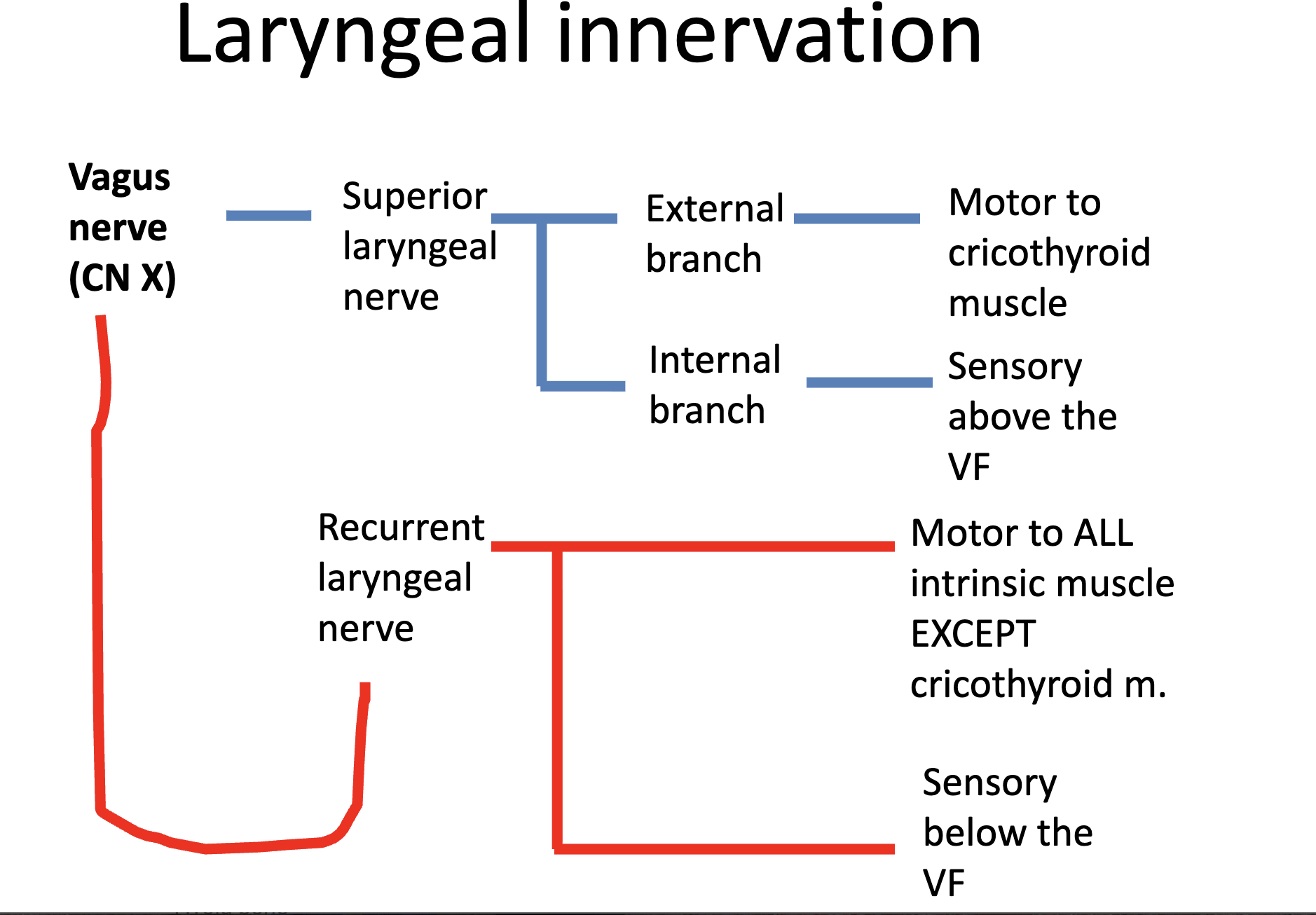
Explain the RNL
The recurrent laryngeal
nerve (RLN) takes a
different path on the
right and left sides
• R: Goes around right
subclavian artery
• L: Goes around aortic
arch
• L RLN longer than R RLN
Explain the SLN
• Internal branch:
Sensory above the
vocal folds
• External branch:
Motor to
cricothyroid muscle
Which CN innervates the larynx?
CN X
What is the space above the true vocal folds called?
Supraglottis
What is the space below the true vocal folds called?
subglottis
Bernoulli’s principle
In fluid flow, an increase in velocity occurs
simultaneously with decrease in pressure


Name muscle and action
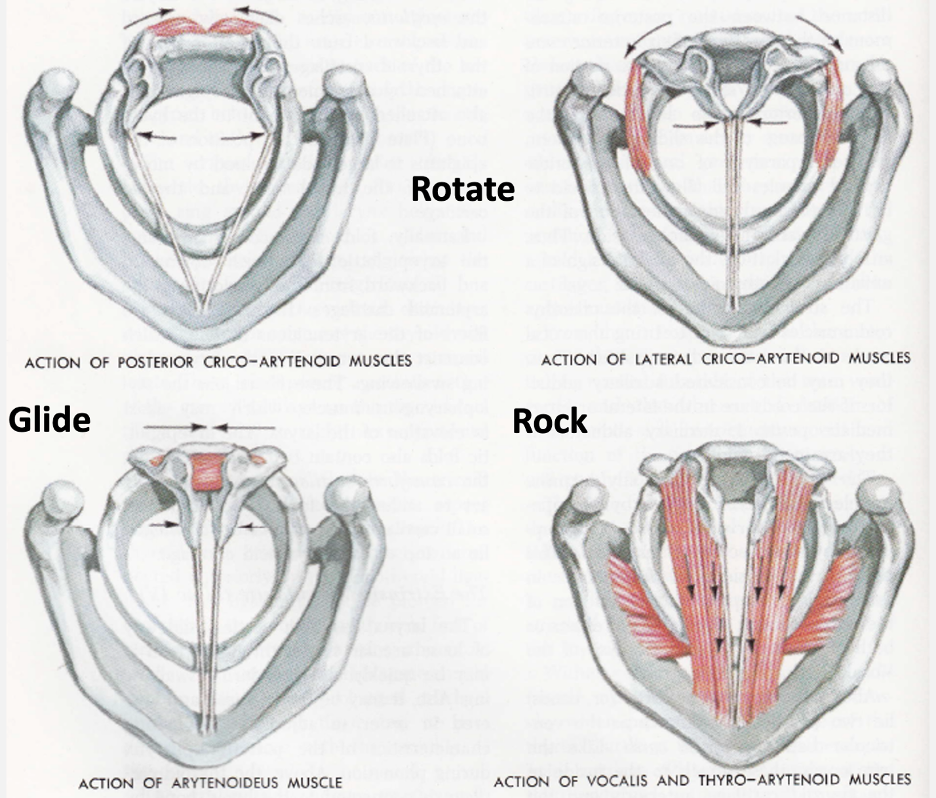
Name muscle and action

What bone is this>
Label each part
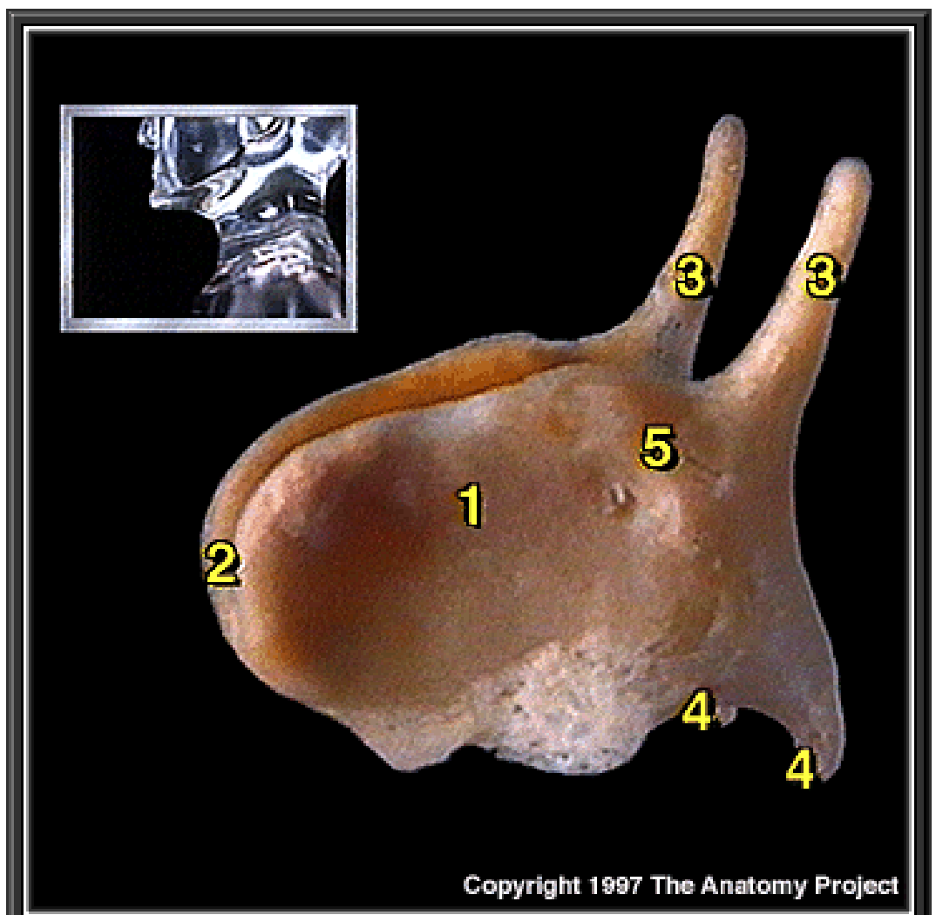
What is this?
Can you ID each of the number

Label each part
Label each part

Label each part
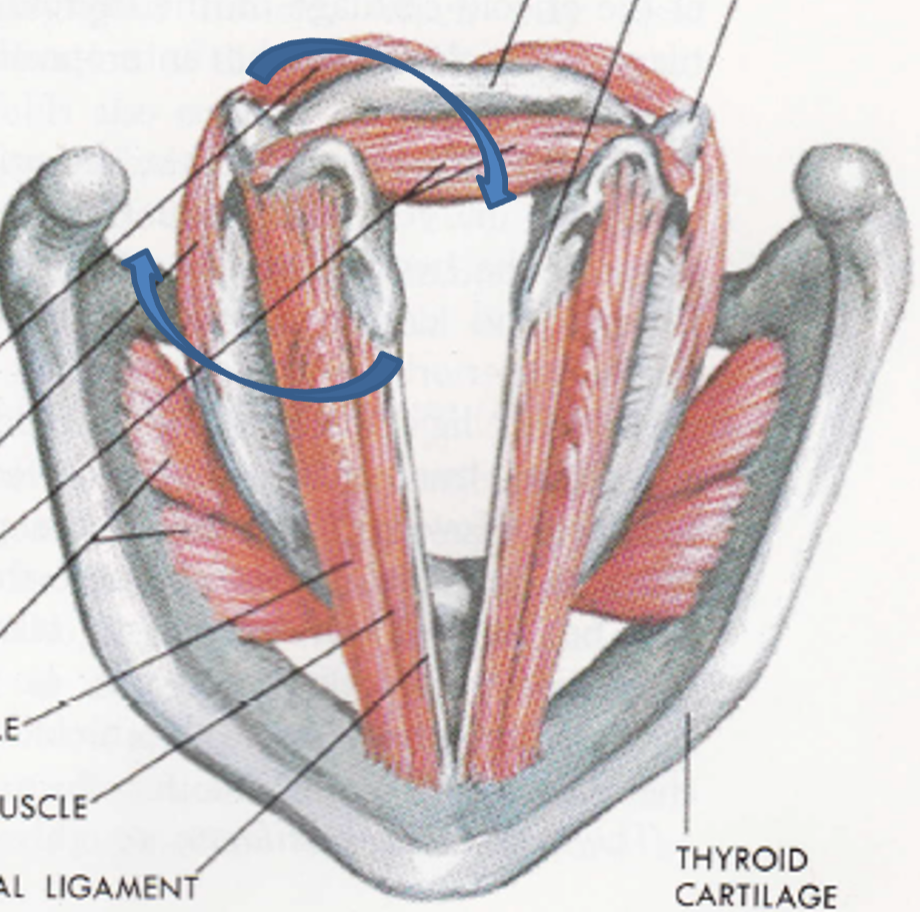
Locate each of the muscles in this picture
Label each part

Locate the IA and PCA
Label each part

Locate muscles and name
Label each part

Where is the styloglossus
Label each part
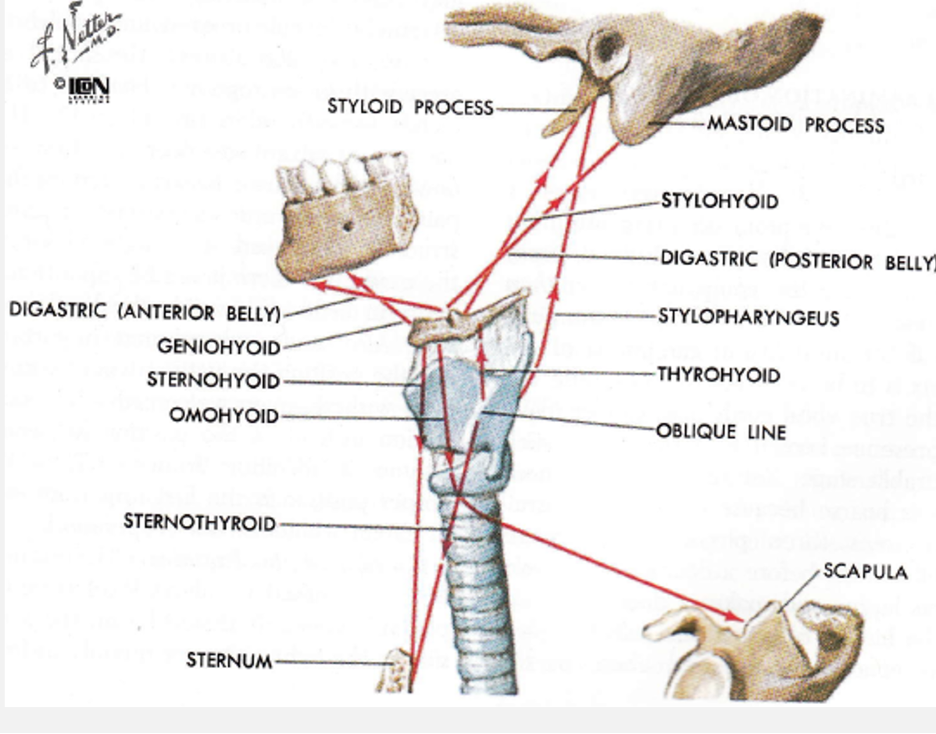
Label each part
Which muscle rocks the VF?
Thyro-arytenoid and thyrovocalis (vocalis)
Which muscles rotate the VF?
LCA and PCA
Which muscles glides?
IA - transverse and oblique cricoarytenoids (arytenoidieus)