Chapter 10 | FIN 3050
 Call Kai
 Learn
Learn Practice Test
 Spaced Repetition
 Match
Match Flashcards
 Knowt Play
1/64

There's no tags or description
Looks like no tags are added yet.
Name | Mastery | Learn | Test | Matching | Spaced | Call with Kai | Chat |
|---|
No analytics yet
Send a link to your students to track their progress
65 Terms
What is the primary risk associated with bonds?
Bonds can be just as risky as stocks.
What are the main components of a bond's cash flow?
Fixed coupon payments and face value at maturity.

What is the face value of a bond?
The amount paid at maturity, typically $1,000.
What is a coupon in the context of bonds?
Interest payment based on face value and stated coupon rate, usually paid semiannually.
Define Yield To Maturity (YTM).
The rate investors demand, used to discount cash flows.
How do bond prices and yields behave in relation to each other?
Bond prices and yields move in opposite directions.
What is the formula for calculating bond price?
Price = PV of coupons + PV of par, discounted at the market YTM.

What is a par bond?
A bond that sells at its face value when the coupon rate equals the market yield.
What characterizes a premium bond?
A bond that sells for more than its face value when the coupon rate is greater than the market yield.
What characterizes a discount bond?
A bond that sells for less than its face value when the coupon rate is less than the market yield.
What happens to premium bonds over time?
Premium bonds lose value over time as they converge to par.
What happens to discount bonds over time?
Discount bonds gain value over time as they converge to par.
What is the relationship between coupon rate and market yield for a premium bond?
For a premium bond, the coupon rate is greater than the market yield.
What is the relationship between coupon rate and market yield for a discount bond?
For a discount bond, the coupon rate is less than the market yield.
What is duration in bond valuation?
Duration measures interest-rate sensitivity of a bond.
What is the purpose of duration matching?
To help manage future cash-flow risk.
What is the calculation for bond price using a financial calculator?
Input face value, coupon payment, yield to maturity, and years to maturity.
How do you calculate Yield to Maturity (YTM)?
Solve for YTM that produces the current bond price using the bond formula.
What is the significance of a flat yield curve in bond valuation?
It assumes all cash flows will be reinvested at the same yield.
What is the effect of coupon frequency on bond valuation?
Semiannual coupons require valuation in six-month periods.
What does a quoted YTM represent?
Quoted YTM is annualized with semiannual compounding.
What is the formula for calculating present value of future cash flows?
PV = C / (1 + YTM/2)^(2M) + FV / (1 + YTM/2)^(2M).
What is the impact of time on bond prices as maturity approaches?
Prices converge to par as maturity nears.
What is Yield to Maturity (YTM)?
YTM is the discount rate that sets the net present value (NPV) of a bond's cash flows to zero.
How can YTM be calculated using a financial calculator?
By inputting cash flows into the calculator and solving for the Internal Rate of Return (IRR).
What cash flows are involved in calculating YTM?
The initial investment (CF0), periodic coupon payments (CF1, CF2, etc.), and the face value at maturity (CFn).
What is the formula for calculating Yield to Call (YTC)?
YTC = (C + (CP - Price) / T) / ((CP + Price) / 2), where C is the annual coupon, CP is the call price, and T is the time to the earliest call.
What is the difference between Clean Price and Dirty Price of a bond?
Clean Price excludes accrued interest, while Dirty Price includes accrued interest.

What happens to bond prices when YTM rises?
Bond prices decrease when YTM rises.
What is the relationship between coupon rates and bond prices?
Higher coupon rates generally lead to higher bond prices, while lower coupon rates lead to lower bond prices.
What is Macaulay Duration?
Macaulay Duration is the present-value-weighted average time to receive a bond's cash flows.

How does maturity affect a bond's duration?
Longer maturity typically results in higher duration, indicating greater sensitivity to interest rate changes.
What is the significance of a bond's price converging toward par?
As a bond approaches maturity, its price will converge toward its par value.
What is the impact of interest rate risk on bond prices?
Longer bonds are more sensitive to interest rate changes, leading to greater price fluctuations.
What does a higher duration indicate about a bond's risk?
A higher duration indicates greater price volatility and sensitivity to interest rate changes.
What is the purpose of calculating YTM?
To determine the return on a bond if held to maturity, especially when market price is known.
How does a callable bond differ in pricing from a non-callable bond?
Callable bonds may have different yield measures, as they can be redeemed by the issuer before maturity.
What is the effect of coupon rate on bond price sensitivity?
Lower-coupon bonds are generally more sensitive to yield changes than higher-coupon bonds.
What is the formula for calculating YTM when a bond is priced at a discount?
YTM > Coupon Rate when the bond is priced below par.
What is the formula for calculating YTM when a bond is priced at a premium?
YTM < Coupon Rate when the bond is priced above par.
What does the term 'accrued interest' refer to?
Accrued interest is the interest earned on a bond since the last coupon payment, which must be compensated to the seller.
What is the significance of the IRR in bond calculations?
IRR is used to determine the yield of a bond based on its cash flows.
What does YTM tell an investor?
YTM provides the expected annual return if the bond is held until maturity.
What is the impact of a bond's coupon rate on its current yield?
Current yield increases as the coupon rate increases, assuming market value remains constant.
What is the relationship between bond prices and market interest rates?
Bond prices move inversely to market interest rates; as rates rise, prices fall and vice versa.
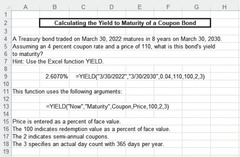
What is the role of Excel in calculating bond yields?
Excel can simplify yield calculations using built-in functions like YIELD, avoiding complex trial-and-error methods.
How do you calculate the percentage change in bond price when YTM increases?
Use the formula: %∆ in Bond Price ≈ − Duration × (New YTM - Old YTM) / (1 + Old YTM)
What is Modified Duration?
Modified Duration is a variation of Macaulay Duration that measures price sensitivity to yield changes.
What does a Modified Duration of 8.05 indicate?
It indicates that for a 1% increase in YTM, the bond price is expected to drop by approximately 8.05%.
What is the significance of the starting YTM in the price change formula?
The starting YTM appears in the denominator, affecting the magnitude of the price change estimate.
What is the formula for calculating Macaulay Duration for a bond at par?
Duration = (1 + YTM/2) / (YTM + CPR) - 1 / 2
What is the relationship between bond prices and yields?
Bond prices and yields move in opposite directions; as yields rise, bond prices fall and vice versa.
What is convexity in bond pricing?
Convexity describes the curvature in the bond price-yield relationship, indicating that price gains from yield drops are larger than price losses from equal yield rises.
What is a dedicated portfolio in bond investing?
A dedicated portfolio is designed to fund a known future cash payment, such as pension benefits or insurance obligations.
What are the two main risks in bond portfolio planning?
Price Risk (yields rise → bond prices fall) and Reinvestment Risk (coupon payments reinvested at uncertain future rates).

What is dynamic immunization?
Dynamic immunization involves periodic rebalancing of a dedicated portfolio to keep its duration aligned with the target date.

What happens to bond prices when interest rates rise?
Bond prices decrease when interest rates rise due to the inverse relationship between price and yield.
What happens to bond prices when interest rates fall?
Bond prices increase when interest rates fall, as the present value of future cash flows becomes higher.
What is the target date in a dedicated portfolio?
The target date is the date when the cash payment is due, guiding investment decisions.
What is the effect of coupon reinvestment rates on bond portfolios?
If future rates are lower than expected, reinvestment of coupon payments can hurt overall returns.
What is the impact of a bond's cash flows on its valuation?
A bond's cash flows, including coupon payments and face value, directly affect its valuation.
What are the components of a bond's cash flows?
Coupon payments and the face value (principal) at maturity.
How do semiannual coupon payments affect bond valuation?
They require adjustments in the calculation of yield and duration, impacting the bond's price sensitivity.
What is the difference between par, premium, and discount bonds?
Par bonds are sold at face value, premium bonds above face value, and discount bonds below face value.
What does it mean if a bond has a Macaulay Duration of 10.05 years?
It means the average time until cash flows are received is 10.05 years.