Cell Physiology - Midterm ONE
 Call Kai
 Learn
Learn Practice Test
 Spaced Repetition
 Match
Match Flashcards
 Knowt Play
1/84

Earn XP
Description and Tags
BIOLOGY 3P03
Name | Mastery | Learn | Test | Matching | Spaced | Call with Kai | Chat |
|---|
No analytics yet
Send a link to your students to track their progress
85 Terms
Nerves and muscles coordinate ______ and are easily _______.
locomotion, excitable
Why understand cell physiology?
Any interruption of homeostasis at the cellular level affects tissues, organs and our entire systemic make-up.

What do membranes facilitate?
The exchange of material.
What can pass through the simple cell membrane?

Selectively permeable
lets some particles pass through, while not others
How does a cell deal with being selectively permeable? Especially given that a cell’s membrane contains many other components…(eg. Cholesterol)
combining a basic physical barrier (the lipid bilayer) with specialized helper structures, like proteins and cholesterol, that actively manage what goes in and out
Fluid mosaic model
Contains important proteins: receptors, enzymes, cell adhesion molecules, identification molecules; and other molecules (eg. Cholesterol)
How does the cell membrane control permeability?
Carriers: to transfer larger, water-soluble molecules across the membrane
Channels: to transfer small, water-soluble ions across the membrane
Carriers VS Channel proteins (image)

Requirements for diffusion?
Concentration gradient
Random motions of molecules - BROWNIAN motion
Diffusion
The random movement of molecules between two regions with different concentrations
Movement from a region of high concentration to a region of low concentration
Simple Diffusion
A molecule can move through a cell membrane
When will net diffusion be fastest across a cell membrane?
when the difference in the number of molecules between the inside and outside of the cell is large
Flux (J)
The number do molecules passing through a certain cross-sectional area in a certain period of time
Formula for net diffusion
Δ C/Δ x (change in concentration, over distance x)
Fick’s Law of Diffusion (Flux formula)
J= [- D (Δ C)]/(Δ x)
Where D= diffusion coefficient and can include –ve sign to denote diffusion
always occurs DOWN a concentration gradient
Factors to consider for rate of net diffusion & effect on rate
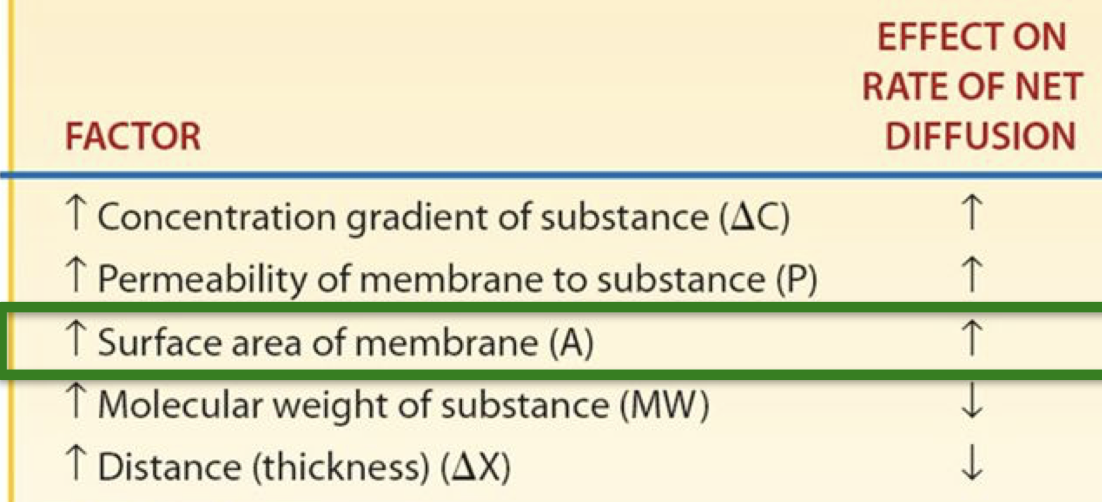
Formula for the diffusion of a gas across a sheet of tissues
J= [D(A)(Pout - Pin)]/x
Pulmonologists use a variation of Fick’s law where…
J= [D(A)(Pout - Pin)]/x
Is rewritten as
J= diffusion capacity x (Pout-Pin )
FAcilitated diffusion
A molecule is transported through the cell membrane by a channel or carrier protein that is embedded in the membrane
Three important properties of ion channels:
They conduct ions across the membrane
They recognize and select specific ions
They open and close in response to mechanical, electrical or chemical signals
Ionic movements during an action potential

Stimuli by which various ion chanels open
electrical
temperature
pH
stretch
ligands
Some biophysical properties of ion chanels
open and close quickly
open quickly but close slowly
open slowly and remain open
only enable ion movement in one direction
remain open all the time
Large macromolecular transmembrane proteins with many hydrophobic, membrane-spanning domains can be:
hetero-oligomers of different protein subunits
homo-oligomers of one type of subunit
a single polypeptide chain organized into repeating transmembrane domains/motifs (here, each motif act as the equivalent of one subunit)
Some channels have auxiliary subunits that help with the gating of the pore
Conformational changes
Ion channel gating involves a likely coordinated twisting and bending of the alpha helices of that channel (also provides more hydrophilic surface area in the pore for the ions to interact with)
Ions are conducted through aqueous ion channels
Ions interact with water due to the dipolar nature of water molecules
Oxygen atom tends to attract electrons; bears a slight net negative charge
Hydrogen atoms tend to lose electrons; bear a slight net positive charge
Selective passage
Ion channels are selective passages
So cations (+ charged ions) are attracted to the oxygen of water, while anions (- charged ions) are attracted to hydrogen
This hydration cloud around an ion ALSO makes it very unlikely that an ion can cross the hydrophobic lipid bilayer (that would require a LARGE amount of energy)
Channel has aqueous pore that allows ions to cross the membrane through facilitated diffusion (down a concentration gradient)
Water-filled ion channels have a selective filter that weakly binds the transported ion (for less than 1μs), which together with pore diameter, & electrostatic and diffusion forces, enable selective passage of ions
P-loops
form inner and outer helices of each subunit to make up the selectivity filter in the narowerst part of the poor in the ion channel
Types of ion channels
Resting channel (leak chanel)
Voltage gated channel
Ligand gated channel
signal-gated chanel
How can we measure current through a single ion channel?
channels open and close in an all-or-none fashion
When channels are opened, this results in a brief passage of ions
This results in measured current of ions through the ion channel
Current is measured in picoamperes (pA); characteristically a few pA
Gigaseal
a tight seal between a cell and a glass pipette that has high electrical resistance (1 gigaohm)
All ions that flow through channel, flow into pipette
seal resistance > 10 gigaohms GΩ [giga = 109]; the higher the seal resistance the lower the background noise!
Gigaseal procedure
bring the tip of a clean glass pipette (tip size ~1um) to the surface of a ‘clean’ single cell (extracellular matrix, etc. removed after enzymatic digestion of tissue and mechanical dissociation so as to obtain single cells)
Apply suction - very tight seal forms between pipette glass and cell membrane
Recording current through single ion channels in muscle
Patch clamp pipette is filled with acetylcholine-containing saline
Current is measured through the single channel
Can use this technique to study activity of all major classes of ion channels (eg: leak, voltage-gated, ligand-gated, mechanically-gated) in many cell types
1 ampere
1 coloumb/second
Charge of a monovalent cation
1.6 × 10^-19 coloumb
pico (p)
x 10 ^ -12
Calculating ion transport through a single ion channel
coloumb/second x ion/coulomb(which is the charge)
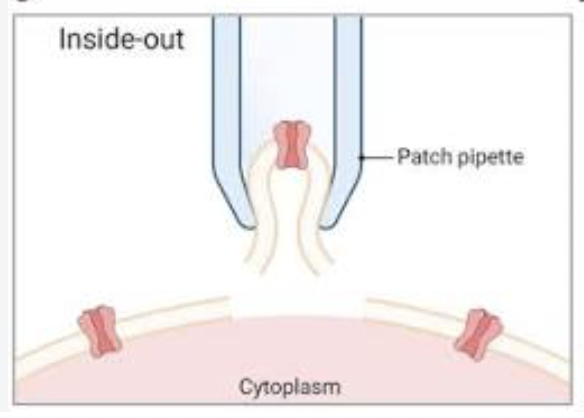
Inside out patch clamp
The electrode is quickly withdrawn from the cell (in cell- attached configuration), leaving the patch of membrane attached to the electrode
This exposes inside surface of the membrane to the external solution- useful for studying factors affecting the inside “cytoplasmic” surface of the channel
For example: test effects of intracellular factors that control membrane channel activity
Outside out patch clamp
The electrode is slowly withdrawn from the cell (in whole-cell mode), allowing a piece of membrane to ‘bleb out’ from the cell
Here, outside surface of membrane patch faces external solution
Useful in studies of ligand-gated ion channels since ligand can be applied to the bathing solution, and bind to receptor/channel on outside

Coordinated channels during an action potential
The gates of both voltage-gated channels are closed when the membrane is hyperpolarized
Depolarization activates voltage sensors (+) and allows channels to open (Na+ first, then K+)
Na+ channels inactivate during depolarization but many types of K+ channels do not
Pumps
Some are powered by ATP (ATPase pumps), some use the electrochemical gradients of co-transported ions as a source of energy
Transporters
move ions across the membrane more slowly compared to ion channels
Why do pumps and transporters require energy?
Because they are moving molecules against [ ] gradients.
Channelopathies, eg. hyperkalemic periodic paralysis
Patients with hyperkalemic periodic paralysis have mutations that alter the normal function of their voltage-gated sodium channels
As a result, are not able to close the inactivation gates
This misregulation is usually triggered by high serum K+ levels and results in periodic muscle paralysis (due to inexcitability of muscle cells)
Why are Na⁺, K⁺, and Cl⁻ important for excitable cells?
They exist at different concentrations on the two sides of the cell membrane. This difference contributes to a difference in electrical voltage across the membrane, called the membrane potential (Vₘ)
What is membrane potential (Vₘ)?
The difference in electrical voltage across the cell membrane.
How do ions move across the membrane when an excitable cell is at rest?
Through leak ion channels and transporters.
What does the sodium-potassium pump transport?
3 Na⁺ moved out and 2 K⁺ moved in.
What is the resting membrane potential?
The difference in voltage across the membrane of an excitable cell when it is at rest. It results from differences in ion concentrations across the membrane.
What mostly determines the resting membrane potential?
K⁺ leak
Why does K⁺ mostly determine the resting membrane potential?
At rest, excitable-cell membranes are mostly permeable to K⁺ because K⁺ leak channels are the most abundant open ion channels
What is the role of the Na⁺/K⁺ pump in the resting membrane potential?
The K⁺ leak channels mostly determine the resting membrane potential, while the Na⁺/K⁺ pump maintains the ion gradients/potential
What two forces act on ions across a cell membrane?
Chemical forces and electrical forces
What is the chemical gradient?
The tendency of an ion to move because of a difference in its concentration across the membrane
What is the electrical gradient?
The tendency of a charged ion to move because of electrical charge differences across the membrane.
What determines the net direction of ion movement?
The sum of the chemical and electrical forces acting on the ion.
What is an electrochemical gradient?
The combined effect of the chemical gradient + electrical gradient acting on an ion.
What is the ultimate goal of an ion moving across a membrane?
The ion tends toward reaching its equilibrium potential
What is an ion's equilibrium potential (Eᵢₒₙ)?
The membrane potential at which the electrical gradient exactly balances the chemical gradient, resulting in no net movement of that ion
At equilibrium potential, does the ion stop moving completely?
The important point from the lecture is that there is NO NET movement of the ion because the electrical and chemical forces balance each other
What does it mean if the chemical and electrical gradients are balanced?
Neither force has a net advantage, so there is no net movement of that ion.
Can we calculate the equilibrium potential of an ion?
Yes — using the Nernst equation
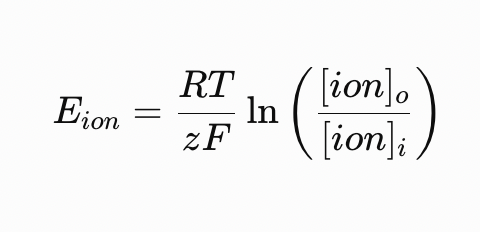
What is the full Nernst equation
R = gas constant
T = temperature in Kelvin
z = valence of the ion
F = Faraday's constant
What is R in the Nernst equation?
The gas constant:
R=8.314J/mol
What is T in the Nernst equation?
Temperature in Kelvin.
Convert Celsius to Kelvin:
T= C+273
What is z in the Nernst equation?
The valence/charge of the ion.
Na⁺ → z = +1
K⁺ → z = +1
Cl⁻ → z = −1
What is F in the Nernst equation?
Faraday's constant, representing the charge of one mole of electrons:
F=96,485C/mol
Why do we use a simplified Nernst equation?
The full equation can be simplified using constants and a temperature assumption, making it much easier to calculate equilibrium potentials.
What simplification does the lecture give for RT/F at 25°C?
FRT=25mV
at 25°C
How do you convert the natural logarithm (ln) to a base-10 logarithm?
Multiply by approximately 2.3
What simplified Nernst equation does the lecture give?
Eion=58mVlog(z[ion]o[ion]i)
What is the equilibrium potential for Na⁺ in the example cell?
ENa=+57mV
Why is Eₙₐ positive in this example?
The Nernst calculation gives a positive equilibrium potential, meaning the electrical potential required to balance Na⁺'s chemical gradient is positive. The lecture's calculated value is +57 mV
What is the equilibrium potential for K⁺ in the example cell?
EK=−91mV
Why is Eₖ negative?
The Nernst calculation gives a negative equilibrium potential for K⁺. The lecture's calculated value is −91 mV
What does Eₙₐ = +57 mV mean?
At approximately +57 mV, the electrical and chemical forces on Na⁺ balance, producing no net Na⁺ movement
What does Eₖ = −91 mV mean?
At approximately −91 mV, the electrical and chemical forces on K⁺ balance, producing no net K⁺ movement
Why can different ions have different equilibrium potentials?
Each ion has a different concentration distribution across the membrane, so each ion has a different electrochemical gradient and therefore a different equilibrium potential
What is the relationship between membrane potential and equilibrium potential?
An ion's equilibrium potential is the membrane voltage at which the chemical and electrical gradients for that specific ion balance, resulting in no net movement
Why are equilibrium potentials important for excitable cells?
They help us understand what happens to ions when excitable cells are excited.