NEW Crime & Punishment (copy)
 Call Kai
 Learn
Learn Practice Test
 Spaced Repetition
 Match
Match Flashcards
 Knowt Play
1/197

There's no tags or description
Looks like no tags are added yet.
Name | Mastery | Learn | Test | Matching | Spaced | Call with Kai | Chat |
|---|
No analytics yet
Send a link to your students to track their progress
198 Terms
When were the Middle Ages?
c.1000-1500
When was the Early Modern Period?
c.1500-1700
When was the Industrial Period?
c.1700-1900
When was the Twentieth Century?
c.1900-2000
What are the 8 factors?
Wealth and poverty
Attitudes/beliefs/values
Church and religion
Government and lawmakers
Individuals
Urbanisation
The media
Travel and technology
Give an example of 2 famous families that ruled during the Early Modern Period
Tudors, Stuarts
What were the categories of crime in Anglo-Saxon England?
Crimes against the person: physical harm to another person
Crimes against property: taking or damaging something that belongs to another person e.g. theft & arson, poaching,
Poaching was considered a social crime and many villages did not punish people who did it.
Moral crimes: adultery, not sticking to the rules and customs of the Church
Crimes against authority: treason or rebelling against the King or nobility
What is a social crime?
An illegal act that people within society do not see as a crime.
When was Anglo-Saxon England?
c. 500AD -1066 - until the Norman Conquest/ Battle of Hastings
What were the Saxon methods of crime prevention?
blood feud: If someone was murdered, the family had the right to track down and kill the murderer - it became a cycle of violence
tithings: All males over the age of twelve had to belong to a tithing. Anglo-Saxon England was made up of shires
Each shire was divided into hundreds
Each hundred was divided into ten tithings
Members of each tithing monitored each other
If one tithing member broke the law, the others would be responsible for either
Taking them to court
Paying a fine
Tithings was an effective self-help system designed to
Prevent crime
Emphasise collective responsibility
hue and cry: If the victim of a crime, raised ‘the hue and cry’ by calling out for help, the entire village had to down tools and join in the hunt to find the criminal. If they didn’t the whole village had to pay a hefty fine given by the local manor court. This made the chances of being caught much higher.
trial by jury: If someone was accused of a crime, the local village would decide if the accused was guilty or innocent with a jury made up of men from the village, who knew both the accuser and the accused
in a trial by jury: oaths were taken before God, and often played a major role in administering justice. When juries could not reach a verdict, the decision was handed over to God through trial by ordeal. Both types of trials reflected the highly Christian nature of Anglo-Saxon society.
trial by ordeal: letting God decide:
trial by hot iron: accused had to carry a piece of red hot iron for three metres. if the wound healed cleanly God had found her innocent
trial by hot water: accused put his hand into boiling water to pick up an object, if the wound healed cleanly God had found him innocent
trial by cold water: if the person sank, they were innocent
trial by ‘blessed bread’: taken by priests, if he choked on the bread he was guilty.
Wergild: a system of fines, paid to the victim of crime in the form of compensation
execution: for serious crimes such as treason against the king and betraying your lord
mutilation: Punishment for regular offenders
prisons: only used for holding the accused before trial
Anglo-Saxon community
Communities were small and tight-knit
Everyone knew everyone else, which meant that
People were expected to look out for each other
Most people had a strong sense of duty towards their community
If an individual committed a crime, they let down their whole community
The crime rate was fairly low
Anglo-Saxons & Religion
Anglo-Saxons were also devout Christians
They firmly believed in an eternal afterlife
The Church offered ways to help people go to heaven and avoid hell
Every village had a priest
Everyone was expected to attend church and live by its rules
The Church became more influential in law enforcement under the Normans
The beliefs and structure of Anglo-Saxon society impacted how the law was enforced
Norman Crime Prevention methods that were changes
In 1066, William I became the first Norman king of England
He faced opposition from many Anglo-Saxons
Law enforcement therefore became an important priority
William destroyed people’s homes to make way for new castles. Many Saxons suffered. Some Saxons became angry with their Norman conquerors and fought back, sometimes killing Norman soldiers. William ordered that if any Norman was murdered all the people of the region had to join together to pay a hefty fine. It was called the Murdrum fine.
The Normans introduced another form of trial by ordeal, trial by combat. The accused fought the accuser until one was beaten or killed. God had decided that the loser was guilty and then he was hanged.
William used fines for lesser crimes. He ordered that fines should be paid to the king’s officials instead of to the victims as compensation.
William introduced new laws. He introduced the hated Forest Laws. Trees could not be cut down for fuel or for building. People in the forests were forbidden to own dogs or bows and arrows. The punishment for hunting deer was to be blinded.
They changed the language of the legal system
Laws were written and court procedures were held in Norman French
Court records were kept in Latin
This disadvantaged most Anglo-Saxons, who understood neither language
Occasionally, whole areas rebelled against the Normans. William dealt with them harshly. In 1069 the people of York rebelled. William sent his army to devastate the area. Thousands of innocent people were murdered along with the rebels. Corpses lay rotting in the streets, villages and fields of crops were burnt down.
The Normans also established new courts:
Manor courts
Introduced after the feudal system came to England
The courts met to discuss and punish crimes that occurred on the lord of the manor’s land
Church courts
Used to try members of the Church who were accused of crimes
Dealt more lenient punishments than in other courts
Did not use capital punishment
Norman Crime Prevention methods that were continuities
William was eager to keep the laws that were effective the same. He therefore kept Saxon trial by jury, tithings and the hue and cry.
The Normans kept the religious ritual of Saxon trial by Ordeal.
William used the death penalty for serious crimes.
What happened to fines under William the Conqueror?
Now paid to the king (rather than the individual).
Later Middle Ages
1200-1500
Explain one way in which law enforcement in the Norman era was different from law enforcement in the later medieval era
In the Norman era, trial by ordeal was still used when juries could not reach a verdict . Whereas, in the later medieval era, trial by ordeal stopped being used after 1215 because Pope Innocent III abolished it .
Continuity in later medieval law enforcement | Change in later medieval law enforcement |
|---|
Continuity in later medieval law enforcement | Change in later medieval law enforcement |
|---|---|
The hue and cry system was still used | From 1285, the sheriff could form a posse to help whenever the hue and cry system failed |
Tithings remained in place | Some towns also had a night watch |
Trial by jury, combat and ordeal were still used | In 1215, Pope Innocent III abolished trial by ordeal |
Later medieval kings created some new positions of authority in law enforcement
Coroners
Formally appointed by Richard I in 1194
Tasked with investigating deaths that lacked obvious or natural explanations (such as illness)
Keepers
Knights appointed by Richard I from 1195
Tasked with helping to keep the peace in some ‘unruly’ areas
Developed into Justices of the Peace (JPs) by Edward III in 1327
The role expanded when the Justices of the Peace Act was passed in 1361
For example, JPs were now allowed to preside over local courts
Parish constables
Introduced by Edward I in 1285
Responsible for keeping the peace in their parish
Men in the parish volunteered to do this role in their spare time
Held the post for one year
How did Henry II change law enforcement?
became king in 1154
reorganised the courts and set up prisons for those waiting for trial - Assize of Clarendon
ordered Justices in Eyre to hear the most serious criminal cases
this increased the role of the king in legal matters
issued standard written instructions to local sheriffs: the whole system was becoming more uniform across the country
Change & continuity in law enforcement in the 13th & 14th centuries
growth of towns like London = more opportunity for crime
Shift away from local communities dealing with crime- a more centralised approach was needed.
Government appointed officials started dealing more with crime.
however…
Older approaches remained in use too.
Townspeople were still expected to play their part in apprehending offenders, and towns were divided into areas called wards for that reason.
New laws in the later middle ages: change & continuity
Black death meant less workers available - about 1/3 of the population died, so peasants started demanding more money for their work, worrying the wealthy landowners.
1351: Statute of Labourers law passed, which introduced a max wage for workers & made it a crime to ask for higher wages
change: Role of parliament in law-making was growing.
continuity: in the Norman period the ruling class also introduced laws to protect their own interests e.g. the Forest Laws
Justices of the Peace
1327: All men judged to be ‘good and lawful’ by the King became JPs- they met x4/year to carry out magistrate duties and enforce the law.
CHANGE: Increased central authority of the King and government power base.
Normans ___________ the Saxon wergild. Fines were now ____________________________
The use of ________________________ also rose dramatically. The Normans frequently carried out such harsh punishments in public. They wanted to make sure _____________________________
adapted
paid directly to the king.
The use of corporal and capital punishment also rose dramatically. The Normans frequently carried out such harsh punishments in public. They wanted to make sure the newly conquered population behaved
Later medieval reforms in the court system also led to some significant changes:
Prisons were introduced, and fines became more common. High treason became a more clearly defined capital offence. However, kings also gave people ways to escape the death sentence. On the whole, capital punishment gradually decreased.
_____________ also affected medieval punishment. A person’s _____ determined their _______in the Anglo-Saxon era.
Later in the medieval era, it also determined what kind of capital punishment they would receive.
The Normans factored in ______, treating _____much more harshly than ___. People’s _____________ also counted. __________________________________________
Social status
class
wergild
gender
women
men
religious authority: By the Norman era, the clergy had their own, separate church courts. These courts tended to give much more lenient punishments.
Punishment in medieval England
Two of the most severe forms were:
Corporal punishment: Used to inflict physical pain
Punishment for crimes like petty theft and public disorder, flogging is an example
Capital punishment: Used to kill
Punishment for the most serious crimes, such as murder and treason
Removed the most dangerous criminals from society
There were two main methods in the medieval era:
Beheading
Hanging
Early Anglo-Saxons used the retributive blood feud system, which often led to
Even more violence
Long-running disputes between families
The Saxon Wergild became an alternative to this
It was more about compensation than retribution
It made further violence much less likely
Fines and compensation became the most common punishments in the Anglo-Saxon era
Criminals had to pay a fine to their victims or their victims’ families
Used for many crimes, including murder
Also used in cases of physical injury
The stocks and pillory were other forms of punishment
Used to humiliate criminals in public
Often punished crimes like public disorder
Later Medieval Punishments
King Henry II introduced prisons
These were mostly holding cells for those accused of serious crimes
Fines became more common
Corporal punishment was still widely used
As before, it mostly punished reoffenders
Capital punishment was also still used
The capital offence of high treason was defined more clearly in law
Those convicted would be punished by being hung, drawn and quartered
In some cases, those convicted of serious crimes could avoid the death sentence by
Buying an official pardon from the king
Fighting in the king’s army during war
Joining the Crusades
How did the Church Define Crime in the Thirteenth Century?
The Church was especially concerned with 'moral' crimes
This reflected the importance it placed on being a good Christian
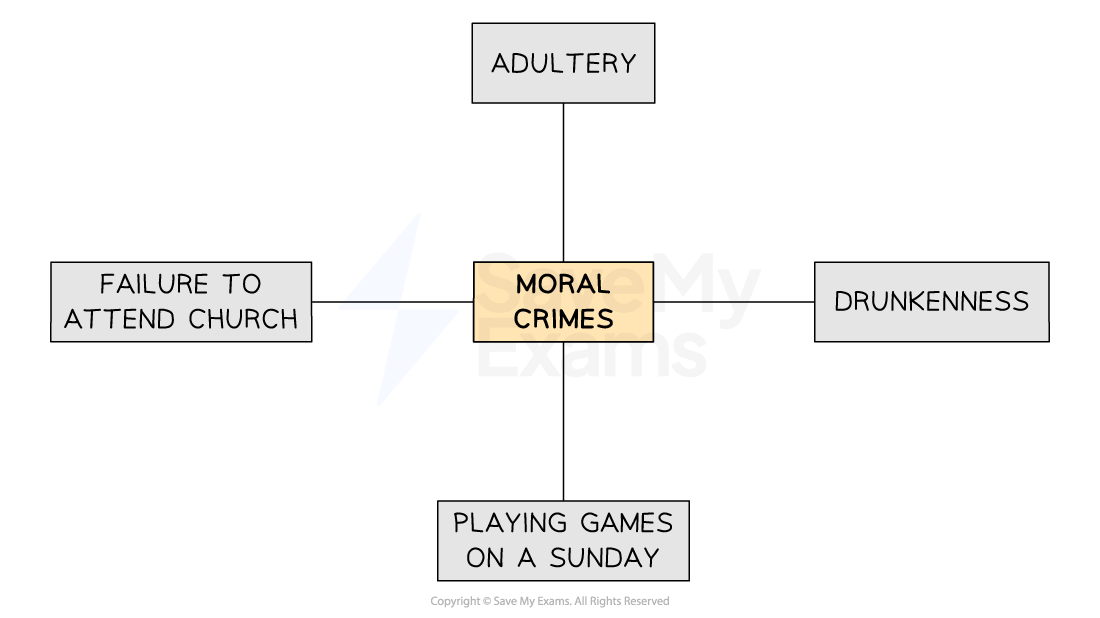
some of the punishments the Church courts used instead of the death penalty
Church courts had a different attitude to punishment than other courts did. They:
Considered punishments motivated by retribution alone to be wrong
Believed that punishments should allow criminals to
Reflect on their crimes
Regret their actions
Reform themselves
punishments:
forced pilgrimage
apology at mass
Punishment in the later Middle Ages
CONTINUITY: Punishments still relied on a mixture of fines, corporal punishment, and execution.
CHANGE/NEW PUNISHMENT introduced for high treason (plotting to kill or betray the king): ‘hanged, drawn, and quartered’.
policing changes & continuities from 1100 to the later Middle Ages
changes: constables, sheriffs, coroners, Justices of the Peace
continuities: hue and cry, tithings, sanctuary
trials and courts changes & continuities from 1100 to the later Middle Ages
changes: Henry II reorganised courts, royal judges visit each county twice a year for serious cases, trials by ordeal abolished 1215, juries picked at random (still local), prisons introduced to hold criminals until their trial
continuities : local juries, manor courts, trial by ordeal until 1215, benefit of the clergy
punishments changes & continuities from 1100 to the later Middle Ages
changes: execution used more often, hanged drawn and quartered for high treason
continuities: death penalty, fines, corporal punishment
Why was the Church so important?
It told them how to get into Heaven
It was a place for people to gather and celebrate saints and milestones in their lives
Paintings taught people how live
The Church was a place to find out information
People believed reaching Heaven was the greatest thing. The Church would ask for money to forgive people..
Evidence that the Church hindered the justice system in the early thirteenth century
benefit of the clergy: church courts were more lenient and any churchman had the right to try in their own courts
if someone accused of a crime could reach a church they could claim sanctuary and claim the protection of the church: nobody could remove them by force for 40 days, and after this they had to face trial or leave the country
before 1215, trial by ordeal was used, which seemed to be based on luck rather than real guilt or innocent, so guilty criminals sometimes escaped punishments while innocent people could be punished.
Sanctuary
Only available in important churches, such as those
On a pilgrimage route
Linked to an important religious event
Those accused of a crime could go to a church and claim sanctuary
The ringing of a bell alerted villagers that the criminal was in sanctuary
The sheriff was not allowed to arrest them
The criminal in sanctuary then had 40 days to either:
Attend their trial
Leave the country
Those who chose this option had to walk to the nearest port, barefoot, carrying a cross
They would then leave by ship
Anyone who refused both options became an outlaw
What was ‘Benefit of Clergy?’
Members of the clergy had the right to be tried only in a Church court, not a Royal Court by the King. This was known as benefit of clergy.
The Church courts rarely used the death penalty as punishment, so they were seen as more lenient. Punishments imposed by the Church included forced pilgrimage, or confession and public apology at mass.
However, it was often easy for anyone to claim benefit of clergy. The ‘test’ to judge whether someone was a member of the clergy was to recite Psalm 51 in the Bible, since most people could not read/write. But people could still memorise the Psalm!
It was unequal
Women were not allowed to be priests
As a result, they could not claim benefit of clergy
It was open to abuse
Illiterate laymen could claim benefit of clergy
Reformers believed it allowed criminals to escape punishment
laymen
those who were not members of the clergy
What does ‘retribution’ mean?
Making someone pay/suffer for their crimes.
Restitution
compensating someone.
Reformation
Martin Luther spread new ideas about the Church, this led to Christianity splitting into two - Catholics and Protestants
Rehabilitation
giving someone the tools then need to rebuild their life/return to normal society.
Features of Protestants
simple church: no crosses or candles
People will find understanding of God from the Bible (in English).
simple robes
monarch head of the church
Features of Catholics
The language of the church is Latin.
Beautiful decorated churches are needed to worship God.
pope head of the church
People need priests to help them understand God.
King John
in 1215 King John signed the Magna Carta.
Explain: This had a big impact on the nature of law enforcement and punishment because now no one- even the king- was not above the law and everyone had a right to a fair trial.
Witchcraft: Punishment, Why people committed the crime
Punishment: | Hanging |
Why people committed the crime: | They didn’t, but people thought they did because of: Poverty - the woman’s crops had grown Bad things happening Religion - change in religions caused distrust |
Vagrancy: Punishment, why people committed the crime
Whipping, ear burning. 1547-1570 - execution and slavery |
Needed work Monasteries had been shut down so the poor could not receive help. The rich were scared of crimes being committed e.g. theft |
Heresy: Punishment, why people committed the crime
Execution |
Different beliefs - the religion changed with the monarchs (starting with Henry VIII) |
Social and Religious Changes in Early Modern England
Social changes
Farming became more efficient
Land enclosure increased
This meant that all farmland, including common land, was fully used
By 1700, most of the country’s land was enclosed
The population increased
Towns and cities expanded
Trade flourished
More people moved to urban areas to look for work
Religious changes
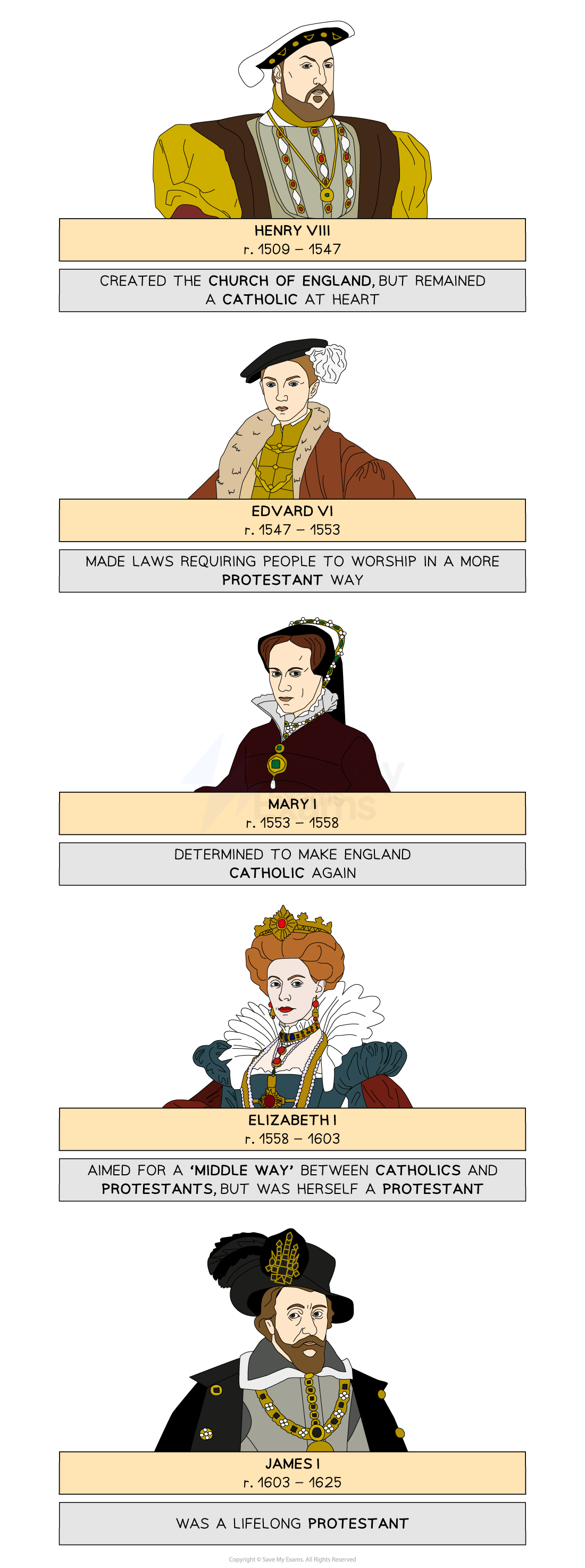
The English Reformation began with Henry VIII, who
Broke away from the authority of the Roman Catholic Church
Became the head of the Church of England
It was unpopular with the mostly Catholic population
The following years were full of religious confusion, unrest and extremism
England’s official religion swung back and forth between Catholicism and Protestantism
This depended on the religious beliefs of the different monarchs:
The different monarchs & the reformation
what were the signs of a witch?
wrinkles / being an old woman
‘witch’s mark’ e.g. a mole
having a familiar - an animal such as a cat
Why did vagrancy become a crime in the Early Modern Period?
Became a crime as a result of pressure the general population put on the government
Vagabonds often wandered in search of work
This made them strangers to the community
Many relied on begging and charity to survive
The settled population hated, feared and resented them
In the Middle Ages, the vast majority of people had never left the town or village in which they were born. They lived, worked and died there; many were tied to the land in what was known as the Feudal System. But as feudalism began to decline in the later Middle Ages, things began to change. By 1500, the growing population, falling wages, and rising food prices, meant that greater numbers of people left their villages in search of jobs. The unemployed, homeless people were known as vagabonds or vagrants.
there was no system to help the needy, as henry viii had closed down the monasteries.
When a vagabond arrived in a new village or town, it wasn’t always easy for them to find work. With nowhere to live, and nothing to live off, it was inevitable that some would turn to crime. The better-off, settled population began to see all vagabonds as potential criminals. Concern about vagabondage intensified during times of poverty and hardship, when the numbers of unemployed people increased.
What laws were passed to prevent vagabondage?
New laws were passed to deal with this perceived threat such as the Vagrancy Act of 1547 - the able-bodied without work for more than three days were branded with the letter ‘V’ and sold as a slave for two years - and the Act for the Relief of the Poor in 1597 - split vagrants into two categories, ‘deserving’ (elderly/disabled) and ‘undeserving’ (those fit for work).
Why were people worried about vagabonds?
vagabonds were seen as lazy and dangerous.
it was believed that those who were not working would be tempted by the devil to commit sins; England was a very religious country
wealthier people did not feel as though they should help those who appeared able to work: they already paid poor rates to help the genuinely poor in their local parish, and they didn’t want to spend more money helping those from other areas of the country.
it was argued that vagabonds committed crimes to get money such as theft, assault, and even murder, and people didn’t want there to be an increase in these crimes.
What factors led to vagrancy becoming a crime?
wealth & poverty: falling wages & higher food prices led to people leaving their village to look for other work, and wealthy people didn’t want to help people more
attitudes and beliefs: believed they would be tempted by the devil, and believed that vagabonds committed crimes to get money.
government & lawmakers: concerned about these potential criminals: passed the Vagrancy Act & the Act for the Relief of the Poor in 1597
how were vagabonds punished in the Early Modern Period?
Whipping, sold into slavery for 2 years, branding, burning through the ear, execution, houses of correction, banished from England.
why did people believe in witchcraft?
The Civil War - people were already living in fear and Matthew Hopkins’ actions made them panic about witches
harvests failing / death of livestock - witches were often scapegoated for these events.
More and more vagabonds came to towns and cities. The settled population, especially wealthy people, did not trust vagabonds. Vagabonds were often accused of being witches.
Religion - change in religions caused distrust, and people believed that witches worked for the devil and that the Devil was tempting good Christians away from God. People became very fearful of witches’ ‘harmful magic’
King James I’s ‘demonologie’: told how to identify witches and conduct your own witch trials - he said that witchcraft was a crime against the king & god. especially fearful of another catholic rebellion after gunpowder plot & was obsessed with uncovering conspiracies against him, including witch hunts.rising fear of vagabonds made people more suspicious of the poor
Matthew Hopkins - named himself ‘witchfinder general’ and hunted witches in the East of England. used methods like not allowing the ‘witch’ to sleep & restricting them to a starvation diet of bread/water to get confessions. his witch hunts 1645-1647 saw the largest number of executions.
historians believe that up to 1000 people were executed for witchcraft from 1542-1736
Changes in punishing witchcraft in the Early Modern Period
Henry VIII’s reign: in 1542 laws were passed which made witchcraft a serious crime, punishable by death
In 1563 Elizabeth I passed a law defining major and minor witchcraft. Major witchcraft was punishable by hanging.
In 1604 James I passed further harsh laws against witchcraft.
Why did belief in witchcraft decline?
end of the civil war
Matthew Hopkins died
scientific ideas became more popular and widespread
religion and superstition began to have less influence
Why did Crimes Against Authority Increase in Early Modern England?
Religious and political changes led to an increase in crimes against authority
Heresy
Increased after the English Reformation
Involved having the wrong religious beliefs at the wrong time
Important clergymen played a role in charging and judging cases
Treason
Increased due to there being more disputes about who should rule
Involved not accepting the monarch’s authority (political or religious)
The Gunpowder Plot of 1605 is an example of treason
Henry VIII religion & treatment of catholics & protestants
Catholic, but turned protestant
Closed down Catholic monasteries and seized their wealth and land.
Protestant were executed for heresy. Punished as criminals.
Edward VI religion & treatment of catholics & protestants
Protestant
Some Catholic priests were imprisoned
He pleased other protestants by introducing a prayer book in English and by allowing priests to marry. He also made Church interiors plain.
Mary I religion & treatment of catholics & protestants
Catholic
tried to restore the Catholic Church and made the Pope the head of the Church again.
Almost 300 people were executed as heretics for refusing to follow the Catholic faith.
Elizabeth I religion & treatment of catholics & protestants
Protestant
She tried to find a middle way in both religions and wanted to create a Protestant Church that made Catholics feel comfortable with her being the Head of the Church of England.
James I religion & treatment of catholics & protestants
Protestant
treated catholics well until the gunpowder plot, then got stricter
Favoured Protestants over Catholics, particularly after the Gunpowder Plot.
Law Enforcement in Early Modern England
Policing
Still largely relied on ordinary people in the local community
Many medieval systems and roles continued, including
Hue and cry
Coroners
Parish constables
Urbanisation led to some changes
Crimes increased
Ordinary people were given more power to deal with crimes themselves
They could obtain an arrest warrant from a Justice of the Peace (JP)
This allowed them to catch a criminal and deliver them to the constable
They were given rewards for this (usually money)
Reward payments could be as high as a year’s income (for a typical middle-class family
Trials
Most trials still took place locally
JPs:
Introduced in medieval England
Took on a greater role in early modern England
Attended quarter sessions four times a year, JPs met with other JPs across England to judge more serious crimes
JPs met with other JPs across England four times a year, to judge more serious crimes
They had the power to give criminals the death sentence
Judged manor court cases
These continued to handle local, minor crimes (like drunkenness and selling underweight bread)
How did the Role of the Church in Law Enforcement Reduce in Early Modern England?
Edward VI changed the law; people could no longer claim benefit of clergy for serious crimes, like murder
Sanctuary was also restricted before it was eventually abolished
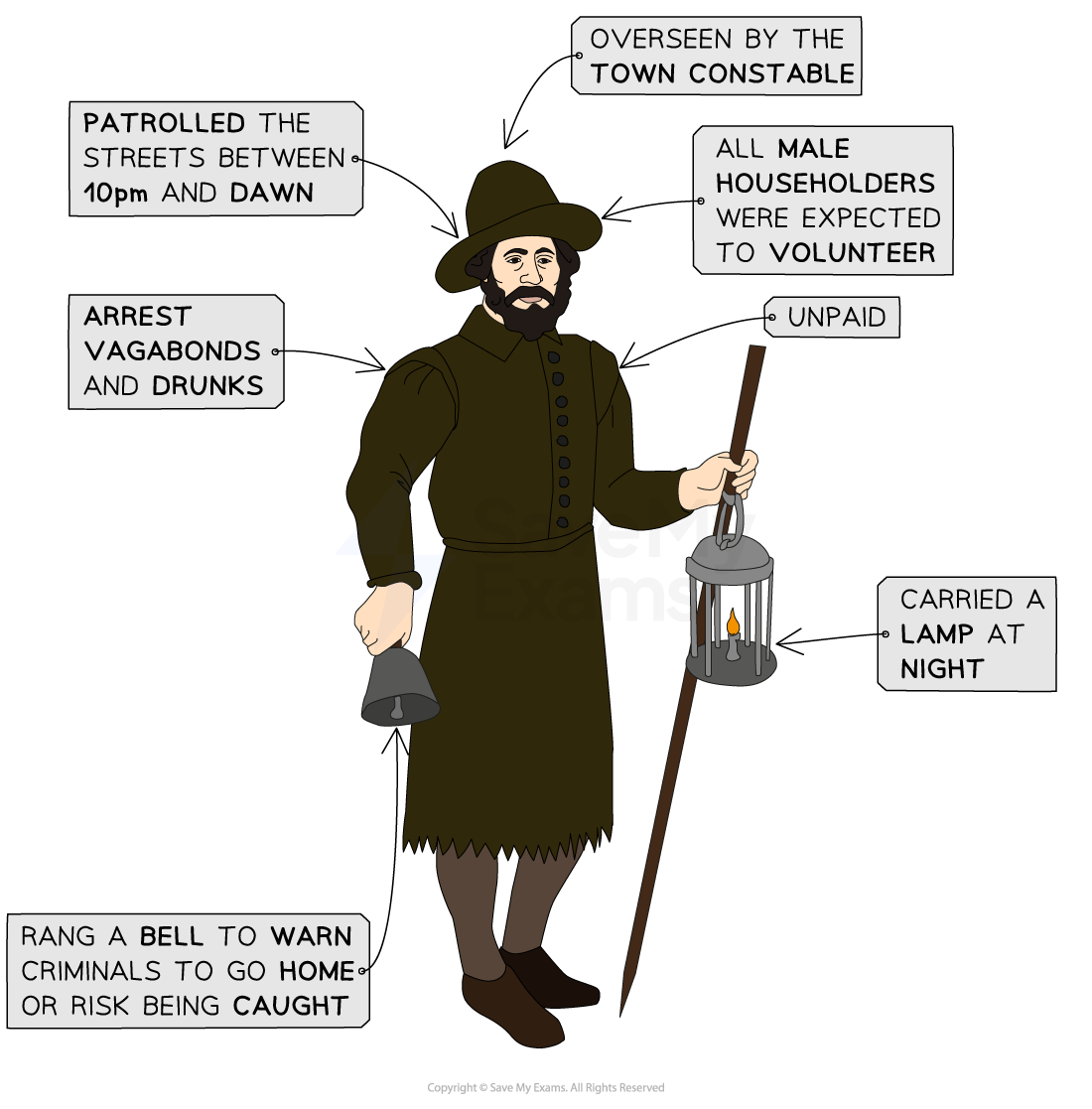
Local Early Modern Law Enforcement: Town Watchmen
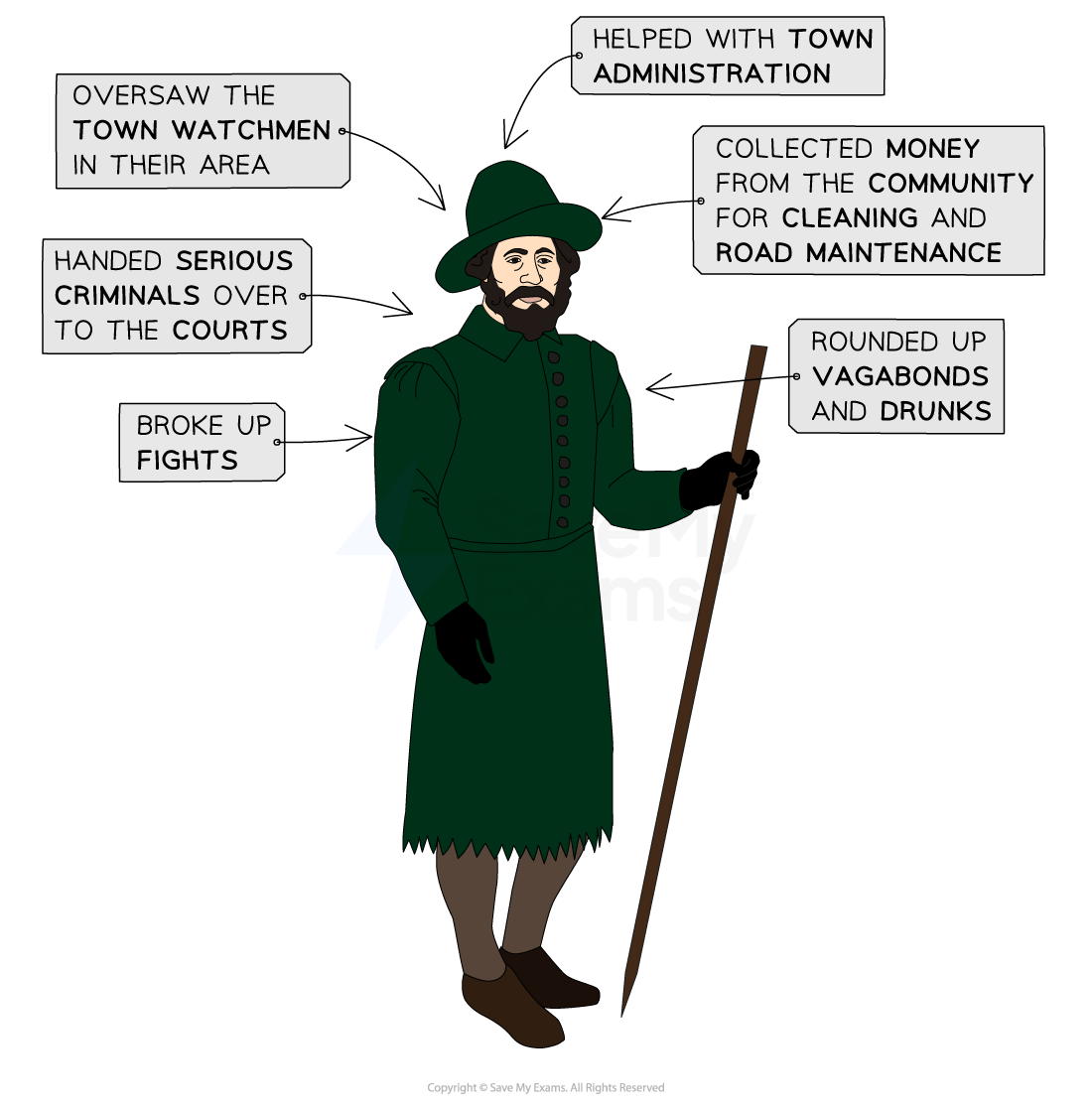
Local Early Modern Law Enforcement: Town Constables
Continuity of Corporal and Capital Punishment Methods in Early Modern England
Corporal punishment methods
Corporal punishment continued to be used to punish a range of crimes, including
Petty theft
Many repeat offenders were still punished with maiming
Public disorder
This continued to be punished with flogging
Vagabondage
A series of vagrancy acts determined the punishment for this crime
Vagabonds were generally punished with the stocks, branding and whipping
Some vagabonds were also sent back to where they came from, put into houses of correction or sold into slavery
Capital punishment methods
Capital punishment continued to be used to punish the most serious crimes, including
Arson
Murder
Poaching
Smuggling
Treason
The Gunpowder Plotters were hung, drawn and quartered for treason
Witchcraft
Other punishment methods in Early Modern England
Fines
Remained the most common punishment
Used for minor offences
These included gambling, swearing or failing to attend church
There was also a new form of punishment:
Houses of correction
Built in urban areas
Housed criminals who were poor and children who were homeless or orphaned
Punished vagabonds and repeat offenders with hard labour and whipping
Conditions were very poor
Those staying there had to pay for their own living costs
By the 17th century, similar houses known as bridewells began to spread across the country
What was the Gunpowder Plot?
The Gunpowder Plot was an attempt by a group of Catholics in 1605 to blow up James I. England at this time was a Protestant country. Before James was crowned king he had made some vague promises to be more lenient towards Catholics. However, little improved for the Catholics when James I took the throne. In anger, a group decided the only way to make their voices heard was to blow up Parliament and the King.
Who was the leader of the gunpowder plotters?
Robert Catesby
When was Guy Fawkes caught?
5th November 1605
The Bloody Code
In the late 17th century, the ‘Bloody Code’ was introduced
This increased the number of capital offences
It included crimes that seem minor by today’s standards, like
Poaching rabbits
Stealing bread
what year was the bloody code introduced?
(The Black Act)
1723
What types of crimes did the Bloody Code make punishable by death?
Damaging trees; ruining fishponds; stealing horses
How many crimes were punishable by death at the end of the century?
200
What was the aim of the Bloody Code? Why was it introduced?
Deterrence (to deter people from committing further crimes)
The ‘Bloody Code’ was introduced at a time when people saw rising crime as a big problem
In reality, crime rates were actually falling around this time
The reasons for the introduction of the ‘Bloody Code’
Fear | Crimes were publicised through pamphlets and public executions. In addition, speeches made by those sentenced to death were often published. All of this heightened the public’s fears. It gave people the impression that crime was rapidly rising |
Urbanisation | The growth of towns and cities meant that people no longer knew all their neighbours. Medieval law enforcement methods, like the hue and cry and parish constables, became less effective as a result. Equally, busy streets made it easy for criminals to avoid being seen or caught |
Traditional views | Many maintained the medieval view that only harsh punishments could deter criminals and reduce crime overall |
Landowners’ views | The government was made up of wealthy landowners. They saw poor and homeless people as a source of plague and criminality. They perceived the growing number of people in poverty as a threat to their property and privileges. They passed the laws making up the ‘Bloody Code’ as a way to keep poor people in their place |
Why weren’t many people actually hanged as a result of the Bloody Code?
Because of the jury- committed ‘pious perjury’ to allow for people to escape with a lighter punishment.
Change in Punishments: Transportation to American colonies
Transportation started to be used as a punishment during James I’s reign
Those convicted of crimes were sent on ships to the new colonies of North America
Here, they did manual work by helping to build settlements
Working conditions were very harsh
Sentences were either seven or 14 years
Once their sentence was over, many could not afford to return to England
Between 50,000 and 80,000 people were transported to North America, including
Men
Women
Children
What was Transportation?
being sent away from England to serve a period of punishment in a colony abroad.
Why was transportation favoured by the authorities?
It was seen as an effective deterrent.
England did not have an effective prison system so prison was not an alternative punishment.
England wanted to establish permanent colonies in North America, so convicts could be used to populate and provide manpower for these colonies.
Some people were developing new ideas about punishment and that it should allow for rehabilitation (giving criminals the chance to reflect on and improve their lives).
Explain one way that methods of punishment changed from the medieval to the early modern period
The introduction of the ‘Bloody Code ’ changed punishments from the medieval to the early modern period. The 'Bloody Code' greatly increased the number of capital offences as it introduced a harsher punishment for minor crimes. By 1688, there were 50 capital offences. Under the 'Bloody Code', capital offences were given for poaching rabbits and stealing bread .
Up until 1770, how many people were transported to America?
an estimated 50,000-80,000 people
When were the first people transported to Australia?
1788
How was the Bloody Code ineffective?
Many crimes were committed by desperate people who did not think much about the consequences.
Executions were not always carried out as criminals could receive a pardon if they could prove their previous good character or the juries could be more lenient if they felt bad for them.
How did prisons change from the 16th-17th century?
Early 16th century: prisons held petty criminals, vagrants, and drunk and disorderly offenders, until trial. prison conditions & hygiene was poor
1556: a new, purposeful type of prison/house of correction was opened and named Bridewell prison. It was used to punish poor people who’d broken the law (e.g. vagabonds) and to house poor children who were homeless or orphaned. All inmates had to do hard labour.
17th century: more prisons like Bridewell opened.
The Catholic plotters main aims:
To kill the king and other leading Protestants
To replace the king with a Catholic monarch
Why was the Punishment for Treason so Harsh in Early Modern England?
Aim of punishment | How the punishment for treason was seen to fulfil this aim |
|---|---|
Deterrence | Punishment for treason took place in public. The authorities thought that, if people could see the dire consequences of treason, they would be put off committing the crime themselves. Harsh punishment was a way to prevent crime in the absence of a police force |
Retribution | Treason was the most serious and worst crime of all. Because of this, it received the most serious and worst kind of punishment |
Describe one feature of the Gunpower Plot in 1603.
The members of the Gunpowder Plotters, like Guy Fawkes, were arrested and tortured. In 1605, they were tried and found guilty of treason and sentenced to death.
Describe one feature of Matthew Hopkins’s role in the witch-hunts of 1645-47
A Justice of the Peace employed Matthew Hopkins to find witches in East Anglia. Hopkins was paid for every prosecution.
Changes & continuities in policing from 1500-1700
In 1500 - no police force. Tithings and the hue and cry were the main methods of catching offenders. Leading villagers became constables. Sheriffs were used to catch criminals on the run.
Change: Watchmen employed in large towns (poorly paid). First salaried officials paid for policing (Watch Acts – tax introduced for paying watchmen).
Community watch for criminals (similar to neighbourhood watch?)
Rewards for catching criminals.
Continuities: - Constables, sheriffs still used.
Citizens still had to find criminals themselves if they wanted justice.
Hue and cry still used.
Changes & continuities in trials and courts from 1500-1700
1500: Trial by jury was used for most offences. Royal judges travelled around the country dealing with serious cases
Changes: 1700s – rise of prosecution lawyers for those who could afford them.
1730s – defence lawyers used for the first time (if affordable).
Showed remorse – could be let off.
People could speak about good character at court.
Continuities: Local manor court still used when necessary.
Practice of trial by jury remained (still used 12 local people).
Royal courts still used.
Changes & continuities in punishments from 1500-1700
1500: Capital punishments was the most common form of punishment in royal courts. Hanging and other punishments were public to scare others from offending. Prisons were only used for people awaiting trial.
Changes:
Increase in whipping – more commonly used in 1700s.
Executions for smaller crimes (Bloody Code).
Transportation used a lot at first but stopped after 1771 when America became independent. (started in early 17th century)
Punishments increased as number of crimes increased.
Houses of Correction were built
Continuities:
Jails (gaols) still used as holding cells before trial.
Stocks, pillories and whipping still used for smaller crimes.
Execution still used but more frequently.
Hanging – still a common way of executing someone.
Women being punished for speaking out - ducking stool and scold’s bridle
Why did heresy become a crime?
catholics & protestants has different beliefs - the religion changed with the monarchs ( starting with Henry VIII).
Mary I executed almost 300 protestants for heresy.
Why did Crime Increase in Eighteenth- and Nineteenth-Century Britain?
Industrialisation:
Mechanised production in factories left many jobless
Those who did work in factories faced harsh conditions and poor pay
Rising unemployment and low wages led to extreme poverty
As in the early modern era, some resorted to committing ‘survival crimes’ like petty theft
Urbanisation:
As in the early modern era, town and city populations continued to increase
Many urban areas became overcrowded
Areas became exposed to more strangers
Communities were no longer tightly knit
Criminals could more easily avoid being caught
highway robbery
Robbery was a common crime in the 18th century. Highway robberies often happened on the streets and roads approaching London.
Highwaymen were robbers on horseback and they usually worked alone or in small groups. They attacked travellers in carriages or on horseback.
People decided to become highwaymen because after the English Civil War ended, many people were left without jobs. Some people also just wanted to become richer.
If highwaymen were caught, the punishment was hanging.