Chapter 7: Aggregate Expenditure (2)
 Studied by 0 people
 Call with Kai
 Learn
Learn Practice Test
 Spaced Repetition
 Match
Match Flashcards
 Knowt Play
1/54

There's no tags or description
Looks like no tags are added yet.
Name | Mastery | Learn | Test | Matching | Spaced | Call with Kai |
|---|
No study sessions yet.
55 Terms
What is the aggregate expenditure model
the relationship between total spending in the economy and real gdp, holding price level constant
the four components of Aggregate expenditure
Consumption (C)
Planned Investment (Ip)
Government purchases (G)
Next Exports (NX)
Consumption
spending by households on goods and services
Planned Investment
planned spending by firms on capital goods, research and development, and spending by households on new residential properties
Government Purchases
spending by federal, state, and local government on goods and services
Net Exports
Exports - Imports (X-M)
Aggregate Expenditure equation
AE = C + IP+G+NX
What is the difference between I and IP
I represents actual investment, while IP represents planned investment
What is investment (I)
firms spending on factories, tools, buildings, R&D, and inventories
What are inventories
goods produced in the current year but not sold, unused raw materials, and partially processed goods
What happens when there is no unplanned change in inventories
actual investment = planned investment
AE = real GDP
What happens when there is an unplanned increase in inventories
actual investment > then planned investment
Real GDP > AE
What happens when there is an unplanned decrease in inventories
planned investment < actual investment
AE < real GDP
When does macroeconomic equilibrium occur
when AE = real GDP
What happens when AE exceeds real GDP
inventories decline
Production and employment increase
What happens when AE is less than real GDP
Inventories increase
Production and employment decrease
What happens when AE = Real GDP
there is no unplanned changes in inventories
There is no change in employment or production
what is the primary cause of fluctuations in real GDP from one year to the next
increases and decreases in AE
What is the largest component of AE
consumption
The five variables that influence the level of total consumption by households
Current disposable income
Household wealth
Expected future income
Price level
The interest rate
CHEPI!
Current disposable income
total household income (income + transfer payments) minus personal income taxes
(YD = Y - T)
Household wealth
household assets (real estate, stocks, bonds, etc) minus liabilities (debt)
Expected future income
income expected in the future
An ↑ in expected future income leads to an ↑ in consumption now
A ↓ in expected future income leads to a ↓ in consumption now
Price level
a measure of the average price of goods and services in an economy
the interest rate
additional money charged on loans
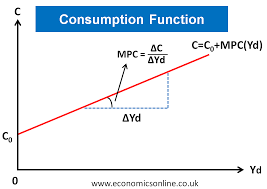
The consumption function
an algebraic relationship between consumption and income
What is the slope of the consumption function
Marginal Propensity to Consume (MPC) OR (ΔC/ΔY)
What is the MPC
the change in consumption spending when income changes by 1 dollar
The Consumption Function Units
Y = consumption spending, X = real GDP/income
National Income Equation
Y = Consumption (C) + Savings (S) + Taxes (T)
Marginal Propensity to Save (MPS)
tells us how much of an extra $1 that you earn you put into savings
MPS and MPC equation
1 = MPS + MPC (when taxes are constant)
The three variables that determine the level of investment in an economy
Expectations of future profitability
Interest rate
Taxes
TIE!
Expectations of future profitability
when firms expect higher future profits, they invest more
When firms expect lower future profits, they invest less
The interest rate
A higher interest rate decreases investment
A lower interest rate increases investment
Taxes
an increase in taxes decreases investment
a decrease in taxes increases investment
Three key determinants of net exports
The price level in the US, relative to price in other countries
The growth rate of real GDP in the US, relative to other countries
The exchange rate between the US dollar and other currencies
PEG!
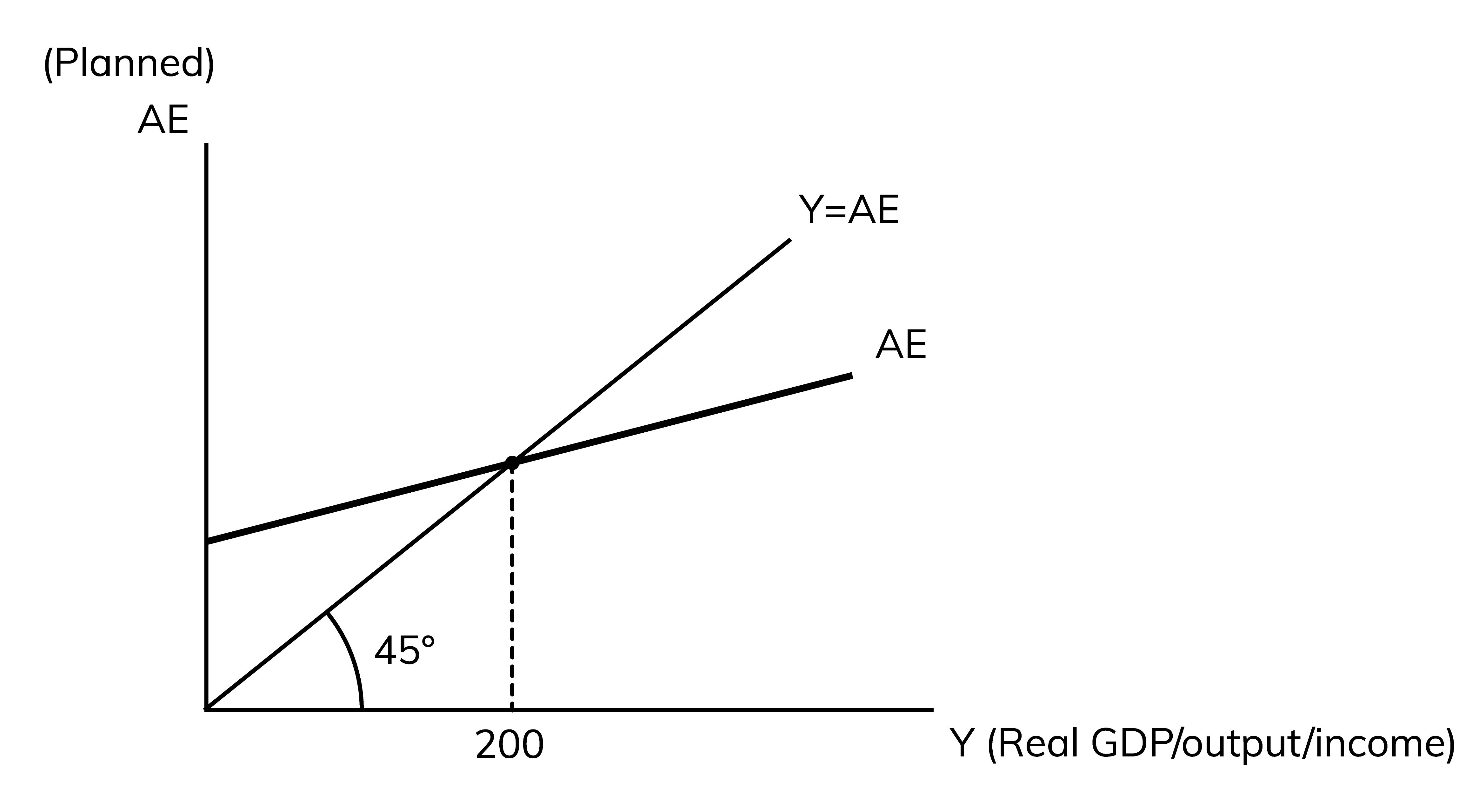
How is macroeconomic equilibrium illustrated
a 45o angle line
Units for the AE graph
Y = AE (C) ; X = real gdp/income (Y)
When is real GDP greater than AE
Points below the 45 degree line
When is AE greater than real GDP
Points above the 45 degree line
Unplanned changes in inventories equation
Y - AE
autonomous expenditures
spending that is unaffected by changes in real gdp
what are the autonomous expenditures of AE
planned investment, government purchases, and net exports
What is Consumption split between
autonomous and non autonomous
The spending multiplier
the ratio of the increase in real GDP to the increase in autonomous spending
Spending multiplier equation
(1/1-MPC)
Change in Y equation
ΔY = multiplier x ΔAE
The Paradox of Thrift
When everyone tries to save more at the same time, spending, gdp, and total income in the economy falls
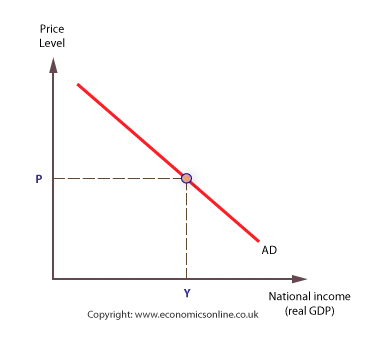
The Aggregate Demand curve
shows the relationship between the price level and the quantity of real gdp (output) demanded
what is the relationship between price level and AE
inverse relationship for (C + I + NX)
AD curve units
Y = Price level, X = Real GDP
Shift vs. movement for AD curve
movement: price level
Shift: anything else
Consumption function equation
A = C0 + (MPC x Y)
where MPC = slope of consumption function
C0 = fixed number/constant
equilibrium real GDP equation
Y = (1/1-MPC)(C + I + G + NX)