Chapter 2: Basic Principles of Physiology-Membrane Transport
 Call Kai
 Learn
Learn Practice Test
 Spaced Repetition
 Match
Match Flashcards
 Knowt Play
1/106

There's no tags or description
Looks like no tags are added yet.
Name | Mastery | Learn | Test | Matching | Spaced | Call with Kai | Chat |
|---|
No analytics yet
Send a link to your students to track their progress
107 Terms
What type of membrane is the plasma membrane?
A semi-permeable membrane
What does semi-permeable mean?
It allows some substance to cross while restricting other
What are the 3 functions of the plasma membrane?
Barrier
Regulation of Transport
Communication with other cells
What two environments does the plasma membrane separate as a barrier?
The intracellular and extracellular environments
What does intracellular mean?
Inside the cell
What does extracellular mean?
Outside of the cell
What does the plasma membrane regulate?
The exchange of substances across the membrane
What is the communication function of the plasma membrane?
Communication with other cells
How does the plasma membrane being semi-permeable relate to transport?
Being semi-permeable allows the membrane to control which substances cross, so it can regulate transport across the membrane
What are the 3 major types of membrane transport?
Diffusion (Passive)
Active Transport
Vesicular Transport
What are the two types of diffusion?
Simple diffusion
Facilitated diffusion
In what direction do substances move during diffusion?
From high concentration to low concentration
Does passive diffusion require energy from the cell?
No
What is simple diffusion?
Passive movement of a substance directly across the membrane
What is facilitated diffusion?
Passive movement across the membrane with the help of a transport protein
Connection card: What do simple diffusion and facilitated diffusion have in common?
Both are passive and move substances from high → low concentration
What is the major difference between passive diffusion and active transport?
Passive diffusion does not require energy, while active transport requires energy
What does vesicular transport use to transport substances?
Vesicles, which are small membrane-bound sacs
How does diffusion help the plasma membrane perform its transport function?
Diffusion allows substances to move across the plasma membrane from higher to lower concentration
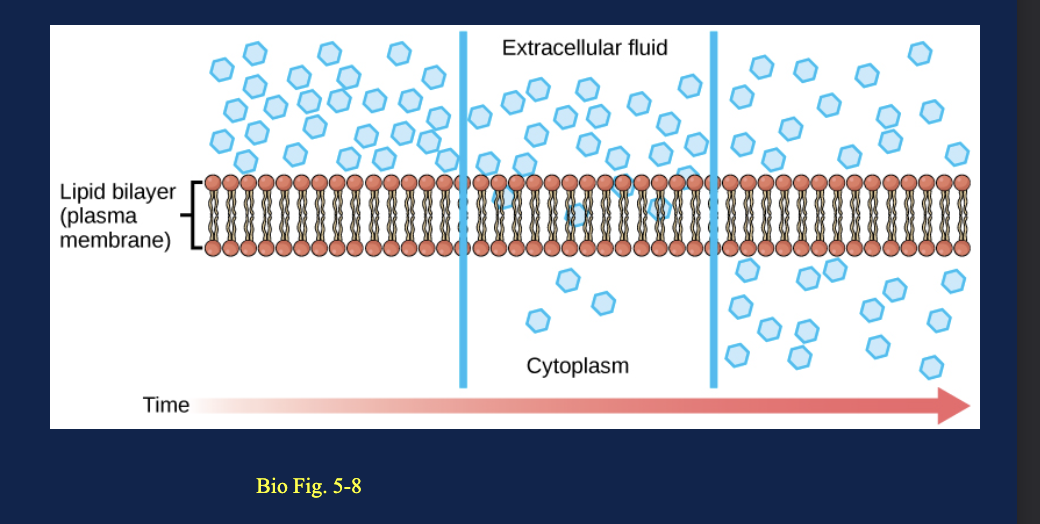
What process is shown in this figure?
Passive diffusion across the plasma membrane
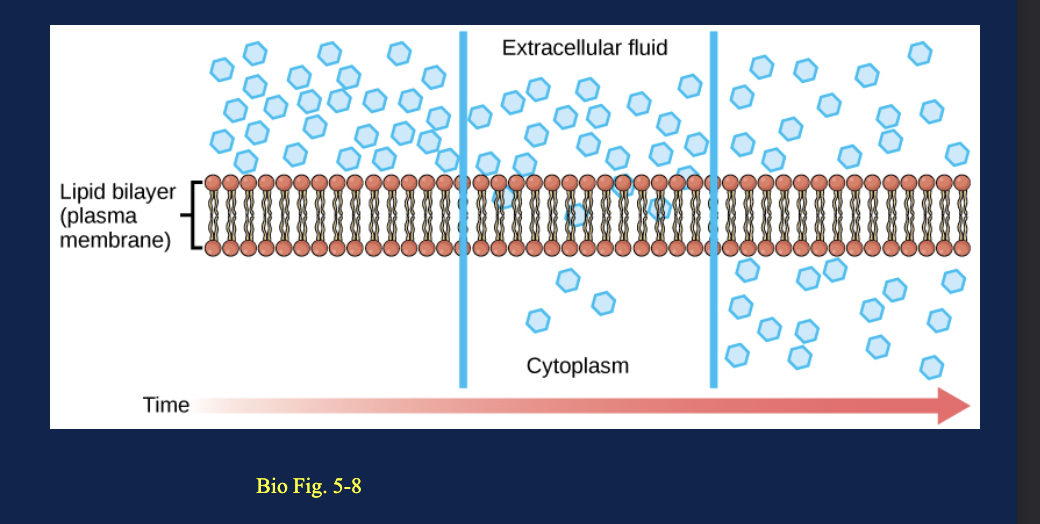
What does the arrow at the bottom of the diffusion figure represent?
Time passing from left to right
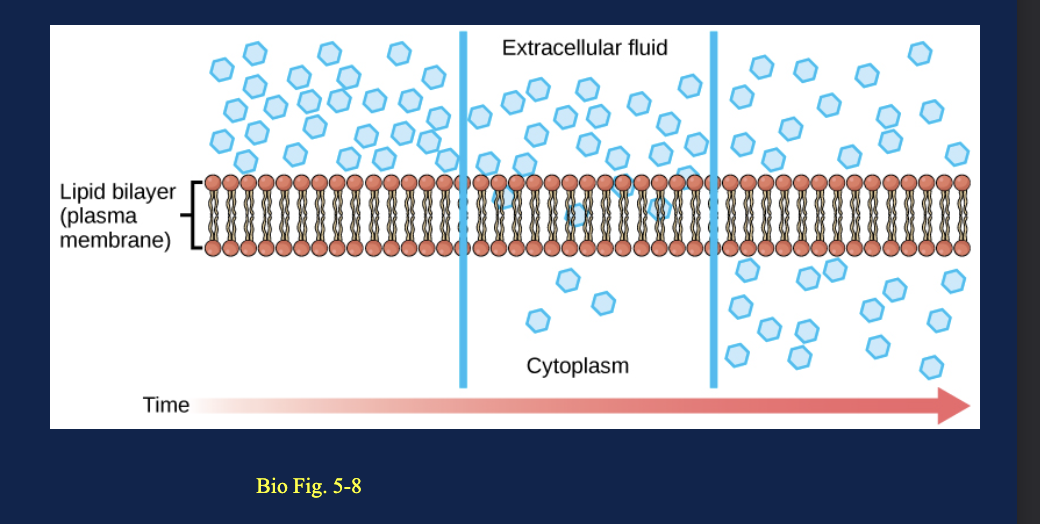
Where is the initial concentration of molecules highest in this figure?
In the extracellular fluid (outside the cell)
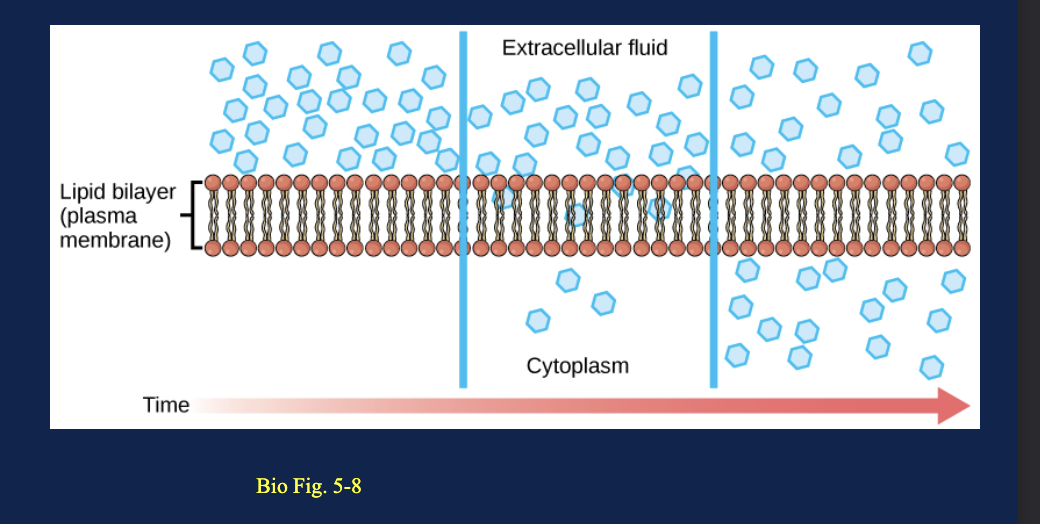
Where is the initial concentration of molecules lowest in this figure?
In the cytoplasm (inside the cell)
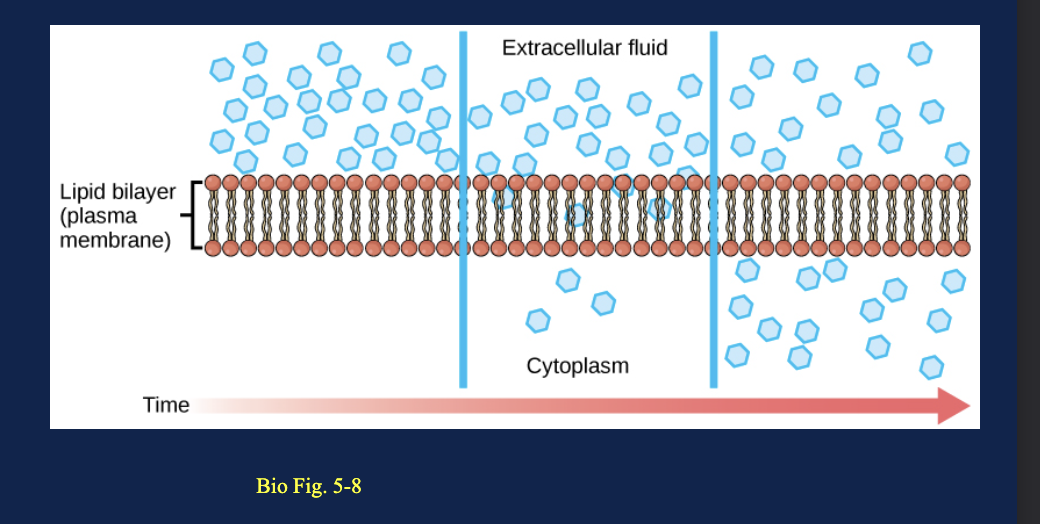
In what direction is the net movement of molecules during diffusion?
High concentration → Low concentration
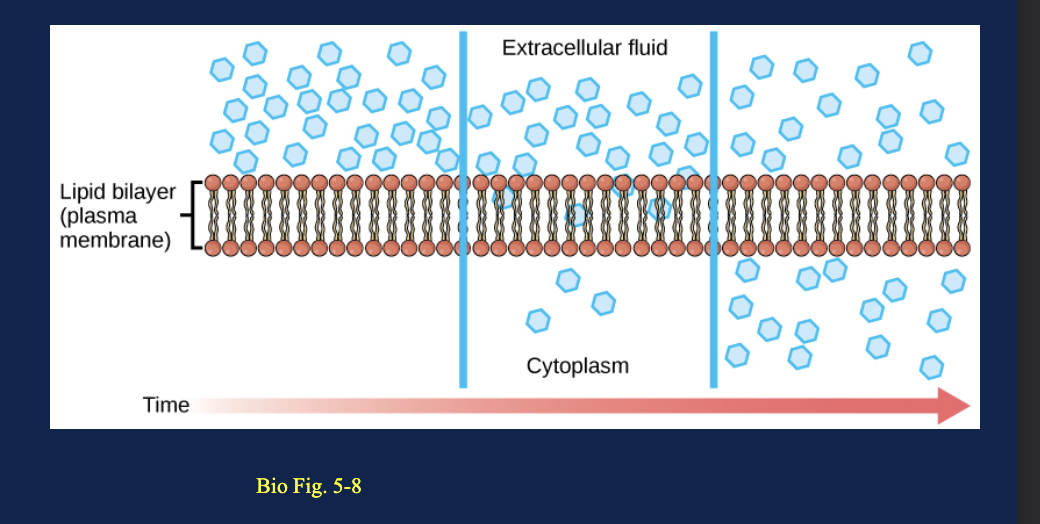
What is concentration gradient?
A difference in concentration between two areas
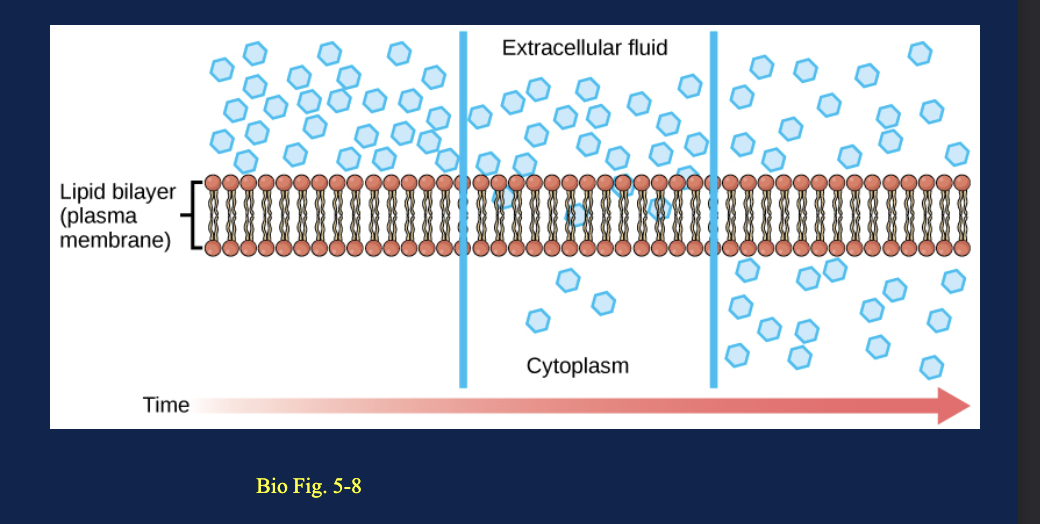
What happens to the distribution of molecules over time during diffusion?
The molecules become more evenly distributed
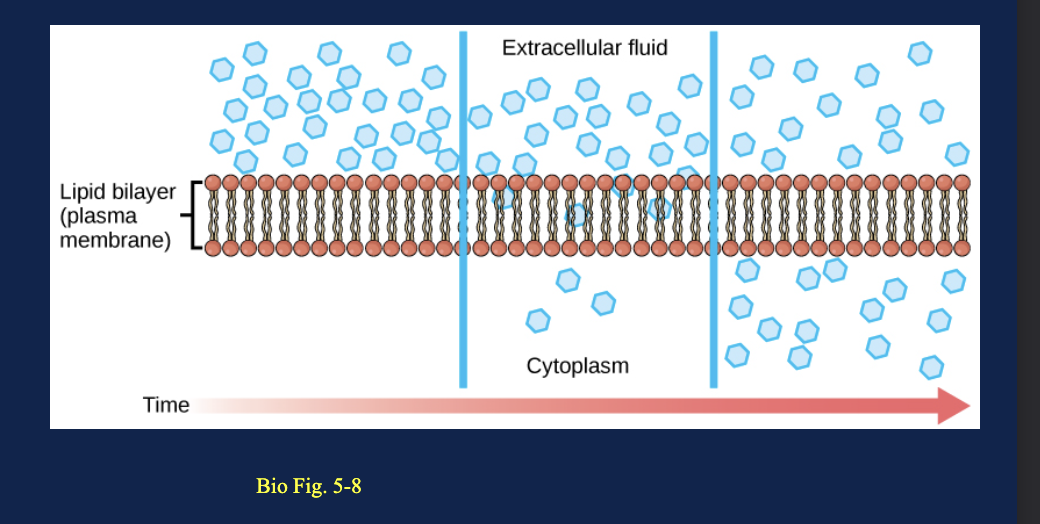
Does diffusion shown in this figure require cellular energy?
No. It is passive transport
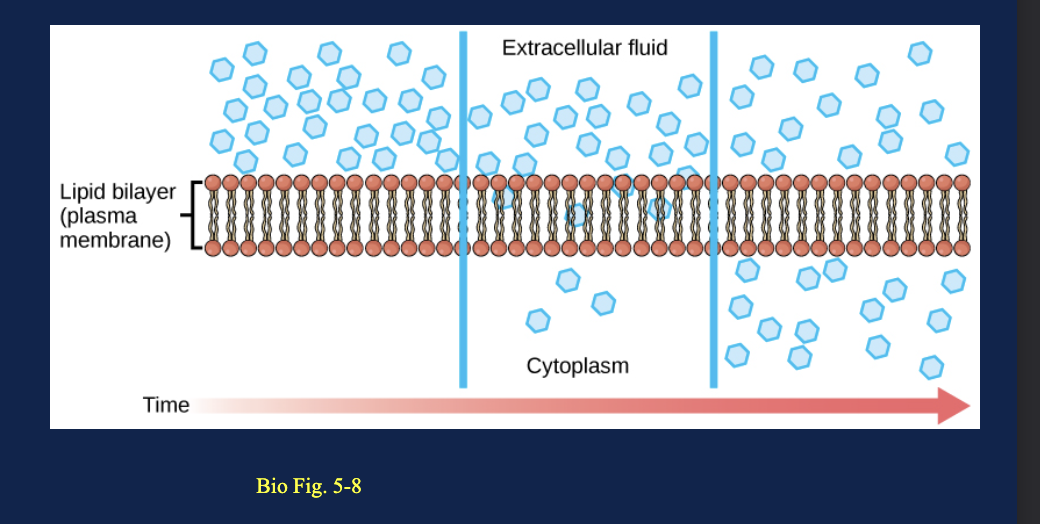
Explain what is happening in the diffusion figure from left to right
Molecules initially have a higher concentration outside the cell than inside. Over time, they diffuse across the plasma membrane from high to low concentration, becoming more evenly distributed
What is diffusion?
The tendency of molecules to disperse (spread out) to achieve equilibrium of concentration
In what direction does net diffusion occur?
From high concentration to low concentration
What does moving “down the concentration gradient” mean?
Moving from high concentration → low concentration
What causes diffusion?
Random molecular motion
Is diffusion passive or active?
Passive
Does passive diffusuion require cellular energy?
No
How long does diffusion proceed?
Until equilibrium is reached
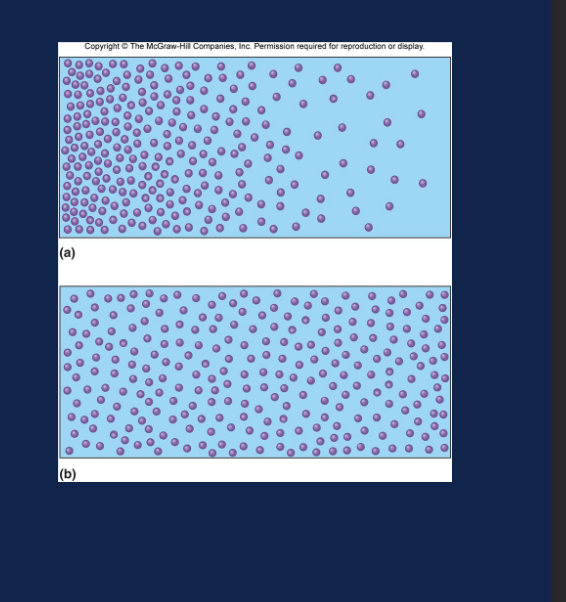
What does equilibrium mean in this diffusion figure?
The molecules have become evenly distributed in concentration
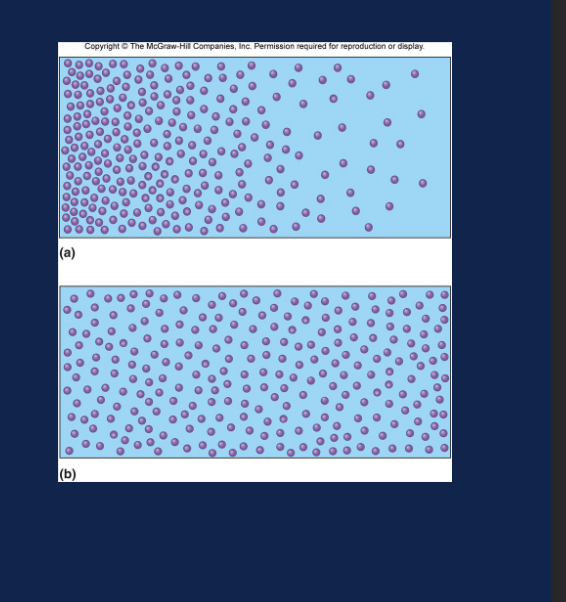
What is happening in figure (a)?
There is a high concentration of molecules on the left and a low concentration on the right.
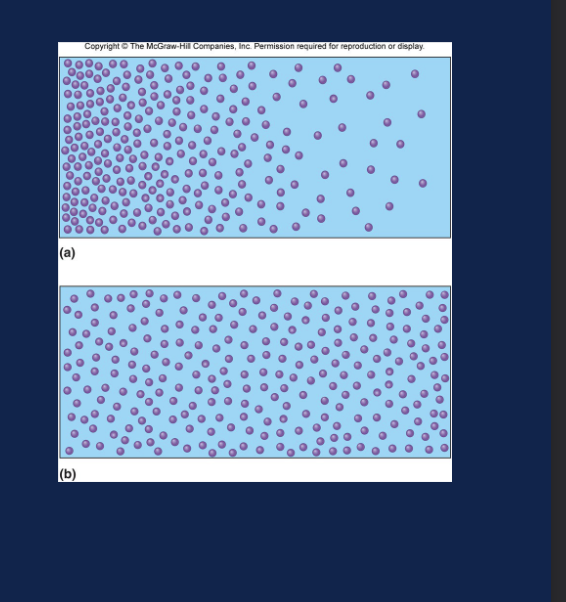
What does figure (b) represent?
Equilibrium, where the molecules are evenly distributed in concentration
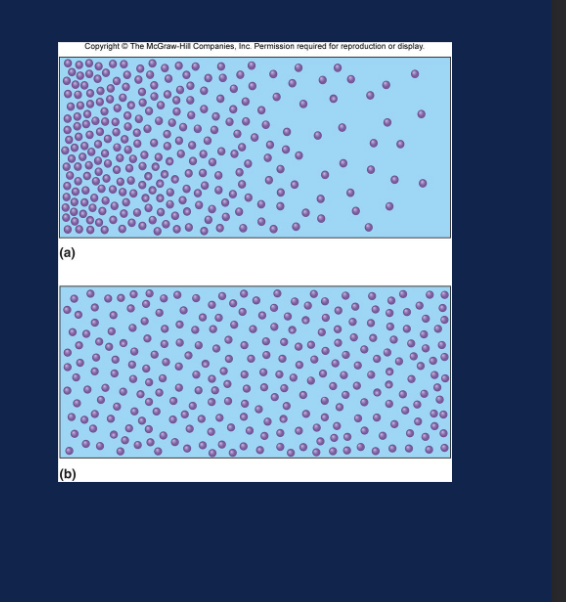
Connection card: Explain the entire diffusion figure from (a)→(b)
Molecules move from high → low concentration due to random molecular motion, moving down their concentration gradient until equilibrium is reached.
What is simple diffusion?
Movement of molecules directly through the plasma membrane from high → low concentration
Do molecules undergoing simple diffusion need a transport protein?
No. They move directly through the membrane
What types of molecules can undergo simple diffusion?
Hydrophobic molecules
Lipophilic molecules
What does lipophilic mean?
Lipid-loving or soluble in lipids
What are some examples of molecules capable of simple diffusion?
Ethanol
Vitamins A, D, & E
O2
CO2
H2O
What is the diffusion of H2O called?
Osmosis
What three factors affect the rate of simple diffusion?
Concentration gradient
Size of molecules
Lipid solubility
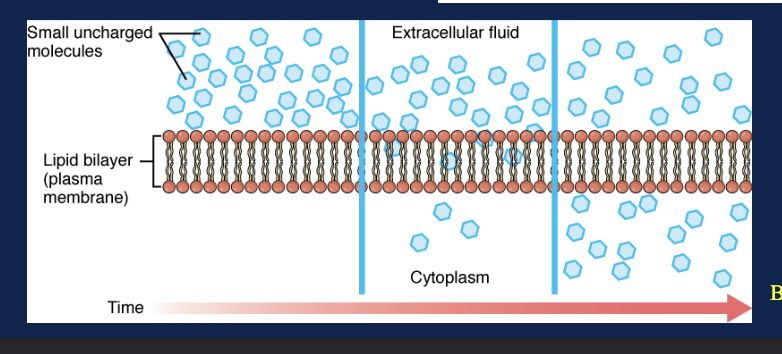
What shows that the bottom figure represents simple diffusion?
Small molecules move directly through the lipid bilayer
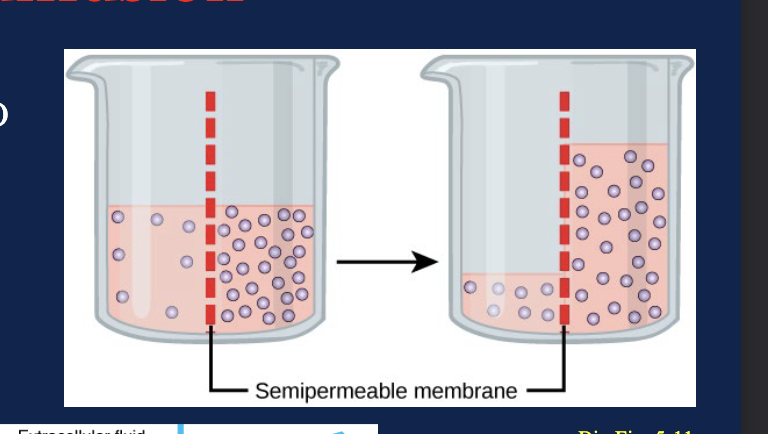
What is happening in the osmosis figure?
Water crosses the semipermeable membrane toward the side with more solute, causing the water level on that side to rise
Connection card: How are diffusion, simple diffusion, and osmosis connected?
Diffusion = movement of concentration from high → low
Simple diffusion = movement of substance directly through membrane
Osmosis= Diffusion of H2O
What is facilitated diffusion?
Passive movement across the membrane with the help of a membrane transport protein
Does facilitated diffusion require cellular energy?
No it is passive
In what direction do molecules move during facilitated diffusion?
High concentration → Low concentration
What two types of proteins are show for facilitated diffusion?
Channel proteins
Carrier proteins
What does it mean that a channel protein is selective?
It allows specific substances to pass
What does it mean that a channel protein is gated?
The channel can be opened or closed to regulate movement
What substances does the slide associate with channel proteins?
Small ions
How does a carrier protein move a molecule across the membrane?
The molecule binds to the carrier, the protein changes shape, and the molecule is moved across
What is conformational change?
A change in the shape of a protein
What substances does the slide associate with carrier proteins?
Larger molecules, such as glucose and amino acids
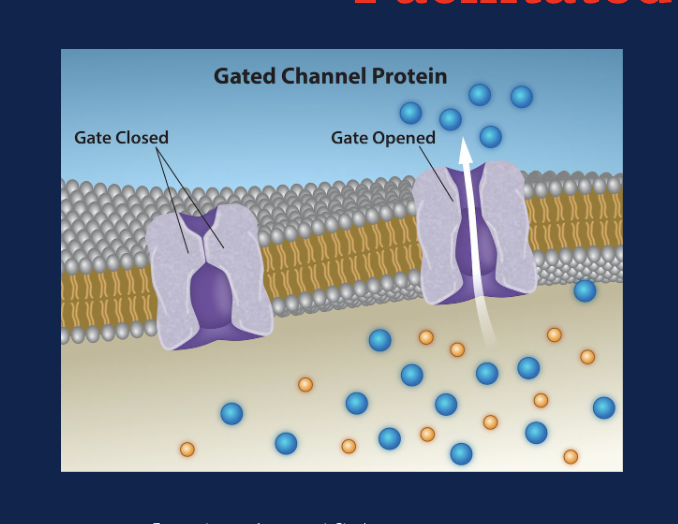
How can you recognize a channel protein in a figure?
It forms a passageway or channel through the membrane that can be opened or closed
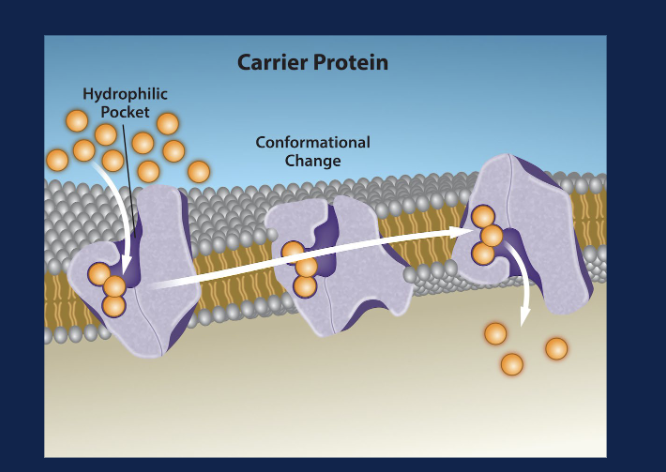
How can you recognize a carrier protein in a figure?
A molecule binds to the protein, and the protein changes shape to move it across
Connection card: What is the major difference between simple diffusion and facilitated diffusion?
Simple Diffusion → moves substances directly through the lipid bilayer
Facilitated Diffusion → moves substances with the help of a membrane protein
What does the rate of simple diffusion depend on?
The concentration gradient
What happens to the rate of simple diffusion as the concentration gradient increases?
The rate of simple diffusion increases
What two things determine the rate of facilitated diffusion?
The concentration gradient and the number of available transport proteins
What is transport maximum?
The maximum transport rate reached when all available transporters are occupied
What does “occupied” mean when discussing transport proteins?
The transport proteins are already being used by molecules

What happens to facilitated diffusion once all transport proteins are occupied?
The transport rate levels off at its maximum
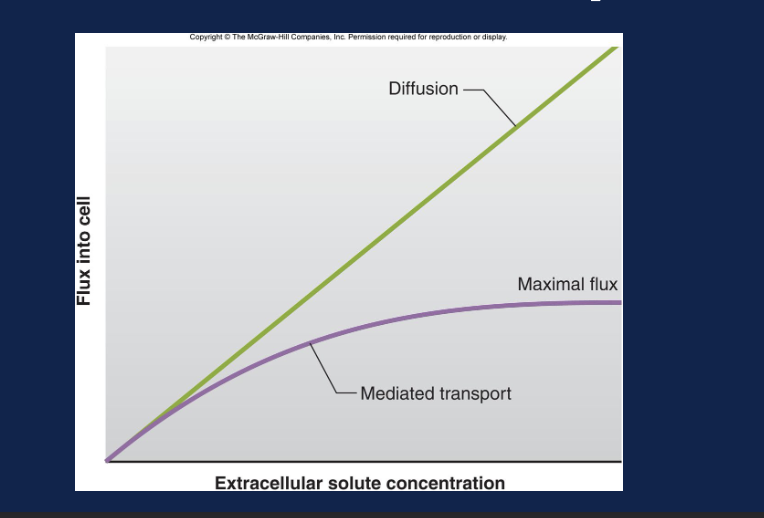
What does flux into the cell mean on the graph?
The rate of movement into the cell
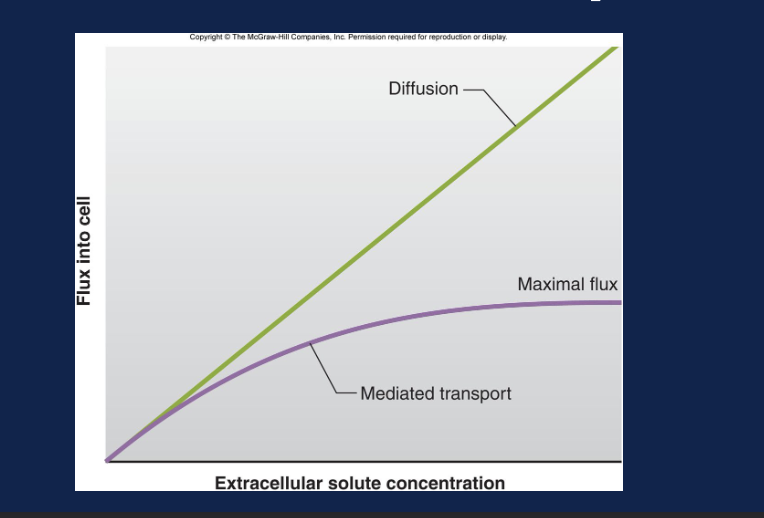
Which line on the graph represents simple diffusion?
The straight line that continues increasing
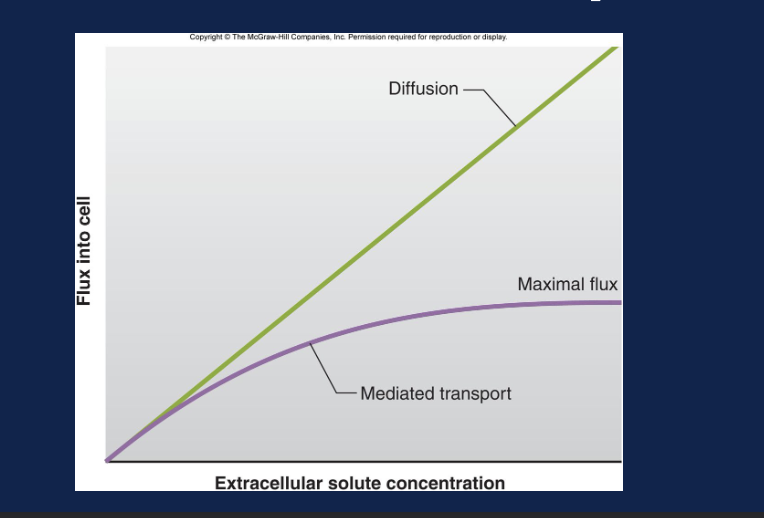
Why does the facilitated/mediated transport curve level off?
Because all available transport proteins become occupied
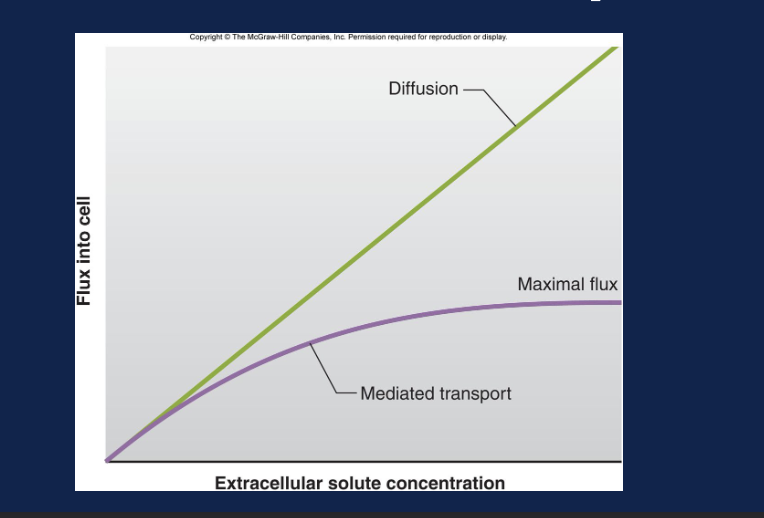
What does the plateau of the mediated transport curve represent?
Maximal flux/ transport maximum
Connection Card: Why does facilitated diffusion reach a transport maximum while simple diffusion does not in the graph?
Facilitated diffusion depends on a limited number of transport proteins, while simple diffusion does not require transport proteins
What does it mean when transport protein is regulated?
Its activity is being controlled
What are four ways transport proteins can be regulated according to the slide?
Binding of regulatory molecule
Changes in membrane potential
Covalent modification
Insertion or removal of transport proteins
How can binding of a regulatory molecule regulate a transport protein?
A regulatory molecule binds to the protein and changes its activity
What is membrane potential?
The electrical difference across the cell membrane
How can membrane potential regulate transport proteins?
Changes in membrane potential can change the transport protein activityWh
What type of covalent modification does the professor give as an example?
Phosphorylation
What is phosphorylation?
The addition of a phosphate group to a molecule/protein
ow can phosphorylation regulate a transport protein?
Adding a phosphate group can change the protein’s activity
How can the number of transport proteins in the membrane be regulated?
Transport proteins can be inserted into or removed from the membrane
Connection card: Why can inserting more transport proteins into the membrane increase transport?
It creates more available transport proteins for substances to use.
In other words: More transport proteins = more opportunities for substances to cross.
What is active transport?
Transport of molecules against their concentration gradient
In what direction does the active transport move molecules relative to their concentration gradient?
Low concentration → high concetration
Does active transport require energy?
Yes
Connection Card: Why does active transport require energy?
Because molecules are being moved against their concentration gradient
In other words: Moving low→ high is like moving uphill and requires energy
What are primary active transporters also called?
Pumps
What energy source is used directly by primary active transporters?
ATP
What are the three primary active transporters listed on the slide?
H+-ATPase
Ca2+-ATPase
Na+/K+-ATPase
What type of active transport is Na+-dependent cotransporter?
Secondary active transport
What provides the energy for Na⁺-dependent secondary active transport?
The Na+ concentration gradient
What is the major difference between primary and secondary active transport?
Primary → directly uses ATP
Secondary → uses energy stored in an ion gradient, such as Na+
Connection Card: How do diffusion and active transport differ in direction and energy use?
Diffusion: high → low, passive
Active transport: low → high, require energy
What type of transport is Na+/K+-ATPase?
Primary active transport
Why is the Na⁺/K⁺-ATPase considered primary active transport?
Because it directly uses ATP to transport ions
How many Na+ and K+ ions are moved by the Na+/K+-ATPase per cycle?
3Na+ OUT and 2 K+IN
Where do the 3 Na+ions initially bind to the Na+/K+pump?
On the inside of the cell
What happens to ATP after Na⁺ binds to the pump?
ATP is broken down and a phosphate is added to the pump.
What causes the Na⁺/K⁺ pump to change shape and release Na⁺ outside?
Phosphorylation of the pump