COORDINATE GEOMETRY
 Call Kai
 Learn
Learn Practice Test
 Spaced Repetition
 Match
Match Flashcards
 Knowt Play
1/3

Earn XP
Description and Tags
MATHS
Name | Mastery | Learn | Test | Matching | Spaced | Call with Kai | Chat |
|---|
No analytics yet
Send a link to your students to track their progress
4 Terms
Graphs
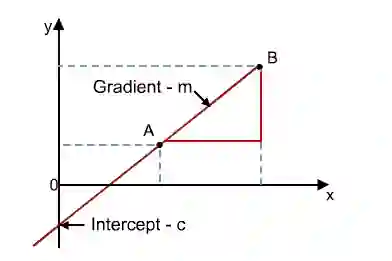
Gradient of a Straight Line
Measure of the steepness of a straight line
Gradient=y2−y1x2−x1Gradient=x2−x1y2−y1
Equation of a LineAx+By=C(General Equation of Line)Ax+By=C(General Equation of Line)xa+yb=1(Intercept Form)ax+by=1(Intercept Form)y=mx+c(Slope–Intercept Form)y=mx+c(Slope–Intercept Form)
m = gradient
c = y-intercept (the point the graph meets the y-axis)
Midpoint of GraphMidpoint=(x1+x22, y1+y22)Midpoint=(2x1+x2, 2y1+y2)Length between Two PointsDistance=(x2−x1)2+(y2−y1)2Distance=(x2−x1)2+(y2−y1)2Cartesian Coordinate System
They are written in the (x,y) for
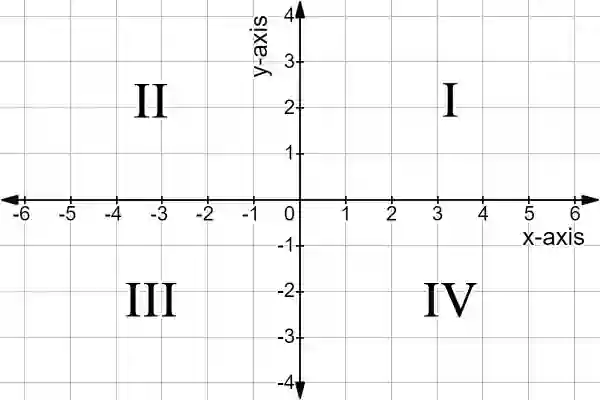
Quadrant 1: (x,y)
Quadrant 2: (-x,y)
Quadrant 3: (-x,-y)
Quadrant 4: (x,-y)
Sketching Graphs
Graphs
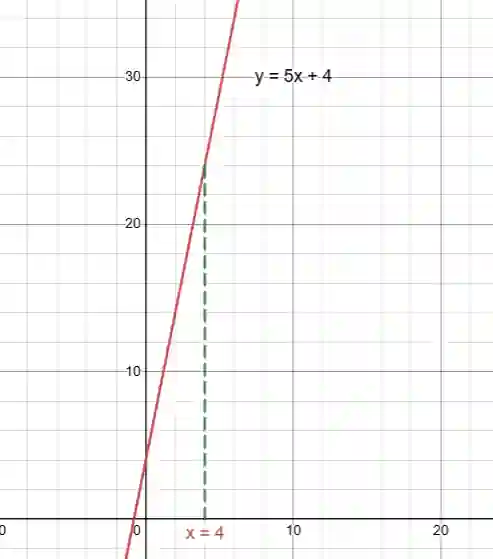
Step 1: Plot the y-intercept (c) on the graph
Step 2: Substitute x values (whole number values) into the equation and solve for y
Step 3: The substituted x value is the x coordinate, and the solved y value is the y coordinate
Step 4: Repeat for 4 more values and draw a straight line connecting these points
How to Derive Equation of Line from Graph
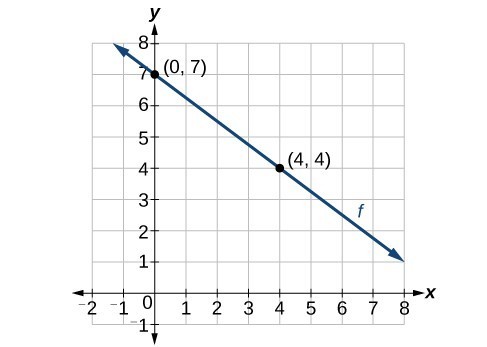
Find the gradient of (0,7)(0,7) and (4,4)(4,4):
m=y2−y1x2−x1m=x2−x1y2−y1
m=4−74−0m=4−04−7
m=−34m=4−3
Equation of the line: y=mx+cy=mx+c
y=−34x+cy=−43x+c
Substitute (0,7)(0,7):
7=−34(0)+c7=−43(0)+c
7=c7=c
Therefore, y=−34x+7y=−43x+7
Parallel Lines and Perpendicular Bisectors
Parallel Lines
Two lines are parallel if they share the same gradient but different y-intercepts
For eg, y=3x+5 and y=3x+12y=3x+5 and y=3x+12
Since the gradient of both lines is the same, and they have different y-intercepts, they are parallel to each other
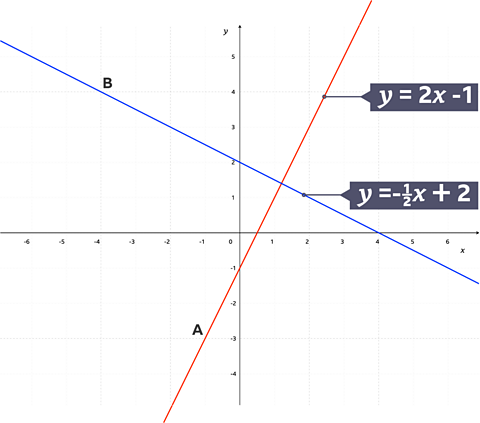
Perpendicular Lines
Two Lines are perpendicular if they meet at 90º
If Line A has a gradient m, then the gradient of Line B is -1/m
For eg, y=2x+4 and y=−12x+5y=2x+4 and y=2−1x+5
Two lines are perpendicular if the gradient of one line is the negative reciprocal of the other
Perpendicular Bisectors
Perpendicular Bisector is a line that intersects another line at its midpoint, and lies at an angle of 90º
Example:
Point A has coordinates (7, −17)
Point B has coordinates (19, −11)
We want the equation of the perpendicular bisector of AB.
Step 1: Midpoint
M= (x1+x22, y1+y22) M=(2x1+x2,2y1+y2)
M= (7+192, −17+(−11)2) M= (27+19,2−17+(−11))
M= (282) M= (226,2−28)
M= (14) M13, −14)
Step 2: Gradient of AB
m AB=y2−y1x2−x1mAB=x2−x1y2−y1
m AB=−11−(−17)19−7mAB=19−7−11−(−17)
m AB=612=12mAB=126=21
Step 3: Gradient of perpendicular bisector
m⊥=−1m AB=−2m⊥=−m AB1=−2
Step 4: Equation of perpendicular bisector
y−(−14) =−2(x−13) y−(−14) =−2(x−13)
y+14=−2x+26y+14=−2x+26
y=−2x+12y=−2x+12
Therefore, the equation of the perpendicular bisector is:
y=−2x+12y=−2x+12
COORDINATE
GEOMETRY