Fundamentals of Nursing & Medication Administration Flashcards
 Call Kai
 Learn
Learn Practice Test
 Spaced Repetition
 Match
Match Flashcards
 Knowt Play
1/84

Earn XP
Description and Tags
Vocabulary practice flashcards covering fundamental nursing concepts, historical figures, the nursing process, infection control, wound care, medication administration, health promotion models, and critical thinking principles.
Name | Mastery | Learn | Test | Matching | Spaced | Call with Kai | Chat |
|---|
No analytics yet
Send a link to your students to track their progress
85 Terms
Florence Nightingale
The first practicing epidemiologist who established a nursing philosophy based on health maintenance and restoration, improved battlefield sanitation, and organized the first nursing training program.
Clara Barton
The founder of the American Red Cross.
Lillian Wald & Mary Brewster
Pioneers who developed public health and home health nursing.
Novice
The first stage in Benner's proficiency model; refers to a nursing student or beginner with no previous experience in the field.
Advanced Beginner
The second stage in Benner's proficiency model; refers to a new graduate nurse possessing some level of clinical experience.
Competent
The third stage in Benner's proficiency model; describes a nurse who has held the same clinical position for 2–3 years.
Proficient
The fourth stage in Benner's proficiency model; describes a nurse who understands patient situations holistically.
Expert
The fifth stage in Benner's proficiency model; describes a nurse with a diverse background and an intuitive grasp of clinical situations.
Basic Critical Thinking
The initial level of critical thinking where a learner trusts experts, follows rules step-by-step, and thinks concretely.
Complex Critical Thinking
The intermediate level of critical thinking where the nurse analyzes alternatives, weighs risks and benefits, and recognizes that multiple options exist.
Commitment
The highest level of critical thinking where the nurse anticipates needs, makes independent clinical choices, and assumes full accountability.
Objective Data
Observable and measurable patient measurements or findings, such as vital signs, laboratory values, or wound color.
Subjective Data
Verbal statements or personal perceptions provided directly by the patient, such as pain scale ratings or expressed feelings.
Problem-Focused Diagnosis
A clinical judgment written in the format: [Problem] related to [Etiology/Cause] as evidenced by [Defining Characteristics/Symptoms].
Risk Diagnosis
A clinical judgment written as Risk for [Problem] as evidenced by [Risk Factors], containing no 'related to' etiology because the problem has not yet occurred.
SMART Goals
Patient-centered planning targets that are Specific, Measurable, Achievable, Realistic, and Timed.
Direct Care
Nursing interventions performed directly with the patient, including physical care, ADLs, lifesaving measures, teaching, and counseling.
Indirect Care
Nursing actions performed away from the patient, such as documentation, interprofessional collaboration, delegating, and managing the environment.
Active Natural Immunity
Immunity produced by contracting an actual disease, stimulating the body's immune system to produce antibodies.
Active Artificial Immunity
Immunity induced by vaccines, which stimulate antibody production without causing the disease.
Passive Natural Immunity
Transferred immunity received by a fetus or infant via the placenta or breast milk.
Passive Artificial Immunity
Immunity acquired through an intravenous immunoglobulin infusion providing direct preformed antibodies.
Contact Precautions
Transmission-based isolation requiring a gown and gloves for pathogens such as MRSA, VRE, and C. difficile (which requires handwashing with soap and water).
Droplet Precautions
Isolation precautions requiring a mask and eye protection when close to patients with pathogens like Influenza, Pneumonia, or Pertussis.
Airborne Precautions
Isolation precautions requiring an N95 respirator and a negative pressure room for airborne infections like Tuberculosis, Measles, or Varicella.
Protective Isolation
Neutropenic precautions designed to protect immunocompromised patients, prohibiting fresh flowers or raw produce and utilizing a positive pressure room.
Stage 1 Pressure Injury
Localized area of intact skin presenting with non-blanchable erythema.
Stage 2 Pressure Injury
Partial-thickness skin loss with exposed dermis, appearing as a shallow open ulcer with a pink/red wound bed or an intact/ruptured serum blister.
Stage 3 Pressure Injury
Full-thickness skin loss in which adipose tissue and epiboly (rolled edges) are visible, without exposure of bone, tendon, or muscle.
Stage 4 Pressure Injury
Full-thickness skin and tissue loss with exposed or palpable bone, tendon, ligament, or muscle.
Unstageable Pressure Injury
Full-thickness tissue loss where the extent of damage cannot be determined because the base is obscured by slough or eschar.
Deep Pressure Injury
Localized, non-blanchable deep red, maroon, or purple discoloration of intact/non-intact skin, or a blood-filled blister.
Dehiscence
The partial or total separation of wound layers.
Evisceration
Total separation of wound layers accompanied by the protrusion of visceral organs through the opening; requires application of sterile, saline-soaked gauze.
Maceration
Softening and tissue breakdown of skin resulting from continuous exposure to excessive moisture.
Serous Exudate
Clear, watery plasma wound drainage.
Sanguineous Exudate
Bright red wound drainage indicating active bleeding.
Serosanguineous Exudate
Pale, pink, watery wound drainage composed of a mixture of clear serum and blood.
Purulent Exudate
Thick, yellow, green, or brown wound drainage indicating an active infection.
Primary Prevention
Health intervention implemented before disease occurs to prevent onset, such as immunizations, seatbelt use, and health education.
Secondary Prevention
Screening and diagnostic measures targeted at detecting latent, asymptomatic disease early, such as mammograms or routine blood pressure screenings.
Tertiary Prevention
Rehabilitation and treatment measures aimed at minimizing disability from permanent or chronic conditions, such as physical therapy.
Quaternary Prevention
Action taken to protect patients from excessive medical interventions that cause more harm than good.
Precontemplation
The initial stage of change where an individual is unaware of a problem and has no intention to alter behavior.
Alarm Stage
The first phase of General Adaptation Syndrome (GAS) where fight-or-flight mechanisms trigger CNS stimulation and catecholamine release, elevating heart rate and blood pressure.
Resistance Stage
The second phase of GAS during which the body stabilizes and compensates to return to homeostasis.
Exhaustion Stage
The final phase of GAS where prolonged stress depletes energy reserves, resulting in allostatic load and vulnerability to illness.
Eustress
Positive stress that acts as a driver for motivation and growth.
Compassion Fatigue
A state of physical/emotional exhaustion combining burnout and secondary traumatic stress from caring for suffering individuals.
Second Victim Syndrome
Trauma experienced by healthcare providers following involvement in an unexpected clinical medical error.
Stereognosis
The ability to perceive and identify the size, shape, and texture of an object solely through tactile touch.
Proprioception
An awareness of body positioning and movement within spatial surroundings.
Six Rights of Medication Administration
Core safety verification standards ensuring right Patient, Right Route, Right Time/frequency, Right Drug, Right Dose, and Right Documentation.
Enteral Medication Administration
The delivery of liquid or crushed medications via NGT or PEG tubes, requiring a 30–40 mL water flush before and after medication, with the patient kept in Semi-Fowlers position (>30× elevation) for 30 minutes.
Otic Administration for Children ≤ 3 Years
Ear drop instillation technique requiring the pinna to be pulled down and back before administering room-temperature drops.
Otic Administration for Patients ≥ 4 Years
Ear drop instillation technique requiring the pinna to be pulled up and back before administering room-temperature drops.
Inhalation Medication Protocol
Administration rule requiring bronchodilators to be given before steroids, waiting 1–2 minutes between puffs, and rinsing the mouth after steroid inhalers.
Rectal Suppository Insertion
Procedure where the lubricated medication is inserted with a gloved finger past the sphincter 3–4 inches aiming toward the umbilicus in Left Lateral Sims position, retaining for 30–40 minutes.
Ventrogluteal Injection Site
Preferred deep intramuscular site for adults requiring a 1–1.5 inch needle (18–25 gauge) inserted at a 90× angle, holding up to 3 mL of solution without aspiration.
Z-Track Method
An intramuscular injection technique designed to pull skin laterally during injection to seal painful, irritating, or staining medications (like iron) in the muscle.
Subcutaneous Injection
Parenteral delivery into fatty tissue at a 45–90× angle using a needle length <1 inch (25–31 gauge), with fluid volume capped at 1 mL.
Intradermal Injection
Parenteral insertion just under the epidermis at a 10–15× angle with bevel up using a short needle (26–27 gauge, 1/4–1/2 inch) to produce a wheal, such as in PPD testing.

Syringe Measurement
The correct technique of measuring liquid dosage inside a syringe aligned with the top black rubber ring (shoulder), not the pointed cone tip.
Mixing Regular and NPH Insulin
The process of drawing Regular (clear) insulin first before NPH (cloudy) insulin into the same syringe to avoid contaminating short-acting vials with long-acting solution.
Orthostatic Hypotension
A diagnostic drop in blood pressure defined by a decrease of →20 mmHg in systolic pressure or →10 mmHg in diastolic pressure within 1–3 minutes of changing positions from supine to sitting or standing.
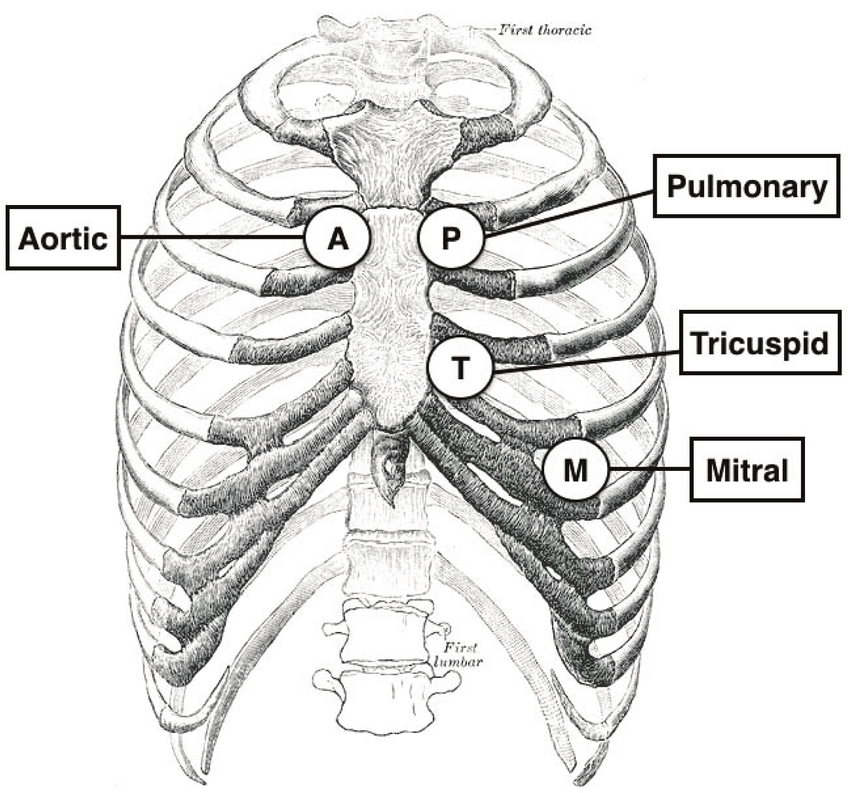
Cardiac Valve Auscultation Sites (APETM)
Landmarks for heart sound auscultation: Aortic (Right 2nd ICS), Pulmonic (Left 2nd ICS), Erb's Point (Left 3rd ICS), Tricuspid (Left 4th ICS), and Mitral (Left 5th ICS mid-clavicular line).
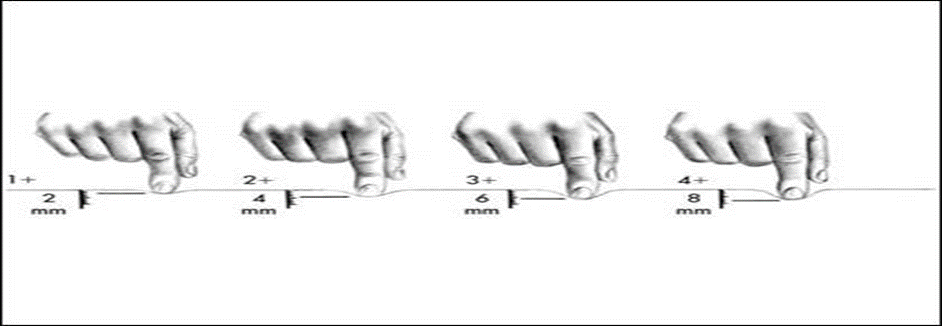
Pitting Edema Scale
Clinical grading system measuring depression depth: 1+ (2 mm), 2+ (4 mm), 3+ (6 mm), and 4+ (8 mm).
Health
A state of complete physical, mental, and social well-being and not merely the absence of disease or infirmity, as defined by the World Health Organization (WHO).
Social Determinants of Health (SDOH)
Environmental factors where people are born, live, learn, work, play, worship, and age; divided into Economic Stability, Education Access/Quality, Health Care Access/Quality, Neighborhood/Built Environment, and Social/Community Context.
Acute Illness
An abnormal condition characterized by abrupt onset, severe symptoms, and short duration.
Chronic Illness
An ongoing impairment or loss of body function lasting >6 months requiring long-term management.
Exacerbation
An acute flare-up or worsening period of symptoms in a client with a underlying chronic illness.
Health Belief Model
A psychological model examining how patient attitudes, perceptions of disease severity, and self-efficacy predict willingness to take preventive action.
Health Promotion Model
A framework defining health as a positive, dynamic state of well-being rather than just the absence of disease.
Health-Illness Continuum
A conceptual scale viewing health as a dynamic, fluctuating state ranging from high-level wellness to death on opposite ends.
Nuclear Family
A traditional family structure composed of two parents and their biological or adopted children.
Blended Family
A family unit formed when two parents bring unrelated children from prior relationships into a shared household.
Cultural Assimilation
The process whereby a minority individual or group absorbs the traits of a dominant culture, shedding original unique characteristics.
Culture Shock
Psychological discomfort or anxiety felt when placed into an unfamiliar cultural setting.
Cultural Imposition
The practice of imposing one's own cultural beliefs and values onto individuals from another background.
Ethnocentrism
The belief that one's own cultural beliefs, values, and practices are superior to those of other groups.
Cultural Humility
A lifelong commitment to critical self-reflection, continuous learning, and recognizing power imbalances while building respectful partnerships.
Nutrix
The Latin root word meaning 'to nourish', from which 'nursing' originates.
Nurse Practice Acts (NPAs)
State legislative statutes overseen by State Boards of Nursing that regulate nursing scope of practice and safeguard public welfare.
Clinical Judgment
The observable clinical outcome resulting from systematic critical thinking and decision making in professional nursing.