Exam 3 Health Assessment Fortis College
 Call Kai
 Learn
Learn Practice Test
 Spaced Repetition
 Match
Match Flashcards
 Knowt Play
1/162

There's no tags or description
Looks like no tags are added yet.
Name | Mastery | Learn | Test | Matching | Spaced | Call with Kai | Chat |
|---|
No analytics yet
Send a link to your students to track their progress
163 Terms
What is lethargy?
Limited spontaneous movement, sluggish speech, drowsy, falling asleep quickly
What is obtunded?
Confused, Sleeps most of the time, difficult to wake. Speech mumbled and difficult to wake.
What is delirium?
Acute confusional change or loss of consciousness and perceptual disturbance
What is stupor?
Partial or almost complete unconsciousness. Spontaneous consciousness, has appropriate motor response.
What clinical symptoms does the nurse assess in a patient with posttraumatic stress syndrome?
Relives trauma, same feelings arise. Avoidance of triggers, hypervigilance, sleep problems, difficulty concentrating, leading to feelings of perm damage. High Anxiety!
What are illusions?
misperceptions of real external stimuli
What are delusions?
fixed false beliefs
What is hypochondriasis?
Morbid worrying about own health. Feels sick with no actual reason.
What are hallucinations?
false sensory experiences, such as seeing something in the absence of an external visual stimulus
How does the nurse assess for Dysarthria?
Assess if the patient is able to form words and articulation is clear and understandable
How does a nurse assess for Dysphonia?
Judge the quality of speech by noting if the person makes laryngeal sounds effortlessly and shares conversation appropriately.
How does the nurse assess for Aphasia?
Word choice is effortless and appropriate for educational level. The person completes sentences and pauses to think.
How is orientation usually lost?
First to time, then to place and rarely to person.
How does recent memory defecate occur?
delirium, dementia, amnestic syndrome, or Korsakoff syndrome in alcoholics.
What are the four main headings in mental status assessment?
ABCT- Appearance, Behavior, Cognition and Thought process.
What is mental status?
a person's emotional and cognitive functioning
What is a mental disorder?
a significant impairment in psychological functioning
What are the two reasons most people seek medical care?
Anxiety and depression
What is the PHQ-2
A screening tool for depression
What is the Mini-Mental State Examination?
It is an examination done to assess a client's cognitive status by evaluating the following:
a. Orientation to time and place
b. Attention span and ability to calculate by counting backward by seven
c. Registration and recalling of objects
d. Language: including naming objects, following commands, and ability to write
If a person is alert
They are awake and readily aroused
If a person is in a coma
They are completely unconscious
What is Broca's aphasia?
"broken speech", trouble speaking, halting/jarring speech but you can understand what people are saying"
What is global aphasia?
Both receptive and expressive
What is Wernicke's aphasia?
"fluent aphasia", nothing the person says makes logical sense and you have trouble understanding"
What is systole?
Contraction of the heart. Emptying of the blood into the ventricles. as pressure within the ventricles rises, the mitral and tricuspid valves snap shut. This produces the first heart sound, S1.
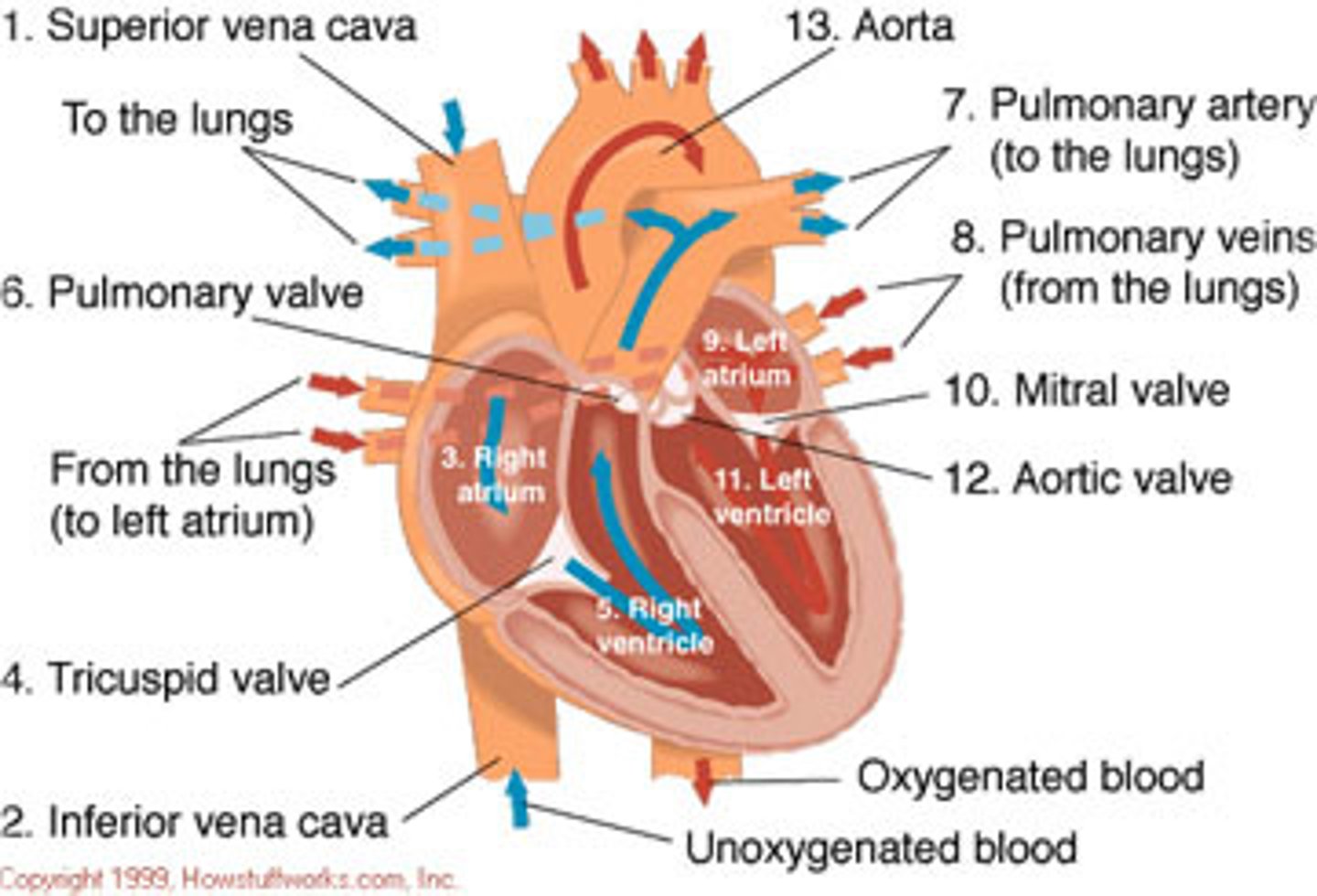
How does blood flow through the heart?
Inferior and superior vena cava (1) dump blood into the right atrium (2)
Right ventricle (3)
2 pulmonary arteries (4) that lead to the lungs (5) where blood becomes oxygenated
Pulmonary veins (6) bring blood from the lungs back to the left atrium (7)
Left ventricle (8) is large and muscular to pump blood into the aorta (9) and to the rest of the body (10)
Eventually blood will be pumped back to each vena cava (1)
What is mitral stenosis?
narrowing of the mitral valve. due to calcification.
What heart sound do you hear with mitral stenosis?
S1 heart sound is accentuated, opening snap after the S2 heard over wide area of the pericardium followed by a murmur.
What is a murmur?
gentle, blowing, swooshing sound that can be heard on the chest wall. Low pitched diastolic rumble between S1 and S2 heart sounds.
When does the S1 heart sound occur?
At the beginning of systole (end of diastole). LUB
When does the S2 heart sound occur?
At the beginning of Diastole (end of systole). DUB
When does the S3 heart sound occur?
Immediately after S2
When does the S4 heart sound occur?
before S1 at the end of diastole
What activity is associated with a P-Wave?
Repolarization of the Atria
What is the QRS complex?
depolarization of the ventricles
What is the T wave?
repolarization of ventricles
What is a bruit?
turbulent blood flow
How does a bruit sound?
Blowing or Swishing
Where is a spot you can hear a Bruit?
The Carotid Artery
A PT has a possible stroke what does the term FAST stand for?
F- Face
A- Arm Weakness
S- Speech Difficulty
T- Time to call 911
What is the correct technique to assess the vessels in the neck in an older person?
Keep the neck in neutral position use the bell of the stethoscope.
What is the range for a normal heart rate in a healthy young adult?
60-100 BPM
Where does the nurse place the stethoscope to listen to the carotids?
angle of the jaw, at the base of the neck and midclavicular at the middle of the neck
How do you grade a pulse?
4+= Bounding 3+=Increased 2+= Normal 1+=weak 0= absent
What does the spleen do?
filters blood, stores RBC, produces antibodies
What does a tangential light do?
Uses light and shadows to point out imperfections
What is dyspnea?
shortness of breath
What is orthopnea?
difficulty breathing while lying down
What is cyanosis?
blue discoloration of the skin
What is pallor?
Pale skin
What is nocturia?
excessive urination at night
What does APE MAN stand for?
aortic, pulmonic, erb's point, tricuspid, mitral
Where do you find the apical impulse?
4-intercostal space @ or inside the midclavicular line
What is peripheral arterial disease?
disease of blood vessels supplying the arms and legs
Where are the major pulses nurses feel for?
Temporal, Cortaid, Brachial, Radial, Tibial, Aortic, Femoral, Popliteal, Dorsalis Pedis, Apical, Tibias Posterior.
The Physician tells you that the patient has an arterial obstruction in the foot what finding would you expect?
Absent pulse
The Patient has arterial insufficiency of the lower extremities. Which assessment finding would confirm that condition?
Using a doppler
What order does the heart layers go in from outside to inside?
Pericardium, Myocardium, Endocardium
When do the AV valves open?
during diastole, or the hearts filling faze.
What are the AV valves?
tricuspid and mitral
What is considered the pace maker of the heart?
SA node
What order does electrical impulse come in from the heart?
SA Node, AV Node, Bundle of His, Bundle Branches
How do you calculate cardiac output
CO=HRxSV
What is preload?
venous return that builds during diastole
What is afterload?
peripheral resistance against which the left ventricle must pump
What are the risk factors peptic ulcer disease?
frequent use of NSAIDs, alcohol, smoking, h. pylori infection
What is a pulse deficit?
the difference between the apical pulse and the radial pulse
How do you calculate pulse deficit?
apical pulse minus radial pulse
What quadrant is the liver located in?
RUQ
What quadrant is the stomach, spleen and pancreas located in?
LUQ
What quadrant is the sigmoid colon located in?
LLQ
The patient has hyperactive bowl sounds (Borborygmus). What are the common causes of this activity?
Increased motility, Early mechanical bowl obstruction, Gastroenteritis, Brisk Diarrhea, laxative use, subsiding paralytic ulcers.
What are the symptoms of appendicitis? which quadrants are involved?
starts with dull diffused preumbilicial pain shifts to sever sharp persistent pain. Pain an tendinous a RLQ (McBurney Point). Aggravated by movement and coughing. PT may exhibit deep breathing, anorexia, nausea, vomiting and fever.
What test can the nurse use to test for appendicitis?
Iliopsoa muscle test- Person in supine position, lift the right leg straight up, flexing at the hib; then push down over the lower part of the right thigh as the person as the person tries to hold up the left leg. test is negative is the person feels no pain.
Rebound test (Blumberg sign)- Push down slowly and deeply and lift up quickly. Negative if there is no pain.
The nurse need to assess the PT spleen what is the first step in this assessment?
Reach Left hand over the abdomen and behind the left side at the 11th and 12th rib. Lift hand up for spleen
What are the symptoms of kidney stones?
Dysuria (pain when urinating)
Haematuria (blood in urine)
Reduced urine flow
Low back pain
Renal colic (pain)
Strangury (pain inhibiting micturition)
Fever
The nurse notes tender sigmoid colon in the PT being assessed. What is the significance of this finding?
Normal
What are the correct steps in abdominal assessment?
1) Void first
2)Inspect
3)Auscultate
4)Percuss
5) Palpate
What is the first step in assessing the liver?
You always palpate LAST!!
Why is assessment of the liver and liver functions so important in older adults with regards to medication?
Drug Metabolism is impaired bc of blood flow through the liver and the liver size is decreased. Prolonged liver metabolism caused increased side effects.
What is the typical color and shape of striae? Why do pregnant women often develop these?
silvery, white, linear and jagged. occurs due to elastic fibers in the reticular layer of the skin are broken after rapid or prolonged stretching.
PT falls sustaining possible injuries. what assessment technique does the nurse do first?
Inspection for dilation
How is Phalen's Test done? what is normal?
Hold both hands back to back while flexing muscles in arms. normal if no symptoms.
A Pt walks up the stair and hears "crunching" sounds? What word describes what the patient is experiencing?
Crepitation
What is grade 5 muscle testing result
Full ROM against gravity, full resistance
What is grade 4 muscle testing result
Full ROM against gravity, some resistance
What is grade 3 muscle testing result
Full ROM w/ Gravity
What is grade 2 muscle testing result
Full ROM w/ gravity is eliminated
What is grade 1 muscle testing result
short contractions
what is grade 0 muscle testing result
no contractions
A PT tells the nurse she has osteoarthritis. what question(s) will the nurse ask the PT about joints?
Any stiffness or swelling? Heat, tenderness to joints? Limitation of movement.
What leads to accelerated bone loss in older women?
Menopause b/c of lack of estrogen. BMI underweight.
Moving arms to the side and slightly inward would be call what kind of ROM?
Adduction
Moving the hips and knees away from the body is call what kind of ROM?
Abduction
Standing up is what kind of ROM?
Extension
Walking on your heels is what kind of ROM?
Dorsal Flexion
The spine has how many connecting bones?
33
There are how many cervical bones in the body?
7
There are how many lumbar bones in the body?
5