A&P Chapter 1 Study Guide
 Call Kai
 Learn
Learn Practice Test
 Spaced Repetition
 Match
Match Flashcards
 Knowt Play
1/144

There's no tags or description
Looks like no tags are added yet.
Name | Mastery | Learn | Test | Matching | Spaced | Call with Kai | Chat |
|---|
No analytics yet
Send a link to your students to track their progress
145 Terms
Anatomy
Study of internal and external structure and relationships among body parts
Physiology
Study of how body parts work to perform vital functions
Gross (macroscopic) anatomy
Study of large body structures visible to the naked eye
Regional anatomy
Looks at structures in a particular area
System anatomy
Looks at one system
Surface anatomy
Looks at internal structures as they relate to overlying skin (visible muscle, or veins seen on serface)
Microscopic anatomy
Deals will structures to small to be seen with the naked eye
Cytology
Study of cells
Histology
Study of tissues
Developmental anatomy
Traces structural changes that occur throughout the life span
Embryology
Study of developmental changes that occur before birth
Renal physiology
Study of the functions of the kidney
Neurophysiology
Study of the functions of the nervous system
Cardiovascular physiology
Study of the functions of the heart and blood vessels
Chemical level
Atoms and molecules
Cellular level
Cells and their organelles
Tissue level
Groups of similar cells
Organ level
Contains two or more types of tissues
Organ system level
Organs that work closely together
Organismal level
All organ systems combined to make the whole organism
What are the levels of Structural Organization
Chemical level
Cellular level
Tissue level
Organ level
Organ system level
Organismal level
What are the 11 Organ Systems
Integumentary
Skeletal
Muscular
Nervous
Endocrine
Cardiovascular
Lymphatic
Respiratory
Digestive
Urinary
Reproductive
Whats Integumentary System major functions
- Forms the external body covering (nails, hair)
- Protects deeper tissues from injury
- Synthesizes vitamin D
-Houses pain/pressure receptors, sweat & oil glands
Whats Skeletal System major functions
- Protects and supports body organs
- Provides framework for muscles
- Stores minerals
- Blood cells form within bones
Whats Muscular System major functions
- Allows movement
- Maintains posture
- Produces heat
Whats Nervous System major functions
- Fast‑acting control system
- Responds to internal/external changes
- Activates muscles and glands
Whats Endocrine System major functions
- Glands secrete hormones
- Regulates growth, reproduction, and metabolism
Whats Cardiovascular System major functions
- Blood vessels transport blood
- Blood carries oxygen, CO₂, nutrients, wastes
Whats Lymphatic System major functions
- Returns leaked fluid to blood
- Disposes of debris
- Houses immune cells (lymphocytes)
- Mounts immune response against foreign substances
Whats Respiratory System major functions
- Keeps blood supplied with oxygen
- Removes carbon dioxide
Whats Digestive System major functions
- Breaks down food
- Absorbs nutrients into blood
- Eliminates indigestible food as feces
Whats Urinary System major funtions
- Eliminates nitrogenous wastes
- Regulates water, electrolytes, and acid‑base balance
whats Reproductive System major functions
Produces offspring
Responsiveness (excitability)
Ability to sense changes (stimuli) in the environment and respond to them
Excretion
Removal of wastes from digestion and metabolism
Reproduction
- At the cellular level, reproduction involves division of cells for growth or repair
- At the organismal level, reproduction is the production of offspring
What are the Survival Needs
Nutrients
Oxygen
Water
Normal Body Temperature
Appropriate Atmospheric Pressure
Homeostasis
Maintenance of relatively stable internal conditions despite continuous changes in the envirnment
Law of mass balance
Steady state in which the total amount of substance the body takes in must be equal to the amount it loses
Receptor (sensor)
- Monitors environment
- Responds to stimuli—changes in a variable that evoke a response
- Sends information to the control center (input)
Control center
- Receives input from receptor
- Determines set point and appropriate response to input
- Sends information to the effector (output)
Effector
- Receives output from control center
- Provides the means to respond (via muscle or gland)
- Response either reduces (negative feedback) or enhances (positive feedback) the effect of the stimulus
Negative feedback
- Most feedbacks
- Responce reduces or shuts off the original stimulus
Positive feedback
Response enhances or exaggerates the original stimulus
Anatomical position
Body erect, feet slightly apart, palms facing forward with thumbs pointing away from body
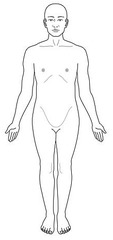
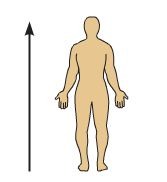
Superior
Above/toward the head
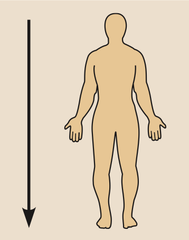
Inferior
Below
Anterior (ventral)
Front/in front of
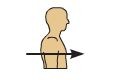
Posterior (dorsal)
Back/behind something

Medial
Toward the midline/inner
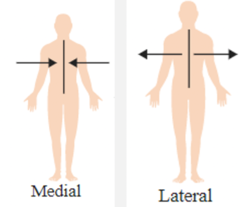
Lateral
Away from midline/outer
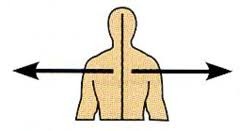
Intermediate
Between medial and lateral

Proximal
Closer to the point of attachment

Distal
Farther from the point of attachment
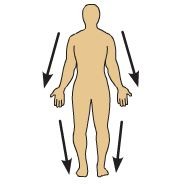
Superficial
Towards the surface (skin is superficial to the skeletal muscles)
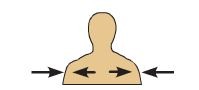
Deep
away from surface (lungs are deep to the skin)

What are the two major divisions of the body?
Axial
Appendicular
Axial part
Main axis of our body
- Head, neck, trunk
Appendicular part
Appendages or limbs; attached to body's axis
- legs and arms
Cephalic
Head

Frontal
Forehead

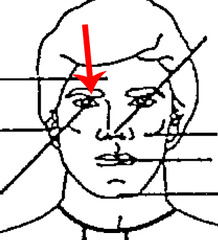
Orbital
Eye
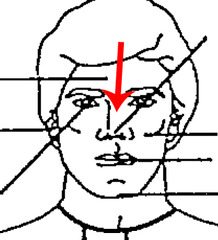
Nasal
Nose
Buccal
Cheek

Oral
Mouth
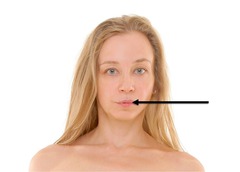
Mental
Chin

Cervical
Neck
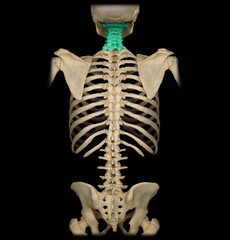
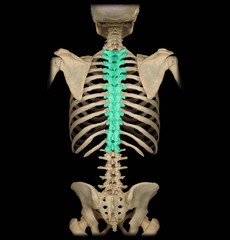
Thoracic
Chest
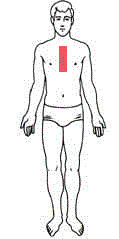
Sternal
Breastbone
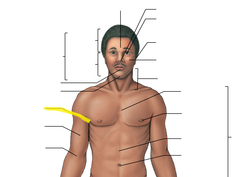
Axillary
Armpit
Mammary
Breast

Abdominal
Abdomen

Umbilical
Navel

Pelvic
Pelvis

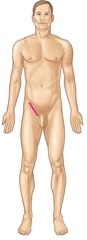
Inguinal
Groin
Pubic
Genital region

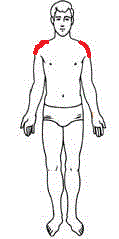
Acromial
Shoulder
Brachial
Arm
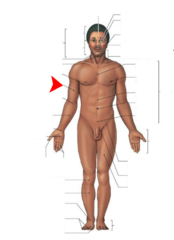
Antecubital
Front of elbow
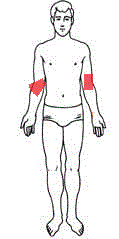
Antebrachial
Forearm

Carpal
Wrist

Palmar
Palm
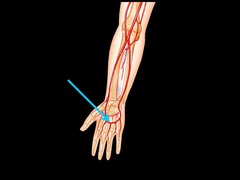
Digital
Fingers
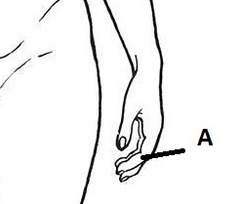
Pollex
Thumb

Coxal
Hip

Femoral
Thigh

Patellar
Kneecap
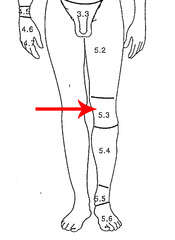
Crural
Leg

Fibular or Peroneal
Side of leg
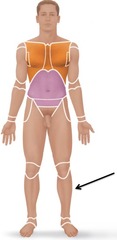
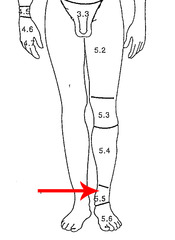
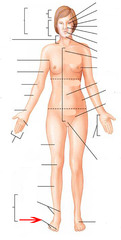
Tarsal
Ankle
Digital
Toes
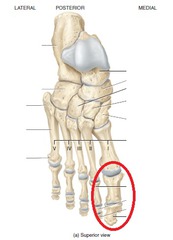
Hallux
Big toe
Anterior / Ventral Region
Front
Posterior / Dorsal
Back
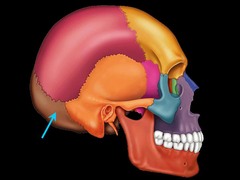
Occipital
Back of head
Scapular
Shoulder blade
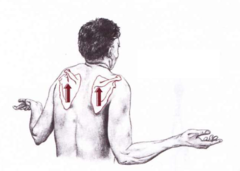
Vertebral
Spine

Lumbar
Lower back

Sacral
Area between hips

Gluteal
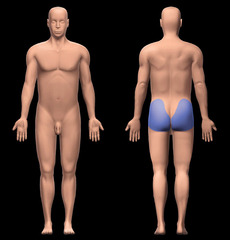
Buttock