Exam 2 End of Lecture Questions
 Call Kai
 Learn
Learn Practice Test
 Spaced Repetition
 Match
Match Flashcards
 Knowt Play
1/21

There's no tags or description
Looks like no tags are added yet.
Name | Mastery | Learn | Test | Matching | Spaced | Call with Kai | Chat |
|---|
No analytics yet
Send a link to your students to track their progress
22 Terms
A young child tastes seltzer water for the first time and exclaims “It’s spicy” even though seltzer contains no capsaicin or other classic “spicy” compounds. This perceptual confusion is best explained by which neural coding principle?
a) population coding
b) labeled line coding
c) temporal coding
d) cortical plasticity
b) labeled line coding
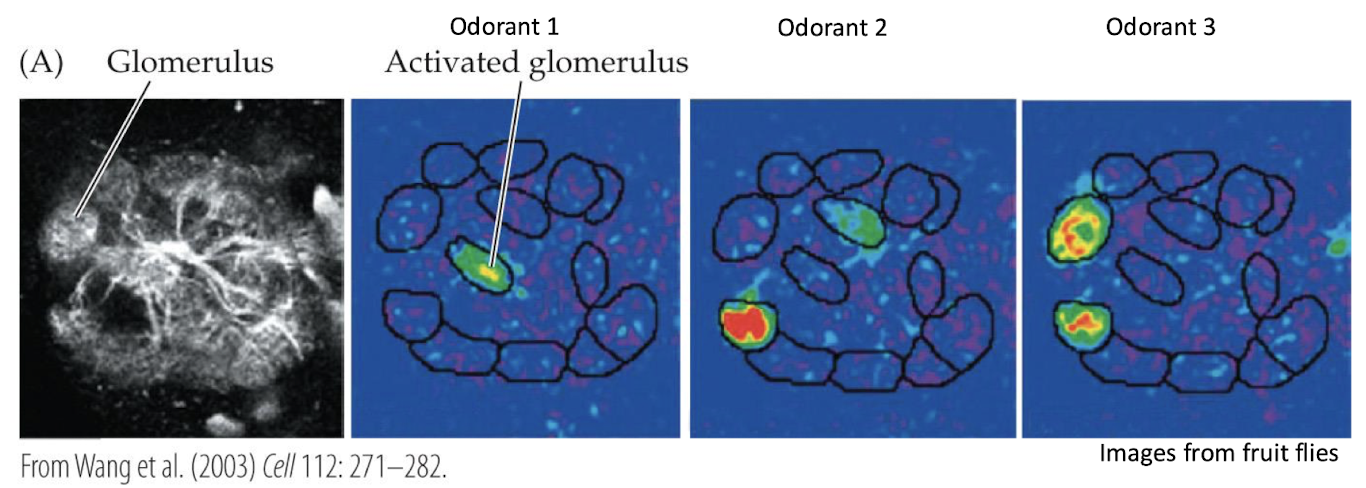
Which technique was most likely used for these experiments in the fruit fly?
a) fMRI
b) PET
c) calcium imaging
d) EEG
c) calcium imaging
“1 bipolar neuron may activate 8,000 glomeruli” this is an example of
a) divergence
b) convergence
c) transduction
d) translation
a) divergence
With increasing receptor convergence you get ___ resolution and ___ sensitivity
a) increasing, increasing
b) increasing, decreasing
c) decreasing, increasing
d) decreasing, decreasing
c) decreasing, increasing
A cortical map refers to the organized representation of sensory or motor information across the surface of the cerebral cortex, in which:
a) neurons are randomly distributed with no relationship between their location and function
b) adjacent regions of a receptor surface (like the skin or retina) are represented by adjacent regions of cortex, preserving spatial or topographic relationships
c) each cortical neuron responds equally to all locations on the sensory surface
d) only the primary motor cortex contains organized representations, while sensory cortices do not
b) adjacent regions of a receptor surface (like the skin or retina) are represented by adjacent regions of cortex, preserving spatial or topographic relationships
Better spatial resolution corresponds to:
a) smaller receptive fields
b) larger receptive fields
c) spatial resolution does not depend on receptive field size
a) smaller receptive fields
A person walks into a bakery and initially notices a strong smell of fresh bread, but the smell seems to fade after a few minutes even though the odor concentration in the air hasn’t changed. Separately, a startled mouse stops jumping in response to a repeated loud tone after hearing it 20 times, but if a novel stimulus (like a light flash) is introduced, the mouse’s startle response to the tone returns. What best distinguishes the mechanisms underlying these two phenomena?
a) both are identical processes just occurring in different sensory systems
b) sensory adaptation; habituation
c) habituation; sensory adaptation
b) sensory adaptation; habituation
Retinal cones are concentrated…
a) in the fovea of the retina
b) in the optic disc of the retina
c) in the retinal periphery
d) at an ice cream parlor
a) in the fovea of the retina
The receptive field sizes of retinal ganglion cells receiving information from cones tends to be ___ than those receiving input from rods
a) larger
b) smaller
c) same size
b) smaller
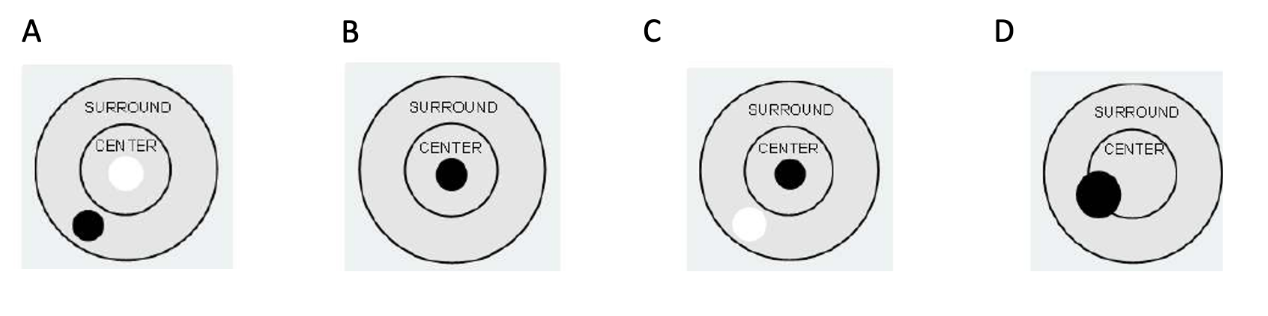
Which stimulus in the receptive field would evoke the largest response in an OFF-center retinal ganglion cell?
C!!! OFF-center RGCs are activated when there is a darker region in the center of their receptive fields. While this is true for B and C, C has a bright spot in the surround. The surround always is antagonist to the center, so the bright spot in the surround increases the firing rate even more.
Lateral inhibition in the retina, which underlies center-surround antagonism, is primarily mediated by which cell type?
a) photoreceptors
b) amacrine cells
c) horizontal cells
b) bipolar cells
c) horizontal cells
Based on what we learned about receptive fields, which cell likely has higher spatial acuity?
a) midget
b) parasol
a) midget
What do you think the function of the retinal-superior colliculus pathway is?
a) diurnal cycles
b) perception
c) head orientation
d) reflexes to light
c) head orientation
What aspect of light sensing may these ipRGCs may be involved in?
a) color vision
b) night vision
c) circadian rhythms
d) light sensitivity
c) circadian rhythms
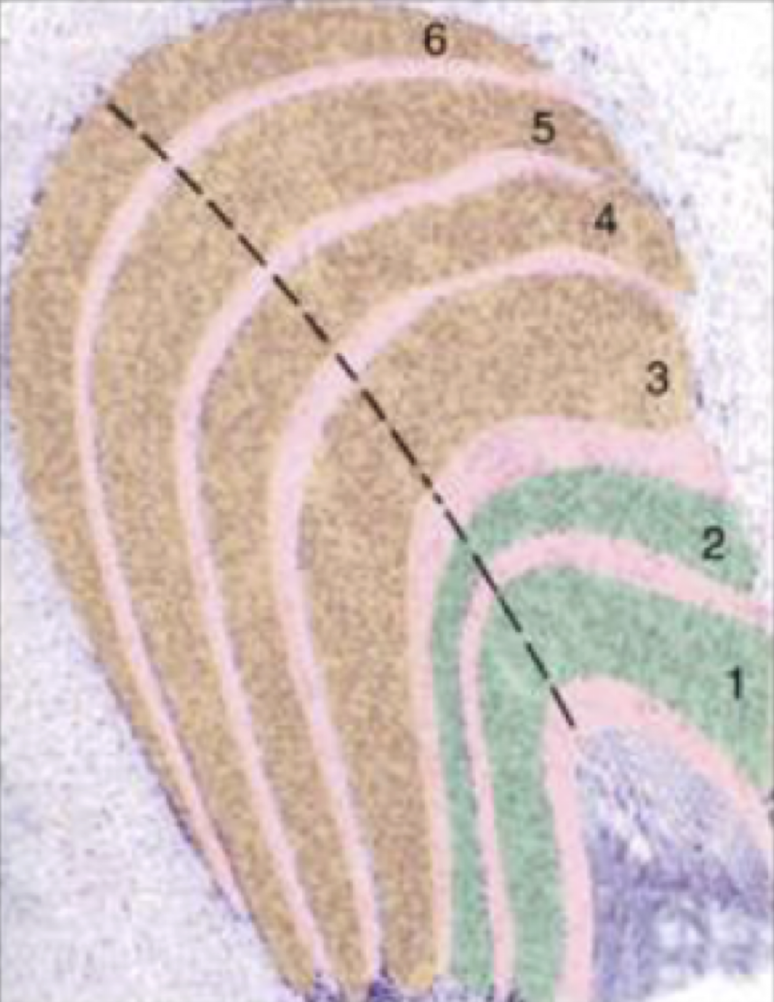
The cells in the shaded green part of the LGN are
a) koniocellular
b) parvocellular
c) magnocellular
d) stellarcellular
c) magnocellular
In what layer of V1 do you start to have depth-sensitive neurons?
a) layer VI
b) layer IV
c) layer II
d) layer I
b) layer IV
A patient with a rare genetic condition shows an absence of ocular dominance columns in V1 (confirmed via post-mortem histology) but has otherwise normal binocular vision, including stereopsis. This found would be MOST surprising given that:
a) ocular dominance columns are traditionally thought to be irrelevant to binocular function
b) ocular dominance columns are located in the retina, not the cortex
c) stereopsis is classically thought to depend on convergence of segregated monocular inputs
d) binocular vision does not require any cortical processing
c) stereopsis is classically thought to depend on convergence of segregated monocular inputs
Consider two V1 neurons: Neuron A has a receptive field 0.1 degree in diameter at the fovea; Neuron B has a receptive field 2 degrees in diameter located 40 degrees into the periphery. A researcher proposes that despite this size difference, both neurons occupy roughly similar amounts of cortical tissue in terms of synaptic input complexity. What principle explains why foveal and peripheral neurons might have comparable local processing despite vastly different receptive field sizes?
a) Cortical magnification compensates for the changing sampling density of retinal ganglion cells across eccentricity, allocating disproportionate cortical territory to central vision
b) Retinal magnification compensates for the changing sampling density of geniculate relay cells across eccentricity, allocating disproportionate subcortical territory to central vision
c) Cortical magnification compensates for the changing conduction velocity of optic nerve fibers across eccentricity, allocating disproportionate cortical territory to peripheral vision
d) Receptive field magnification compensates for the changing density of cortical layer IV neurons across eccentricity, allocating disproportionate retinal territory to central vision
a) Cortical magnification compensates for the changing sampling density of retinal ganglion cells across eccentricity, allocating disproportionate cortical territory to central vision
A researcher performs 2-deoxyglucose (2-DG) metabolic labeling in an animal viewing a stimulus containing color but no defined contours or edges (e.g., isoluminant color patches). Based on the known organization of V1 and V2, labeling would be expected to be HIGHEST in
a) V1 interblobs and V2 pale/interstripes
b) V1 layer 4B and V2 thick stripes
c) V1 layer VI exclusively
d) V1 blobs and V2 thin stripes
d) V1 blobs and V2 thin stripes
A patient with bilateral parietal lobe damage (dorsal stream) but intact temporal lobe (ventral stream) is shown a picture of a cup and asked to (1) verbally identify the object and (2) reach out and grasp it appropriately. Based on the what/where(how) framework, which pattern of performance would be predicted?
a) Normal identification of the object, but impaired/poorly-scaled grasping and reaching
b) Impaired identification, but normal grasping
c) Both identification and grasping would be equally impaired
d) Neither task would be affected since parietal cortex is unrelated to vision
a) Normal identification of the object, but impaired/poorly-scaled grasping and reaching
The primary visual cortex may have information about a stimulus that is unable to be utilized if there is damage to one of the “higher order” or more specialized processing area?
true or false?
True
The stimulus below will activate which visual pathway?
a) dorsal, in temporal lobe
b) dorsal, in parietal lobe
c) ventral, in temporal lobe
d) ventral, in parietal lobe
c) ventral in temporal lobe