Intro to Vector-Borne diseases
 Call Kai
 Learn
Learn Practice Test
 Spaced Repetition
 Match
Match Flashcards
 Knowt Play
1/68

There's no tags or description
Looks like no tags are added yet.
Name | Mastery | Learn | Test | Matching | Spaced | Call with Kai | Chat |
|---|
No analytics yet
Send a link to your students to track their progress
69 Terms
What are some examples of flea-borne pathogens and diseases?
Cat scratch disease, flea-borne spotted fever, plague, murine typhus
What are some examples of factors that are driving emergence/reemergence of vector-borne diseases?
Land use changes
Unknown factors
Climate/whether related
Global trade and travel
Vector adaptation
Pathogen factors
Host factors
What is the causative agent of Rocky Mountain Spotted Fever (RMSF)?
Rickettsia rickettsil
What is spotted fever rickettsiosis? (SFR)
Group of diseases caused by closely related Rickettsia species
Which SFR is the most common and most serious SFR in the USA?
Rocky Mountain Spotted Fever
What type of bacterium is R. rickettsil?
Obligate intracellular bacterium
How is R. rickettsii maintained?
Usually maintained in cycle between small mammals (rodents, lagomorphs) and biological vectors (several tick species)
Who are incidental hosts in the transmission cycle of R. rickettsil?
Humans and in most cases dogs
When can dogs be potential reservoir hosts for RMSF?
When the vector is brown dog tick
The American dog tick is commonly associated with transmission of RMSF in what areas of the US?
Middle-eastern US and California
The Rocky Mountain Wood tick is associated with transmission of RMSF in what part of the US?
Western
Which tick is an important vector in Arizona and US-Mexico Border?
Brown Dog Tick
What does it mean when humans are incidental hosts for RMSF?
Not involved in maintenance
What does it mean that humans are dead-end hosts for RMSF?
Do not develop enough rickettsemia and unlikely to transmit R. rickettsil to uninfected ticks
Dogs usually play what role in the maintenance and transmission of RMSF?
Incidental or dead end host, can be reservoir host if brown dog tick
How to prevent RMSF in dogs?
Tick control with approved acaricides
Check and remove ticks from pets asap to prevent transmission —> takes at least 4-6 hours before transmission
No licensed RMSF vaccine for dogs
How do dogs act as sentinels for RMSF in humans?
Dogs are highly susceptible to R. rickettsii and have relatively high exposure to ticks compared to humans
Disease in dogs can serve as sentinel for risk in humans
Dogs and humans may be simultaneously exposed to infected ticks resulting in temporal and spatial clusters of disease

What disease is this image of in humans?
Spotted Fever Rickettsiosis in humans
Spotted Fever Rickettsiosis in humans
Nationally notifiable to PH officials
Flu-like symptoms: acute onset of fever, headache, chills, muscle and joint pain
Invades endothelial cells: vasculitis, rash
Neurological signs, circulatory, and pulmonary complications
Risk of severe disease in immunocompromised
How is RMSF different in Arizona and USA-mexico border?
Transmitted by the brown dog tick
Free roaming dogs spread infected ticks within communities
Warm climate suitable for ticks year round
Incidence very high compared to rest of USA
What is the causative agent of Lyme disease?
Borrelia burgdorferi
What type of agent is Borrelia burgdorferi?
bacterium
What species are important reservoirs for lyme disease?
Rodents
What are humans role in the transmission of lyme disease?
Incidental dead-end hosts
What animals are affected by lyme disease?
dogs, cats, horses
What is the prevalence of lyme disease in the USA?
Major public health concern, accounts for 82% of tick-borne diseases
How is B. burgdorferi transmitted?
Transmitted by Ixodes spp ticks
What is the role of dogs in the transmission of lyme disease?
Incidental dead-end hosts just like humans
What is the role of deer in the transmission of lyme disease?
Source of blood for ticks and tick survival
Deer are not infected with agent and do not infect ticks
How long does it take after tick attachment before transmission of lyme disease occurs?
At least 24 hours
What are the general principles for diagnosis of VBDs?
Consider clinical symptoms, season, geographical location, and history of potential exposure
Molecular tests detect genetic material of pathogen
Serology detects antibodies or antigens to determine exposure to pathogen
Microscopy: blood smears or other tissue biopsy smears visualize pathogens in blood or tissues
What are some challenges in the diagnosis of VBDs?
Similar clinical symptoms
Co-infections
Cross reactivity: false positives can occur with related pathogen
Timing of the tests: molecular tests perform better in the acute phase of infection
Discordant results may occur when use different tests
Limitations of serology
What are some examples of nucleic acid amplification testing (NAAT)? and what specimens can be used?
PCR, RT-PCR
Can use various specimens: whole blood, serum, tissues
What does a positive PCR or RT-PCR result mean?
Presence of nucleic acid (DNA)
What does a negative PCR or RT-PCR result mean?
Pathogen not detected in sample
Why might a false negative result occur in a PCR or RT-PCR?
Low pathogen load
What does IFAT stand for?
Indirect immunofluorescence antibody test
What does the IFAT test for?
Presence of IgG and IgM antibodies
Also quantifies antibodies
When should you perform an IFAT test?
During acute and convalescent phase > 4-fold increase in AB titers shows acute infection
Single test: active infection or previous exposure
Can IFAT tests cross react?
Yes, with prior infections or vaccination
What is IFAT testing not ideal for?
Initial stages of infection as it tests for AB and host usually mounts antibody response ~2 weeks after
>4 fold increase in titer between acute and convalescent sera 2-4 weeks apart shows acute infection
How to interpret a negative serology test
No AB detected against the pathogen
Either the animal not exposed to pathogen or is an early infection and AB response has not yet mounted
False negatives may occur
What stain do you use for a blood smear microscopy to test for VBDs?
Giemsa or Wright stain
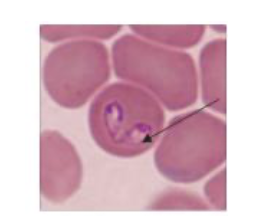
What does this blood smear micrscopy indicate?
Babesia infection: intra-erythrocytic parasite

What does this blood smear microscopy represent?
Anaplasma: morulae inside neutrophil of dog
What are some characteristics of performing blood-smear microscopy?
Relatively inexpensive
Requires experience person
What is a mosquito-borne arbovirus?
West Nile Virus
What type of virus is west nile virus?
Orthoflavivirus, RNA virus
Arbovirus/arthropod-borne virus transmitted by mosquitoes
What is west nile virus maintained in cycle between?
Wild birds and mosquitoes
What species can the pathogen be present in?
Humans, equines, and avians
How is WNV primarily (99%) transmitted to humans?
By mosquito bite
What are minor/rare transmission routes of WNV to humans?
Contact with cloacal/oral fluids from infected birds
Blood transfusion and organ transplants
Mother-to-child
Lab acquired infections
What are dead-end hosts of WNV?
Humans and horses
Dogs and cats play what role in transmission of WNV?
Can be infected but WNV is not maintained in these species
Can humans transmit WNV to other humans?
Yes, only other humans through unnatural conditions such as a blood transfusion
How to prevent WNV in humans?
Integrate mosquito management
Public education to avoid mosquito bites
Surveillance
What is the surveillance system arbonet?
National surveillance system for arboviruses in USA
Developed in response to emergency of WNV
Electronic: track and report arboviral activity
Monitor arboviruses in humans and non-humans
What is the causative agent of dirofilariasis?
Dirofilaria spp.
What is Dirofilariasis?
Mosquito-borne filarial nematode infection usually associated with carnivores
What factors determine distribution of dirofilariasis?
Vector, climate, domestic or wild carnivore reservoirs
Temperate regions: seasonal transmission
Endemic areas/tropics: year round
Outdoor animals increased risk of infection
Where is dirofilariasis most common in the USA?
Southeastern USA
What is the preferred detection test for dirofilariasis in dogs?
Adult worm antigen detection test
Sensitive and specific
Small fraction of adult-worm infected dogs test negative
Some infected dogs have no microfilaria
What tests will increase chances of diagnosis of dirofilariasis?
Combining microfilaria test and adult antigen test
Routine annual screening in endemic areas
How to prevent dirofilariasis?
Year-round macrocyclic lactone is effective in DOGS
Integrated mosquito control: repellants, environmental control
Infected dogs should be treated
Prevention recommended for cats in endemic areas
Humans: avoid mosquito bites, repellants
What is the causative agent of Chagas disease or american trypanosomiasis?
Trypanosoma cruzi
What is the vector for Chagas disease?
Kissing bugs (triatomine bugs)
What are other transmission routes of Chagas disease?
Food/water contamination linked to outbreaks
Blood transfusion, organ transplants
Canine chagas disease
Becoming health concern in dogs in USA
T. cruzi reported in various wild animals in southern states
Range of clinical symptoms: febrile illness, chronic phase is bad
No cases of canine to human transmission
What does chagas disease have an affinity for?
Cardiac and smooth muscle