General Chemistry 162 Notes
 Call Kai
 Learn
Learn Practice Test
 Spaced Repetition
 Match
Match Flashcards
 Knowt Play
1/37

There's no tags or description
Looks like no tags are added yet.
38 Terms
Significant Figures in Calculations
Recall that trailing zeros (zeros after a decimal) are significant. Calculation of sig fig is different for add/sub and multiplication/divison

Types of Chemical Bonds
Ionic Bond: Nonmetal + Metal
Nonmetal gain electrons(anion) while Metal lose electrons(cation) via transfer. These bonds form ionic compounds
Covalent Bond: Nonmetal + Nonmetal
The bond between two or more nonmetals via sharing. These bonds form molecular compounds
Ions & Polyatomic Ions (Do Not Confused w/ ionic bonds)
Ions(monoatomic): a neutral atom gains or loses electrons. Any element with a charge ±
NO BONDS because it is one element (Ex: Na^+, Cl^-)
Multiple ions (polyatomic ions): Two or more atoms covalently bonded elements with an overall charge of +\-
Ex: SO4^-2
Application:
Na⁺ + OH⁻
Na⁺ is a monatomic ion.
OH⁻ is a polyatomic ion.
The attraction between Na⁺ and OH⁻ is ionic.
But the bond inside OH⁻, between O and H, is covalent. Aka polyatomic ions. (Must have charge overall in the atoms unlike ionic bonding)
Ex: NaOH although both have charges pos and neg. It is an ionic bond/ ionic compound because it is nonmetal + metal, AND it doesn’t have an overall charge like all polyatomic ions do.
Moles, mol, molecules
Mole concept: Mole is a chemist dozen. It is the amount of material containing 6.022 × 10^23 particles/atoms etc. (Avogadro’s Number)
Mol: The abbreviation of mole
Molecules: Two or more atoms joined chemically (covalent bonding) in a specific geometrical arrangement. Ex: H2O, O2
Chapter 13 Solutions
The next key terms and concepts will be part of chapter 13
Solution Concentration
Solution: Homogeneous mixture of two substances (either ionic or covalent)
Solvent: Major component of solution
Solute: Minor component of solution
Aqueous solution: Whenever water is the solvent.
Molarity, Concentration, Dilute
Molarity(M): the amount of solute (in mol) divided by volume of solution (in liters)
Concentration: Large amount of solute
Dilute: Small amount of solute

Exothermic & Endothermic
Endothermic: absorbs heat from its surroundings (+)
Exothermic: describes a process that releases heat to its surroundings (-)
The change of heat in solute and solvent are both endothermic (+) while the change of heat in a mixture is exothermic (-)
Expressing Solution Concentrations (IMPORTANT!)
Common ways of reporting solution concentration include molarity, molality, parts by mass, parts by volume, mole fraction, and mole percent.
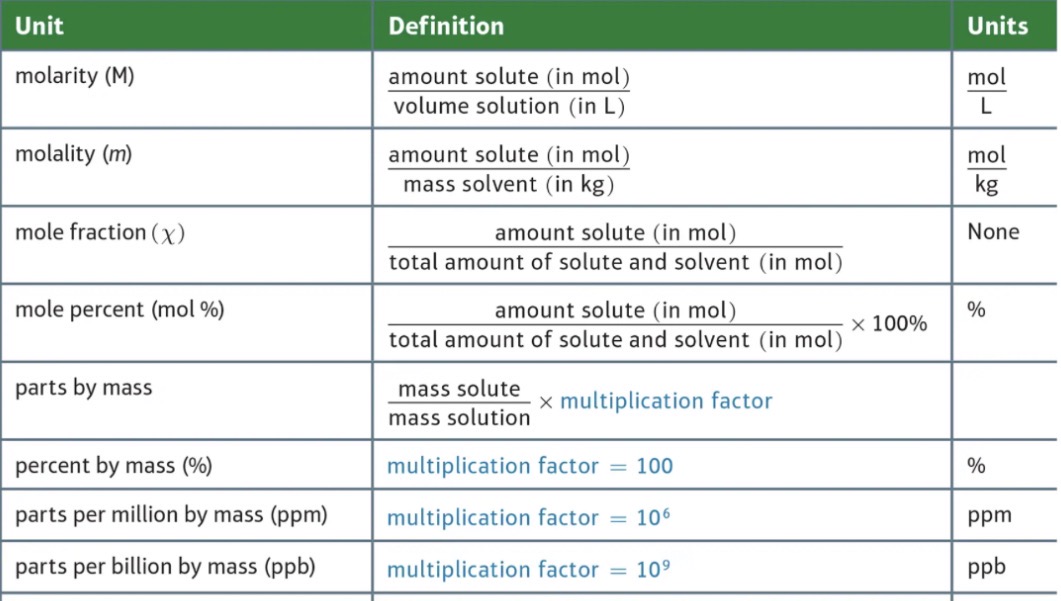
Molality vs. Molarity
A concentration unit that is independent of temperature is molality (m). it is the amount of solute (in moles) divided by the mass of solvent (in kilograms)
Molarity (M) depends on volume and temperature. It is the amount of solute (in moles) divided by the volume of solution (in slithers (L))
Colligative Properties
A colligative property is a property that depends on the number of particles dissolved in solution, not on the type of particle. (Moreover the identity of the substance does not matter. If they have the same num of particles, they have the same effect)
The four colligative properties:
Vapor Pressure Lowering
Freezing Point Depression
Boiling Point Elevation
Osmotic Pressure
Van’t Hoff factor (i)
The ratio of moles of particles in solution to moles of formula units dissolved is called the Van't Hoff factor (i)

Rate, Concentration, Collisions
The greater the number of particles in a given volume (aka concentration), the greater the number of collisions per unit time. The rate depends on the concentration of the particles.
Rate Law
The relationship between the rate of reaction and the concentration of the reactant.
k is the rate constant
n is the reaction order
There’s also three orders (0,1,2)

Integrated Rate Law
The relationship between concentration of [A] and the time of the reaction. Also has 3 orders
![<p>The relationship between <strong>concentration of [A] </strong>and the <strong>time of the reaction</strong>. Also has 3 orders</p>](https://assets.knowt.com/user-attachments/92302b5d-e85d-4e24-be57-e35e12c76ce4.jpg)
Half-Life of Reactions t1/2 (unit s)
The time it takes for the amount of a reactant to become HALF of what it was. In chemical kinetics, we focus on the reactant concentration and half of its initial value.
Example:
100g —> 50g
So the half-life is 5 minutes because it took 5 minutes for the amount to become half.

The Arrhenius Equation: Temperature and Reaction Rate
The modern form of the Arrhenius equation shows the relationship between the rate constant (k) and the temperature in kelvin (T):

Activation Energy (Ea)
The energy barrier or “hump” that must be surpassed in order for reactants to turn into products
Frequency factor (A)
The frequency factor (A) as the number of times that the reactants approach the activation barrier per unit time.
Two-point Arrhenius equation
This equation may vary, but we can use the one below.

Reaction Mechanism & Elementary Step & Reaction Intermediate
The reaction mechanism is the series of individual chemical steps by which an overall chemical reaction occurs.
Each step in a reaction mechanism is an elementary step which cannot be broken down into simpler steps.
A reaction intermediate forms in one elementary step and is consumed in another. Look at the image attached for an example.

Catalyst
a catalyst is a substance that increases the rate of a chemical reaction but is not consumed by the reaction.
Homogenous Catalyst
a substance that speeds up a chemical reaction while existing in the same physical phase (such as a liquid or a gas) as the reactants
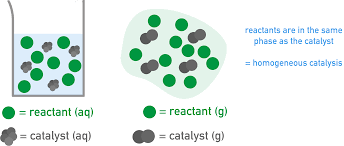
Heterogenous Catalyst
A heterogeneous catalyst is a substance that speeds up a chemical reaction while existing in a different physical phase than the reactants

Dynamic Equilibrium
dynamic equilibrium = equal forward and reverse reaction rates, NOT equal concentrations.
Forward vs. Reverse Reaction
Forward = reactants → products
Reverse reaction = reactant ← product

Equilibrium Constant (K)
K = products ÷ reactants
K is a number that tells you the ratio of products to reactants when a reaction is at equilibrium.
The K is italicized to differ from temperature in kelvin!
Law of Mass Action
The relationship between the balanced chemical equation and the expression of the equilibrium constant.

The significance of K
K is about WHERE the reaction ends up, NOT HOW FAST it gets there.
Large K → mostly products at equilibrium
Small K→ mostly reactants at equilibrium

Acids and Bases
Arrhenius definition:
Acids are substances that when dissolved in water produce a hydronium, H3O+ (hydrogen ion H+).
Bases are substances that when dissolved in water produce a hydroxide ion, OH–
Brønsted–Lowry
Acids donate H+ (Becomes conjugate base)
Base accept H+ (Becomes conjugate acid)
Strong Acids
A strong acid is a strong electrolyte.

Strong Bases
A strong base is a strong electrolyte.

Weak Acids
A weak acid is a weak electrolyte.

Weak Base
A weak base is a weak electrolyte.

Amphoteric
Substances that can act as acids or bases
Factors that determine acid strength
H–Y bond strength (Binary Acid)
Electronegativity
Oxidation state (for oxyacids)
Number of oxygen atoms (for oxyacids)

Acid strength rules for Oxyacids
The more electronegative the element Y is, the more it weakens and polarizes the H-O bond and the more acidic the oxyacid is.
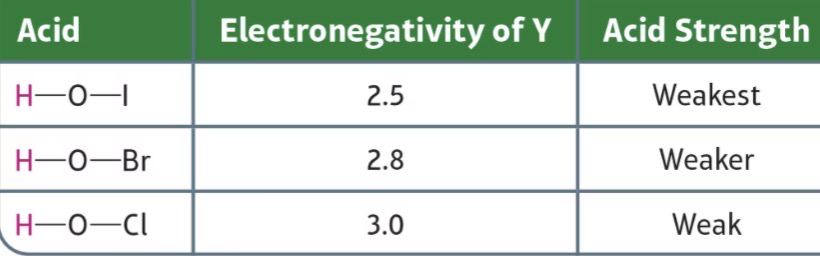
The Acid Ionization (Ka)
We quantify the relative strength of a weak acid with the acid ionization constant (Ka), which is the equilibrium constant for the ionization reaction of the weak acid in water.