PSYC1000: Final Exam (all modules)
 Call Kai
 Learn
Learn Practice Test
 Spaced Repetition
 Match
Match Flashcards
 Knowt Play
1/54

There's no tags or description
Looks like no tags are added yet.
Name | Mastery | Learn | Test | Matching | Spaced | Call with Kai | Chat |
|---|
No analytics yet
Send a link to your students to track their progress
55 Terms
Thomas Hobbes
- Believed in materialism, senses, wrote books denying soul and brain.
- Believed in machinery and brain's natural processes.
Rene Descartes
- Religious ideas used for psychology
- Believed in substance dualism - "the mind is a nophysical substance"
- Identified the mind with
consciousness and and self-awareness, formulated idea of mind-body problems
- His ideas were popular with the Catholic Church as a result.
dualism
- idea that people made up of immaterial body and soul
materialism
all mental processes and consciousness are the direct result of physical, material interactions within the brain.
empiricism
- Human knowledge is learned through experience and patterns, ultimately derive from sensory experience.
- We learn after experiencing new things.
nativism
- Opposite of empiricism, although tougher to test.
- Knowledge (such as time+space) is natural to the human mind, we are born with knowledge.
Primacy Recency effect
- the tendency to show greater memory for information that comes first or last in a sequence
anxiety/anxiety disorders
anxiety: state of alarm in response to a vague series of danger (danger that may never happen).
- fear keeps us alive, ex: fight or flight responses, anxiety and fear are different
- anxiety causes overwhelming feelings, person unable to to make decisions, person ignores feelings of fight/flight
- anxiety disorders are very common (most common mental health issue in the U.S.)
- CBT therapy + meds helps treat/lessen anxiety disorders
cognitive therapy/behavioral therapy/CBT
- commonly used to treat anxiety disorders
- a form of psychotherapy that treats emotional and behavioral issues by identifying and correcting unhelpful, distorted thought patterns
GAD (generalized anxiety disorder)
- excessive worry about practically anything
- vague, intense feelings of concern, fearfulness
- also called free, floating anxiety
- fear is out of proportion to the actual danger
- first appears in childhood, happens due to chemical imbalance and genetics can pass down generalized anxiety
- affects more women than men, also because of societal, gender roles, causing men to cover up symptoms with substance abuse
- cognitive theorists believe that GAD is caused by dysfunctional thinking.
- Basic irrational assumptions presented:
1. any strange situation is dangerous
2. Person is unsafe until proved safe
phobias
- persistent and unrealistic fears of particular objects, activities, situations, and thoughts
- people tend to avoid these fears, objects, or thoughts about it
- fears are normal, phobias are much more intense fears, people with phobias have greater desires to avoid the fear object or situation
- majority don't seek help for their phobias because they usually do not have to come across it daily. However, other phobias can occur in daily life, such as phobias of elevators. Unreasonable phobias that don't interfere with daily activities include snakes, dragons, ghosts.
Social phobias:
- severe persistent and unreasonable fears of social or performance situations where embarrassment may occur. A fear of performing in adequately in front of others.
xtra info:
- phobias developed through conditioning. Once fears are required, they are continued because feared objects are avoided.
- develop through modeling such observations and imitations and maintained through avoidance
- behavioral techniques used for treatments, this can include desensitization.
panic disorder
- overwhelming feeling where you feel as if you are dying or going crazy. in reality, the person is not losing their mind or dying
- an intense feeling of anxiety, having the person want to flee the situation
- Panic disorders can also occur in result of phobias (phobia of something for example)
- Panic disorders begin when a person begins to feel fear of the panic attack itself, happens more and more while impairing their daily quality of life
- Panic attacks usually subside after less than 24 hours, due to the body eventually getting tired of pumping adrenaline
OCD (Obsessive compulsive disorder)
- person feels need to perform certain routines repeatedly (compulsions) or has certain thoughts repeatedly (obsessions)
- believe that doing these routines will make them calmer/safer
- routines trains the brain to actually believe the routine protects the person, even though the routines become obsessive and the fear is irrational most of the time
acute stress disorder
- lasts less than a month
- related to severe traumatic experiences (same with PTSD)
- may experience flashbacks
PTSD (post-traumatic stress disorder)
- lasts more than a month
- related to severe traumatic experiences (same with acute stress)
- cbt therapy, like other anxiety disorders
- not everyone develops PTSD after witnessing a traumatic event
Drug abuse
- intentionally using drugs in a way that is unhealthy or illegal in attempt to treat common mental disorders such as anxiety or depression
- mental health condition associated with mental illness. Drug abuse causes mental illness, creating chemical imbalances in the brain.
Major depression
- long-term pervasive sense of sadness, hopelessness, lasting longer than six months
- boss of interest in life or daily routines
- can lead to suicide
- mild or moderate depression impairs a person's quality of life
Bipolar disorder
- has two components, one is depression, other is mania. Mania can lead to grandiose beliefs, inappropriate elation or euphoria.
- Irritability and inappropriate social behavior.
- Meds have been proven effective to help with bipolar disorder caused by chemical imbalance in the brain.
Schizophrenia
- complex brain disorder, causes individual to lose their concept of reality
- may not be able to tell the difference between reality and fantasy
- results in hallucinations, delusions, extremely disordered, thinking, and behavior that impaired daily functioning and can be disabling
- people with schizophrenia require lifelong treatment with medications
(ex: delusions can be extremely bizarre beliefs)
mutations
- a random error in gene replication that leads to a change
- Abnormalities and errors occur with genes, causing mutations in the gene. Most mutations can be more harmful than helpful.
selective breeding
- the human practice of breeding animals or plants that have certain desired traits
welhelm wundt
- father of modern psychology
- established psychology as a disciplinary study
ivan pavlov
- discovered classical conditioning by training a dog to salivate to cues/stimuli
* - Demonstrated that new stimulus responses can be learned, same as how you can take away fear as well as add to fear (in a person or animal) *
independent variable
variable that is manipulated
dependent variable
The outcome factor; the variable that may change in response to manipulations of the independent variable.
IV VS. DV
IV changes, DV changes as a result of the change.
reinforcement
- any stimulus or event that functions to increase the likelihood of the behavior that led to it
- in operant conditioning, any event that strengthens the behavior it follows
experiment vs. correlational study vs. descriptive study
experiments:
- Testing hypothesis, cause + effect between 2 variables or more
- Direct and conclusive way to test hypothesis, you have control over variables.
correlational study:
- identify relationships or associations
- Variables are not manipulated by researchers. **
descriptive study:
- Not researching the cause + effect, just describing something (ex: illness within a community).
Problems with correlational studies?
Cons:
- Can be hard to know the cause + effect.
- No control over variables
- Subject can lie on self reports, bias
why does forgetting occur?
- as we learn information, other types of information gets replaced (interference)
- lack of rehearsal can lead to forgetting (decay)
- however, forgetting can occur if information may not have been received into the brain in the first place. This is not real forgetting.
(Example: Not paying attention to receive the information to begin with such as wearing earplugs in class. )
- If it does not get into the brain through the sensory system the there is nothing to remember later
- This is summed up in the term Failure to Encode
why do we remember some things better than others?
- people's brain prioritizes different memories that are emotional, relevant, surprising, frequently rehearsed, or tied to rewards
within subject experiment
- Everyone gets the same treatment (ex: same medication for all groups).
between groups experiment
- Groups get different treatments each (ex: one group gets a different medication than the other groups).
clive wearing + memory loss
- 7 second memory, couldn't remember any new details about his life after his memory loss, only his life before
- still forgot names of his kids, the time, forgot that he even had the condition to begin with every few minutes
- not able to relearn and retain info after relearning
decay
- fading away of memory over time
interference
- memories fight for space
observational learning
- learning by observing others
Albert bandura:
pioneered idea of observational learning
classical conditioning
Learning through association/reflexes
Habituation
decreasing responsiveness with repeated stimulation
- ex: hearing a baby continue crying on a train, eventually the person will tune it out instead of responding again since it keeps repeating.
research settings
Laboratory study and field study.
Laboratory Study:
researchers place subject in laboratory with controlled variables.
Field Study:
researchers go out onto subject's environment.
What is a gene?
Genotype: Inherited genes
Phenotype: Observational traits (eye color, hair color, etc.)
Careers in Psychology
Practicing vs. academic psychologists (you can do/be both at once)
Practicing: treats patients
Academic: does research and teaches.
What are 4 questions psychologists answer?
1. What causes us to do what we do?
2. What causes us to feel what we feel?
3. What causes us to believe what we believe?
4. What causes us to perceive what to perceive?
Law of association by continuity
- If a person experiences two or more environmental events at the same time or right after the other (continuously), the person will relate these ideas w/ one another.
- Human brains add associations to words.
- Physical things can appeal to a person's 5 senses (tastes, smells, visuals, sounds, touches) and remind someone of a past experience, sometimes in result of an occurance of a traumatic event.
- (Ex: 1. Little Albert experiment)
- (Ex: 2. Another experiment where a baby is taught to associate apple with the word "apple").
Evolutionary psychology
- Living things behave in ways to promote their survival and production.
- (Ex: mother protecting her children, whether it be an animal or a human).
What is a hypothesis?
- What you think will happen after an experiment.
- You can run experiments to test a hypothesis.
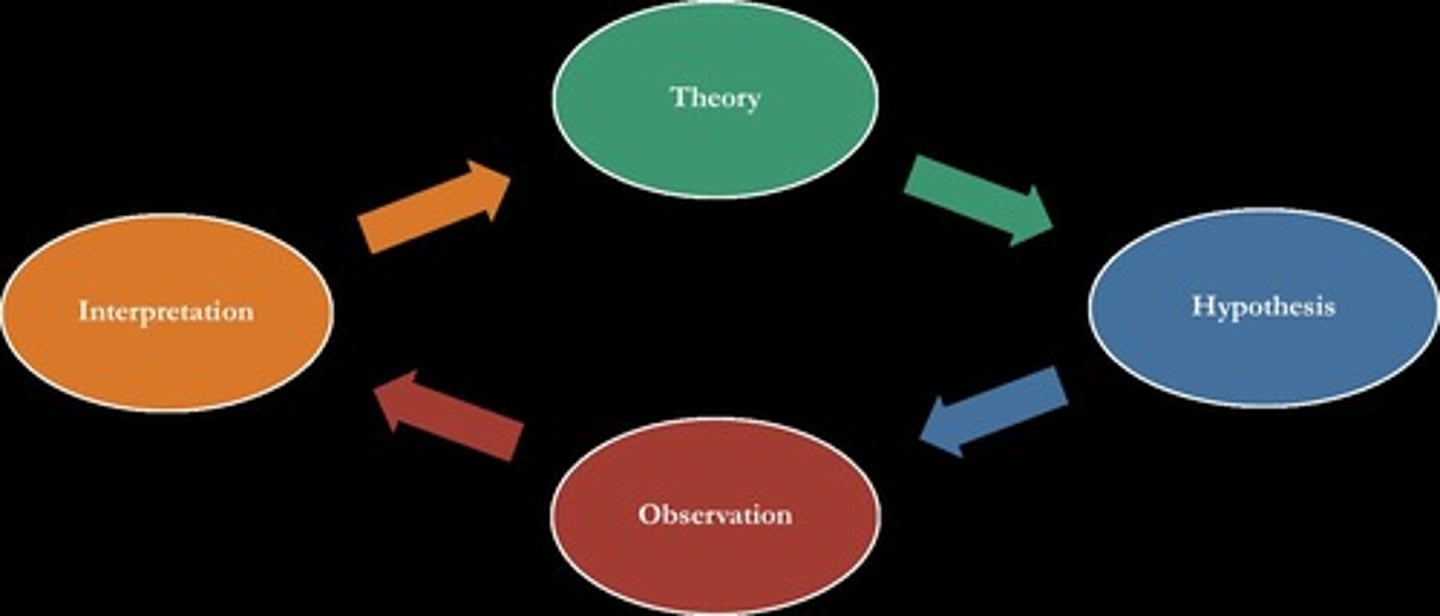
What is the cycle of science?
Facts lead to theories, leading to hypothesis, theories might become facts.
Theory (use theory to make a prediction)
-> Prediction (design an experiment to test theory)
-> Experiment (perform experiment)
-> Observation
-> Theory (create or modify the theory after observation of experiment)
Difference between genotype and phenotype
Genotype: Inherited genes
Phenotype: Observational traits (eye color, hair color, etc.)
extinction
extinguishing conditioned response
Spontaneous Recovery
bringing conditioned response back after extinction
- you can bring back conditioned response, easier this time to condition the subject (whatever behavior it was before the extinction)
operant conditioning
- increasing or decreasing a response
- a type of learning in which behavior is strengthened if followed by a reinforcer or diminished if followed by a punisher
(ex: liking a restaurant (reinforcer) so you continue going when you're in the area (behavior is strengthened))
Edward Lee Thorndike:
- a leading researcher in the area of operant conditioning and the law of effect
B.F. Skinner:
Behaviorist that developed the theory of operant conditioning by training pigeons and rats
Positive Reinforcement and Negative Reinforcement
reinforcement: increase of whatever behavior
-positive rein: arrival of some stimulus following a response makes the response more likely to occur.
(ex 1: get something good --> increase behavior)
(ex 2: words of affirmation, prizes)
-negative rein: removal of some stimulus following a response makes the response more likely to occur.
(ex 1: take away something bad --> increase behavior)
(ex 2: taking away privileges, phone taken away)
bonus
- POSITIVE REIN works better long-term because it's a motivator
- neg rein can cause person to find a way around the punishment/neg reinforcement
Positive Punishment and Negative Punishment
Punishment: decreasing of behavior
positive punishment: arrival of stimulus decreases the likelihood of response occurring again
negative punishment: removal of stimulus decreases the likelihood of the response occurring again
(ex: taking money away from person)
emprical researcher
research that operates from the ideological position that questions about human behavior can be answered only through controlled, systematic observations in the real world
what is learning?
to comprehend something, retaining something in your memory, changing your subsequent behaviors by being taught and remembering new behaviors (rehearsal used in learning, ex. studying)