emes 446 midterm 1
 Call Kai
 Learn
Learn Practice Test
 Spaced Repetition
 Match
Match Flashcards
 Knowt Play
1/34

There's no tags or description
Looks like no tags are added yet.
Name | Mastery | Learn | Test | Matching | Spaced | Call with Kai | Chat |
|---|
No analytics yet
Send a link to your students to track their progress
35 Terms
microorganism
traditionally defined as an organism that is too small to be seen clearly with the naked eye (usually smaller 1 millimeter in diameter)
includes viruses, bacteria, many algae, fungi, and protozoa
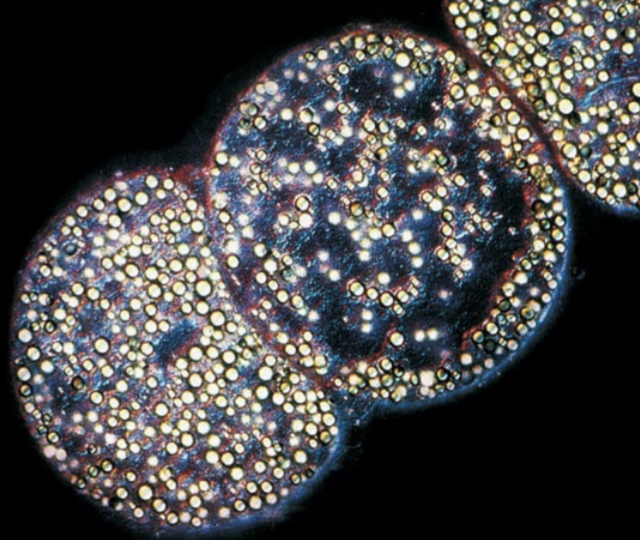
EXCEPTION: bacterium thiomargarita
thiomargarita (bacterium)
isolated off the coast of Namibia in seafloor sediment
grows in strands of single cells
approx. 1 mm in diameter (3 million times the volume of an average bacterial cell)
visible to the naked eye
important events in microbiology
1676- Leeuwenhoek discovers “animalcules” (the FATHER of microbio)
1953- Watson and Crick propose the double helix structure for DNA
1977- escherichia coli genome sequenced
2003- first human genome sequence was completed
antonj van leeuwenhoek
father of micrbio
dutch, born in 1632
known for building the first microscope
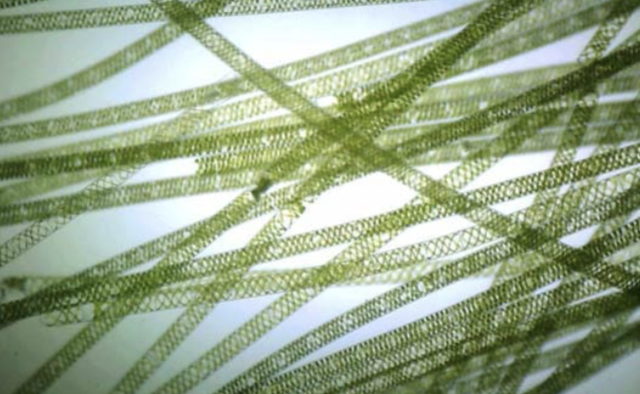
1674- discovers the alga Spirogyra
1677- first to observe spermatozoa
1683- discovered bacteria in dental tartar
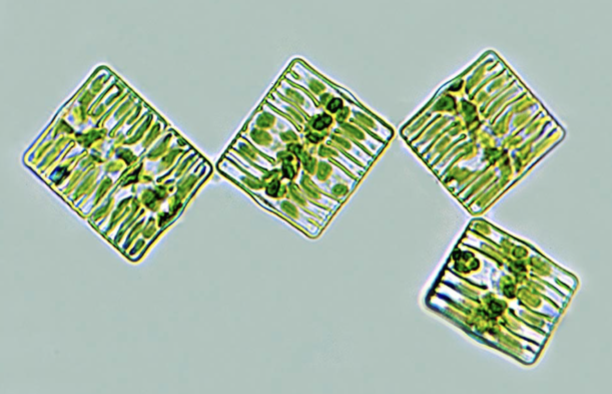
1702- discovered diatoms in water
1674- discovery of alga Spirogyra
this event has been considered by some to be the simultaneous births of the fields of microbiology, protistology, and phycology
1677- the first to observe spermatazoa
leeuwenhoek originally thought these were parasites in the genitalia
1683- discovered bacteria in dental tartar
leewenhoek’s first “sample” was his own dental tartar, and later when he was in his 80’s and his teeth fell out, he would study the bacteria in the roots
1702- diatoms in fresh water
now we know diatoms in the ocean produce 20% of the oxygen that we breath
the spontaneous generation hypothesis
the hypothesis that some vital force contained in or given to organic matter can create living organism from inanimate objects
was widely held belief throughout the middle ages
a common example was maggots arising on mean that been left in the open
Redi thought maggots arose on meat because flies laid their eggs on meat, which hatched into maggots
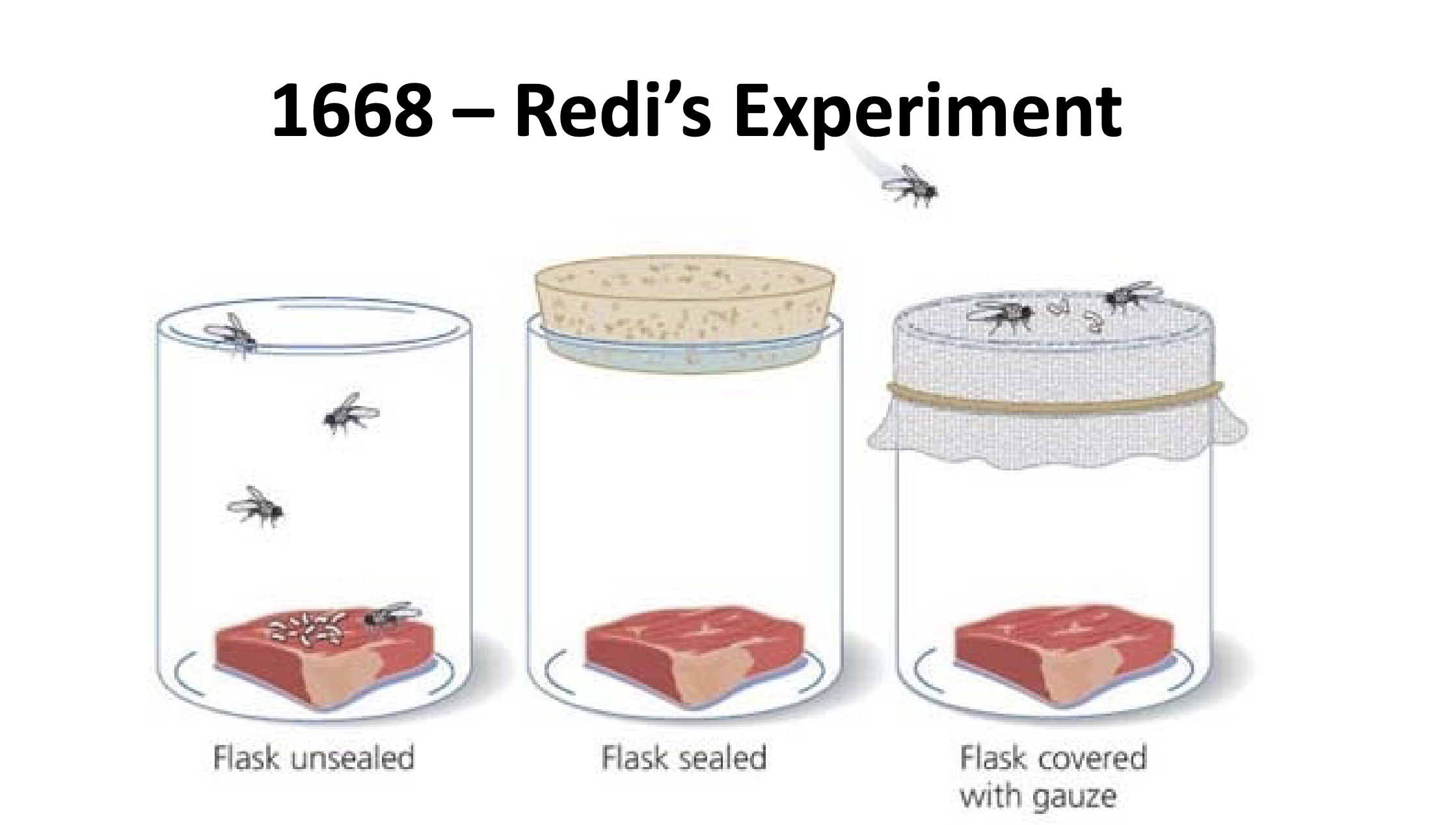
redi’s experiment
challenged the “spontaneous generation” hypothesis
maggots grew on meat in unsealed jar, did not grow on sealed jar, and grew on the gauze-covered jar (but not directly on the meat)
cell theory
all living things are composed of cells
cells are the basic unit of structure and function in living things
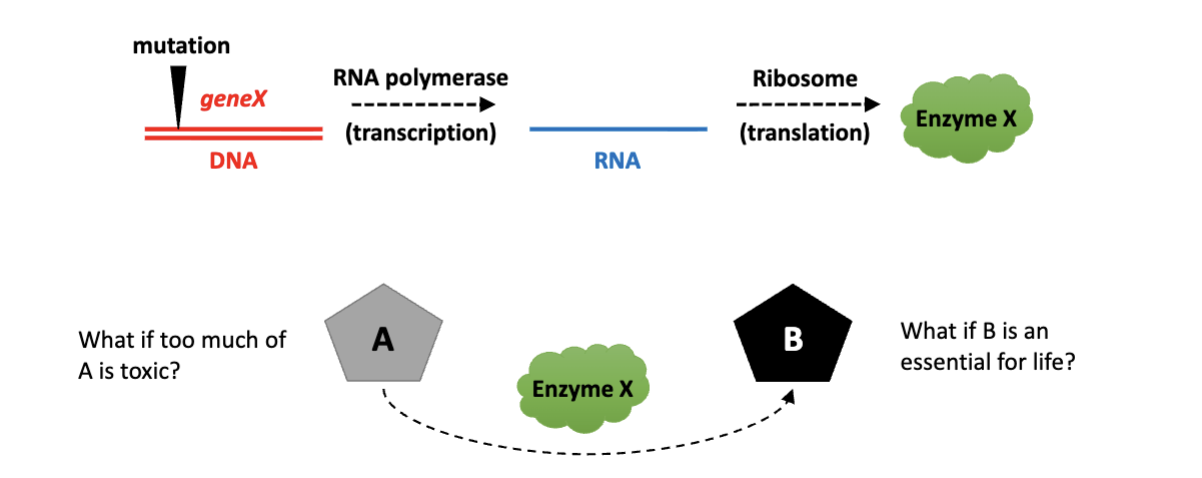
one-gene-one-enzyme hypothesis
states that one gene results in the production of one enzyme
the genetic code
a set of rules by which information encoded in genetic material (DNA or RNA sequences) is translated into proteins (amino acid sequences) by living cells
61 “sense” codons encode for 20 different amino acids (>100 amino acids in nature)
3 “nonsense” or “stop” codons terminate translation when the protein is complete
**most living organisms use the same “universal code” to synthesize proteins
symbiosis
greek for “living together”
first used by german mycologist Heinrich Anton de Bary in 1879
de Bary defines symbiosis as “the living together of unlike organisms”
symbiotic relationships are close and often long-term interactions
Lichens
the FIRST described symbiosis
2 partners: a single FUNGI and single PHOTOSYNTHETIC partner (cyanobacteria (protists with chloroplasts) or algae (bacteria with chlorophyll- related to chloroplasts))
partners together form structure that individual symbionts cannot make
fungal hyphae protect photosynthetic partner from environ. hazards (desication)
photosynthetic partners provides fungi with fixed carbon
a long-term relationship (estimates at 400 million years)
mutualism
A has positive effect on B
B has a positive effect on A
OBLIGATORY
an obligatory relationship where there is some reciprocal benefit to both interacting partners
partners often will not survive if separated
cooperation
A has positive effect on B
B has a positive effect on A
NOT OBLIGATORY
commensalism
A has a positive effect on B
“no effect” of B to A
predation
one organism eating another
parasitism
parasite going into host to get benefits
amensalism
A uses up resources to exclude B
EXPLOITATIVE COMPETITION
interference competition
A directly inhibits/kills B
symbiont
the microbe
host
the larger organism
ectosymbiont
symbiont is on the surface of the host
endosymbiont
symbiont within the host
can be intracellular (within host cell) or extracellular (in body cavities but not intracellular)
holobiont
when there is more than one symbiont, this group of organisms (host and all its microbial symbionts) is sometimes called a “holobiont” Ex. corals
microbiome
when there are multiple microbial symbionts within a host
aposymbiotic
a host that is without its symbiotic partner
can potentially be seen in nature
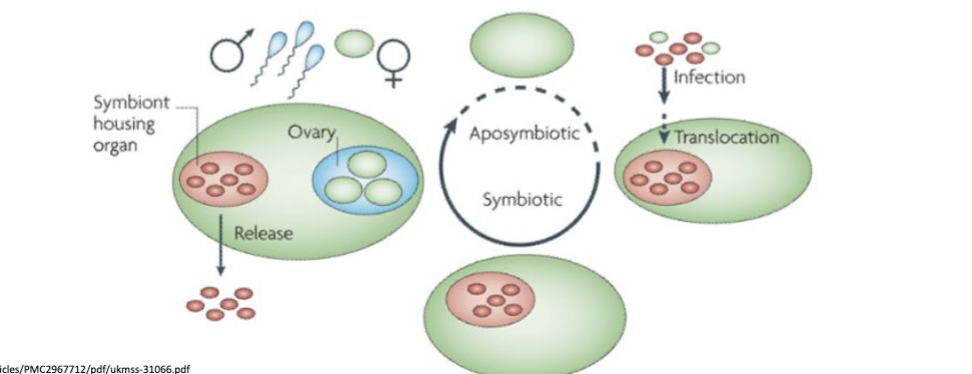
horizontal transmission
cyclic occurrence of aposymbiotic and symbiotic phases in the host’s life cycle
symbiont has a facultative life style consisting of the host-associated and the free-living phases
the free-living population serves as the inoculum for the symbiosis
examples- soybean, bobtail squid, vestimentiferan tubeworm
vertical transmission
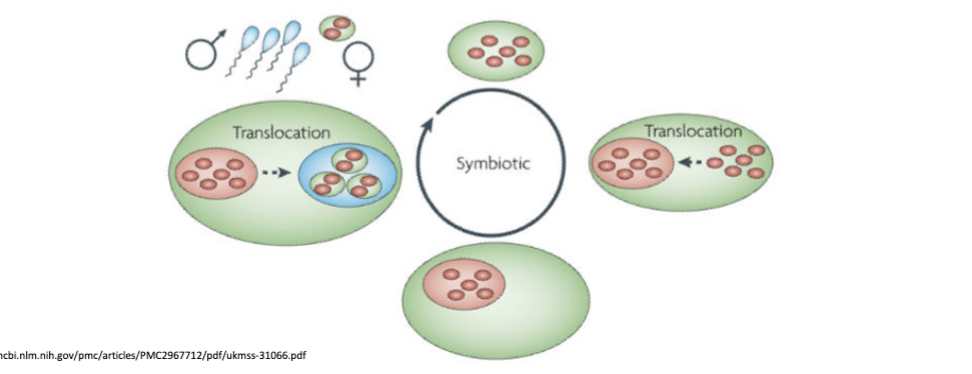
transfers symbiont directly from parent to offspring
no aposymbiotic stage (symbiosis is permanent)
symbiont transmission occurs (most often) through the eggs because eggs have more space and nutrients
examples- hermaphroditic bryzoan, hermaphroditic earthworm
pros/cons of horizontal transmission
pros
more opportunities to evolve (symbiont)
increase fitness as needed (host)
pros/cons of vertical transmission
pros
host do not have to compete for symbionts
most common for obligatory mutualisms
cons
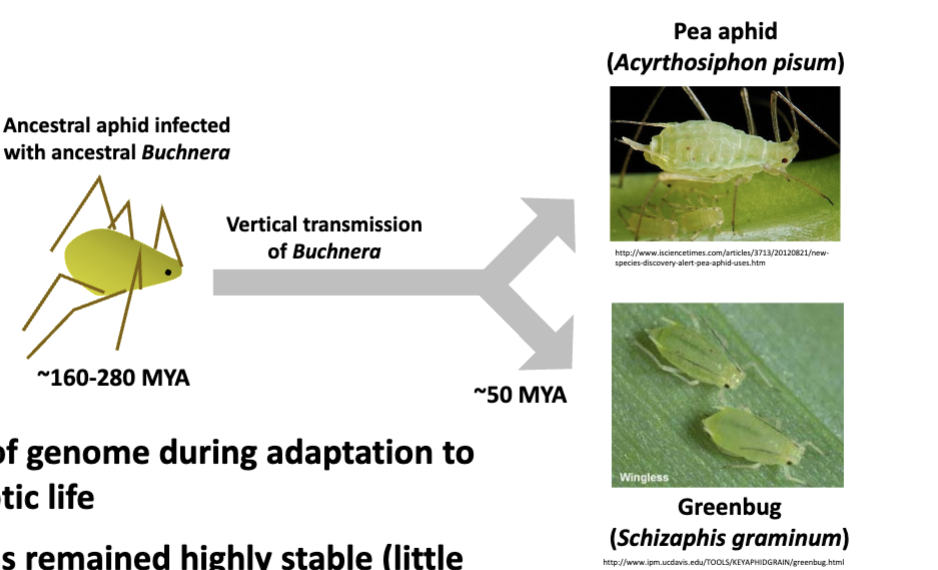
pea aphid and the Buchnera aphidicola
host- pea aphid
symbiont- intracellular endosymbiont Buchnera)
transmission mode- maternal vertical transmissions
obligatory mutualism
pea aphid feeds on plant phloem sap that is deficient in essential aminod acids
Buchnera lives inside aphid and aids in synthesis of these amino acids
Buchnera is transferred to offspring through mat. vert. trans.
pea aphid has many secondary symbionts, but Buchnera is its primary symbiont showing that symbiosis are not typically monospecific (one bacterium one host)
history of B. aphidicola Mutualism
lost approx. 86% of genome during adaptation to endosymbiotic life
genome has remained highly stable (little change) over the last 50 million years