HCI3 Exam 1 - Change Identification
 Call Kai
 Learn
Learn Practice Test
 Spaced Repetition
 Match
Match Flashcards
 Knowt Play
1/66

There's no tags or description
Looks like no tags are added yet.
Name | Mastery | Learn | Test | Matching | Spaced | Call with Kai | Chat |
|---|
No analytics yet
Send a link to your students to track their progress
67 Terms
change
transition from the current state to a desired future state by effectively planning, identifying risks, enabling and leading teams, measuring performance, and supporting continuous improvement
knowledge, organization, process, and environmental
the four types of capabilities required to change from current state to future state
sigmoid curve
describes the life cycle of organizations, products, processes, and individual persons or careers
faster
'new' products, processes, initiatives, and organizations rise and decay at a _______ (slower/faster) rate
shock, denial, anger/blame, bargaining/self-blame, depression/confusion, acceptance, and problem-solving
list the 7 stages of the human response to change
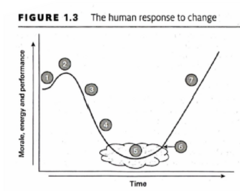
denial
early stage in human response to change in which energy and performance are the highest
depression
later stage in human response to change in which energy and performance are the lowest
change
the actual events, activities, and steps that can be put into a diary or project plan
transition
the human, psychological process of letting go of one pattern and engaging with a new one
neutral zone
describes the in-between time when the old is gone and the new isn't fully operational
physiological, safety, love, esteem, and self-actualization
list the hierarchy of needs from the most basic to the tip of the pyramid
basal ganglia
responsible for much of everyday life and requires little energy to operate
prefrontal cortex
used to process new information, very energy intensive and used more in a change situation
amygdala
operates the fight, flight, or freeze response and disables emotional and rational thought
define situation, create vision of desired end-state, and identify forces that help drive and resist change
Lewin's unfreeze step includes these 3 actions
organizational culture
established system of accepted behaviors, values, beliefs, and assumptions that is widely shared within the organization, and which as a result no one notices; 'the way things are down around here'
one (surface)
level ____ of organizational culture includes visible artifacts and products like office layout and furnishings
two (deeper)
level _____ of organizational culture includes norms and values that are most often noticed when violated
three (deepest)
level _____ of organizational culture includes basic assumptions and not often articulated but underpin many of the norms and values of some societies
strategy
what an organization is going to do in the future that responds to the changing environment in which it needs to develop and prosper
true
T/F: the primary purpose of a strategy is to show how an organization intends to develop given its operational environment
concepts, processes, and outputs
the three components of an effective strategy
concept
answers the question 'What is our strategy?'
process
the thought process required to answer the question 'What is our strategy?'
output
because a particular statement of the strategy is only true at a certain point in time
far environment
industry structure, big external drivers (PESTLE) and trends, potential for disruption, and addresses the question 'What business are we in?'
near environment
concerns competitor organizations, nature of the value proposition to customers, business model, and addresses the question 'How do we compete?'
political, economic, social, technology, legal, and environment
define PESTLE when referring to external drivers in the far environment
largest business and exploiting economies of scale
in the near environment, how does a company achieve overall cost leadership?
differentiation
in the near environment when a company offers a product that is entirely unique and has no competitors
focus
in the near environment, achieved by establishing an advantageous access to a specific customer segment, geography, or product application
where are we now? where do we want to go? how do we get there?
three basic questions of all change analysis
five forces mode, SWOT analysis, and Lewin's forcefield analysis
3 tools for examining the present situation - where are we now?
threat of new entrants/substitutes, bargaining power of new buyers/suppliers, and rivalry amongst competitors
Porter's five forces to examine present situation - where are we now?
SWOT analysis
used to compare a business model against a competitors with strengths, weaknesses, opportunities, and threats
external
in a SWOT analysis, opportunities and threats and viewed as ______ (internal/external)
fishbone diagram
give another name for Ishikawa's cause and effect diagrams developed in the 1960s to support quality control
influential observers
in a power matrix, which of the following would you want to keep satisfied:
spectators (low power low interest), active players (low power high interest), influential observers (high power low interest), and key players (high power high interest)
confirmation bias
tendency for people to pay attention only to information that confirms their beliefs and ignore evidence that indicates otherwise
status quo bias
preference for people to keep things the way they are and avoid change
availability bias
tendency to perceive more memorable or easily available information as the most significant
bandwagon effect
more people come to believe something, the more others want to join in and believe it too
build awareness of need, achieve shared understanding of requirements among stakeholders, and gain people's commitment to engagement
a thorough approach to communicating change involves:
awareness, desire, knowledge, action, and reinforcement
the five measures of engagement
stakeholders, communications, developing skills, building support, resistance, feedback, and measurement
developing a change management plan requires __________ (7)
concrete experience, reflective observation, abstract conceptualization, and practical experimentation
the "learning loop" involves ______ (4)
activitist
someone with a preference for concrete experience is described as a ______
reflector
someone with a preference for reflective observation is described as a ________
theorist
someone with a preference for abstract conceptualization is described as a _______
pragmatist
someone with a preference for practical experimentation
self-awareness
ability to recognize and understand your moods, emotions, drives, and their effects on others
self-regulation
ability to control or redirect disruptive impulses and moods/propensity to suspend judgment; think before acting
motivation
passion to work for reasons that go beyond money or status/propensity to pursue goals with energy and persistence
empathy
ability to understand emotional make-up of other people/skills in treating people according to their emotional reactions
social skill
proficiency in managing relationships and building networks/an ability to find common ground and build rapport
resilience
practicing an ability to think positively, maintaining perspective, developing supportive relationships, ability to cope, and adapt when things don't go as planned
coercive
'do what i say' leadership approach
authoritative
'come with me' leadership approach
affiliative
'people come first' leadership attitude approach
democratic
leadership approach that gives people a voice in decisions and builds organizational flexibility and idea generation; can feel 'leaderless'
pacesetting
leadership style that sets high performance standards
coaching
leadership approach that focuses on personal development rather than immediate work-related tasks
character, relationships, agreements, systems, and processes
components of successful and competent negotiating
preparation, exchange information, bargaining, and closure
phases of negotiation
bargaining
phase of negotiation where risk of failure/unsuccessfulness is highest
separate people from the problem, focus on interests not opinions, mutual options for mutual gain, and insisting on objective criteria
conducting negotiations requires these four approaches
true
T/F: conflict can deliver positive outcomes