Unit 2 - Tooth Morphology (Chapter 12)
 Call Kai
 Learn
Learn Practice Test
 Spaced Repetition
 Match
Match Flashcards
 Knowt Play
1/45

There's no tags or description
Looks like no tags are added yet.
Name | Mastery | Learn | Test | Matching | Spaced | Call with Kai | Chat |
|---|
No analytics yet
Send a link to your students to track their progress
46 Terms
Morphology
study of the size, shape, structure and surface of teeth
How many teeth in anterior permanent dentition?
12 (includes incisors & canines)
What incisors erupt first
(lower) Central incisors
Which teeth are the longest in permanent dentition?
canines
which teeth are the smallest in permanent dentition?
mandibular central incisors
pegged laterals
incisors with a pointed or tapered shape

diastema
space or gap between teeth in same arch
how many teeth in posterior permanent teeth?
20 (includes premolars & molars)
which tooth is referred to as wisdom tooth?
3rd molars
How many teeth in primary dentition?
20
what method of identification is used in universal/national system for primary teeth
alphabetical (letters A-T)
what teeth are not included in primary dentition?
premolars
what teeth are non-succedaneous?
molars
characteristics of primary teeth
very white enamel
narrow & long roots
large pulp chamber
thin enamel
no mamelons
Why are primary teeth important?
important for function and development of permanent teeth
assist in speech
give shape to the face
3 main parts to tooth
enamel
dentin
pulp cavity

what feature do newly erupted central & lateral incisors have on incisal ridges?
mamelons

pinpoint depression where two or more grooves meet
pit
Non-succedaneous
tooth that does not replace a primary tooth
Cusp of Carabelli
5th cusp found of the maxillary 1st molar
which primary tooth has an H-shaped groove pattern on its occlusal surface?
Mandibular molar
Which primary tooth in the largest?
Molar
which molar is the largest & which is the smallest?
Largest: 1st molar
Smallest: 3rd molar
what canines usually erupt first?
mandibular
Cingulum
raised, rounded area on cervial third of the lingual surface

margional ridge
rounded, raised boarder on the mesial & distal portions of the lingual surfaces of anterior teeth and occlusal table of posterior teeth
Fossa
wide, shallow depression on the lingual surfaces of teeth

Incisal edge
ridge on permanent incisors that appears flattened on labial, lingual, or incisal view after tooth eruption

canine eminence
external verticle bony ridge on the labial surface on canines

cusp
major elevation on the masticatory (includes occlusal) surface of canines & posterior teeth (includes canines, premolars, and molars)
Imbrication lines
slight ridges that run mesiodistally in the cervial third of the teeth (includes incisors and canines)

inclined cuspal plane
sloping area between cusp ridge

central groove
most prominent developmental groove on posterior teeth

margional groove
developmental groove that crosses marginal ridges, serves as a spillway for food
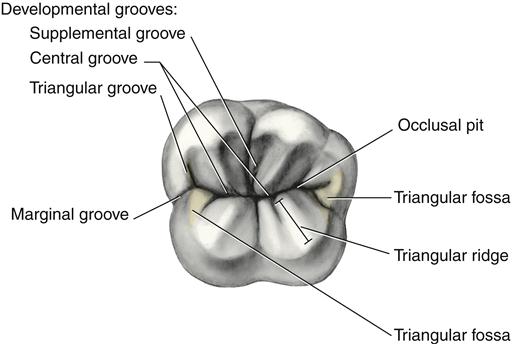
triangular groove
developmental groove that separates a marginal ridge from the triangular ridge of a cusp

furcation
area between (two or more) root (branches)
bifurcated
divided into two
trifurcated
dividied into three
bifurcation
area/space between two roots
trifurcation
area between three roots
bicanineate
two-cusp type of mandibular second premolar
tricanineate
three-cusp type of mandibular second premolar
root numbers of maxillarry teeth
Incisors: 1
Canines: 1
1st premolars: 2
2nd premolars: 1
All molars: 3
root numbers of mandibular teeth?
Incisors: 1
Canines: 1
1st premolars: 1
2nd premolars: 1
All molars: 2
cusps on maxilary teeth
Canines: 1
1st premolar: 2
2nd premolar: 2
1st Molar: 4
2nd Molar: 4
3rd Molar: varies (3-5)
1-2-2-4-4-variable
cusps on mandibular teeth
Canine: 1
1st premolar: 2
2nd premolar: 3
1st Molar: 5
2nd Molar: 4
3rd: varies (4-5)
1-2-3-5-4-variable