DSA07 Disorders of Volume
 Call Kai
 Learn
Learn Practice Test
 Spaced Repetition
 Match
Match Flashcards
 Knowt Play
1/46

There's no tags or description
Looks like no tags are added yet.
Name | Mastery | Learn | Test | Matching | Spaced | Call with Kai | Chat |
|---|
No analytics yet
Send a link to your students to track their progress
47 Terms
-ADH
-SNS
-RAAS
What hormones/systems are the major regulators for Water/Sodium balance?
Disorders of sodium balance and total body sodium content
Disorders of ECF volume are really what?
B/c it is the major cation of ECF
Why does Sodium determine the extracellular volume, out of all the solutes?
60%
What is the Total Body Water (TBW) percentage of a male under 65 y/o?
50%
What is the Total Body Water (TBW) percentage of a female under 65 y/o?
50%
What is the Total Body Water (TBW) percentage of a male over 65 y/o?
45%
What is the Total Body Water (TBW) percentage of a female over 65 y/o?
2/3
ICF contains how much of the TBW?
1/3
ECF contains how much of the TBW?
3/4 of ECF --> 1/4 of TBW
Extravascular fluid (interstitial & transcellular fluid) contains how much of the ECF (therefore how much of the TBW)?
1/4 of ECF --> 1/12 of TBW
Intravascular fluid (plasma) contains how much of the ECF (therefore how much of the TBW)?
Fluids with tonicity of 280 mOsm/kg (similar to plasma) --> maintains fluid ONLY in extracellular space (1/4 to plasma, 3/4 to interstitium)
Describe Isotonic Fluids (ex: Normal Saline, Lactated Ringers)
Fluid w/ tonicity of 154 mOsm/kg --> 1/3 into ICF, 2/3 into ECF (aka 1/6 to plasma)
Describe Half normal Saline (Hypotonic Fluid)
Fluid w/ tonicity of 0 (no effective osmoles --> distributes to all spaces, aka ICF and ECF) ==> 1/12 remains w/ plasma
Describe D5W (5% Dextrose) or Free Water (Hypotonic Fluid)
Hydrophobic Cell membrane
What separates the ICF from the ECF?
K+ (pumped inwards by Na/KATPase)
What solutes maintains osmotic pressure in the ICF?
Na+
What solutes maintains osmotic pressure in the ECF?
Capillary walls
What separates the plasma from interstitial fluid in the ECF?
Proteins (esp Albumin) and Na+
What solutes maintains osmotic pressure in the plasma?
2(Na) + BUN/2.8 + Glucose/18 + ETOH/4.6
Calculate Serum Osmolality
Corrected Na = ([Na] + 1.6(Glucose) - 100)/100
Calculate Correction of Serum Sodium via Glucose decrease (aka Insulin)
B/c water passively follows sodium
How does Sodium retention & excretion control extracellular volume?
Amount of blood within the arterial system that maintains tissue perfusion - correlated with ECF changes (not really TBW)
Define Effective Arterial Blood Volume, aka EABV (or Effective Circulating Volume, or ECV)
Sodium
Given it's effect on extracellular volume, what is the major determinant for EABV?
-Volume
-Cardiac Output
-Vascular Resistance
What factor changes can modify EABV?
-Catecholamines (increase CO & SVR)
-RAAS (Na+ & water retention via aldosterone)
-Non-osmotic ADH release (increase ECF Volume)
What mechanisms are activated when EABV falls?
-Heart Failure (low CO)
-Cirrhosis (low SVR)
What are examples of chronic conditions that cause low EABV, despite causing high TBW (due to sodium/water retention)?
-Lowered SNS & RAAS
-ANP Release
What mechanisms are activated when EABV rises?
ADH
What hormone helps manage both Water Balance AND Sodium Balance?
Plasma Sodium
What metric reflects Water Balance?
EABV (ECV)
What metric reflects Sodium Balance?
Hypovolemia
Define Condition:
Decrease in ECF volume (NaCl or ECF losses exceed input)
-Hx: Third space, Renal, Skin or GI loss of ECF
--Skin = Heat/sauna
--GI loss = N/V with decreased intake
--Renal loss = Intrinsic salt-wasting disorders of kidney/salt-wasting diuretics
-Sx:
--Polyuria (maybe DM)
--Polydipsia (maybe Thirst)
--Polyphagia (maybe Salt Craving)
--SEVERE = Weakness and eventually LOC
-PE:
--Less skin turgor
--Dry mucosa
--Dry axilla
--Furrows on tongue
-Dx:
--Orthostatic Hypotension
+/- Low Jugular Venous Pressure
--Labs
---BUN/Cr = 20:1
---FEna < 1% (prerenal azotemia, secondary to ECF depletion)
---Cl (urine) < 10-15 mmol/L
--Echo = IVC collapse/expands
--CVP decrease
-Tx: REMOVE ongoing precipitant and correct ECF volume loss
Loss of Body fluids
What would be the differential diagnosis for Hypovolemia plus these sx?:
-Diarrhea
-Bleeding
-Tachypnea
Diuretic Abuse
What would be the differential diagnosis for Hypovolemia plus these sx?:
-Hypokalemia
-Metabolic Alk w/ increased urine NaCl
Bulimia
What would be the differential diagnosis for Hypovolemia plus these sx?:
-Metabolic Alk with VERY LOW Urine Cl
Inherited or acquired renal ion transport diseases with salt wasting
What would be the differential diagnosis for Hypovolemia plus these sx?:
-Malaise
-Lassitude (lack of interest, energy or spirit)
-Fatigability
-Salt Craving
Salt and water PO
What is the Tx for mild hypovolemia?
Bolus and then continuous normal saline or Ringer's lactate (LR)
What is the Tx for severe hypovolemia?
Avoids Hyperchloremic Acidosis (except in pts with lactic acidosis)
What is the advantage of using Ringer's lactate (LR, solution w/electrolytes) to Tx Severe Hypovolemia?
Use blood products instead of crystalloids with goal of increasing hematocrit up to 35%.
What is the Tx for hypovolemia due to severe blood loss?
Interstitial Edema?
Any factor that decreases the hydrostatic pressure in the arterial side or oncotic pressure in the venous side can cause what?
Congestive Heart Failure (CHF)
Define Condition:
Usually due to weaker heart --> kidneys & liver not perfused enough --> kidneys deteriorate --> fluid builds up and leaks from vessels into interstitium
-Sx:
--Weight Gain
--Weakness
--Dyspnea on exertion
--Less exercise tolerance
--Paroxysmal nocturnal dyspnea
--Orthopnea
-PE:
--Lateral PMI
--IJV/EJV pressure
--3rd Heart sound
--Rales
--LE pitting edema
-Dx:
--Labs
---Increased BNP
---Occult Hyper/Hypothyroidism
--Imaging
---PA & lateral CXR = Kerley-B lines
---Echo = contractility of left ventricle (either preserved or reduced EF)
-Tx: REDUCE NA+ INTAKE + Diuretics (Loop Diuretic +/- Thiazide)
Hepatic Cirrhosis
Define Condition:
Chronic disease characterized by replacement of normal liver tissue with diffuse fibrosis that disrupts the structure and function of the liver
-Sx: Renal sodium/Water retention --> Ascities (scarring --> arterial vasodialtion + BP drop --> stimulates NaCl retenion)
-Tx:
--NaCl Restriction
--Diuretics (Loop + Spirono)
--Large Volume Paracentesis
--Peritoneovenous Shunting (PVS)
--Portosystemic Shunting (TIPS)
--Liver Transplant
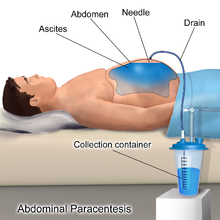
Procedure to remove ascitic fluid
Define Abdominal Paracentesis
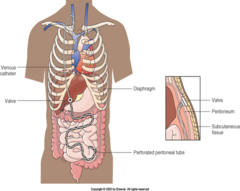
Puts ascitic fluid back into venous system
Define Peritoneovenous shunting (PVS)
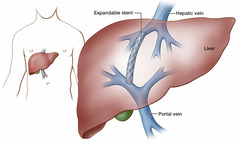
Stent placed between portal vein and hepatic vein in order to decrease the portal hypertension and improve ascites
Define Portosystemic Shunting (TIPS)
Nephrotic Syndrome
Define Condition:
Major Cause of Edema
-Sx/PE/Dx:
--Hypoalbuminemia
--HLD
--Edema (may lead to Anasarca if Albumin drops too much)
-Tx:
--Tx Systemic Causes
--Less Na+ Intake
--Diuretics (Loop initially)
--Albumin Admin (rare due to cost & S/Es)