INB365S Exam 1 Review
 Call Kai
 Learn
Learn Practice Test
 Spaced Repetition
 Match
Match Flashcards
 Knowt Play
1/78

There's no tags or description
Looks like no tags are added yet.
Name | Mastery | Learn | Test | Matching | Spaced | Call with Kai | Chat |
|---|
No analytics yet
Send a link to your students to track their progress
79 Terms
0.9% saline/normal saline (NS)
isosmotic (300 mOsM NP)
isotonic (300 mOsM NP)
fixes hemorrhage
5% dextrose in 0.9% saline/D5-normal saline (D5NS)
hyperosmotic (300 mOsM NP + ~300 mOsM PP)
technically 278 mOsM PP
isotonic (300 mOsM NP)
5% dextrose in water/D5W
isosmotic (300 mOsM PP)
hypotonic (dextrose is PP)
0.45% saline/half-normal saline (1/2NS)
hypoosmotic (150 mOsM NP)
hypotonic (150 mOsM NP)
fixes dehydration (hydrates cells but keeps some fluid in the plasma)
5% dextrose in 0.45% saline/D5-half-normal saline (D5 1/2NS)
hyperosmotic (150 mOsM NP + ~300 mOsM PP)
technically 278 mOsM PP
hypotonic (150 mOsM NP + dextrose is PP)
Cell membrane functions
physical isolation
regulation of exchange with the environment
communication between the cell and the environment
structural support
what can diffuse across the membrane without help?
small hydrophobic/lipophilic molecules (O2, CO2, N2)
small uncharged polar molecules (urea, water (slowly))
cholesterol-based molecules (lipophilic) (steroid hormones)
types of peripheral proteins
structural
enzyme
types of integral proteins
structural
transporters
enzymes
receptors
simple diffusion
movement of a molecule directly across the lipid bilayer
passive transport - no outside energy source required (uses energy from gradients)
molecules move down a concentration gradient (high → low)
rate increases with increased temperature
rate decreases with increased molecular size and distance from the initial site
stops at equilibrium (uncharged molecules)
Fick’s law of diffusion across membranes

channels
integral membrane transport protein
continuous, water-filled pore
strictly facilitate passive transport
transport smaller molecules and ions
rapid transport rate
can be open channels (pores) or gated channels
ligand-gated, mechanically gated, and voltage-gated
carriers
integral membrane transport protein
never form an open channel (must undergo a conformational change)
facilitate both passive and active transport
transport larger, polar organic molecules
slower transport rate
has specificity, competition, and saturation
can be uniporters (one solute) or cotransporters
symporters (same direction)
antiporters (opposite directions)
how are carriers similar to enzymes?
catalyze transport processes
have specific substrates (specificity)
undergo conformational change
affected by temperature, pH, etc.
subject to competition and saturation
have allosteric sites
have an active site where substrate binds
which substance is also transported by a carrier?
a competitor

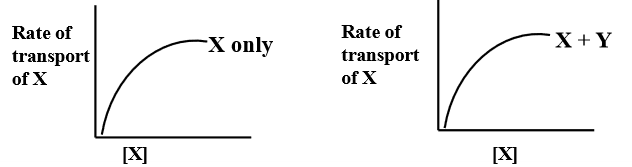
what characteristic of mediated transport is illustrated by the 2nd graph?
specificity (the presence of molecule Y has absolutely no effect on the transport of molecule X)
what is the adaptive significance (benefit) or specificity in physiology?
can manage what goes in and out of the cell
what is the term for a substance that inhibits transport of another substance, but is not actually transported?
competitive inhibitor
for a single carrier, saturation of transport depends on ____. for a whole cell or tissue, saturation depends on ____
substrate concentration; substrate concentration and the number/density of carrier proteins present
can a substrate outcompete a competitive inhibitor?
yes
can a substrate outcompete a noncompetitive inhibitor
no
where are the higher concentrations of ions in the ICF and ECF?
ICF: K+, A-
ECF: Na+, Cl-, Ca2+
primary active transport
uses ATP to go against the concentration gradient
secondary active transport
uses the gradient established by a primary active transporter + uses the kinetic energy of a molecule going down its concentration gradient
which carriers use primary active transport?
uniport
antiport
which carriers use secondary active transport?
antiport
symport
what is not categorized as a “means/mode/method” of movement?
symporter, uniport, antiport (must describe the energy used)
which way is secretion?
ECF/basolateral → lumen/apical
which way is absorption?
lumen/apical → ECF/basolateral
what is the formula for concentration?
C = S/V
osmosis
water moves from low solute concentration to high solute concentration (dilutes)
what are the common penetrating, non-penetrating, and partially penetrating solutes?
P: urea
NP: ions
PP: glucose
osmolarity vs molarity
osmolarity takes into consideration the dissolution of the solute in solution
ex: 1 M NaCl is 2 OsM
osmolarity vs tonicity
osmolarity: compares any 2 solutions (even a cell)
describes a solution’s concentration compared to another
mechanism of equilibrium: diffusion
nature of solutes does not matter
tonicity: describes a solution compared to a cell
describes how that solution will affect the behavior of the cell - whether the solution will cause water to move out of the cell or not
mechanism of equilibrium: osmosis
only NP solutes matter
total body water
60% of body weight (in kg)
ICF = 67% of TBW
ECF = 33% of TBW
interstitial fluid = 25% of TBW/75% of ECF
plasma = 8% of TBW/25% of ECF
markers of body compartments (indicator substances of volume)
deuterium oxide (D2O) - TBW
inulin - ECF
Evan’s blue - plasma
physiological reference man values
weight: 155lb or 70kg
TBW: 42L (60% of weight)
plasma osmolarity: 300 mOsM
volumes of distribution: 28L ICF; 14L ECF
dehydration
lose hypoosmotic solution (mostly water) → increase solute concentration in ECF and ICF
fix with a hypotonic solution (causes cell to swell and restore water lost)
all solutes lost come from ECF
hemorrhage
lose isosmotic solution only from ECF → same solute concentration as before
fix with isotonic solution (restore plasma volume)
assumptions for RBC problems
cell contents are NP
water moves to dilute
water moves faster than solutes
the solute and volume of the external solution are infinite compared to the solute and volume of the cell
only the relative concentration of NP is important
osmolarity initial cell response
hyperosmotic = cell will shrink
isosmotic = cell will not change
hypoosmotic = cell will swell
tonicity ultimate cell response
hypertonic = cell will shrink
isotonic = no net change in cell
hypotonic = cell will swell
is NP outside = 0, cell will burst/hemolyze
what are the isotonic IV solutions?
normal saline
D5-normal saline
what are the hypotonic IV solutions?
D5W
1/2-normal saline
D5-1/2-normal saline
which IV solution do you use to correct dehydration?
hypoosmotic and hypotonic solution (1/2-normal saline)
which IV solutions do you use to correct hemorrhage?
normal saline (isosmotic and isotonic)
D5-normal saline
what is a potential side effect of D5-1/2-normal saline?
cellular edema (IV solution is hypotonic, which causes water to move into cells)
why should you not give free water to collect for dehydration?
water is hypotonic with an NP = 0, so the RBCs hemolyze and can kill the patient
types of local cell-cell communication
gap junctions - direct cytoplasmic connects between adjacent cells
juxtracrine (contact-dependent signals) - require interaction between membrane molecules on 2 cells
autocrine signals - act on the same cell that secreted them
paracrine signals - secreted by one cell and diffused to adjacent cells
types of long cell-cell communication
endocrine system - hormones are secreted by endocrine glands/cells into the blood. only target cells with receptor for the hormone respond to the signal
nervous system:
neurotransmitters - chemicals secreted by neurons that diffuse across a small gap to the target cell
neurohormones - chemicals released by neurons into the blood for action at distant targets
intracellular receptors
cytosolic or nuclear
bind steroid or thyroid hormones
act as transcription factors
cell membrane receptors
integral membrane proteins
bind peptide hormones and other lipophobic signals
usually activate a secondary messenger
homeostasis
maintain bodily functions within specific livable ranges, adjusting to internal and external changes
requires physiological control systems
a sensor/detector → an integrating center/controller → an output signal and target
uses negative feedback loops
why is a transporter exporting more of a molecule in response to increased concentration not a homeostatic response?
it is driven by mass action kinetics, not reflex control
there is no dedicated sensory and control system
there is no negative feedback loop or set point regulation
local control systems
paracrines
restricted to the tissue/cell involved
ex: low oxygen in the tissue = dilate blood vessel
reflex/systemic/long control systems
cells at a distant site control the response
response loops
feed-forward
feedback loops
negative feedback
positive feedback
what are the 3 components of a control system (local or long)
a sensor/detector → an integrating center/controller → an output signal and target

response loop
stimulus → sensor → input signal → controller → output signal → target → response
ex: knee jerk reflex
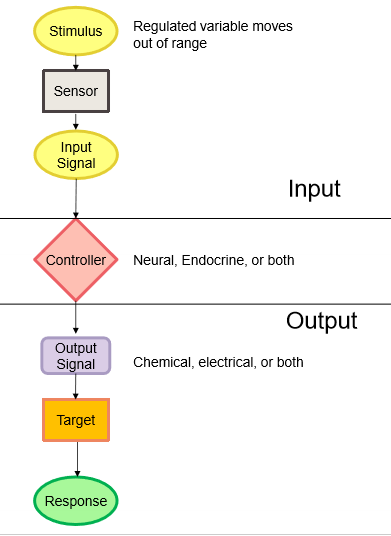
feedback loops
regulates the response loop
the response becomes the stimulus
response loop + feedback
negative feedback loop - inhibits the response (homeostasis!)
positive feedback loop - upregulates the response (not homeostasis)
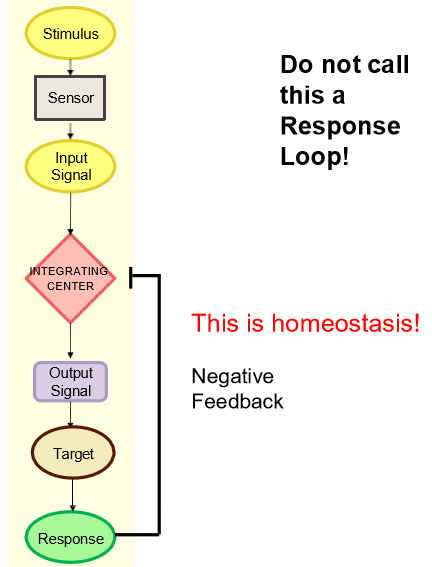
feed forward loop
anticipates change
response loop + no stimulus
not homeostasis

neural response loop
separate sensor and controller (CNS)
output signal - motor efferent neurons

endocrine response loop
sensor and controller are the same (endocrine gland)
output signal - hormone

simple endocrine reflex general components
stimulus
receptor - endocrine cell/gland
afferent path
integrating center - endocrine cell/gland
efferent path - hormone
effector - cell with receptor
response - tissue response, systemic response
insulin release pathway
stimulus - increased plasma glucose
receptor - pancreatic beta cell
afferent path
integrating center - pancreatic beta cell
efferent path - insulin
effector - adipose and muscles cells
response - decreased plasma glucose
simple neural reflex general components
stimulus
receptor - cell ending, whole cell, multicellular
afferent path - afferent/sensory neuron
integrating center - brain and/or spinal cord (CNS)
efferent path - efferent motor neuron
somatic motor neurons
autonomic motor neurons
effector
somatic: skeletal muscles
autonomic: smooth muscle, cardiac cells, glands
response
somatic: contraction
autonomic: heart range, blood pressure, etc.
knee jerk pathway
stimulus - striking patellar ligament
receptor - mechanoreceptor
afferent path - sensory/afferent neuron
integrating center - spinal cord
efferent path - somatic motor neuron
effector - skeletal muscle
response - muscle contraction
the efferent in the baroreceptor reflex in response to high BP is ______
parasympathetic
hormones
hormone - substance released into the blood stream to target a distant cell/organ
neurohormone - hormone released from a neuron
trophic hormone - hormone that targets another endocrine gland
trophic neurohormone - hormone released from a neuron that targets another endocrine gland
3 major classes of hormones
amine - synthesized from either tyrosine or tryptophan
catecholamines (norepinephrine) (behave like peptides) and thyroid hormones (tetraiodothyronine) (behave like steroids)
steroid - made from cholesterol
adrenal cortex and gonads (aldosterone)
-sterone
bound to carrier proteins in plasma
can act as transcription factors
peptide - synthesized by linking amino acids
most hormones (secretin, CRH)
dissolved in plasma
anterior pituitary
endocrine gland that receives trophic hormones from the hypothalamus
connected to the hypothalamus via a portal system

posterior pituitary
stores neurohormones from the hypothalamus (derived from neural tissue)
has a neural connection to the hypothalamus
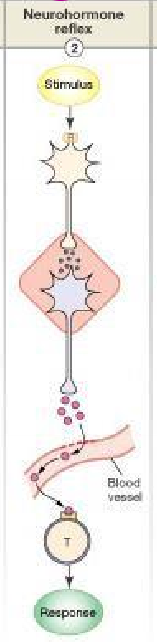

what are the left labels of the image?
hypothalamic hormones
anterior pituitary hormones
endocrine targets and the hormones they secrete
nonendocrine targets

long loop negative feedback
occurs when endocrine gland hormones are high and inhibit the anterior pituitary and hypothalamus
the primary and most influential regulatory mechanism controlling the overall pathway
short loop negative feedback
occurs when anterior pituitary hormones are high and inhibit the hypothalamus
where do primary, secondary, and tertiary pathologies integrate?
primary - endocrine gland
secondary - anterior pituitary
tertiary - hypothalamus
synergism
effect of 2 or more hormones on the same parameter is greater than additive
1 + 1 > 2
ex: in stressful situations, cortisol, epinephrine, and glucagon cause plasma glucose to skyrocket

permissiveness
one hormone is needed for another to exert its full effect
first hormone has no direct effect on the parameter
1 + 1 = 1 (or 2 + 0 > 2)
ex: in development, thyroid hormone is necessary for normal growth
ex: thyroid hormone increases epinephrine receptors on cell surfaces

antagonism
hormones have opposing effects
1 + 1 = 0
ex: ADH increases blood volume and BP; ANP causes Na+ and water excretion
ex: hormone A breaks down bone; hormone B builds bone
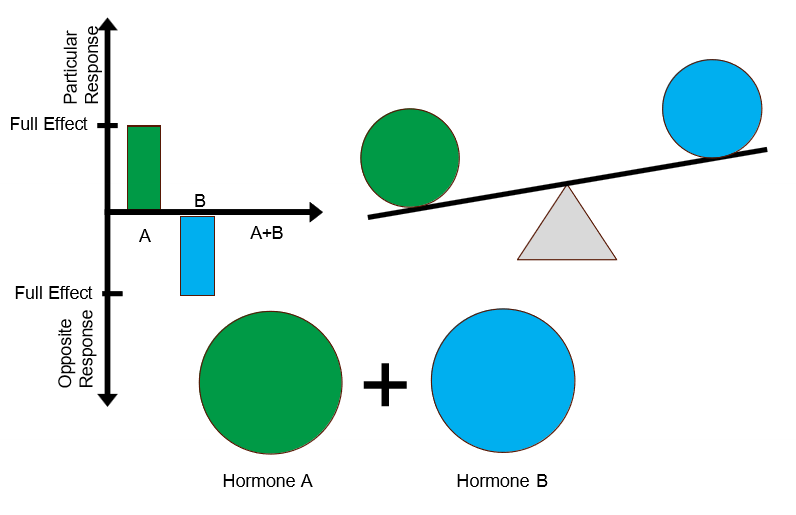
mechanisms of hormone interactions
separate pathways
e.g. antagonism; insulin increases glucose uptake by muscle and adipose while glucagon increases gluconeogenesis by the liver
crosstalk between secondary messenger pathways
parallel actions - increasing Na+ vs increasing Ca2+
convergent actions - phosphorylating the same protein
antagonistic actions - one upregulates, one downregulates cAMP
regulate synthesis or release of hormone or receptor
permissiveness