Parkinson's Disease Pharmacotherapy (L10)
 Call Kai
 Learn
Learn Practice Test
 Spaced Repetition
 Match
Match Flashcards
 Knowt Play
1/76

There's no tags or description
Looks like no tags are added yet.
Name | Mastery | Learn | Test | Matching | Spaced | Call with Kai | Chat |
|---|
No analytics yet
Send a link to your students to track their progress
77 Terms
PD is largely a clinical diagnosis based on motor and non-motor symptoms (bradykinesia ± rigidity and/or resting tremor)
response to __________ is supportive of diagnosis, but not required
levodopa
drugs that can worsen PD
anti_______ or prokinetic dopamine blockers (metoclopramide, prochlorperazine, and promethazine)
anti_______ dopamine blockers (haloperidol and risperidone)
emetic, psychotic
________________ provides the greatest symptomatic motor benefit and is appropriate for many patients
carbidopa/levodopa
__________ therapies should be selected according to the specific problem: wearing off, OFF episodes, dyskinesia, or residual symptoms
adjunct
PD pharm therapy improves symptoms by increasing __________ (primary treatment), directly stimulating __________ receptors, prolong levodopa effects, and modifying glutamatergic, adenosine, or _______ signaling
dopamine, dopamine, choline
PD pharm therapy improves symptoms by increasing dopamine (primary treatment), directly stimulating dopamine receptors, prolong levodopa effects, and modifying glutamatergic, adenosine, or choline signaling
always start _______ and go ________
low, slow
when to initiate PD treatment
Levodopa: preferred when greater ________ symptom relief is needed or adverse-effect vulnerability limits other options
motor
when to initiate PD treatment
______________: preferred when greater motor symptom relief is needed or adverse-effect vulnerability limits other options
Levodopa
when to initiate PD treatment
dopamine agonist: _________ (age) patients with mild symptoms (lower risk of hallucinations, sleepiness, orthostasis, and decreased impulse control)
young
when to initiate PD treatment
_____________: younger patients with mild symptoms (lower risk of hallucinations, sleepiness, orthostasis, and decreased impulse control)
dopamine agonist
_________ is the precursor for dopamine in the dopaminergic neuron
L-DOPA
Selegiline, Rasagiline, and Safinamide are all ____________ (class)
MAO-B inhibitors (decrease dopamine breakdown)
Ropinirole, Pramipexole, Rotigotine, and Apomorphine are all __________ (class)
dopamine agonists (increase dopamine in the synaptic cleft at D1 and D2 receptors)
Entacapone, Opicapone and Tolcapone are all _____________ (class)
COMT inhibitors (decrease L-dopa breakdown)
Carbidopa-Levodopa: Carbidopa _______ cross the BBB and Levodopa _______ cross the BBB
does not, does
Carbidopa/Levodopa: gold standard for Levodopa therapy
__________ is the dopamine precursor
Levodopa
Carbidopa/Levodopa: gold standard for Levodopa therapy
Carbidopa blocks ___________ conversion of levodopa to hep reduce ADEs from ____________ converted dopamine
peripheral (AEs ex: hypotension, tachycardia, N/V)
Carbidopa/Levodopa: gold standard for Levodopa therapy
____________ blocks peripheral conversion of levodopa to hep reduce ADEs from peripherally converted dopamine (hypotension, tachycardia, N/V)
carbidopa
Carbidopa/Levodopa: gold standard for Levodopa therapy
most effective symptomatic therapy which improves ___________, ________, and ________ (motor symptoms)
bradykinesia, rigidity, tremor
Carbidopa/Levodopa: gold standard for Levodopa therapy
disadvantages: motor fluctuations and __________
dyskinesia (unwanted/unexpected movements)
Carbidopa/Levodopa formulations and clinical role
IR tablet: initial therapy and flexible titration
ER tablet: longer coverage or selected motor fluctuations
Carbidopa/Levodopa/__________: given to prevent metabolism of L-Dopa in the periphery
Entacapone (COMT inhibitor)
Carbidopa/Levodopa formulations and clinical role
IR tablet: initial therapy and flexible titration
ER tablet: longer coverage or selected motor fluctuations
Inhaled levodopa: _________ treatment for intermittent OFF episodes
rescue
Carbidopa/Levodopa formulations and clinical role
IR tablet: initial therapy and flexible titration
ER tablet: longer coverage or selected motor fluctuations
_________ levodopa: rescue treatment for intermittent OFF episodes
inhaled
Carbidopa/Levodopa formulations and clinical role
IR tablet: initial therapy and flexible titration
ER tablet: longer coverage or selected motor fluctuations
intestinal _________: for advanced PD with refractory motor fluctuations
suspension
Carbidopa/Levodopa formulations and clinical role
IR tablet: initial therapy and flexible titration
ER tablet: longer coverage or selected motor fluctuations
___________ monotherapy: additional peripheral decarboxylase inhibition if needed (i.e. if the levodopa is causing too many peripheral SEs)
carbidopa
starting dose: carbidopa/levodopa IR 25/100mg, 1 tablet PO ______ times daily
titrate by 1 tablet every 1-2 days
three (TID)
starting dose: carbidopa/levodopa IR 25/100mg, 1 tablet PO three times daily
titrate by 1 tablet every _________
1-2 days
starting dose: carbidopa/levodopa IR 25/100mg, 1 tablet PO three times daily
usual max dose: carbidopa 200mg/day and levodopa 2000mg/day (not a hard cutoff tho)
dosing >_____ times a day may be necessary
carbidopa 70-100mg per day required to inhibit dopamine decarboxylase
4
starting dose: carbidopa/levodopa IR 25/100mg, 1 tablet PO three times daily
usual max dose: carbidopa 200mg/day and levodopa 2000mg/day (not a hard cutoff tho)
dosing >4 times a day may be necessary
carbidopa _______mg per day required to inhibit dopamine decarboxylase
100
starting dose: carbidopa/levodopa IR 25/100mg, 1 tablet PO three times daily
titrate by 1 tablet every 1-2 days
titration is based on balance of _________ and ___________
efficacy and side effects
carbidopa/levodopa is best taken (and best absorbed) when taken _________ food
without (i.e. take on an empty stomach for best absorption)
carbidopa/levodopa is best taken (and best absorbed) when taken on and empty stomach (can take w/ food if GI upset occurs, just be aware absorption will decrease)
space out high ________ meals and ________ supplements by 2 hours (large amino acids compete with levodopa for transport across the gut and BBB)
protein, iron
carbidopa/levodopa ADEs: _________ hypotension, dizziness, __________, _________ control disorders, and __________/ psychosis/ suicidal ideation
orthostatic, dyskinesia, impulse, hallucinations (not to be confused with symptoms of peripheral L-dopa conversion: N/V, tachycardia, anorexia)

carbidopa/levodopa: addressing motor fluctuations
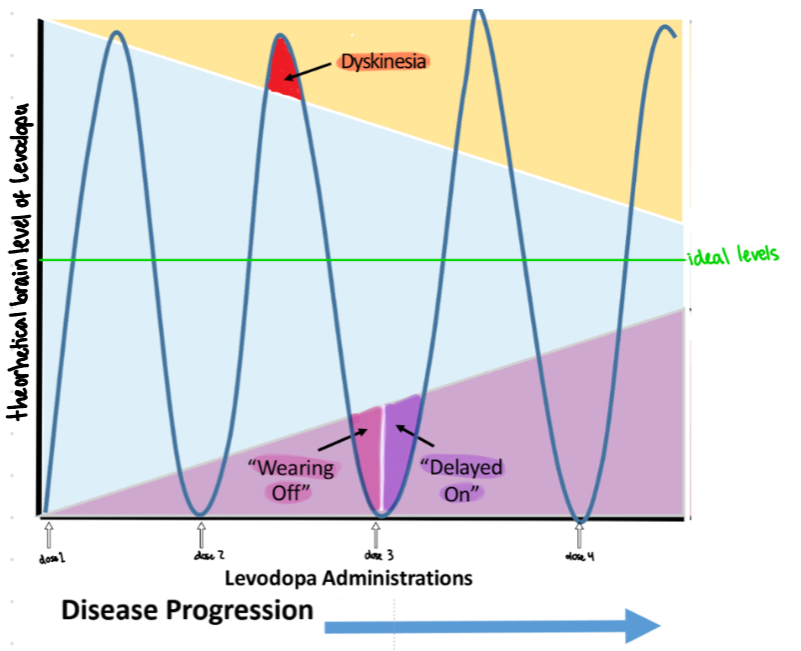
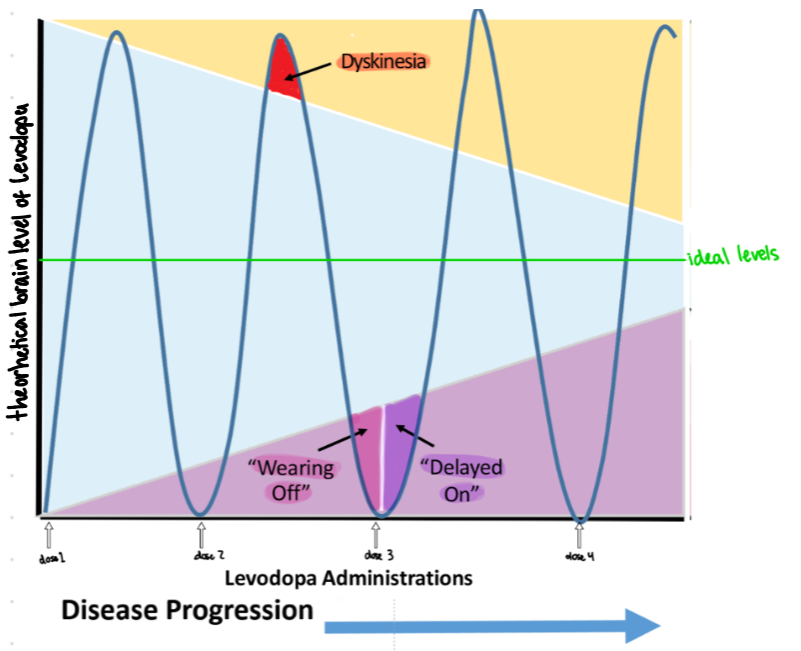
wearing off: symptoms _________ before the next _____________ (signs of motor symptoms arise)
return, dosing interval
carbidopa/levodopa: addressing motor fluctuations
_________ _____: symptoms return before the next dosing interval (signs of motor symptoms arise)
wearing off (happens just as drug reserve in body is running out/ right before the next dose)

carbidopa/levodopa: addressing motor fluctuations
wearing off: symptoms return before the next dosing interval (signs of motor symptoms arise)
solution: increase ___________ OR consider addition of _________ or _________
frequency, MAO-B or COMT inhibitors
carbidopa/levodopa: addressing motor fluctuations
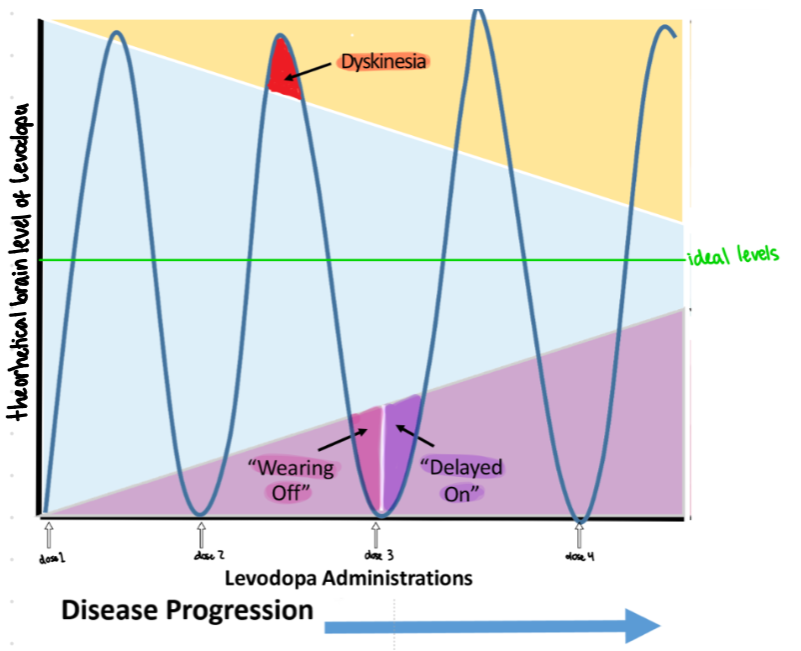
_________ on: therapeutic benefits are _________
delayed (happens right after dose is taken when drug is still accumulating up in the body)


carbidopa/levodopa: addressing motor fluctuations
delayed on: therapeutic benefits are delayed
solution: take drug ___________ OR change the formulation
on empty stomach (so it gets absorbed quicker)

carbidopa/levodopa: addressing motor fluctuations
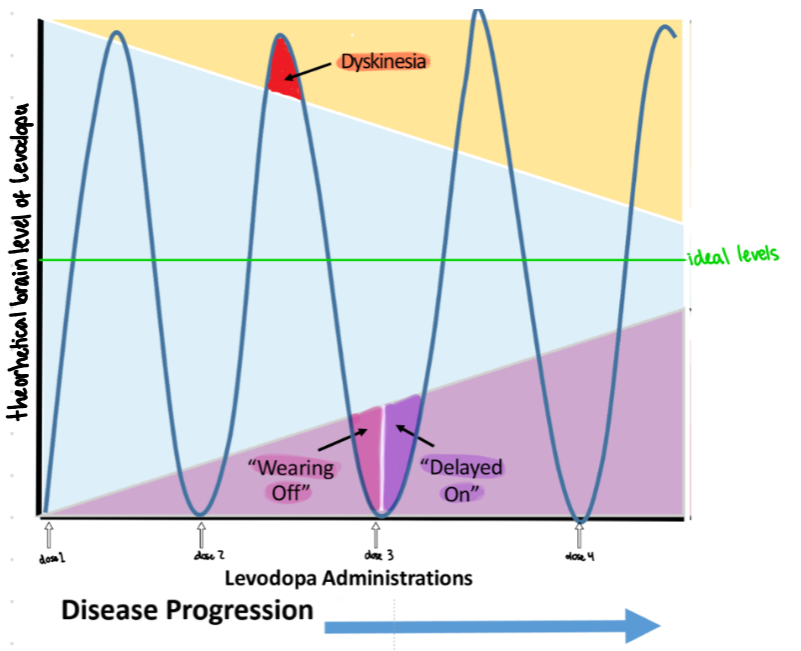
peak-dose dyskinesia: __________ body movement caused by too high of __________ level
involuntary, dopamine
carbidopa/levodopa: addressing motor fluctuations
___________ ___________: involuntary body movement caused by too high of dopamine level
peak-dose dyskinesia
carbidopa/levodopa: addressing motor fluctuations
peak-dose dyskinesia: involuntary body movement caused by too ________ of dopamine level
high

carbidopa/levodopa: addressing motor fluctuations
peak-dose dyskinesia: involuntary body movement caused by too high of dopamine level
solution: __________ dose OR consider addition of _____________
reduce, Amantadine
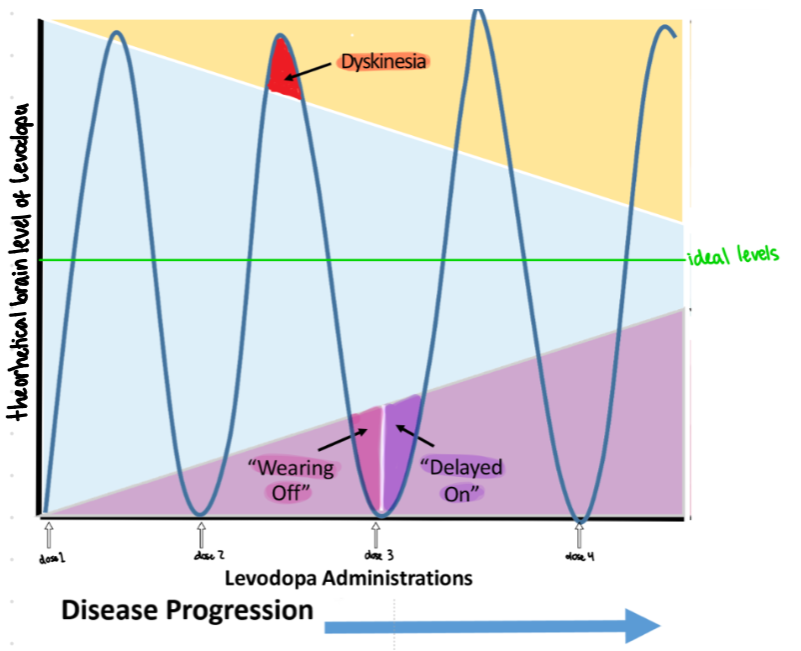
dopamine agonist: really the only advantage of these over Carbidopa/Levodopa is that the 1st-episode of ___________ is delayed
dyskinesia
dopamine agonists: may be used as __________ for early symptoms in selected patients
monotherapy
dopamine agonists
may be used as monotherapy for early symptoms in selected patients
may be added to __________ to reduce “wearing OFF” time
levodopa

dopamine agonists
may be used as monotherapy for early symptoms in selected patients
may be added to Levodopa to reduce _____ ________
OFF time

dopamine agonists
may be used as monotherapy for early symptoms in selected patients
may be added to Levodopa to _________ “wearing OFF time”
reduce
dopamine agonists: AEs
-N/V, constipation, dry mouth
-hallucinations
-sudden onset of _______
-________ control
-dizziness, orthostatic hypotension, peripheral edema
sleep, impulse (new or worsening gambling, hypersexuality, compulsive shopping, binge eating)
adverse effects of _____________
-N/V, constipation, dry mouth
-hallucinations
-sudden onset of sleep
-impulse control
-dizziness, orthostatic hypotension, peripheral edema
dopamine agonists (Pramipexole or Ropinirole)
dopamine agonists
___________ is dosed PO TID (or ER tablet daily) and must be renally adjusted if CrCl is <50 mL/min
Pramipexole
dopamine agonists
Pramipexole is dosed PO TID (or ER tablet daily) and must be __________ adjusted if __________
renally, CrCl <50
dopamine agonists
___________ is dosed PO TID (or ER tablet daily) and is a major CYP1A2 substrate (caution with inducers like omeprazole, smoking) (caution with inhibitors like ciprofloxacin, cimetidine)
Ropinirole
dopamine agonists
Ropinirole is dosed PO TID (or ER tablet daily) and is a major CYP_____ substrate (caution with inducers like omeprazole, smoking) (caution with inhibitors like ciprofloxacin, cimetidine)
1A2
dopamine agonists
___________ is a 2mg/24-hour patch that can be applied once daily at the same time to different sites
Rotigotine
dopamine agonists
Rotigotine is a 2mg/24-hour _________
patch
dopamine agonists
___________ is a 2mg/0.2mL subQ PRN rescue treatment
AEs: hypotension, N/V (pre-treat with anti-emetic)
Apomorphine
dopamine agonists
Apomorphine is a 2mg _________ PRN rescue treatment
AEs: hypotension, N/V (pre-treat with anti-emetic)
subQ
dopamine agonists
Apomorphine is a 2mg/0.2mL subQ PRN _________ treatment
AEs: hypotension, N/V (pre-treat with anti-emetic)
rescue
COMT-inhibitors work by increasing duration of action of _________ by blocking enzymatic breakdown of _________ to inactive metabolites (3-OMD)
levodopa
___________ work by increasing duration of action of levodopa by blocking enzymatic breakdown of levodopa to inactive metabolites (3-OMD)
COMT-inhibitors (Entacapone and Opicapone)
COMT-inhibitors are used as _________ therapy only (adjunct or mono)
adjunct (to Levodopa)
COMT-inhibitors are used as adjunct therapy only
____________: 200mg PO with each dose of carbidopa/levodopa (TID-QID)
___________: 50mg PO once daily at bedtime
Entacapone, Opicapone
MAO-B inhibitors work by blocking the breakdown of __________ into inert compounds
dopamine (does not work on L-dopa)
MAO-B inhibitors work by blocking the breakdown of dopamine into inert compounds
they are used as adjunct therapy with __________ to decrease “wearing OFF” time and improve the wearing off of symptoms
carbidopa/levodopa
MAO-B inhibitors work by blocking the breakdown of dopamine into inert compounds
they are used as adjunct therapy with carbidopa/levodopa to decrease ____ ________ and improve the wearing off of symptoms
OFF time
MAO-B inhibitors work by blocking the breakdown of dopamine into inert compounds
ADEs: ____ _________ (may exacerbate psychosis in patients with psychiatric disorders) and may exacerbate SEs of ________
CNS depression, levodopa
______________ work by blocking the breakdown of dopamine into inert compounds
ADEs: CNS depression (may exacerbate psychosis in patients with psychiatric disorders) and may exacerbate SEs of levodopa
MAO-B inhibitors (Selegiline, Rasagiline, Safinamide)
______________ have a limited role in treating tremor-prominent PD (consider in younger patients without cognitive impairment)
anticholinergics (Benztropine or Trihexyphenidyl)
anticholinergics have a limited role in treating _________-prominent PD (consider in younger patients without cognitive impairment)
tremor
_______________ is an NMDA-receptor antagonist that is primary used to remedy levodopa-induced dyskinesia
Amantadine
Amantadine is an NMDA-receptor antagonist that is primary used to remedy _________-induced dyskinesia
levodopa
_______________ (like Istradefylline) block the indirect pathway in the basal ganglia (=reduce the suppression of movement) and therefore decrease bradykinesia
used as adjunct to levodopa in patients experiencing “OFF” episodes (not used as monotherapy)
A2A antagonists
PD _________ is treated the same as any other patient with ________ (if medication is required, select therapy with minimal motor-symptom worsening effects like Pimavanserin, Quetiapine, Clozapine)
psychosis
monitoring PD treatment
efficacy: tremors, bradykinesia, rigidity, activities of daily living, and QOL
if these are not getting better we can increase the ______ or increase the _________
dose, frequency
monitoring PD treatment
levodopa: assess wearing-off symptoms, delayed-on symptoms, and ___________
dyskinesia
monitoring PD treatment
________: assess wearing-off symptoms, delayed-on symptoms, and dyskinesia
levodopa
monitoring PD treatment: drug-specific
____________: assess sleep attacks, impulse control disorders, and hallucinations
dopamine agonist