UPCAT SCI - CHEM ATOMS

0.0(0)
Studied by 0 people
call kaiCall Kai
learnLearn
examPractice Test
spaced repetitionSpaced Repetition
heart puzzleMatch
flashcardsFlashcards
GameKnowt Play
Card Sorting

1/26

flashcard set

Earn XP

Description and Tags

Last updated 1:28 PM on 5/25/26
Name
Mastery
Learn
Test
Matching
Spaced
Call with Kai

No analytics yet

Send a link to your students to track their progress

27 Terms

1
New cards
Atom
The basic unit of an element that can enter into a chemical combination.
2
New cards
Law of Conservation of Mass (Dalton)
States that atoms are neither created nor destroyed in a chemical reaction
3
New cards
Subatomic Particles
The three basic components of an atom: protons (positive), electrons (negative), and neutrons (neutral).
4
New cards
Electron
The first subatomic particle discovered
5
New cards
Plum Pudding Model (Thomson)
An early atomic model proposing that an atom is a uniform, positive sphere with negatively-charged electrons embedded like raisins.
6
New cards
Cathode Ray Experiment
The experiment by J.J. Thomson that led to the discovery of the electron and its negative charge-to-mass ratio.
7
New cards
Oil Drop Experiment
The experiment by Robert Millikan that calculated the exact charge and mass of a single electron.
8
New cards
Gold Foil Experiment
The experiment by Ernest Rutherford that proved atoms are mostly empty space with a tiny, dense, positive core called the nucleus.
9
New cards
Nucleus
The extremely dense, positively-charged core at the center of an atom containing protons and neutrons.
10
New cards
Neutron
An electrically-neutral subatomic particle discovered by James Chadwick to account for unexplained atomic mass.
11
New cards
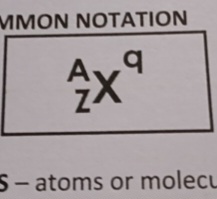
Atomic Number (Z)
The number of protons in an atom's nucleus, which identifies the element and dictates its position on the periodic table.
12
New cards
Mass Number (A)
The total number of protons plus neutrons in an atom's nucleus (not explicitly written on the periodic table).
13
New cards
Atomic Mass
The mass of an atom, mostly attributed to its protons and neutrons since electron mass is negligible.
14
New cards
Planetary Model (Bohr)
An atomic model proposing that electrons revolve around a positive nucleus in fixed, predetermined circular orbits.
15
New cards
Quantum Mechanical Model
The modern atomic model (Schrödinger) stating that electrons are found in 3D probability spaces called orbitals, not fixed orbits.
16
New cards
Orbital
A three-dimensional space around the nucleus where there is a high probability of finding an electron.
17
New cards
Quantum Numbers
A set of four numbers that act as an "address" to completely describe the energy, shape, orientation, and spin of an electron.
18
New cards
Principal Quantum Number (n)
Indicates the main energy level (shell) and size of the orbital
19
New cards

Azimuthal Quantum Number (l)

Describes the specified subshell of an atom

20
New cards
Magnetic Quantum Number (ml)
Dictates the orientation of an orbital in three-dimensional space
21
New cards
Spin Quantum Number (ms)
Describes the direction of the electron's spin
22
New cards
Orbital Electron Capacities
Maximum number of electrons each orbital type can hold: s holds 2, p holds 6, d holds 10, f holds 14.
23
New cards
Aufbau Principle
States that electrons must fill lower-energy orbitals first before moving to higher-energy ones (governed by the n+l rule).
24
New cards
Hund's Rule of Multiplicity
States that every orbital in a subshell must be singly occupied with an electron of the same spin before any orbital is doubly occupied.
25
New cards
Pauli's Exclusion Principle
States that no two electrons in the same atom can have the exact same set of four quantum numbers
26
New cards

Si Sally Pumasok Sa Pinto Si Daddy Pumasok Sa Door Paano Si Father Daddy Paano Si Father Daddy Paano Si

Mnemonic for electron configuration

27
New cards

Electron Configuration

The specific arrangement or distribution of an atom's electrons across its available energy levels and subshells.