ANPS - Neurons and Nervis System Basics
0.0(0)
Studied by 0 people Call Kai
 Learn
Learn Practice Test
 Spaced Repetition
 Match
Match Flashcards
 Knowt Play
Card Sorting
1/63

Earn XP
Description and Tags
Last updated 4:13 PM on 10/16/22
Name | Mastery | Learn | Test | Matching | Spaced | Call with Kai | Chat |
|---|
No analytics yet
Send a link to your students to track their progress
64 Terms
1
New cards
central nervous system
brain and spinal cord; integrative and control centers
2
New cards
peripheral nervous system
cranial and spinal nerves; communication between CNS and the rest of the body
3
New cards
sensory (afferent) division
somatic and visceral nerve fibers, impulses go from receptors to the CNS
4
New cards
motor (efferent) division
motor nerve fibers, impulses go from CNS to muscle/gland cells
5
New cards
somatic nervous system
voluntary, impulses CNS -> skeletal muscle
6
New cards
autonomic nervous system
involuntary, CNS -> cardiac or smooth muscle and glands
7
New cards
sympathetic division of autonomic system
mobilizes body during activity
8
New cards
parasympathetic division of autonomic system
conserves energy, promotes house-keeping functions during rest
9
New cards
neuron
basic unit of nervous system, excitable cells that transmit electrical signals, do not divide after fully mature
10
New cards
glia
non-excitable, primarily support and protect neurons, undergo mitosis throughout life
11
New cards
properties of neurons
excitable, conductive, extreme longevity, amitotic
12
New cards
cell body (soma)
enclosed by plasma membrane, contains cytoplasm and nucleus, biosynthetic center of the cell, chromatophilic substances, conducts electrical signals towards the axon
13
New cards
Nissl bodies/substances
collections of ribosomes in the cytoplasm of a neuron, stain dark purple, grey color of grey matter
14
New cards
dendrites
receive information from other neurons, dendritic spine, more dendrites = more input and more proteins
15
New cards
dendritic spine
receive input and transfer to cell body, little extensions off of the dendrite
16
New cards
arbors
pattern of dendrites
17
New cards
axon
singular process leaving the cell body
18
New cards
axon hillock
where the axon connects to the cell body
19
New cards
axon collaterals
the branches that come of the main branch of the axon
20
New cards
axon terminal
form synapses with target cells, contain synaptic vesicles, site of neurotransmitter release
21
New cards
synapse
made of presynaptic neuron + synaptic cleft + postsynaptic neuron
22
New cards
cytoskeleton
provides support and structure for neurons; microfilaments intermediate filaments and microtubules
23
New cards
intermediate filaments
provide tensile strength throughout the neuron, bundle to form neurofibrils, stains are specific because of different composition
24
New cards
anterograde transport
movement of material from cell body to the synaptic terminal
25
New cards
retrograde transport
movement of materials from the synaptic terminals to the cell body
26
New cards
unipolar neuron
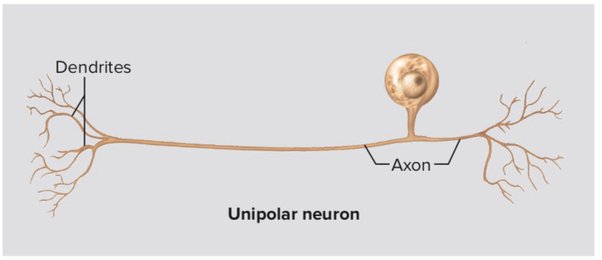
27
New cards
bipolar neuron
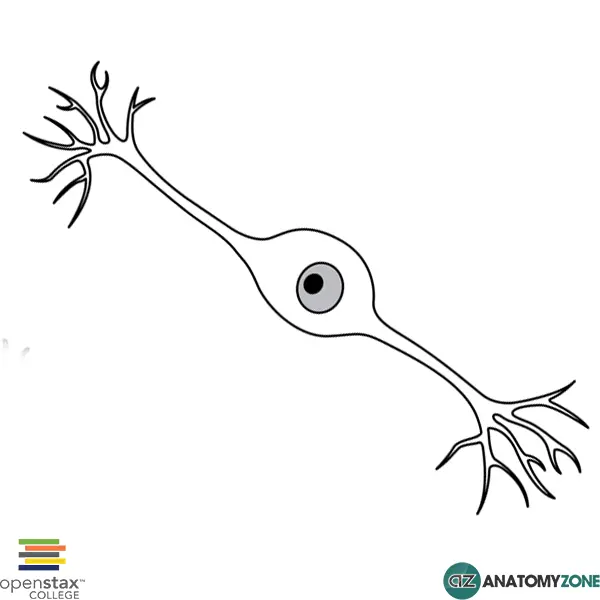
28
New cards
multipolar neuron
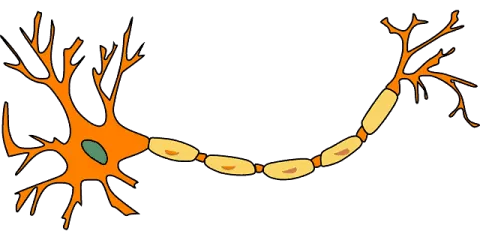
29
New cards
astrocytes
most abundant glial cell, feet cover capillaries, control chemical environment around neurons
30
New cards
oligodendrocytes
type of glial cell, highly branched from a single soma, produce myelin sheath, can support axons of many surrounding neurons
31
New cards
microglia
type of glial cell, monitor neurons and extracellular space for health and signs of disrupted homeostasis, capable of phagocytosis
32
New cards
ependymal cells
line the CNS fluid-filled cavities, produce cerebrospinal fluid, cilia help circulate cerebrospinal fluid
33
New cards
satellite cell
surround ganglion neuron cell body, regulate cellular environment similar to astrocytes in the CNS
34
New cards
Schwann cell
myelinated PNS axons, critical for nerve regeneration
35
New cards
myelinated
few to many layers of lipid membrane wrapping
36
New cards
unsheathed
axons isolated from one another but no layers of lipids
37
New cards
nerve
cable-like bundle of parallel axons with their glia in the PNS
38
New cards
ganglion
cluster of neuron cell bodies in the peripheral nervous system
39
New cards
epineurium
surrounds the entire nerve
40
New cards
perineurium
surrounds a bundle of neurons
41
New cards
endoneurium
surrounds a single axon
42
New cards
Electrolytes
ions can carry electrical currents in solution
43
New cards
Ion channel
an integral membrane protein that allows ions to pass between intracellular and extracellular environments (leak and gated)
44
New cards
Selectivity
regulates the passage of ions based on size and charge
45
New cards
Receptor
an integral membrane protein that produces a physiological change in a cell after a ligand binds
46
New cards
Ligand
signaling molecule
47
New cards
Leakage ion channel
protein is always open, establish resting membrane potential, selective for a specific ion, net movement based on gradient
48
New cards
Passive movement
the movement of ions does not require ATP, they are following their gradient
49
New cards
Voltage Gated ion channel
gate opens in response to a change in membrane voltage (ex. Muscle and nerve cells)
50
New cards
Chemical (ligand) Gated ion channel
open in response to binding of an extracellular signal (ex. Neurotransmitters)
51
New cards
Ionotropic receptor
type of chemical receptor, channels that open or close in response to an extracellular signal; open ion channels allow ions to move and carry across the membrane
52
New cards
Metabotropic receptor
type of chemical receptor, proteins that respond to an extracellular signal by altering the metabolism in the cell
53
New cards
Neurotransmitter
ligands that are released from neurons at the synapse in order to communicate with different cells, can be excitatory or inhibitory
54
New cards
Acetylcholinesterase
enzyme that breaks down acetylcholine in the synapse
55
New cards
conformational change
single region changes shape on a gated channel protein
56
New cards
general structure change
entire pore changes shape on a gated channel protein
57
New cards
blocking gate
specialized protein responds and plugs the gate in a gated channel protein
58
New cards
4 rules of neurotransmitters
1) synthesized and released from a neuron
2) released from nerve terminals in an identifiable way
3) reproduce the events in another cell that occurred in the cell it was released from
4) must be a way to get rid of the chemical signal
2) released from nerve terminals in an identifiable way
3) reproduce the events in another cell that occurred in the cell it was released from
4) must be a way to get rid of the chemical signal
59
New cards
acetylcholine
neurotransmitter that activates skeletal muscles
60
New cards
biogenic amines
ligands that affect mood, serotonin/dopamine/etc. removed from the synapse via uptake
61
New cards
GABA
inhibitory, principal inhibitory in the brain
62
New cards
Glycine
inhibitory, major inhibitory in the spinal cord and brain stem
63
New cards
glutamate
excitatory, principle excitatory in the brain
64
New cards
neuropeptide
small proteins made of the rough ER