test 3 larping
 Call Kai
 Learn
Learn Practice Test
 Spaced Repetition
 Match
Match Flashcards
 Knowt Play
1/32

There's no tags or description
Looks like no tags are added yet.
Name | Mastery | Learn | Test | Matching | Spaced | Call with Kai | Chat |
|---|
No analytics yet
Send a link to your students to track their progress
33 Terms
AST Converges if…
decreasing and limit equal to 0
for the ratio test, based on the limit..
if L is more than 1, it diverges, if L is less than 1 it converges, if L is equal to 1, it’s inconclusive
To find the degree of the Maclurin Polynomial required for the error in an approximation (ex: sin(0.6))
for each term in the polynomial, plug in 0.6 to see which degree is less than error
to determine values that can be replaced by a taylor polynomial (ex: sinx approximates x - x³/3)…
use the next term and compare to error, then isolate x (ex: x^5/5 < error)
when the limit approaches 0 when trying to find the interval of convergence…
the interval is (-infinity, infinity)
when the limit approaches infinity when trying to find the interval of convergence..
the interval is the center.
to find the interval of a power series in the form a * r^n….
isolate x to find the interval, then when testing each boundary, integrate
to find a power series with a given function…
include the alternating sign if negative, r^n and x^n
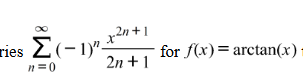
arctan(x) for marclain polynomial..
the same of sin(x)
when approximating a value like arctan(1/6)…
plug in x, stop when it exceeds then sum it up
f(x) = arctan(x)
ln(x) taylor series

binomial series formula for maclurin series

cosine maclaurian series

using a power series to approximate teh value of an inegral with an error…
turn into macluarin series then integrate by term and change bounds.. then sum valid terms that do not make less than 0.01
to identify which points in a cycloid are not smooth..
find dx/dt and dy/dt at 0. figure out which n’s are valid
to find the derivative and second derivative of a parametric equation…
dy/dx = (dy/dt)/(dx/dt) and d²y/dt² = (the derivative of dy/dx)/(dx/dt)
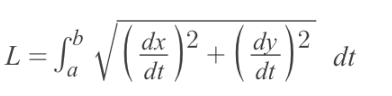
arc length of a curve for parametric equations
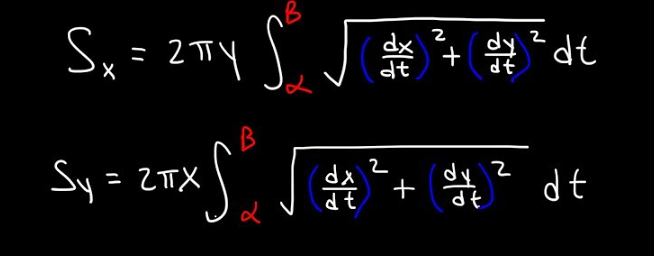
area of a surface revolving the curve for parametric equations
to find polar coordinates…
first identify the quadrant, then find the radius (r = sqrt(x² + y²)), use correct reference formula to find theta, then 2pi - theta and pi - theta for both signs
x in polar form…
r cos theta
y in polar form…
r sin theta
x² + y² in polar form..
r²
to convert rectangular to polar form….
isolate r
polar to rectangular form…
use tan on both sides then multiply both sides by r(?)
shaded loop formula
. set equation to 0 to find possible thetas … choose coordinate that surrounds target
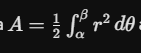
cos² theta
1+cos(2theta)/2
sin²(theta)
(1-cos(2theta)/2
to find outer and inner loop of an area of the region lying between loops..
find the possible thetas for innfer, then for the lower boundary, for the outer itll be the lower boundary from inner to the negatives
to find the intersection of the graphs of the polar equations
equal both equations to each other, and find a theta that makes both equations equivalent
length of curve for a polar
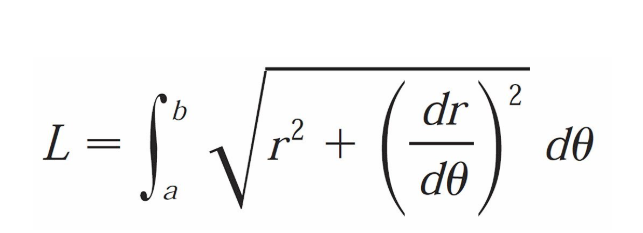
to find area of a common interior of polar equations…
find intersection point with theta to get boundaries, then use r² formula.. then solve integral
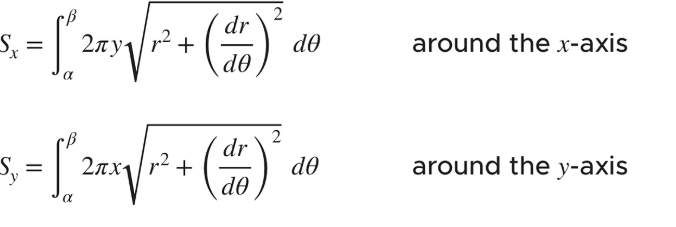
area of a surface revolved around a polar axis or an axis for polar equations