HRT 310 nursery part 2
 Studied by 0 people
 Call Kai
 Learn
Learn Practice Test
 Spaced Repetition
 Match
Match Flashcards
 Knowt Play
1/77

There's no tags or description
Looks like no tags are added yet.
Name | Mastery | Learn | Test | Matching | Spaced |
|---|
No study sessions yet.
78 Terms
Define Essential Element- do not list the essential elements. Also remember your exam definition should not use the words being defined (do not use element or essential)
• An element is said to be essential if it is needed in order for a plant to complete its life cycle
Define Mobile Nutrient
those that can be translocated from older plant parts to new growth when the plant is deficient. Key examples include nitrogen (N), phosphorus (P), and potassium (K).
Define Immobile Nutrient
plant nutrients that do not move easily once absorbed and are often locked in place, meaning deficiency symptoms appear first in the new, upper growth. Examples include Calcium (Ca), Sulfur (S), Iron (Fe), Boron (B), and Copper (Cu). Because the plant cannot relocate them from older leaves, a lack of supply through the roots directly impacts new leaves, causing symptoms like yellowing or discoloration in the newest parts of the plant
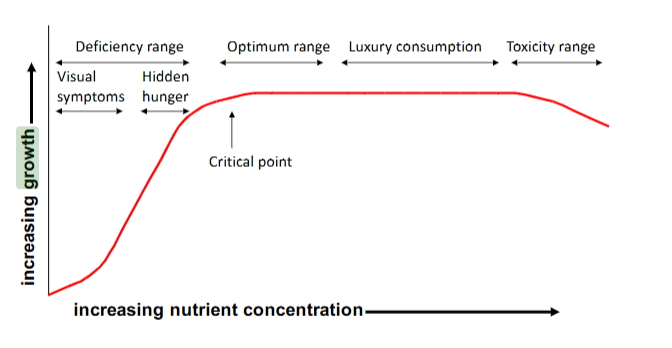
What is the general relationship between plant growth and nutrient concentration that holds for
all essential elements? You can use a graph to represent this, label each of the ranges discussed
coconote
In what form are nutrients taken up by the plant?
coconote
What are the important soil physical and chemical properties? Why are each important?
Soil physical properties
Soil texture & Organic matter
Soil structure
Bulk density
Soil texture
• Determined by mechanical analysis
• % in each of the various soil particle size fractions
• affects many other soil physical and chemical properties
Soil chemical properties
Important chemical properties
– Soil pH
– Cation exchange capacity
– Conductivity (salinity)
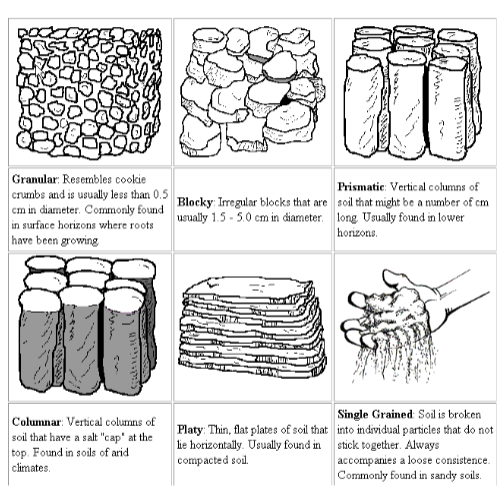
What is the relationship between soil structure and soil texture?
Soil texture
• Determined by mechanical analysis
• % in each of the various soil particle size fractions
• affects many other soil physical and chemical properties
Soil Structure
(in image)
Why is it important to know the pH of a soil?
What is the ideal range for soil pH for most nursery crops?
Name a few plant exceptions to this general soil pH range
Measure of the acidity of soil
pH = log (1/H+)
1 = acidic, 7 = neutral, 14 = basic
The favorable pH range for most plants is
5.5 to 7.5
Conifers generally grow better under
lower pH than hardwoods
Exceptions: Dogwoods, Ericaceae
How do you adjust soil pH if it is too low? If it is too high?
When is the ideal time to do either of these?
What affects the amount of liming or acidifying material to use?
application dependent on soil type. Sandy, dilt, clay, loam. and depends on the desired amount of pH change.
Sulfur reduces pH
Approx. amount of elemental sulfer required to reduce pH at a depth of 7in of carbonate free soil.
Limestone increases pH
Recommended Tons of Limestone per Acre, Estimated from Soil pH and Texture, to Raise the pH of a 6 2/3-in. Plow Layer of Different Soils to pH 6.5.
lime recommendations based on a liming material having 25% passing through a 100-mesh sieve and having a neutralizing value of 90%
Define Cation Exchange Capacity- remember your exam definition should not use the words
being defined
• Cations are positively charged elements in the soil
• Common nutrient elements that occur as cations are K+, Mg+2, Ca+2, NH4+
• Other cations are also taken up by plants; Al+3, Na+2
• The ability of a soil to hold positively charged ions (cations)
• Gives an indication of the ability of soil to hold nutrients
What 3 methods can be used determine the need for fertilizing field grown nursery crops?
In general, fertilization in field nurseries should be based on at least one of the following:
1• Soil testing (pre-plant and post-plant)
2• Visible symptoms (post-plant)
3• Foliar testing (post-plant)
What information will you get from a soil test? How can you use this information?
Soil nutrient analysis
• Typical soil analysis will give macronutrients and some micros (Fe, Mn, Zn, Cu) and also elements that can be toxic (Al)
• Limitation of soil analysis is that it may not indicate the amount available to plants (Fe chlorosis)
What information will you get from foliar analysis?
What kind of samples should you provide?
How can you use this information?
Foliar nutrient analyses
• Sample recently expanded foliage
• Keep track of time of year when sampled
• Deciduous -> Mid-late summer
• Conifers -> Fall
• If possible, sample ‘good’ and ‘bad’ plants
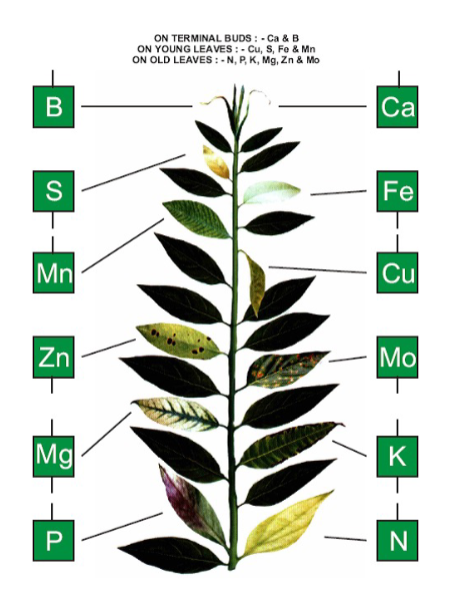
What information can you get from visual plant nutritional deficiency symptoms?
How unique or accurate are they?
Symptoms
• Part of plant affected
• Chlorosis, Necrosis
• Pattern, I.e. interveinal Vs. whole leaf
Other causes
• evidence of pathogens, insects, water stress
How can you optimize plant uptake of fertilizers?
• Fertilize more frequently in smaller amounts
• Band fertilizer along the crop root-zone to ensure
that nutrients are intercepted
• Minimize ammonia volatilization by incorporating
fertilizer
• Avoiding the use of urea during warm, dry periods
Why do we fertilize based usually on nitrogen? What is the nitrogen cycle?
What are the nitrogen inputs (gains) in the nitrogen cycle?
Where is nitrogen removed (losses) from the
nitrogen cycle?
What part of the nitrogen cycle is particularly important to environmental qualityand why?
How much nitrogen should I apply?
• Historically, recommendations for N have ranged as high as 250- 300 lbs N/ac
• Trees don’t need that much N
• Excessive fertilization can lead to nitrate leaching
N Fertilization
• Current recommendations (50-120 lbs per acre per year)
Examples:
• 1st year 50 lbs before budbreak
• Year 2+ 80-120 lbs/year
• 60 lbs per acre/y in 3 split applications
• 20 lbs in March, May & July
-N Fertilization rates based on ‘per plant’
recommendation
-element needed in largest amount
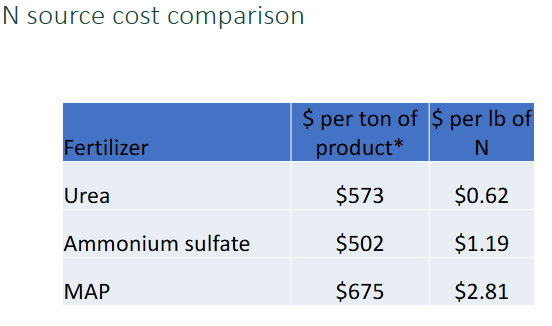
-inorganic vs organic sources (cost, consistency, contamination)
Gases and losses of N
Increase N availability
• Fertilization
• Mineralization
• N fixation
Decrease N availability
• Leaching
• Denitrification
• Crop harvest
Fert Grade
-Total N and available P
Fertilizers are required by law to be labeled with at least 3 numbers. What do these 3 numbers represent? Be sure to include the unit and make sure you use the proper chemical name or symbol
Fertilizer-grade
• total nitrogen as elemental N
• available P as P2O5
• water soluble K as K20
Conversions:
K2O (postassium oxide)= 83% K
P2O5 (phosphorus pentoxide) = 44%P
Can fertilizers be used to modify soil pH? Give 1 example of a fertilizer source that will decrease
soil pH and give 1 example of one that will increase soil pH
Sulfur reduces pH
Approx. amount of elemental sulfer required to reduce pH at a depth of 7in of carbonate free soil.
Limestone increases pH
Recommended Tons of Limestone per Acre, Estimated from Soil pH and Texture, to Raise the pH of a 6 2/3-in. Plow Layer of Different Soils to pH 6.5.
lime recommendations based on a liming material having 25% passing through a 100-mesh sieve and having a neutralizing value of 90%
Effective Neutralizing Value (ENF)
• Based on chemical effectiveness (calcium carbonate equivalent)
• CaCO3 =100
• Particle size (finer mesh increases effectiveness)
• Moisture content
Why is it important to know if a nutrient is mobile or immobile in a plant? How can you use this
when using foliar analysis results and soil tests to determine fertilizer requirements?
Knowing a nutrient's mobility in a plant is crucial for diagnosing deficiency symptoms because mobile nutrients appear first in old leaves, while immobile nutrients first appear in new leaves. This knowledge, combined with soil and foliar tests, helps you determine fertilizer needs:
if a mobile nutrient is deficient and the soil test shows low levels, it indicates a need for more frequent or readily available applications;
if an immobile nutrient is deficient, the soil may need a significant one-time correction or a broadcast application, as the plant cannot pull it from older tissue.
What are the 5 fertilizer application methods? Which is most common?
Which provides the most versatility to meter nutrients to the plant growth stage?
How can efficiency be increased for granular fertilization?
Why and when is foliar fertilization used?
Fertilizer application methods
• Gas (e.g., anhydrous ammonia)
• Granular
• Fertigation
• Foliar
• Organic
Fertilizer application methods
• Granular
Choice of material
• Based on fertilization program
Timing
• Spring (typical)
• Fall (woody crops)
Broadcast/ banding/ hand application
Fertigation
• High up-front costs
• Need high quality water
• Provides opportunity for
injection of systemic pesticides (Chemigation)
Foliar fertilziation
• Essentially a ‘quick fix’
• Typically treating symptom not problem
Container Capacity
the maximum amount of water a container substrate will hold after gravitational drainage.
• Typically 45 – 60%
Available Water
the amount of water that can be extracted
by a plant.
= Container Capacity – Unavailable Water
Unavailable Water
water that is tightly bound to the substrate and cannot be extracted by a plant.
• Typically 25 – 35%
Readily Available Water
the amount of water that can be easily extracted by a plant.
• Typically 25 – 35% of Available Water
Permanent Wilting Point
when the plant has extracted all of the available water and is not able to regain turgor.
What are the important considerations to take into account for irrigation scheduling? Why/how
are they important?
Water quality
-Soluble salts
-Alkalinity
• Container substrate physical properties (water availability terminology)
• Determining irrigation application
• System size, type and application rate (frequency of irrigation)
-How much is too much
-How much is enough
• Nutrients in effluent water
• Cost of water
If scheduling done properly
• Use water more efficiently
• Retains fertilizer where it’s needed
• Reduces certain problems with low quality water (alkalinity)
• Reduces plant losses
• Improves plant growth/quality
• Shortens production cycle (greatest cost benefit)
• Reduces runoff volume
• Reduces nutrient loss in runoff
Is the container the gas tank or beer glass? What does this mean???
metaphor used to illustrate how you view and manage the water reservoir in a container nursery.
if container = gas tank
The container is the fuel that stores water for the plant. Filled adequately so plants have a consistent supply.
-The container holds water that plants use over time.
-Manage irrigation to keep the container full, ensuring min water stress.
If container = beer glass
The container is a glass of beer you drink down once it’s almost empty, and you refill it.
-container seen as a limited volume that is depleted and refilled regularly.
-emphasizes frequent monitoring and precise irrigation to refill exactly what was used instead of keeping ti consistently full
What is the general relationship between substrate (or soil) moisture content and substrate (or soil) moisture tension? Why is this important to understand?
Moisture content is the amount of water present in the substrate or soil, often expressed as volumetric water content (% of vol)
Moisture tension (water tension) is the force or suction the soil excerts to pull water from the substrate. (how hard the plant roots must work to extract water)
What needs to be taken into account when determining how much water is too much to apply?
Container Capacity (CC) = 60% Substrate Moisture Content (SMC)
Unavailable Water (UW) = 25% SMC
Available Water (AW) = 35% water depletion
Readily Available Water (RAW) = CC 35% = 21% (occurs at 39% SMC)
-But don’t really want wilting, say we water to replace 10% below CC (50% SMC)
-Calculation based on overhead irrigation
How do you measure the leaching fraction?
What leaching fraction is best for nurseries in most of the eastern U.S.? Why?
What must you do when using low or 0 leaching fractions?
How much is enough?
• Experience
-Weather/evapotranspiration
- Feel/weight
• Leaching Fraction
• Moisture sensors
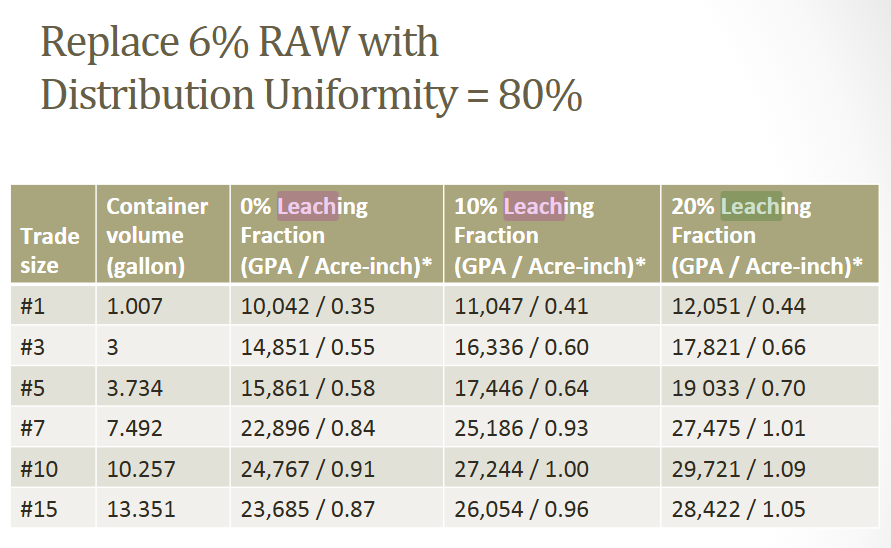
Leaching Fraction (LF) =
(amt of water leached with plant / amt without plant) * 100
-Older recommendations are for LF ≤ 20 %, based on greenhouse studies
-LF = 0 should be considered for nurseries (Eastern US). YOU MUST
-Monitor container EC if go to 0 LF
If you measured a leaching fraction of 42% after running your irrigation system for 1 hour what
would you do?
How do you determine the amount of time to run your irrigation system if you want a leaching fraction of 5%?
with 42% LF after running irrigation for one hour means there is a very high % of irrigation water draining out of the container. ( target is 10-20% or lower).
You should..
-Reduce the runtime of irrigation. to avoid excessive runoff and nutrient water leaching.
-Adjust irrigation schedule. Shorten the time or reduce the volume of water.
-monitor salt levels and runoff. High leaching means less fertilizer and salts in your pot = waste money and harms the environment.
Determine the amount needed for 5%
desired time = current time * desired leaching fraction / measured leaching fraction
(current irrigation time multiplied by desired leaching fraction divided by leaching fraction measured during current irrigation)
measured leaching fraction = 42%
current run time = 60 minutes
desired leaching fraction = 5%
60 × 5 / 42 = 7.14 mins
Running for approx. 7 minutes should give you 5% leaching fraction.
How can substrate moisture sensor be used to schedule irrigation?
Substrate volumetric moisture content determined with Theta probes or Decagon 10HS sensors via a Campbell datalogger programmed to calculate DWU and apply irrigation by controlling solenoid valves. Irrigation is applied based on the highest plant DWU.
Set-point Irrigation
• Can be completely automated
- If so, best for under-canopy irrigation
• Set-point at -8 to -10 kPa turn on, -1.5 to -2 kPa off
• Or turn on at ≥ 25% PAW, turn off at ≤ 5%
Pumping water is cheap in Michigan so saving money on pumping less water is not a compelling argument for conserving water.
What are other costs of improperly using water that are more important when comparing the cost of implementing water conserving practices (irrigation system/control, better manager/crew) to the benefits (savings or additional revenue)?
Cost of Water at the Michigan State Research Nursery
• For 160 irrigation events per year = $0.032 cost per 3 gallon plant
• Reduce water use by 30% = $0.022 cost per plant
• Reduce water use by 70% = $0.009 cost per plant
• Reduce fertilizer leaching by 6% = save $0.005 per plant
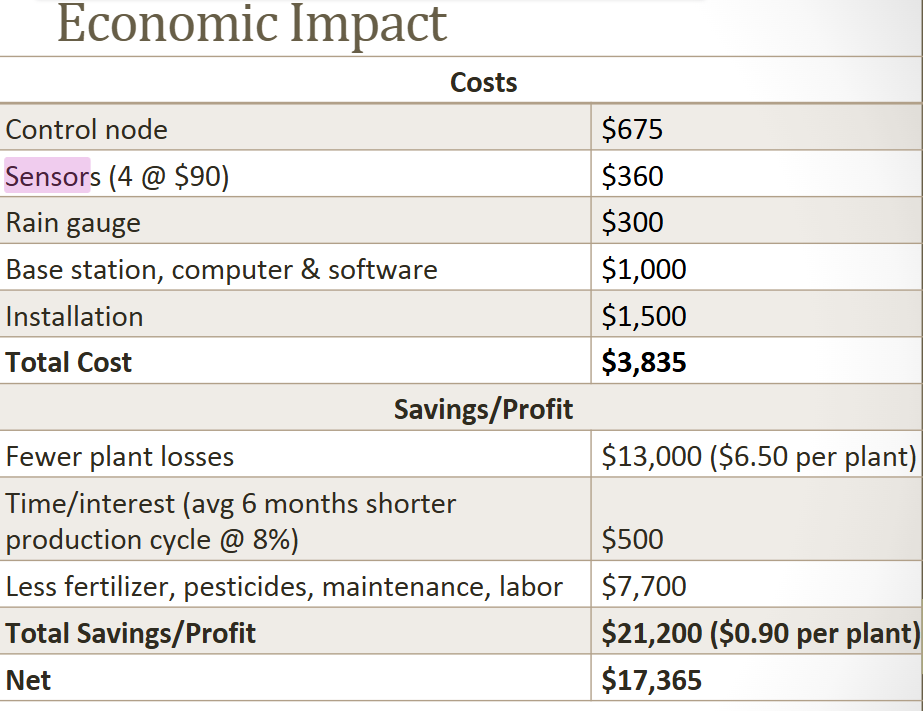
• Saving $0.015-$0.023 per plant, Whoopee!!
• Additional revenue of $158-$242 per acre
• Water is cheap!
Cost of Water
• Cheap! But not the consequences of over-irrigation
• For 160 irrigation events per year = $0.032 cost per plant
• Save $0.005 to 0.018 per plant!
• Less shrinkage, shorter production cycle, less fertilizer applied, less fertilizer lost, less labor, less pesticides used = up to $0.90 more revenue per plant (remember this example is with a “problem” crop)
• Less off-site movement of water and contaminants
What are the benefits of proper irrigation scheduling?
If scheduling done properly
• Use water more efficiently
• Retains fertilizer where it’s needed
• Reduces certain problems with low quality water (alkalinity)
• Reduces plant losses
• Improves plant growth/quality
• Shortens production cycle (greatest cost benefit)
• Reduces runoff volume
• Reduces nutrient loss in runoff
Cold Hardiness
Average winter minimum temperatures in 10°F
increments
Improving Cold Hardiness
Slowing growth:
• Imposing mild drought stress (careful though)
• Fertilizer timing
• Lifting/undercutting (Field seedling production)
Cold Acclimation

Radiation Freeze
• Calm wind, usually following a cold front
• Clear skies
• Temperature inversions
• Frost pockets
Solution
-use wind machine
-use a helopcopter
Use
-irrigation for freeze protection
Typically not used for nursery crops. It is done for fruit crops to protect the flowers so that the plants will bear fruit. Possibility of damaging plants due to ice load.
Advective Freeze
• Associated arrival of cold fronts
• Wind speeds > 5 mph
• May last several days
• Limited additional freeze control methods
Describe the cold acclimation/deacclimation process. What happens to plant cold hardiness in
this process when temperatures warm up for brief spells in the winter?
The acclimation process is how plants increase their cold hardiness in response to gradually decreasing temperatures, shorter day length, and other environmental cues typical of fall and early winter. During acclimation, physiological and biochemical changes occur, such as:
increasing concentration of solutes like sugars and proteins that act as antifreeze agents inside cells.
changes in membrane composition, making membranes more resistant to freeze damage.
dehydration of cells to reduce ice formation inside tissue
production of protective proteins and antioxidants.
Deacclimation occurs when temperatures warm up, particularly during brief warm spells in the winter.
The protective adaptations reverse, for instance, solute concentrations decline, membranes become less tolerant, and cells rehydrate
As a result, the plant’s cold hardiness decreases quickly
This makes plants more vulnerable to subsequent freezes because their tolerance to cold is reduced
How do nurseries attempt to maintain cold hardiness?
site selection and microclimate management
- Avoid frost pockets
- grouping plants by cold hardiness
physical protection methods
-overwintering structures or blankets
container and production techniques
- pot in pot systems
-use of insulating material
Irrigation for freeze protection
- Overhead irrigation during radiation freezes
- use of insulation materials
Management of cold acclimation/ deacclimation
-avoiding premature deacclimation
- gradual temperature changes
Root and soil management
- maintain good soil drainage, prevent cold damage waterlogging
- manage good SOM
Monitoring and forecasting
- Use weather data app to anticipate freeze events, deploy measures if needed.
How do hoophouses provide winter protection?
What types of materials are used to cover
hoophouses?
Winter Protection:
Wind barrier: a hoophouse encloses plants, blocking wind that causes Advective freezes. This helps to retain the heat trapped inside near the ground to prevent rapid temperature drops that damage plants.
Temperature buffering: By creating a controlled microenvironment, hoophouses reduce exposure to extreme cold and temperature flux.
Moisture control: a hoophouse can help maintain humidity and reduce frost formation on plants.
Extended growing season: They prevent or reduce cold damage during winter or early spring, allowing plants to continue growing or survive dormancy with less stress.
What is the main concern with hoophouses as days become longer and sunnier in the winter even while temperatures are very cold?
The main concern with hoophoses during long sunnier days, despite cold temperatures - there is excessive heat buildup inside the structure during the daytime.
solar radiation heats the air and surfaces inside the hoophouse. (temp can rise above outside)
this temperature swing can stress plants as they may experience warmth during the day, but still face cold or freezing temperatures at night
Rapid warming followed by rapid cooling can cause frost damage or physiological stress
ventilation management becomes critical to prevent overheating during sunny days while still protecting plants from cold at night.
What is an alternative cold protection methods
(2 main ones) are there to hoophouses for certain types of plants and what types of plants (2 very
different types of plants)?
Overhead irrigation (frost irrigation)
applies water continuously during freezing conditions to form a layer of ice on plant surfaces. Freezing water releases heat; thawing water takes heat.
used for fruiting crops where saving the flower buds is crucial. Along with hardy perennials, but rare due to potential crop damage from ice weight.
Overwintering blankets or frost cloths
Covering plants with insulating fabric or plastic sheeting that reduces loss and protects against frost formation without fully enclosing the plant.
Used for woody ornamental shrubs that need frost protection but can tolerate some airflow. Or Tender herbaceous perennials or vegetable transplants, lightweight and breathable coverage provides sufficient protection.
Describe the greenhouse effect in relation to solar radiation/light waves.
greenhouse effect happens when sunlight reaches the Earth’s surface as solar radiation, mostly in the form of visible light waves
Sunlight (short-wave radiation) passes through the transparent covering (like glass or plastic)
sunlight warms the ground and objects inside
These warm surfaces then give off heat as long-wave infrared radiation (invisible heat waves)
Greenhouse coverings trap infrared radiation inside because they don’t let the long-wave heat escape easily
his trapping of heat keeps the inside warmer than the outside air.
Define Alkalinity
Alkalinity is more important than pH. While pH can be an indicator of your alkalinity being too high. It is the ability to neutralize acids, equalize the pH of carbonates and bicarbonates or the capacity to resist acidification.
Define Water Quality
The concentration and load of materials, contaminants, biological or otherwise, in water make it suitible or not for plant growth
Total porosity (3/5)
Amount of water held after gravitational drainage
A new shipment of potting substrate has just arrived from your supplier. You have not used this supplier before. What tests and sensory evaluations should you do before accepting the shipment?
EC test, pH test, visual inspection for uniformity, and moisture check, make sure there are no foul or off odors-could be a sign of spoilage, test its organic matter and nutrient levels, test total porosity, air space, CEC.
You can do some tests just by looking at the substrate, such as what color the substrate is or if there is a fog vs a cloud. You may be able to tell quality just by the smells present. You can feel the substrate for moisture. If there is dry bark or mycelium webs do not pot substrate.
a. Why is it important to know the pH and EC of a substrate in the container?
b. Why is it important to know the pH and EC of a substrate in a substrate stockpile?
c. What would you do to a substrate stockpile if pH was too low and EC was too high so that you could eventually use it to pot up plants?
Q:
a.) The pH determines what nutrients plants can take up. EC determines the salt content in a solution.
b.) If the pH is too high (>6), you can be limiting nutrients such as P, Mn, S, Cu, and Zn. Checking the CE of a stockpile when you receive it can help you determine the substrate's salt content and whether it needs improvement, and the cost of improvement.
c.) If the EC is too high, you can leach out the salt from the substrate with good or better quality water.
K:
a. For proper plant growth, too high or too low EC will stunt/stop growth, and pH is a quick/easy way to monitor pH
b. to know if you need to treat it or mix it with old/new stockpile before using it to pot plants in
c. Leach it than add lime, test again, and repeat if needed
You need to apply 150 pounds of nitrogen per acre. The fertilizer you have available has a label with 20 – 3 – 8 on the label. Answer the following (show your work for possible partial credit):
What do the 3 number on the label denote? (3 points)
How many pounds of fertilizer do you need to add per acre to apply the proper amount of nitrogen per acre? (5 points)
How many pounds of potash and phosphate are you applying? (4 points)
Show your work for partial credit. Does your answer make sense logically?
The 3 numbers on the label denote the percentage of NPK in the fertilizer, N on the actual molecule amount and P/K for their oxide, so 20% N, 3% P2O5, and 8% K2O
150/.2=750lbs per acre of fert
750 x.03= 22.5lbs of P
750 x .08=60lbs of K
Your water quality test just came back from the lab. The test shows that alkalinity is 497 ppm bicarbonates and the Total Soluble Salts EC is 2.58. Additionally, your iron at 7 ppm, above the critical level of 3 ppm. You are growing a standard mixture of ornamental shrubs and trees in containers for the Michigan market. You are currently irrigating with overhead irrigation with large nozzle openings. You are considering implementing drip irrigation on your larger plants.
a) What are the ideal levels for alkalinity, EC?
b) How would you manage your irrigation to minimize problems with high alkalinity, high EC, and high iron?
c) Based on your water analysis, what decision will you make regarding drip irrigation?
(8/12)
a.) ideal levels for bicarb/alkalinity levels: <60ppm, soluble salt/EC <.75ppm
b.) to managae I would acidicfy with sulfuric or phospuric acid
c.) Use drip irrigation with an acid injection system
a. What is harvesting on the diagonal?
b. What spacing system is required?
c. Why is it done?
Make a diagram if it helps.
Square spacing is required. It is a method of harvesting where as the name suggests you harvest in diagonal rows, it allows for you to harvest multiple times in a season or different crop types it is also the most space efficient method
Locating a wholesale nursery in an area with several other competing nurseries is not a good practice since the established nurseries have probably saturated the local market.
false, nurseries have an extremely large range of market, it is actually a good idea to be close to other nurseries because you can ship products out together to save costs
The desired ranges for substrates for total porosity is 50-85%, for air space is 25-40%, for container capacity is 10-30%, and for pH is 5-6.
false, TP is correct, aeration is 10-30%, CC is 45-65%, pH is 5-6
The following are listed in order of most to least importance for water quality considerations in most MI nursery areas: 1) pH, 2) pathogens, 2) soluble salts, 3) pesticide contamination, 4) sodium absorption ratio, 5) Na, Fe, S, Cl, B, F, NO3, 6) bicarbonates (alkalinity); 7) heavy metals/industrial waste; 8) fertilizer or similar nutrient contamination.
False
Alkalinity is first before pH
Softwood bark is the primary component of most nursery substrates due to good cation exchange capacity, water holding capacity, and naturally neutral pH.
True
Pine bark is the main component. Most commonly used substrate. You can add organic and inorganic material to boost certain factors of the substrate, such as bulk density. You'll add sand, perlite, or sphagnum moss would add WHC and porosity.
The 6 economic factors to consider when selecting a new nursery site are: 1) land cost, 2) labor availability and cost, 3) water quality, 4) facilities and utilities, 5) topography, and 6) transportation.
False
Water quality and topography are not included in the six economic factors; rather, it is an environmental factors.
The six economic factors that determine where to start your business include: taxes/regulations/zone, competition, labor/workers present, transportation, utilities/facilities, and land cost.
The desired ranges for substrates for total porosity is 50-85%, for air space is 25-40%, for container capacity is 10-30%, and for pH is 5-6.
False
While total porosity is correct. Air space is 10-30% and container capacity is 45-65%
Considering the relationship between turning frequency and microbial activity during the storage of pine bark pile inventories, what factors should be considered to maintain a balance between beneficial microbial processes and the prevention of harmful byproducts?
Turning frequency is positively correlated with beneficial microbial processes; manage by adjusting moisture content.
Locating a wholesale nursery in an area with several other competing nurseries is not a good practice since the established nurseries have probably saturated the local market.
false, nurseries have an extrememly large range of market, it is actually a good idea to be close to other nurseries because you can ship products out together to save costs
Softwood bark is the primary component of most nursery substrates due to good cation exchange capacity, water holding capacity, and naturally neutral pH.
False, softword bark is the primary component of most nursery substrates due to its CEC, and more acidic pH.
The 6 economic factors to consider when selecting a new nursery site are: 1) land cost, 2) labor availability and cost, 3) water quality, 4) facilities and utilities, 5) topography, and 6) transportation.
False
Water quality and topography are not included in the six economic factors; rather, it is an environmental factors.
The six economic factors that determine where to start your business include: taxes/regulations/zone, competition, labor/workers present, transportation, utilities/facilities, and land cost.
The desired ranges for substrates for total porosity is 50-85%, for air space is 25-40%, for container capacity is 10-30%, and for pH is 5-6.
False
While total porosity is correct. Air space is 10-30% and container capacity is 45-65%
Considering the relationship between turning frequency and microbial activity during the storage of pine bark pile inventories, what factors should be considered to maintain a balance between beneficial microbial processes and the prevention of harmful byproducts?
Turning frequency is positively correlated with beneficial microbial processes; manage by adjusting moisture content.
Locating a wholesale nursery in an area with many other similar wholesale nurseries
Question options:
a. Will foster information exchange.
b. Will draw relevant training and workshops to the area from extension and other information providers.
c. Will cause reduced sales.
d. Can allow sharing of shipment and possibly other costs
e. Can allow shared order filling
Biological factors involved in selecting a site include all except
Snow/ Ice prevalence
Adjusting substrate pH with sulfur compounds
Is done to lower pH
Management strategies for water with alkalinity above 215 ppm include the following
-reduce lime application to substrates
-dilute bad water source with good water source if available
-use acid forming fertilizers
Factors affecting spacing include all except
Soil pH and CEC
Describe in detail how the Virginia Tech Extraction Method (also known as the Pour Through Test) was conducted in lab.
The VTEM method involves:
-wait 30 min - 2 hr after watering
-Add water to the container plant.
-Poor directly in the center pot.
-Once you have a sufficient amount leached out (200ml)
-Pipette a sample of the liquid into an EC and pH tester.
-Record the result among several similar plants to get an average.
In comparison to Michigan surface water sources, Michigan well water sources typically have better water quality characteristics except
alkalinity
Some nurseries add sand as a component of container substrates in order to
increase the bulk density
Locating a wholesale nursery in an area with many other similar wholesale nurseries
-Will foster information exchange
-Will draw relevant training and workshops to the area from Extension and other information providers
-Can allow sharing of shipment and possibly other costs
-Can allow shared order filling
Considering the relationship between turning frequency and microbial activity during the storage of pine bark pile inventories, what factors should be considered to maintain a balance between beneficial microbial processes and the prevention of harmful byproducts?
Turning frequency is positively correlated with beneficial microbial processes; manage by adjusting moisture content.
Adjusting substrate pH with sulfur compounds
Adjusting substrate pH with sulfur compounds
Management strategies for water with alkalinity above 215 ppm include the following
-dilute bad water source with good water source if available
-use acid forming fertilizers
-increase irrigation to leach containers