Male Reproductive Surgery
 Call Kai
 Learn
Learn Practice Test
 Spaced Repetition
 Match
Match Flashcards
 Knowt Play
1/51

There's no tags or description
Looks like no tags are added yet.
Name | Mastery | Learn | Test | Matching | Spaced | Call with Kai | Chat |
|---|
No analytics yet
Send a link to your students to track their progress
52 Terms
Canine male reproductive anatomy:
Scrotum
Prepuce
Preputial muscle (preputialis)
Midline
Inguinal regions
Abdominal Male Reproductive Anatomy:
Prostate gland
Testicular vessels
Vas deferens
What is the perineal prepcue ventral to, in feline males?
scrotum
What are found on feline male reproductive anatomy (not found on dogs)?
Androgen-dependent spines along penis (regress 5-6 weeks after castration)
What are the parts of the tunic and spermatic cord anatomy?
●Testis
●Spermatic fascia (green line)
●Parietal vaginal tunic
●Visceral vaginal tunic
●Epididymis
●Ligament of the tail of epididymis
●Cremaster
●Ductus deferens
●Testicular a. and
pampiniform plexus
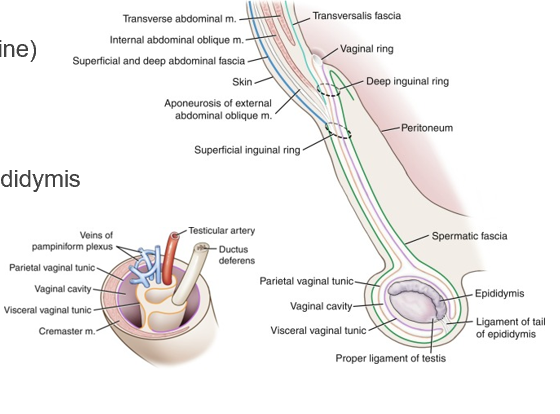
What are some castration indications?
1) Population control
2) Preventive and therapeutic for androgen-dependent disease (generally geriatric illness)
3) Preventive and therapeutic for testicular tumors (common)
4) Odor, behavior (cats)
What are some common androgen-dependent diseases?
Benign prostatic hyperplasia (common)
Chronic prostatitis
Perianal adenomas (common)
Perianal hernias (breed-dependent)
What are some general castration risks?
reduced development of secondary sexual characteristics
What are some castration risk for cats?
increased risk of obesity
Diabetes mellitus
Spontaneous capital physeal fracture/metaphyseal dysplasia
What are some castration risks for dogs?
Prostate cancer (rare in dogs)
Transitional cell carcinoma
Cranial cruciate ligament rupture and other orthopedic diseases (common)
Osteosarcoma and other noeplasms
What are some risk with castration due to timing/breed (dogs)
●Neutering <1 year of age à increased risk of hip dysplasia, CCL rupture, and elbow dysplasia in studies of golden retrievers, Labrador retrievers, and German shepherd dogs.*
●Elevated cancer risk associated with neutering Dobermans at any age (same for female golden retrievers)*
What are some concerns with castration timing in dogs?
most risks associated with early castration
most male reproductive diseases are adult-onset, not prevented by early castration
When do we castrate for population control/shelters?
castration is safe for dogs and cats at 8 weeks/1 kg of body mass
When is the best time to castrate for owned dogs/purebreds?
consider later neuter (after 1 year) for owned dogs likely to be more than 20 kg
Counsel owners of purebred dogs on disease risks associated with castration
Prescrotal approach
adult dogs, larger puppies
limits scrotal irritation
single incision
Scrotal approach
puppies, cats, adult dogs
testicles in puppies can be difficult to isolate
two incisions
associated with scrotal ablation or perineal hernia repair (less common)
Open castration
spermatic fascia and parietal vaginal tunic are incised and the ligament of the tail of the epididymis is separated
Closed castration
spermatic fascia is incised and scrotal attachments broken down to exteriorize the testicle without incising the parietal vaginal tunic
What are the Pros of open castration?
excellent ligature security
can be easier in mature dogs
reduced scrotal manipulation
What are some cons with Open Castration?
Contraindicated if testicular abscess
Slight risk of tunic bleeding if not ligated
What are the pros of Closed Casteration?
Straightforward, easy in younger dogs
Incision not exposed to testicular pathology (tumor, abscess)
What are the cons of Closed castration?
Excessive scrotal manipulation can cause contamination
Ligatures include more tissue
Cryptorchidism
●Is hereditary (mechanism unknown)
●Retained testes are small, with a comparatively large epididymis
●Retained testes are more likely to develop tumors, particularly Sertoli cell tumors and seminomas
●Retained, neoplastic testes more susceptible to torsion
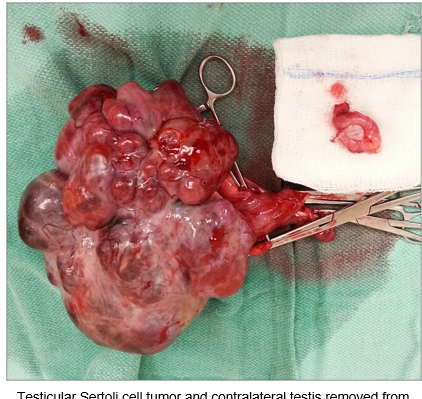
What are some Cryptorchid castration considerations?
right sided cryptorchidism more common
can be difficult to distinguish in an awake patient. Anesthetize and palpate
What to tell is the cat is castrated or if it is a cryptorchi?
Extrude penis and look for spines, secondary sexual characteristics like prominent jowls may be present
How can you tell if the dog is castrated of has a cryptorchid?
prostate larger and cranial to pelvic brim, abdominal ultrasound, presence of secondary sexual characteristics
What to do with an abdominal cryptorchidectomy?
parapreputial skin incision
Abdominal entry (paramedian if unilateral or along linea alba if bilaterl, and you will need to retract prepuce laterally is along linea alba)
Testicular location: near inguinal rings, follow ductus deferens OR testicular artery and veins)
What are some infections related to castration complications?
●Breach of asepsis
●Hair and scrotal skin entering surgical field
●Prevent through: Open castration (less pulling) or, Transect scrotal attachment to epididymis, Prep widely, Drape sufficiently
What is important about castration complications?
●Poor hemostasis >> coagulopathy
●Insecure cord ligation, bleeding from tunics
or skin
How do we prevent hemorrhage in castrations?
○SECURE KNOTS
○Open castration or binding knots on cord
○Ligation of subcutaneous vessels
○Ligating tunics (if open)
○General health screening
What is important to remember about unplanned urethrotomy for castration complications?
When performing a prescrotal castration, ALWAYS push the testicle craniomedially so that the incision is created over the testicle and not the penis and urethra.
Scrotal Albation
Resection of the scrotum at or following castration
What are indications of scrotal ablation?
cosmetic for older dogs at the time of castration
treatment for scrotal hematoma post-castration
What are some risks associated with Scrotal albation?
increased surgical time and complexity
Male reproductive disease:
●Cryptorchidism
●Prostatic abscess/prostatitis
●Testicular tumors
●Transmissible venereal tumors
●Perianal adenoma
●Perineal hernia
●Phimosis/paraphimosis
●Hypospadias
●Prostatic cyst
●Testicular torsion/hernia
Prostatic disease (dog)
●Relatively common in dogs (esp. intact) >6 years old
●Diseases: Benign prostatic hyperplasia (BPH), Prostatic cysts, Prostatitis (acute and chronic), Prostatic abscesses, Prostatic neoplasia—relatively uncommon, risk not affected by castration
Benign Prostatic Hyperplasia (BPH)
Normal glandular hyperplasia and hypertrophy, beginning at 3 yo and affecting >95% of dogs by 9 years of age
What are some causes of benign prostatic hyperplasia (BPH)
increased estrogen:androgen ratio secreted by testes → increased androgen receptors → glandular hyperplasia → cystic hyperplasia
What are some clinical signs of benign prostatic hyperplasia (BPH)?
none-mostly asymptomatic
tenesmus
hematuria or urethral discharge
hemospermia, stilted gait
What are treatments associated with BPH?
Castration or finasteride
Prostatic cyst
form from blockage and consolidation of canaliculi associated from BPH (prostatic cysts), commonly communicate with urethra
Paraprostatic cysts
○are associated with uterus masculinus remnants and are connected to the prostate by a stalk or adhesion
Prostatic cyst therapy:
Castration, ultrasound-guided aspirations, castration or finasteride
Acute Prostatitis
○Clinical signs: anorexia, fever, depression, vomiting, caudal abdominal pain, stiff/stilted gait, preputial discharge
○Dx: History, PE , rectal exam, imaging, hematology, urinalysis/urine culture, prostatic fluid analysis
Chronic Prostatitis
vague signs—most commonly recurrent UTI and urethral discharge. Evaluation of prostatic fluid is helpful
Treatment for Chronic prostatitis includes:
Prolonged treatment with appropriate abx., castration recommended
Prostatic Abscess
sequela to chronic prostatitis; abscesses can be large. Tx includes U/S-guided or surgical drainage, antibiotics
Group 1 Testicular tumors:
Germ cell tumors (seminoma, embryonal carcinoma, teratoma)
Seminoma: generally solitary, associated with prostatic disease, perianal tumors, perianal hernia.
Seminoma
generally solitary, associated with prostatic disease, perianal tumors, perianal hernia
Group 2 testicular tumors:
Sertoli cell tumor, interstitial cell tumor, mixed tumors
Interstitial cell tumor: functional, associated with prostatic disease, perianal tumors, perineal hernia; often bilateral
Sertoli cell tumor: produce estrogen, cause feminization
Interstitial cell tumor:
functional, associated with prostatic disease, perianal tumors, perineal hernia; often bilateral
Sertoli cell tumor:
produce estrogen, cause feminization