Ch.13 Respiration System
 Call Kai
 Learn
Learn Practice Test
 Spaced Repetition
 Match
Match Flashcards
 Knowt Play
1/110

Earn XP
Description and Tags
Human Biology
Name | Mastery | Learn | Test | Matching | Spaced | Call with Kai |
|---|
No analytics yet
Send a link to your students to track their progress
111 Terms
___ described all chemical reactions that occur within the body cells
metabolism
___ (cellular) respiration refers to the metabolic processes occurring in the mitochondria. Molecular oxygen (O2) is used by tissue cells. Carbon dioxide is produced while deriving energy from nutrient molecules
internal
The respiratory quotient; RQ = ___ produced / O2 consumed
CO2
___ respiration is the entire sequence of events involved in the exchange of oxygen and carbon dioxide between the external environment and cells of the body.
external
___ is the volume of air breathed in and out in one minute. Average of 6000 ml
pulmonary ventilation
___ is a single, tiny air sac in your lungs. Like the bulb of raspberry
alveolus
___ are the air sacs (alveolus) which O2 and CO2 are exchanged between the blood and air in the lungs.
alveoli
External respiration includes Pulmonary ventilation. By breathing, air is moved between the atmosphere and alveoli. In addition, oxygen and carbon dioxide are exchanged between the air in the alveoli and blood of the pulmonary capillaries
pulmonary
External Respiration: Oxygen and carbon dioxide are transported by the blood flowing from the lungs to the tissues. These gases are exchanged between the blood and the tissues by diffusion
tissues
Draw stages of external respiration graphic
Draw stages of external respiration graphic
___ (Patm) is the pressure exerted by the weight of the air in the atmosphere on objects on earth’s surface; Patm = 760 mmHg at sea level. It decreases with increasing altitude above sea level. It is also called barometric pressure
Atmospheric pressure
___ is the pressure in the alveoli.
intra-alveolar pressure
___ is a double-walled,closed, fluid-filled sac that separates each lung from the thoracic wall and other surrounding structures. Acts as a protective, frictionless seal allowing your lungs to expand and contract smoothly while you breathe
pleural sac
___ is the interior of the pleural sac
pleural cavity
thin, continuous, watery membranes that line the inside of your chest cavity and wrap around your lungs . Refers to the layer or membrane that make up the pleural sac.
pleura
___ is secreted by the surfaces of pleura and lubricates the pleural surfaces as they slide past each other during respiratory movements
intrapleural fluid
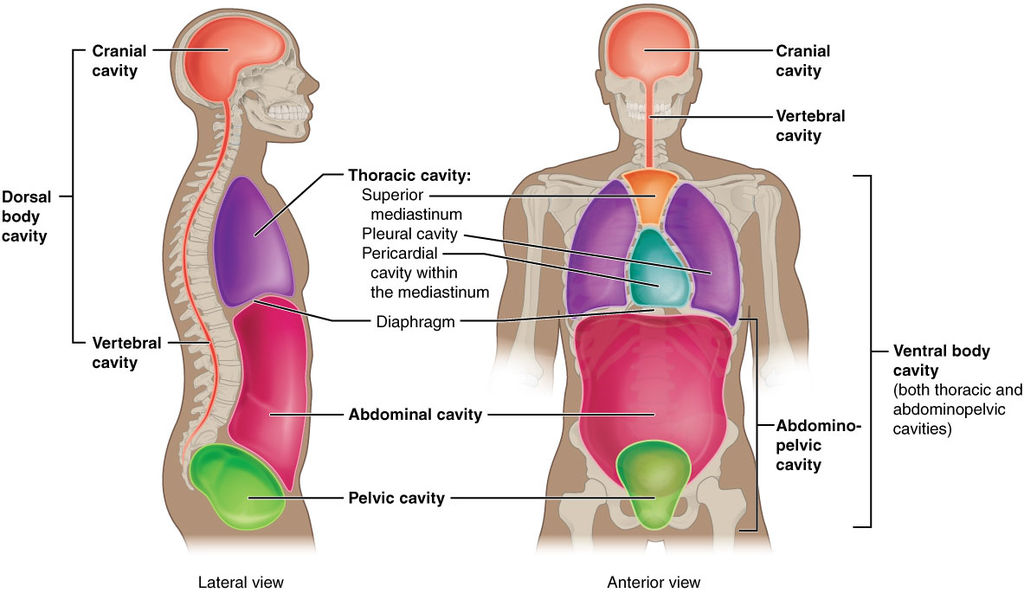
Chest cavity
thoracic cavity
___ is the pressure within the pleural sac. It is the pressure exerted outside the lungs within the thoracic cavity. It is also called intrathoracic pressure. It averages 756 mmHg at rest. This is also written as -4 mmHg, as it is four units below 760 in the atmosphere. As such, it has a slight vacuum compared to normal atmospheric pressure. To have a vacuum means that the area is like a suction to gases that want to fill the space out.
intrapleural pressure
___ is the abnormal condition of air entering the pleural cavity. Could happen if the chest wall is punctured
pneumothorax
___ ’s vacuum is lost during pneumothorax
intrathoracic pressure
PIC
thorax
The lungs are normally stretched, filling the large thorax. This is due, in part, to the intrapleural fluid’s cohesiveness. This stickiness pulls the lungs outward.
lungs
___ is the pressure difference across the lung wall (intra-alveiolar pressure is greater than intrapleural pressure) that stretches the lungs to fill the thoracic cavity, which (the thoracic cavity) is larger than the unstretched lungs
transmural pressure gradient
Draw basic lungs diagram
Draw basic lungs diagram
Changes in the intra-alveolar pressure produces the flow of air into and out of the lungs. If this pressure is less than atmospheric pressure, air enters the lungs. If this pressure is more than atmospheric pressure, air exits from the lungs.
flow
___ states an inverse relationship between the pressure exerted by a quantity of gas and its volume, assuming that the temperature remains constant.
Boyle’s law
Boyle’s law: P1V1 = P2V2 ; P, pressure in mmHg. V, volumed in mmHg.
pressure
Draw Boyle’s law diagram
Draw Boyle’s law diagram
Airway resistance in the respiratory tract influences the rate of airflow (drag). F =∆ P/R
drag
As the difference between the atmospheric and intra-alveolar pressures (∆P) is greater, the air flow is greater. This relationship is a direct proportion. However, if the resistance (R) increases, the airflow is decreased (inverse relationship).
atmospheric
___ are the small, branching airways within the lungs
bronchioles
The major determinant of resistance is the ___ of the conducting airways. The autonomic nervous system controls the contraction of the smooth muscle in the walls of the bronchioles, changing their ___.
radius
Sympathetic stimulation and epinephrine cause ___. The lungs have elastic properties.
bronchodilation
The lungs have elastic ___, rebounding if they are stretched
recoil
___ is the effort required to stretch or distend the lungs. A thin, toy balloon is more compliant than a thick, rubber balloon
compliance
A highly-compliant lung stretches further for a given ___ in pressure than a lung with less compliance
increase
Pulmonary elastic behavior depends on the pulmonary elastic ___ and alveolar surface tension
connective tissue
___ is determined by the thin liquid film that lines the outside of each alveolus. This film allows the alveolus to resist expansion. This film also squeezes the alveolus, producing recoil.
alveolar surface tension
___ is a complex mixture of lipids and proteins secreted by the Type II alveolar cells. It intersperses between the water molecules in the fluid (lining the alveoli) and lowers alveolar surface tension
pulmonary surfactant
A coating of pulmonary surfactant prevents the alveoli from collapsing from this surface tension.
collapsing
An insufficient amount of pulmonary surfactant can produce ___.
newborn respiratory distress syndrome
The work of breathing normally requires _% of total energy expenditure. Factors such as a decrease of pulmonary compliance and an increase in airway resistance can increase this percentage.
3
During each quiet breathing cycle, about _ ml of air is inspired and expired. The lungs do not completely empty about each expiration (a breathe out).
500
Draw variation in lung volume graphic (slides & p.479)
Draw variation in lung volume graphic (slides & p.479)
___ - The air entering or leaving the lungs in a single breath.
tidal volume (TV)
___ - The maximum volume of air that can be inspired at the end of a normal quiet expiration.
inspiratory capacity (IC)
___ - The extra volume of air that can be actively expired by maximal contraction beyond the normal volume of air after a tidal volume (TV).
expiratory reserve volume (ERV)
___ - The maximum volume of air that can be expired following a maximal inspiration.
vital capacity (VC)
Various respiratory dysfunctions can be detected by abnormal patterns measured with the spirometer. Abnormal results include ___ lung disease and restrictive lung disease.
obstructive
___ is less than pulmonary ventilation because of the anatomic dead space. These are the airways where air is not available for gas exchange. Due to this dead space: alveolar ventilation = (tidal volume - dead space volume) x respiratory rate
alveolar ventilation
Breathing patterns (e.g., deep and slow) can affect alveolar ventilation
ventilation
___ is any ventilated alveoli that do not participate in gas exchange with blood because they are inadequately perfused. It is usually small in healthy people
alveolar dead space
There are local controls on the smooth muscle of the airways. An accumulation of carbon dioxide in the alveoli ___ airway resistance.
decreases
An increase of oxygen in the alveoli causes pulmonary vasodilation. It causes vasoconstriction of pulmonary ___
arterioles
Bulk flow of gases and diffusion in ___
tissues
___ is the individual pressure exerted independently by a particular gas within a mixture of gases. Designated by Pgas, thus the ___ of O2 in the atmosphere is PO2
partial pressure
Dalton’s law of partial pressures: The total pressure exerted by a mixture is the sum of the pressures exerted independently by each gas in the mixture. Each gasses pressure, or partial pressure, is directly proportional to its percentage in the mixture
Dalton’s law
Henry’s law: In a mixture of gas, each gas will dissolve in the liquid in proportion to its partial pressure. The more there is, the greater and faster it will dissolve
Henry’s law
Review Dalton’s Law example
Review Dalton’s Law example
Gas exchange occurs by partial pressure gradients. p,486-490
Gas
The exchange of oxygen and carbon dioxide in the pulmonary and tissue capillaries is done by ___.
simple diffusion
Air is a mixture of gases. The partial pressure of each gas depends on its percentage in the total atmospheric pressure. For example, nitrogen is 79% of the air. Its partial pressure is 0.79 x 760 = 600.4
nitrogen
A partial pressure ___ is when there are two partial pressures for a gas in different regions of the body. For example the partial pressure of oxygen is greater in the alveoli (e.g., 100) compared to its partial pressure in the blood of the pulmonary capillaries (e.g., 40). By this gradient, oxygen diffuses from the alveoli into these capillaries (100 to 40, higher to lower). The partial pressure of carbon dioxide is greater in the blood of the pulmonary capillaries (e.g., 46) compared to its partial pressure in the alveoli (e.g., 40). This gas diffuses into the alveoli.
gradient
Draw O2 and CO2 exchange graphic
Draw O2 and CO2 exchange graphic
Partial pressure gradients change the partial pressures of oxygen (e.g., 100) and carbon dioxide (e.g., 40) in the blood returning to the heart from the lungs.
blood
By diffusion, the partial pressures for oxygen and carbon dioxide in the pulmonary capillaries equilibrate with the partial pressures for these gases in the alveoli.
equilibrate
The greater the partial pressure gradients between the alveoli and the blood, the ___ the rate of transfer for the gases
greater
The blood passing through the lungs gains oxygen and ___ some of its carbon dioxide
eliminates
This blood ___ through the left side of the heart and enters the systemic circulation. It arrives at the tissues with the same gas content (e.g., 100 for oxygen and 40 for carbon dioxide) established at lung equilibration. According to Dalton’s Law
passes
Carbon Dioxide moves out of the blood into the ___. Oxygen moves out of the ___ into the blood. Water moves out of the blood into the ___
alveoli
Draw Dalton’s Law exchange graphic
Draw Dalton’s Law exchange graphic
As surface area increases, the rate ___. The alveoli collectively offer a tremendous surface area. Increased pulmonary blood pressure, from an increased cardiac output, increases the area.
increases
The walls of the alveoli and pulmonary capillaries are thin for rapid gas transfer. Pulmonary edema, pulmonary fibrosis, and pneumonia ___ the barriers for gas exchange
thicken
Gas exchange is also directly proportional to the diffusion coefficient for a gas. This coefficient is ___ times as great for carbon dioxide compared to oxygen, as carbon dioxide is more soluble
20
There must be a ___ between the amount of gas in the alveoli (ventilation) and the blood flow in the capillaries (perfusion). Based on feedback mechanisms to control the flow of blood (often based on the PCO2)
coupling
Draw ventilation-perfusion graphic
Draw ventilation-perfusion graphic
Oxygen transport is accomplished by hemoglobin (in erythrocytes). Hemoglobin-oxygen combination: oxyhemoglobin (HbO2). Reduced hemoglobin, deoxyhemoglobin (HHb). HHb + O2 Lungs Tissues HbO2 + H+
deoxyhemoglobin
Most oxygen in the blood is transported by binding with hemoglobin. Hemoglobin combines with oxygen to form oxyhemoglobin. This is a reversible process, favored to form oxyhemoglobin in the lungs. Hemoglobin tends to combine with oxygen as oxygen diffuses from the ___ into the pulmonary capillaries. A small percentage of oxygen is dissolved in the plasma.
alveoli
The dissociation of oxyhemoglobin into hemoglobin and free molecules of oxygen occurs at the tissue cells. The reaction is favored in this direction as oxygen leaves the systemic capillaries and enters tissue cells.
dissociation
Oxyhemoglobin: Fully or partially saturated heme groups. The off-loading of oxygen is not linear, instead being an S-shaped curve (the oxygen-hemoglobin disassociation curve). Causes full saturation at 70 mmHg, and easily offloads oxygen with small pressure changes
saturation
Draw Oxygen-hemoglobin dissociation curve
Draw Oxygen-hemoglobin dissociation curve
The partial pressure of oxygen is the main factor determining the percent hemoglobin saturation. The percent saturation is high where the partial pressure of oxygen is high (lungs). The percent saturation is low where the partial pressure of oxygen is low (tissue cells). At the tissue cells oxygen tends to dissociate from hemoglobin, the opposite of saturation. This relationship is shown in the oxygen-hemoglobin dissociation curve.
low
Oxygen-hemoglobin dissociation curve: The plateau part of the curve is where the partial pressure of oxygen is high (lungs). The steep part of the curve exists at the systemic capillaries, where hemoglobin unloads oxygen to the tissue cells
steep
Draw Oxygen-hemoglobin dissociation curve v.2
Draw Oxygen-hemoglobin dissociation curve v.2
The influence of temperature and the Bohr effect: Several factors influence the offloading of oxygen: H+ concentration (pH), PCO2, BGP (2,3-biphosphoglycerate, which binds reversibly to hemoglobin, produced during ___ respiration). Increasing these factors decreases Hb’s affinity for oxygen. Decreasing these factors increases Hb’s affinity for oxygen
anaerobic
Draw multi-Oxygen-hemoglobin dissociation curve v.1
Draw multi-Oxygen-hemoglobin dissociation curve v.1
The Bohr effect: In capillaries, glucose and oxygen being used creating carbon dioxide (increasing H+ (decrease pH), PCO2). ___ (decreased pH) weakens hemoglobin-oxygen bond, accelerating oxygen offloading (shifts the curve to the right), a phenomenon termed the Bohr effect
acidosis
The Bohr effect: Increased activity raises the temperature of an area, which shifts offloading of oxygen to these tissues. Also under hormonal control (endocrine system), such as ___, epinephrine, growth hormones, and catecholamines.
thyroxine
Draw multi-Oxygen-hemoglobin dissociation curve v.2
Draw multi-Oxygen-hemoglobin dissociation curve v.2
Hemoglobin (Hb) and Nitric Oxide (NO); NO a vasodilator, Hb a vasoconstrictor. Local vessels ___ where gases are unloaded. WHY?!? NO attached to a cystene group and protected from degradation by the iron group in Hb. Oxyhemoglobin unloads oxygen and NO, aiding in oxygen delivery. Deoxyhemoglobin then scavenges NO and CO2, and unloads in lungs
dilate
Most carbon dioxide (about 60%) is transported as the ___ ion.
bicarbonate
Carbon dioxide combines with water to form carbonic acid. The enzyme carbonic ___ facilitates this in the erythrocyte. Carbonic acid dissociates into hydrogen ions and the bicarbonate ion. This two-step, reversible process is favored at the tissue cells. The reverse of this process (bicarbonate ions forming free molecules of carbon dioxide) occurs in the lungs
anhydrase
Most carbon dioxide (about 60%) is transported as the bicarbonate ion. 30% of the carbon dioxide is bound to hemoglobin in the blood. This is another means of transport. About 10% of the transported carbon dioxide is dissolved in the ___.
plasma
By the ___, the plasma membrane of the erythrocyte passively facilitates the diffusion of bicarbonate ions (out of the red cell) and chloride ions.
chloride shift
By the ___ the removal of oxygen from hemoglobin at the tissue cells increases the ability of hemoglobin to bind with carbon dioxide
haldane effect
Carbonic Anhydrase: Enzyme that catalyzes the conversion to carbonic acid (in RBC’s). Bicarbonate ions diffuse from RBC’s to plasma. Chloride ions move from the plasma to RBC’s to counterbalance: ionic exchange is termed the chloride shift
catalyze
Carbon Dioxide transport: CO2 produced in cells (~_ml/min), the same as released by the lungs
200
Carbon dioxide is transported three ways; Dissolved in plasma (7-10% as CO2), Chemically bound to Hb (~20% as ___), As Bicarbonate ion in plasma (~70% converted to HCO3-) CO2 + H2O → H2CO3 → H+ + HCO3-
carbaminohemoglobin
Draw Transport and exchange of carbon dioxide and oxygen diagram
Draw Transport and exchange of carbon dioxide and oxygen diagram