Chem 121 - Alkanes + Hydrocarbons
 Call Kai
 Learn
Learn Practice Test
 Spaced Repetition
 Match
Match Flashcards
 Knowt Play
1/14

There's no tags or description
Looks like no tags are added yet.
Name | Mastery | Learn | Test | Matching | Spaced | Call with Kai | Chat |
|---|
No analytics yet
Send a link to your students to track their progress
15 Terms
What are the 4 different types of hydrocarbons?
Alkanes, Alkenes, Alkynes, and Aromatics
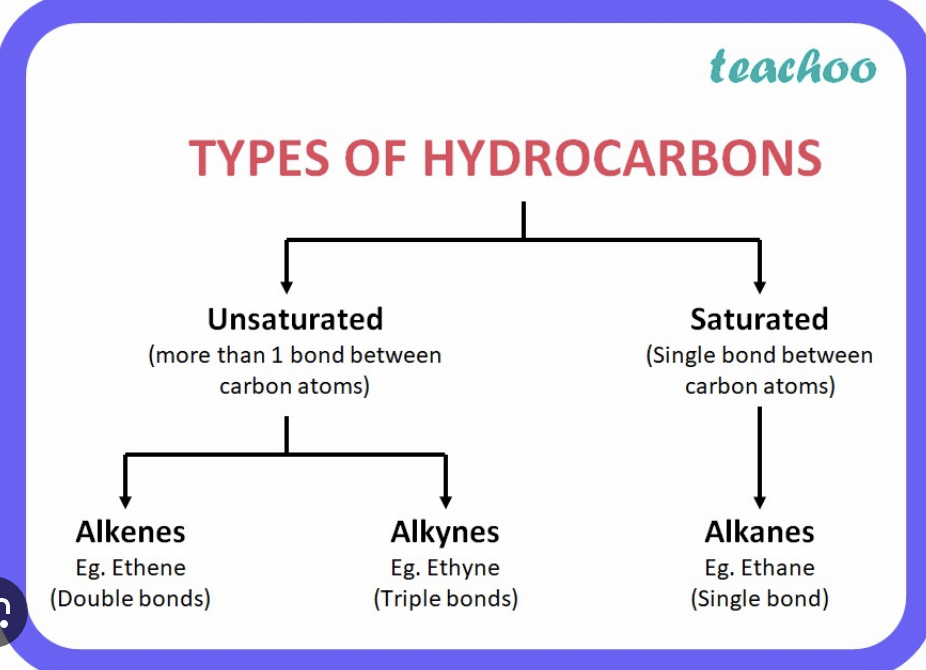
What is a saturated vs. unsaturated hydrocarbon?
Saturated = Max number of hydrogens bonded to carbon skeleton
Unsaturated = Less than the maximum due to multiple bonds
What are the main features + bonding properties of Alkanes? What is the general formula + geometry?
Only single bonds
Saturated hydrocarbons (aliphatic compounds)
General formula: CnH2n+n (Ie. C2H6)
Geometry: sp3 hybridized - tetrahedal
Only (sigma) bonds - meaning they can freely rotate (unless restricted)
Only van der waals force - London dispersion forces
Would a molecule with a longer chain of hydrocarbons have a higher or lower boiling point?
Higher, since more strength would be needed to break the attraction between atoms.
What is a constitutional isomer?
A molecule with the same molecular formula, but atoms are bonded in a different order (which can lead to different physical properties)
What are conformers?
The 3-D shape of a molecule: can change depending on rotation about a C-C single bond.
Higher repulsion (closer together in rotation) = more energy
What are the three parts of organic molecular nomenclature? What do they identify?
Substituents: Tells what groups are attached to a chain (ie. 4-ethyl-)
Prefix: How many carbons are in the longest continuous chain (ie. hept)
Suffix: Tells what type of compound it is (ie. ane)
Ie. 4-ethylheptane
What are the typical steps for naming an organic molecule?
Find the longest continuous carbon chain
Number chain from the end nearest to the first substituent encountered
List substituents along w/ the number(s) of the carbon(s) to which they are attached
What are the names for when you find more than one substituent? (2-5)
Two = di-
Three = tri-
Four = tetra-
Five = penta-
What are the common names for substituents in order (1-10)? Does the boiling point increase or decrease as it gets longer?

How do you order substituents if there is more than 1 type?
List them alphabetically (not including prefixes)
What are cycloalkanes? What are their most common formation - and why?
When alkanes form ring structures. Five and six numbered rings are most common, due to smaller ones being quite strained.
What are cyclohexanes? What conformations can it undergo? Which are more stable?
A form of cycloalkane - the most common ring size.
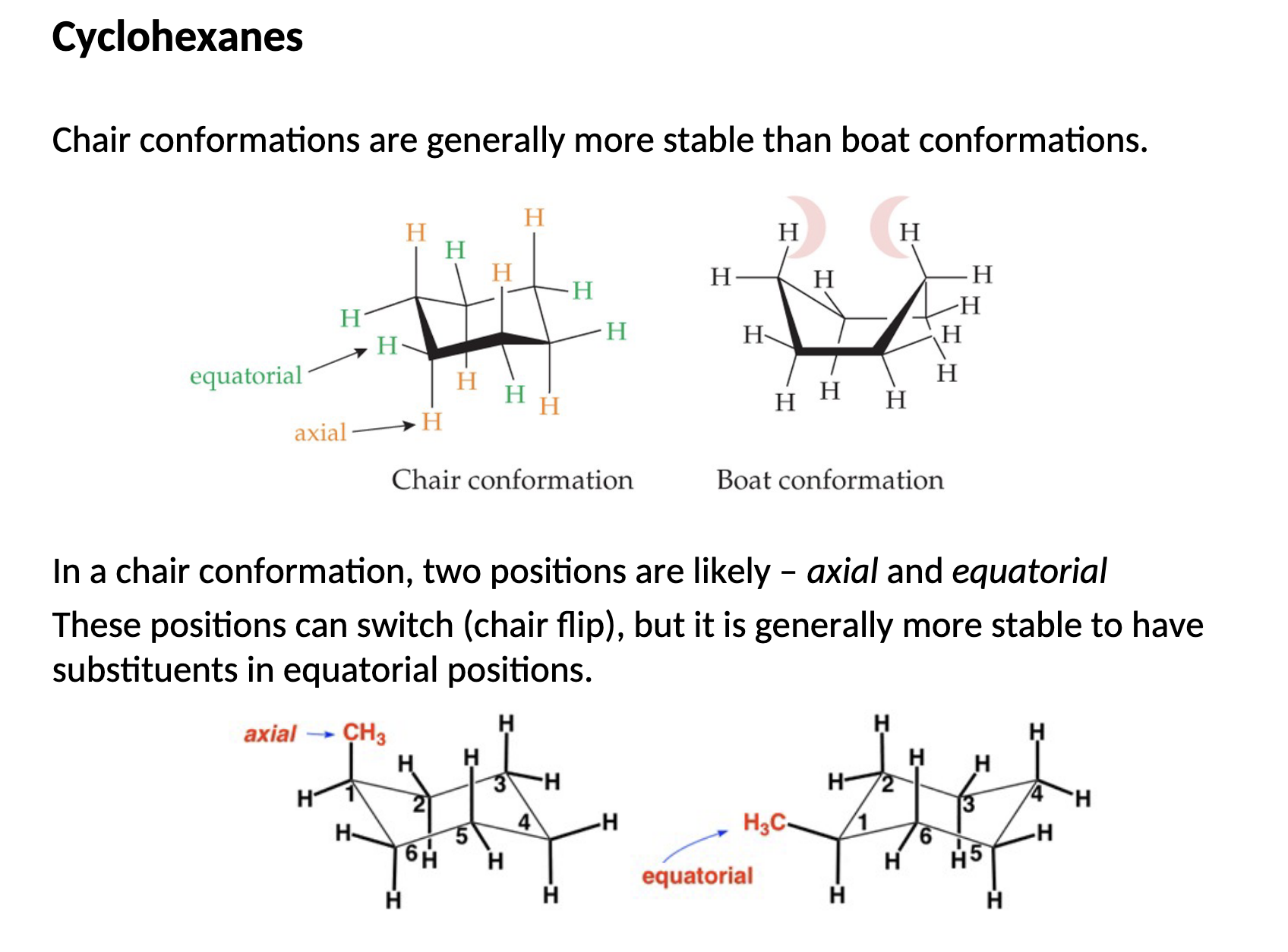
Cyclohexanes can either be found in chair or boat formation:
Chair: most stable. Can be found in either equatorial or axial position. These positions can switch (chair flip) but having substituents in equatorial is generally more favourable.
Axial : all axes point north!
How do you identify the isomerism of a cycloalkane?
Geometric isomers are formed when 2+ substituents are found on a cycloalkane. Look carefully at substituents in relation to the hydrogen atoms.
Orientations:
Cis = substituents are same side
Trans = substituents are on the opposite side
Are alkanes typically reactive or unreactive?
Alkanes are relatively unreactive
Strong, non-polar bonds = excellent non-polar solvents.
Forcing conditions are typically required for reaction (ie. combustion or free-radical reactions)