History of Life final
 Studied by 10 people
 Call Kai
 Learn
Learn Practice Test
 Spaced Repetition
 Match
Match Flashcards
 Knowt Play
1/149

There's no tags or description
Looks like no tags are added yet.
Name | Mastery | Learn | Test | Matching | Spaced |
|---|
No study sessions yet.
150 Terms
Cambrian
• Continental Movements:
Continents clustered near equator; shallow seas widespread.
Laurentia, Siberia, Gondwana shifting apart.
• Climate:
Warm, stable; rising sea levels; high oxygen allows larger body plans.
• Organisms Alive:
Trilobites, Anomalocaris, Hallucigenia, Wiwaxia.
Burgess Shale fauna.
Early chordates like Pikaia.
Explosion of predators + new sensory structures (including eyes).
• Evolutionary “Firsts”:
First shelled organisms (small shelly fauna).
First hard parts (exoskeletons, spines, shells).
First complex eyes (supports Light Switch Hypothesis).
First non-vascular land plants begin appearing near end of Cambrian
First true body plans for most major animal phyla.
Ordovician
AGE OF MULLUSKS
• Continental Movements:
Laurentia, Siberia, and Baltica separate early → merge into Gondwana by mid-Ordovician.
Highest sea levels of the Paleozoic; vast shallow seas.
• Climate:
Early climate extremely hot (114°F water temps!).
High CO₂ → strong greenhouse effect.
Late Ordovician: glaciation → mass extinction.
• Organisms Alive:
HUGE diversification: 4× more marine genera than Cambrian.
Dominated by suspension/filter feeders.
Mollusks explode in diversity (bivalves, gastropods, cephalopods).
Trilobites, brachiopods, graptolites, echinoderms all diversify.
New predatory arthropods (eurypterids).
First starfish, brittle stars, sea lilies.
Ostracoderms (armored jawless fish) appear.
• Evolutionary Firsts:
First true vertebrates (ostracoderms).
First bony armor/plates/scales in vertebrates.
First fungi (mycorrhizae).
First terrestrial plants expand (bryophytes, liverworts).
First corals (reef-forming corals appear).
• End-Ordovician Extinction:
Caused by glaciation, volcanism, and possibly a hypernova.
Silurian
• Continental Movements:
Gondwana covers equator & much of S. Hemisphere.
Massive ocean Panthalassa covers the north.
Sea levels rise early then fall later.
• Climate:
Warm, stable; glaciers retreat.
Low oxygen levels (30–60% of modern).
• Organisms Alive:
Brachiopods, corals, crinoids, mollusks, trilobites common.
Eurypterids (sea scorpions) diverse and HUGE.
Leeches appear.
Major radiation of jawless fish.
• Evolutionary Firsts:
First jawed fish (placoderms).
First cartilaginous fish (Chondrichthyes → sharks, rays, skates).
First bony fish (Osteichthyes).
First true jaws evolved from gill arches.
First vascular plants (Cooksonia).
First terrestrial animals:
Millipede (Pneumodesmus)
Early arachnids.
Devonian
AGE OF FISHES
• Continental Movements:
Laurentia + Baltica collide → Laurussia.
Laurussia + Gondwana start approaching (Pangaea forming).
• Climate:
Warm (86°F sea temps).
High sea levels; later periods experience anoxia.
• Organisms Alive:
Huge reef systems.
First ammonites and nautiloids.
Placoderms dominate; Dunkleosteus is top predator.
Cartilaginous fish diversify.
First ray-finned & lobe-finned fish.
dunkleosteus was top predator
• Evolutionary Firsts:
First lobefin fishes (coelacanths, lungfish, osteolepiforms).
First tetrapods (Acanthostega, Ichthyostega, Tiktaalik).
First insects.
First true forests (lycophytes, ferns, horsetails).
First seed plants.
First plants with true wood (Archaeopteris).
• End-Devonian Extinction:
Triggered by cooling from CO₂ drop due to plant expansion.
Major loss of jawless fish, corals, placoderms.
Carboniferous (mississippian and pennsylvanian)
• Continental Movements:
Pangaea forms.
Gondwana remains in south.
Extensive equatorial swamp forests.
• Climate:
Early Carboniferous: warm (68°F).
Mid Carboniferous: cool (54°F).
Very high oxygen levels → giant arthropods!
Faster Earth rotation → stronger winds (Coriolis effect).
• Organisms Alive:
Sharks and rays dominate after placoderms vanish.
Many bizarre fish forms.
Carboniferous = Age of Giant Arthropods:
Arthropleura (2.6 m millipede)
Meganeura (giant dragonfly)
Gigantoscorpio
Verdant swamp forests with ferns, lycopods, first gymnosperms.
• Evolutionary Firsts:
First reptiles (Hylonomus).
First amniote egg (huge evolution milestone!).
First cycads & early gymnosperms.
First protoconifers.
Largest amphibian diversity in history.
• End-Carboniferous Climate Shift:
Becomes cool + arid → rainforest collapse
name the periods in order
Cambrian, Ordovician, Silurian, Devonian, Carboniferous (Mississippian, Pennsylvanian), Permian, Triassic, Jurassic, Cretaceous, Paleocene, Eocene, Oligocene, Miocene, Pliocene, Holocene
paleozoic (Cambrian, Ordovician, Silurian, Devonian, Mississippian, Pennsylvanian, Permian)
Mesozoic (Triassic, Jurassic, Cretaceous)
Cenozoic (Paleocene, Eocene, Oligocene, Miocene, Pliocene, Holocene)
Camels Often Sit Down Carefully (mississippian, pennsylvanian) Perhaps Their Joints Creak.
Put Eggs On My Plate Please, Henry
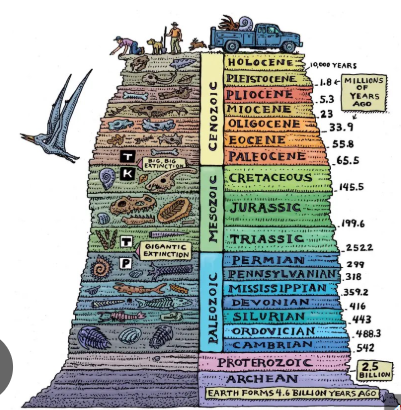
End of the Carboniferous
middle Carboniferous: Cooling reduced temperatures and drying of the climate lead to Carboniferous Rainforest collapse
Amphibians, the dominant vertebrates at the time, fared poorly through this event with large losses in biodiversity;
Reptiles continued to diversify due to key adaptations that let them survive in the drier habitat:
Specifically the hard-shelled egg and scales, both of which retain water better than their amphibian counterparts
Early Permian and land masses
end of the Paleozoic Era (1/3 that make up the phanerozoic)
the earth was still in an ice age, but it began to recede in the early Permian
Also started wet and dried out
Many animal groups which survived the Carboniferous with only a few species rapidly diversified.
land masses:
Northwestern Gondwana collided with and joined southern Laurussia, resulting in the Alleghenian orogeny, occurring in the region that would become North America —> forms PANGEA (the supercontinent).
marine life:
Mollusks, brachiopods, and echinoderms were common
Most dominant life forms were:
Ammonites
Fusulinids – a shelled amoeba-like protist
A Nautilus-like mollusk, Cooperoceras texanum
terrestrial life — plants
Several new groups of seed plants
First cycads
Conifers radiated
dominant plants were conifers, ginkoes, and cycads
insects followed plants into new habitats and broadly diversified
Terrestrial life in the Permian — Amniote Radiation
Amniotes were the animals that evolved from amphibians but could lay eggs on land, so they were no longer amphibians.
Actually evolved in Carboniferous
Since they could range far from water, they quickly evolved to fill many available niches
The earliest amniotes had anapsid skulls with no opening behind the eye – inherited from fishes and early amphibians
Terrestrial life in the Permian — Synapsids
diverged from anapsids
skulls have one skull opening behind the eye socket.
Became dominant animals in the Permian
Never evolved capacity to excrete uric acid instead of urea
Now known as stem-mammals
transitional mammals
Early synapsids had large heavy forelimbs and a lighter hind limb with a greater range of movement
No ankle joint
Toes long and splayed sideways
Forelimbs kept animals upright and hind limbs had momentum
Permian terrestrial life — Amniote Radiation— Diapsids
are amniotes with two skull openings behind the eye socket.
evolve from the sauropsids, the sister group of synapsids
Includes all dominant terrestrial groups of the Mesozoic and all living amniotes except for mammals
Reptiles and bird (reptiles and birds are more modern than mammals in terms of skulls)
reptilian but not dinosaurs yet
early synapsids were all carnivorous
dimetrodon was most powerful land predator — is NOT A DINOSAUR (it’s more closely related to mammals) and it’s big fin on the back is used for thermoregulation
Evolution of Herbivory
most plant material is hard to digest
cellulose can only be broken down if chewed well and manage to get fermenting bacteria to work symbiotically with them
some plant material is high in protein or sugar, but rarer and often have toxins (only small animals can specialize on these)
So three pathways:
1) Small animals that specialize on high calorie foods, such as juices, fruits, or seeds
Small mammals, birds, insects
2) Eat lots of low calorie plants and enlist gut bacteria as symbionts
Large grazing animals
3) Omnivory – large animals that are indiscriminant and eat anything in large volumes
Bears
vegetarianism depends greatly on body size
as animals got bigger, they might have evolved herbivory
need symbiotic bacteria to help digest cellulose
most bacteria only do well in a narrow range of temperatures
thermoregulation is needed
Evolution of Thermoregulation
Body functions are determined by enzymes and enzymes work best at an optimal temperature, so all organisms have an optimal temperature.
Endothermic animals regulate body temperature internally.
High metabolic costs
Ectothermic animals regulate body temperature externally by behavioral thermoregulation
Behavioral thermoregulation means that an animal uses it’s behavior to regulate body temperature.
Means there is trade-off between activities and balancing body temperature
Permian continental shifts and therapsids
Shifting continental geography resulted in major biogeographic changes.
Creation of Pangaea
Changed the climate from wet to dry
dominant permian plants were conifers, ginkoes, and cycads
The changing climate of Pangaea also affected animals
Since most early synapsids had a narrow temperature distribution and couldn’t thermoregulate, they were restricted to warm areas and were much reduced in diversity
Instead, their descendants, called therapsids, radiated and diversified
therapsids and evolution of therapsids
mammal-like reptiles; a group of synapsid reptile that have key mammalian features, such as having their legs vertically beneath their bodies
synapsid descendants with larger skull openings — more powerful jaws; better locomotion
come from synapsids
evolution led to three new advanced forms in the later Permian:
Theriodonts
includes gorgonopsians (the dominant predators in the late Permian; had saberteeth and a large gaping jaw with slamming action
cynodonts
dicynodonts
theriodonts (evolution of therapsids)
Carnivores with low flat snouts and very effective jaws
cynodonts (evolution of therapsids)
small to medium-sized carnivores or herbivores; most mammal-like therapsids
Jaw and teeth adapted to chew – led to many jaw, tooth, and skull features seen today
Descendants became mammals
dicynodonts (evolution of therapsids)
dominant herbivores of the late Permian – first truly abundant worldwide herbivores
Have specialized palate to allow breathing and chewing at same time
Very short snouts, almost no teeth except for tusk-like canines; had beak-like jaw
Ranged from rat-sized to cow-sized
Best known dicynodont is Lystrosaurus
Dominant grazer
The Great Dying (Permian Extinction) — CAUSES
Two extinction events
Mid-Permian – caused by shifts in the tectonic plates when Pangaea came together, which caused the landmass to dry out
Took place over millions of year
Late Permian – Abrupt catastrophic event
Took place rapidly – within one million years
sea levels were low and near shore environments were reduced when most major landmasses collected into Pangaea in middle Permian
partly why so many ocean animals went extinct
asteroid impact
radiation generated by the impact
caused enough heat to generate fires
The impact would have blown a mass of vaporized rock and steam high above the atmosphere
Would form an immense dust cloud that would settle out through the atmosphere during a period of weeks to years.
This would cut down on the sun’s rays so that plants and phytoplankton cannot photosynthesize
The dust would also cause freezing temperatures within days of the impact – stay freezing for months
Catastrophic for non-thermoregulating organisms
Once the dust and aerosols have settled, the enormous amount of water vapor and CO2 released into the atmosphere generate a greenhouse gas effect that will elevate the planet’s temperature for 1000 years
impact triggered massive plume eruption
largest known volcanic eruption occurred
plume tectonics – a giant pulse of heat comes rising to the surface as a plume
as the plum approaches the surface, the plume melts the crust to develop a flat head of basalt magma
Penetrating the crust of the earth, the plume generates enormous volcanic eruptions that pour hundreds of thousand of km3 of basalt over the surface
Flood basalt
The plume event would have produced a tremendous amount of sulfate aerosols that would have added to the debris and contributed to the rapid global cooling, causing ice caps
Once the plume has finally ended, the dispersion of the aerosols would reverse the glaciation and cause a very rapid climate shift in the opposite direction
acid rain, ozone depletion, and a massive dose of CO2 would have set in
it’s also possible that the CO2, methane, and other gases in the atmosphere supersaturated the ocean, resulting in an anoxic environrment (without oxygen)
The Great Extinction (Permian Extinction) — EFFECTS
the end of the Paleozoic
fauna changed so dramatically that this ended an entire era
extinctions
trilobites
families of crinoids, corals, and cephalopods
75% of known amphibian families
80% of reptilian families
2/3 of amphibians, reptiles, and therapsids
affects evolution
at the end of the Permian extinction, synapsids were the dominant large land animals
diapsids were present but not nearly as numerous or diverse as synapsids
synapsids faired more poorly during the mass extinction than diapsids
allowed diapsid reptiles to take over and become the dominant large animals on land and at sea
without P-T extinction, we may never have had dinosaurs, and mammals might be very different and humans might have existed much earlier
marine invertebrates suffered the greatest losses
was the only known mass extinction of insects ever (wipes out some of the biggest)
Plant abundances and distributions changed profoundly – forests virtually disappeared
Gymnosperms and seed ferns were replaced by mosses and liverworts
How do mass extinctions affect evolution? (The Great Extinction — EFFECTS)
Open spots that need filling
The ecosystem is like a big puzzle and mass extinctions remove several pieces. This leaves opportunities for new species to fill those niches and become the missing puzzle pieces. New species won’t be the same as the old species. Mass extinctions remove the incumbent effect – once a species is there and established, it’s difficult to remove, even though it is possible through natural selection.
New habitats
mass extinction events are perpetuated by large natural disasters; often greatly change the landscape and climate; in turn causes animals to adapt to the new habitat; new species created
New biological inventions
occasionally a lineage will evolve a body plan that allows it to do things that have never been done before. much more opportunity to be successful when there are many empty niches
examples: the first eukayotes, tetrapods, flights
who did cynodonts derive from?

What were the Permian precursors to mammals?
therapsids, a group of synapsids that evolved from earlier pelycosaurs. These animals developed several mammalian-like traits, such as more mammal-like jaw and teeth structures, limbs positioned more under the body, and possibly even warm-bloodedness
How did herbivory evolve and why was this difficult?
herbivory evolved from animals having gut bacteria and the inability to digest plants properly. they also need thermoregulation.
Mary Ann Mantell
found the first known dinosaur
sees a dark shiny object in pile of rocks near the side of the road —> ends up being several large teeth
Gideon Mantell
avid collector of fossils
took the teeth that Mary found.
he knew that they had to belong to some species of gigantic plant eater
Named the specimen Iguanodon (similar teeth to the iguana)
Sir Richard Owen
English naturalist and influential 19th-century scientist.
Coined the term “Dinosauria” in 1841, meaning “terrible lizard” (from Greek deinos + sauros)
Recognized that fossils found by Mantell, Buckland, and others belonged to a distinct, extinct group of reptiles.
Was a strong anti-evolutionist and used dinosaurs to argue against Lamarckian evolutionary ideas.
Believed organisms followed divine “archetypes”—fixed patterns created by a creator.
Helped shape early public perception of dinosaurs as huge, slow, lumbering, cold-blooded reptiles.
Worked with sculptor Benjamin Waterhouse Hawkins to create the first life-size dinosaur models for the Crystal Palace exhibition.
Not known for being “nice”—had a reputation for being competitive and difficult, even with other scientists
Charles R Knight
Late 19th–early 20th century paleoartist and illustrator.
One of the first artists to depict dinosaurs as active, agile, and dynamic, instead of slow, clumsy reptiles.
His artwork helped shift public understanding toward a more realistic and modern view of dinosaur behavior and posture.
Created famous pieces like Leaping Laelaps (1897), which portrayed dinosaurs in energetic, predatory motion.
His paintings still appear in major museum halls, including the American Museum of Natural History.
Considered one of the most influential paleoartists in history; shaped how generations visualized prehistoric life.
Were dinosaurs endothermic or ectothermic?
endothermic and were warm-blooded. their physiology was more like that of birds and mammals than that of lizards and snakes
how have our depiction of dinosaurs changed over time?
1850s:
➡ Giant, clumsy lizards
➡ Slow, cold-blooded, tail-dragging
1900s–1950s:
➡ More detailed but still reptilian and sluggish
1960s–1970s:
➡ Athletic, upright, warm-blooded
➡ Birdlike movement and behavior
Modern:
➡ Diverse, intelligent, active, and ecologically complex animals
Over time, depictions of dinosaurs shifted from slow, tail-dragging, lizard-like reptiles to active, agile, and bird-like animals. Early reconstructions showed them as lumbering, cold-blooded brutes, but discoveries in the late 20th century, especially by Ostrom and Bakker, revealed they were dynamic, warm-blooded, and far more sophisticated. Modern portrayals emphasize movement, intelligence, and ecological diversity.
Cope and Marsh Fossil Feud — Was their rivalry a good thing or not?
The contribution was that while their feud greatly advanced paleontology. They destroyed fossils to keep each them from each other, made rushed and inaccurate publication, and damaged the reputation of American science. However, their competition led to massive discoveries (over 120 new dinosaur species). I think that their feud was positive for paleontology because they probably wouldn't have discovered as much as they had without racing eachother. They accelerated the progres of paleontology, bringing public interest. I don't think either of them would have achieved as much as they did without the hatred of the other.
Dinosaurs belong to a large group of reptiles known as Archosaurs, or “ruling reptiles”
diapsid amniote reptiles including dinosaurs, birds and crocodiles
also includes pterosaurs and pterodactyls
took over in the Triassic, did so well that it took another mass extinction event to let mammals dominate again in the Cenozoic
became dominant by mid Triassic — did well with high temperatures
have teeth set in sockets
pair of opening on each side of the rear of the skull, in the temporal area
possess a pair of large triangular openings in front of the eye cavity
Most have powerful hind limbs
Synapsids
a group that includes therapsids (mammal-like reptiles) and mammals dominated during the Permian, almost wiped out in the Great Dying
Dinosauria
is united by many shared derived traits (synapomorphies), including:
Reduced 4/5 digits
Sacrum (part of spine) of three or more vertebrae
Open hole in center of hip socket
Dinosaurs diverged very early on into two main lineages, separated primarily by differences in pelvic structure
Ornithischia
Saurischia
Ornithischia
“bird-hipped dinosaurs”
Duck-billed hadrosaurs
Horned Ceratopsians (Triceratops)
Ankylosaurs
Stegosaurs
Saurischia
“lizard-hipped” dinosaurs
Herbivorous Sauropods, like Brontosaurus (Apatosaurus), Diplodocus
Carnivorous Theropods, such as Tyrannosaurus, and Compsognathous
therapods
the carnivorous saurischian dinosaurs
birds evolved from these dinosaurs
archosaurs and foot/leg movement
crocodile-like archosaurs
had a sprawling side-to-side gait of primitive amphibians and early reptiles
two groups: phytosaurs and aetosaurs
bird-like archosaurs
have a forward gait which allows rapid movement
this advance involved turning the foot from facing outward, as a relatively passive pad for a sprawling gait
Needed a freely hinged ankle with the foot facing forward, to accommodate the front to back gait of advanced vertebrates
Legs held vertically under the body
with their improved stance, dinosaurs could reach an enormous size
though large, could still move quickly and efficiently, like a modern mammal or bird
required a radical reshaping of the ankle joint
ankle joint morphology shows a great deal of complexity and variation
fortunately, ankle bones are small, dense, preserve well
More than other characteristics, what improvement may account for the incredible success of the dinosaurs?
their improved stance and gait. they conquered the earth, and in doing so, gave rise to a new evolutionary line destined to conquer the skies.
dinosaurs evolved many significant improvements, both skeletal and physiological. name the skeletal/morphological adaptations that allowed them to be what they were.
fully improved stance, rapid gait
feathers
pneumatic bone
dinosaurs evolved many significant improvements, both skeletal and physiological. name the physiological/behavioral adaptations
advanced respiratory system (air sacs)
rapid growth rates
uric acid excretory system
endothermy (warm blood)
complex social behavior
pneumatic bones (dinosaur skeletal/morphological adaptations)
most dino bones were not solid, but filled with air spaces, some occupied by structures called air sacs
modern birds have similar bones, rely on air sacs for buoyancy, breathing, etc
would have allowed dinosaurs to become very large, but still relatively lightweight
could move faster, be more maneuverable for their size
neck bons (vertebrae) are filled with these air spaces
similar pneumatic bones have been found in theropods and other dinosaurs
may be a preadaptation for flight in birds
advanced respiratory system (air sacs) (dinosaur physiological/behavioral adaptations)
tied with the pneumatic bones, birds have numerous large air sacs
critical part of their respiratory system
gives them incredibly efficient flow-through ventilation
upright stance also aids in respiration
makes respiration, lung expansion more efficient, especially while running
uric acid excretory system (dinosaur physiological/behavioral adaptations)
makes them better adapted to the more arid Triassic environment
uric acid requires less water than systems based on ammonia and urea
rapid growth rates (dinosaur physiological/behavioral adaptations)
advantage over competitors
important for the largest herbivores and carnivores
can be measured by looking at rings in their bone structure
bones formed growth rings, analogous to growth in rings in trees
growth rings indicate very rapid growth, especially as a teenager (5 tons in 4 years, 2kg a day from age 14 to 18)
by counting growth rings, we can tell age
most sauropods probably lived 70-80
most theropods probably lived 20-30
superior metabolism and endothermy (dinosaur physiological/behavioral adaptations)
an erect stance and active gait had to required an efficient metabolism
dinosaurs must have been warm blooded
studies show that Saurischians (theropods and sauropods) had low metabolic rates and were probably ectothermic
ornithischians were endothermic
some had higher metabolic rates than mammals, much like birds
evidence that at least some dinosaurs were warm blooded
erect stance
rapid gait (run, gallop) - trackways
feathered dinosaurs — insulation
predator/prey ratios
warm-blooded animals (endothermic) need more energy to sustain themselves than cold-blooded animals (ectothermic)
ectothermic (cold blooded) communities have high predatory/prey ratios
a large number of gators can be sustained by relatively small number of fish
endothermic (warm blooded) communities have low predatory/prey ratios
it takes a lot of zebras to sustain a small number of lions
gastroliths
along with coprolites, it tell us something about feeding behaviors
they are large stones that dinosaurs swallowed to help them grind their food
2003 discovery of well-preserved dinosaur shed new light on dinosaur physiology
brachylophosaurus (duck-billed herbivorous dinosaur) specimen named “Leonardo”
showed large stretches of actual skin, with well-preserved scales, tendons, etc
found that his last meal included plenty of well-chewed leaves digested into tiny bits (contained ferns, conifers, and flowering plants, parasites)
dinosaur complex social behavior (dinosaur physiological/behavioral adaptations)
they were successful in part due to their evolution of complex social behavior
rarity of good fossil finds requires a big assumption
very easy to make mistakes
example: Oviraptor was first specimen found near a nest thought to belong to another species, so interpreted remains as an egg-stealer. turned out it was just a good mother dinosaur who was caring for her eggs
behavior we can deduce from fossils:
speed and gait
herding
pack hunting
aggression (male-male competition)
courtship behavior (display etc)
parental behavior
ichnology
study of tracks and traces animals left behind
gives clues to dinosaur behavior
study things such as:
tracks and trackways provide data on speed, gait, behavior. distance between footprints, and distance between alternate prints of he same foot lets us estimate height, stride length, speed, normal gait
coprolites
nets and eggs. tells us a lot about dinosaur behavior
also reveal predator/prey interactions, and social behavior such as herding
there’s evidence of pack hunting
dinosaur speed and gait (ichnology— behavior we can deduce from fossils)
some smaller sprinters could go 30-40mph
large dinosaurs could run about as fast as an elephant (slow)
triceratops could probably keep up with a charging rhinoceros
t-rex probably had a top speed of about 9-13mph
distance between footprints, and distance between alternate prints of he same foot lets us estimate height, stride length, speed, normal gait
dinosaur herding (behavior we can deduce from fossils)
ichnology also reveal predator/prey interactions, and social behavior such as herding
some traveled in herds, with young in the center, adults surrounding them to protect them from predators
several morphological features suggest dinosaurs relied on visual displays for communication (behavior we can deduce from fossils)
display behavior usually occurs when
males display to court females
males display to defend their territories
males establish dominance heirarchies
features that suggest display behavior:
horns
frills
spikes
crests
thickened skulls
Good circumstantial evidence that such structures are display structures
In sexually dimorphic species, well-developed structures are limited to one sex (presumably the male)
In species with large numbers of specimens, these structures only appear on mature individuals (as in modern animals)
thickened skulls of pachycephalosaurus seemed to have evolved for good old-fashioned head butting
triceratops frill bones show combat scars, suggests horn and frills were not just ornamental, but used for fighting
long feathers on the epidexipteryx seemed designed for display, not functional for flight
color patterns
understanding color tells us things about animal’s behavior
example: microraptor was thought to be nocturnal because of its large eye sockets, but is recently discovered to be iridescent
certain dinosaurs may have used their crests to generate sounds for vocal displays
dinosaur colors — visual communication and species identification in modern animals helped determine dinosaur colors
dinosaurs often reconstructed in bright colors
no colors preserved, pigments too delicate
there are visible patterns, however, in the size and type of scales or tubercules or melanosomes
different shapes mean different colors
some fossils contained pigment structures called melanosaomes which are also found in fossilized feathers or skin. We can look at modern birds to see what kind of melanosomes give certain colors and apply it to dinosaurs. Psittacosaurus was light on its stomach and dark on its back.
they had stripes, black and white markings, counter shading
coloniality
often find groups of nests together of similar types
dinosaurs behave very much like modern colonial waterbirds
dinosaur eggs and nests
All dinosaurs laid eggs, but only a handful of species have been found together with their nests
nested like gulls, herons, and ibises do today
they returned to the same location year after year to nest
one nest held the remains of 15 babies each 3ft long
lots of eggshell fragments
baby’s teeth were warn, indicating it had been feeding for some time
suggested that the baby must have spent some time in the nest, being cared for by their parents
they were colonial
evidence shows that some young were altricial
evidence also shows some were precocial
altricial
young that were developmentally immobile for a significant period after hatching/birth
precocial
young that are mobile shortly after hatching/birth
in one fossil nest, the top parts of the eggs were broken into fragments, but the bottoms of the shells were intact
These newborn dinosaurs must have immediately left the nest
Problems with Jurassic Park
T rex, velociraptor, and triceratops all lived during the Cretaceous
movie shows triceratops dun as big as an actual triceratops
nowhere close to the actual size
velociraptors are much more like Deinonychus
The Mesozoic: AGE OF REPTILES — Triassic
supercontinent Pangaea still united most landmasses together
climate was hot and dry and seasonal
very hot summers and cold winters
Permian extinction caused massive damage to ecosystems
oceans, the massive loss of genera left the fauna very uniform
new species, so could become populous
dominant ocean vertebrates included nautiloids, ammonoids (not ammonites), gastropods, echinoderms, and bivalves
reduced diversity because of Permian
early Triassic, Ichthysauria (group of reptiles) returned to the ocean
by mid-triassic, they were dominant in the oceans
sauropterygia (aquatic reptiles)
plesiosaurs evolved during late Triassic from nothosaurs
Nothosaurs — early tiassic marine sautopterygian reptiles
turtles, another group of primitive reptiles took to the water during early triassic
Pleuromeia, a lychophyte was one of the most common plants
conifers, gymnosperms began to recover from Permian. ferns did well in the triassic and gymnosperms eventually recovered
spiders, scorpions, millipedes, and centipedes survived the Permian extinction, as well as some groups of beetles
grasshoppers and lepidopterans (butterflies and moths) evolved in the Triassic
crocodilians did well during the Triassic and greatly diversified
By the late Triassic, the first true flying Pterosaurs had evolved
Sauropterygia (Triassic)
a group of aquatic reptiles that flourished during the Triassic, but most went extinct during the mass extinction event at the end of the Triassic except for the plesiosaurs
nothosaurs
plesiosaurs
pachypleurosaurus
nothosaurs (Triassic)
early Triassic marine sauropterygian reptiles
Lived like seals, spending most of their time in water but living on land.
10 ft in length
Ate fish and cephalopods
Gave rise to plesiosaurs
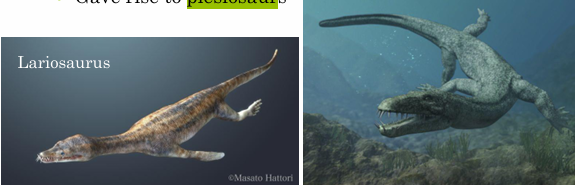
plesiosaurs
evolved from reptiles that returned to sea (nothosaurs) during the late Triassic
the turtles (Triassic)
primitive reptiles that also took to the water during the early Triassic
two main groups of reptiles that survived the Permian extinction were the ___
therapsids (mammal-like reptiles) went extinct during mid Triassic
archosaurs (diapsid amniotes that includes dinosaurs, birds, and crocodilians) became dominant by mid Triassic as they did well with high temperatures
ornithodira (Triassic) evolved into two important groups
Pterosauria
Dinosauromorpha — gave rise to dinosaurs
The Triassic — Dinosaurs; when did dinosaurs first evolve?
first true dinosaurs evolved by late-Triassic
hunted in packs
some bipedal
had flexible hip, faster
had lightweight hollow bones
late-Triassic, dinosaurs diversified and the true _____ had evolved
FLYING Pterosaurs
the first ____ evolved near the end of the Triassic Period from the nearly extinct Therapsids
mammals; early mammals were very small, mainly herbivores or insectivores and therefore were not in direct competition with the Archosaurs or later dinosaurs. first monotremes, arboreal, nocturnal, laid eggs
Triassic Extinction
Pangaea began to break up at the end of the Triassic
huge volcanic eruptions began to occur
Triassic period ended with a mass extinction, particularly severe in the oceans
22% of marine families went extinct
conodonts
all marine reptiles except for ichthyosaurs and plesiosaurs
many brachiopods, gastropods, and mollusks
other groups that went extinct included
important clades of large archosaurian reptiles
large labyrinthodont amphibians,
groups of small reptiles,
some synapsids (except for the proto-mammals).
Some of the early, primitive dinosaurs also became extinct, but more adaptive ones survived to evolve into the Jurassic.
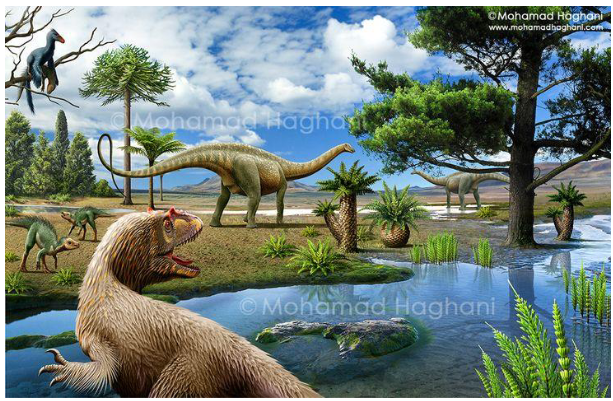
The Mesozoic: AGE OF REPTILES — Jurassic
By the beginning of the Jurassic, Pangaea started drifting into Laurasia and Gondwana
Mountains rose on sea floor, raising sea levels
This created more coastlines and shifted the climate from dry to humid – temps up to 86°F
tree-like cycads, tree ferns, ginkoes, and conifers took over the now moist landscape
mid Jurassic, the oceans teemed with life
plesiosaurs
ichthyosaurs
giant marine crocodiles
large sharks
ammonites
reefs— there were corals but majority of reefs were built by mollusks
ammonites and other cephalopods, crustaceans, and true starfish had become common
skies were also becoming filled with winged vertebrates – NOT dinosaurs
Early species had long, fully toothed jaws and long tails, while later forms had a highly reduced tail, and some lacked teeth.
Many sported furry coats made up of hair-like filaments known as pycnofibers, which covered their bodies and parts of their wings
end of Jurassic, climate began to cool
The Jurassic — Non Reptiles
the first jumping frog evolved (first frog evolved in the Permian)
earliest shelled turtles appeared
The Jurassic — Mammals
things are beginning to look similar in terms of mammals
vilevolodon — sugar glider
castrocauda — early beaver
etc
Lush conditions gave rise to new and extraordinary kinds of dinosaurs — Jurassic Sauropods
all huge, long neck dinos (10-52 tons)
apatosaurus
diplocodus
brachiosaurus
camarasaurus — most common
The Jurassic — Theropod Saurischians
there were many theropods in the Jurassic
many were 20ft long on average
Allosaurus was the top predator of the Jurassic
50ft tall, 28ft long, most abundant predator
The Jurassic — Ornithiscian Dinosaurs
bird hipped
pubis pointing backward
mainly herbivorous dinosaurs
The Jurassic — Cryptoclidus
a plesiosaur that resembled the Loch Ness Monster with four huge flippers, a short tail and a longer, flexible neck. had a long snout and curved sharp teeth which aided in catching small fish, shrimp and squid.
The Jurassic — Pterosaurs
flying reptiles, first vertebrates to have evolved flight.
Their wings were formed by a membrane of skin, muscle, and other tissues stretching from the ankles to a dramatically lengthened fourth finger
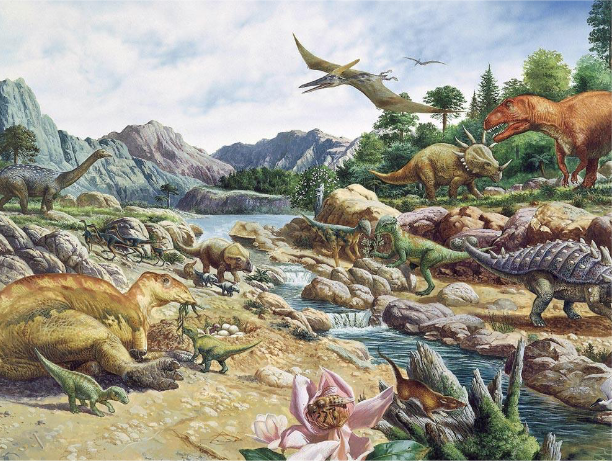
The Mesozoic: AGE OF REPTILES — The Cretaceous
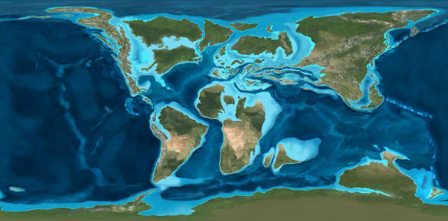
early Cretaceous, Pangaea continued to brake up into modern continents of North America, Europe, and Asia
Gondwana followed, forming South America, Africa, Australia, and Antarctica
Not in modern positions yet though
Broad shallow seas across North America and Europe
at first, cooling climate (from Jurassic)
very wet
evidence of snow
after first 6my, temps increased again and remained warm for rest of period
Warming may have been due to volcanic activity which produced large amounts of CO2
sea levels were high
Flowering Plants (Angiosperms) evolved!
Aided by the appearance of bees – coevolution
Many leafy trees appeared and gymnosperms continued to thrive
rise of mammals — Mammals were still very small but abundant
Marsupials and placental mammals evolved about 115 mya
oceans were filled with large, toothy, fast organisms
ichthyosaurs were probably outcompeted by plesiosaurs and went extinct by mid cretaceous
mosasaurs evolved from aquatic lizards in late Cretaceous; quickly diversified
sea turtles evolved during cretaceous, resembled modern sea turtles
rise of birds — by early cretaceous, there were many birds
The Cretaceous - Sauropods
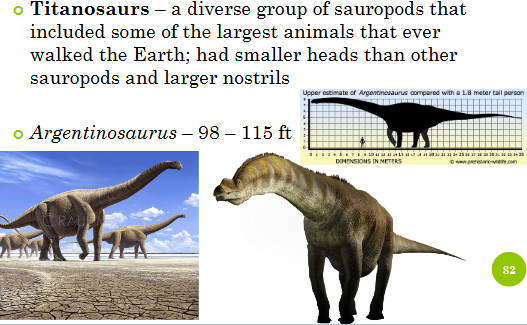
titanosaurs — a diverse group of sauropods that included some of the largest animals that ever walked the Earth; had smaller heads than other sauropods and larger nostrils
argentinosaurus
The Cretaceous — Ornithischia
many ornithischia still around
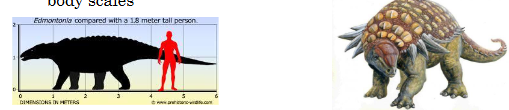
ankylosaurs — herbivorous quadrupeds armored with body scales
The Cretaceous — Theropods
ornithomimosaurs — theropods which looked like ostriches
dromaeosaurs — feathered theropods
The Cretaceous — Pterosaurs
quetzalcoatlus — advanced toothless pterosaurs some of the largest flying animals of all time
wingspan of ~40ft
The Cretaceous — mammals evolved from _____
therapsids
characteristics of mammals
Have hair
Suckle young
Are endothermic (warm-blooded)
key features had to evolve to form mammals — rise of mammals (cretaceous)
jaws
Teeth and tooth replacement
Hearing
Brains
Locomotion
Thermoregulation
Reproduction
live birth
Jaws (key features had to evolve to form mammals — rise of mammals (cretaceous))
cynodonts evolved the masseter, a large muscle that runs from the skull under the cheekbone to the outer side of the lower jaw
Most powerful muscle that closes the jaw
Made jaw movements more precise and easier to control
Biting became more powerful
Force of bite delivered directly through teeth, instead of through jaw hinge
hearing (key features had to evolve to form mammals — rise of mammals (cretaceous))
early cynodonts transmitted ground-borne vibrations through the forelimbs and shoulder girdle to the brain
Hearing system evolved to detect sound through the air
Middle ear-bones became suspended from skull
Don’t have to listen to yourself chew as much
Only advanced mammals evolved the complex spiral inner ear
brains (key features had to evolve to form mammals — rise of mammals (cretaceous))
As jaw and ears evolved, brain got bigger and bigger to accommodate senses and more complex behavior
locomotion (key features had to evolve to form mammals — rise of mammals (cretaceous))
Cynodonts had wheelbarrow locomotion
Hindlimbs evolved to become semi-erect, which brought feet closer together
Ankle changed to give more direct propulsion in line of travel
Spine evolved greater stiffness so that power would be transmitted more efficiently, more flexible necks
thermoregulation (key features had to evolve to form mammals — rise of mammals (cretaceous))
Means you have a much faster metabolism to keep body warmer
Cynodonts evolved diaphragm to allow more efficient respiration
Have to breathe more with faster metabolism
Evolved fur for insulation
reproduction (key features had to evolve to form mammals — rise of mammals (cretaceous))
Suckling – evolved from a special gland that reptiles had to secrete moisture for the eggs while incubating them
Hatchlings may have licked gland to gain moisture
Gradually, nutrients were secreted too = milk
Suckling demands full and flexible cheeks, which mammals evolved
live birth (key features had to evolve to form mammals — rise of mammals (cretaceous))
first mammals (monotremes) laid eggs
Has evolved independently many times – 90 times
Live birth is easier than egg laying in small animals
Probably evolved during Cretaceous
Rise of birds: By early Cretaceous, there were many birds. The origin of flight has nothing to do with feathers. Name the four hypotheses of the origin of Flight
birds had:
shorter tail feathers and shorter tail
shorter body
center of mass closer to wings
shoulder joint that allowed wings to be raised
hypotheses of origin of flight:
the arboreal hypothesis
the cursorial hypothesis
the running raptor hypothesis
the display and fighting hypothesis
The arboreal hypothesis (origin of flight)
flight evolved by birds jumping out of trees
suggests small feathered dinosaurs first glided from branches, making it a plausible path since gliding is common in tree-dwelling animals.
Can’t be because body types of early birds and therapods were not evolved to live in trees
the cursorial hypothesis (origin of flight)
a fast-running reptile would learn to flap its winged arms and eventually fly
proposes that running dinosaurs used their feathered arms to generate lift
less supported because running alone doesn’t create much lift.
Can’t be because before flight, wings would cause increased drag
the running raptor (origin of flight)
Running with synchronized movement of wings to give forward thrust and allow more rapid movement over ground
argues that early predators leapt onto prey from above, using controlled falls that could later evolve into true flight.
Wing thrust would have to become more powerful that leg thrust
the display and fighting hypothesis (origin of flight)
theropods had long display feathers that they would flap for mates or territoriality and flapping would give it lift off the ground during fighting
suggests feathers originally evolved for display or aggressive interactions, and those movements were eventually co-opted into flapping.
How does a bird flap enough during fighting to really fly?
The Cretaceous-Tertiary (KT) Extinction
the end of the dinosaurs
was a mass extinction of three-quarters of the plant and animal species on Earth
occurred over a geologically short period of time approximately 66 million years ago.
It marked the end of the Cretaceous period and with it, the entire Mesozoic Era, opening the Cenozoic Era that continues today
huge asteroid impact
The impact would have sent tidal waves crashing against all the continents and started a chain reaction of volcanic eruptions
the asteroid would have vaporized, sending up a huge cloud of dust into atmosphere
Blockage of Sunlight - Would cause global winter of darkness up to 3 months
Short-term global warming – immediately after the impact, the heat from the impact would have raised global temperatures by as much as 30C for up to 30 days
Followed by the winter of darkness for up to 3 months
Global Wildfires would have broken out instantly
Acid Rain – may have occurred caused by nitrous acids in atmosphere, but not much evidence
Long Term Global Warming followed all of these (but less than a million years)
with the exception of a few reptilian species like leatherback sea turtle and crocodiles, no tetrapods weighing more than 55 lbs surived
all non-avian dinosaurs, pterosaurs, mosasaurs, and plesiosaurs went extinct
ammonites went extinct