Math Formulas/Concepts/Principles/Rules
 Call Kai
 Learn
Learn Practice Test
 Spaced Repetition
 Match
Match Flashcards
 Knowt Play
1/70

There's no tags or description
Looks like no tags are added yet.
Name | Mastery | Learn | Test | Matching | Spaced | Call with Kai | Chat |
|---|
No analytics yet
Send a link to your students to track their progress
71 Terms
A=s²
Formula for finding the AREA of a SQUARE
P = 4s
Formula for finding the PERIMETER of a SQUARE
A = bh/2
Formula for finding the AREA of a TRIANGLE
P = a + b + c
Formula for finding the PERIMETER of a TRIANGLE
A + lw
Formula for finding the AREA of a RECTANGLE
P = 2l + 2w
Formula for finding the PERIMETER of a RECTANGLE
A = h
Formula for finding the AREA of a PARALLELOGRAM
P = 2a + 2b
Formula for finding the PERIMETER of a PARALLELOGRAM
A = (𝑎+𝑏)/2 × h
Formula for finding the AREA of a TRAPEZOID
P = a + b + c + d
Formula for finding the PERIMETER of a TRAPEZOID
V = s³
Formula for finding the VOLUME of a CUBE
SA = 6s²
Formula for finding the SURFACE AREA of a CUBE
V = 𝜋r²h
Formula for finding the VOLUME of a RIGHT CIRCULAR CYLINDER
SA = 2𝜋rh
Formula for finding the SURFACE AREA of a RIGHT CIRCULAR CYLINDER
V = (1/3)𝜋r²h
Formula for finding the VOLUME of a RIGHT CIRCULAR CONE
SA = 𝜋r √r² + h²
Formula for finding the SURFACE AREA of a RIGHT CIRCULAR CONE
V = bh
Formula for finding the VOLUME of an IRREGULAR PRISM
C= 2πr
Formula for finding the CIRCUMFERENCE of a CIRCULAR REGION
A = πr²
Formula for finding the AREA of a CIRCULAR REGION
V = (4/3)πr³
Formula for finding the VOLUME of a SPHERE
SA = 4πr²
Formula for finding the SURFACE AREA of a SPHERE
acute angle
angle that measures below 90 degrees
right angle
angle that measures 90 degrees
obtuse
angle that measures larger than 90 degrees but less than 180 degrees
straight angle
angle that measures 180 degrees
complementary angles
angles that add up to 90 degrees
supplementary angles
angles that add up to 180 degrees
equal
vertical/opposite angles are ____
common side, vertex
adjacent angles have a __________ and ______
line
a straight path of points that has no beginning or end
ray
contains one endpoint and extends forever in one direction
segment
a portion of a line that has two endpoints
intersecting lines
lines that come together at a point
perpendicular lines
lines that intersect at right angles
parallel lines
lines that are the same distance apart and never meet
transversal lines
lines that crosses two or more lines
180 degrees
the sum of all angles of any triangle is ___
equilateral - three equal angles (all angles are 60 degrees) and three sides of the same length
isosceles - two equal sides and two equal angles
scalene - no equal sides and angles
types of triangles
acute triangles
triangle with angles that measure never more than 90
obtuse triangle
a triangle that contains one angle that measures more than 90 degrees
right trianglea
a triangle that contains a 90 degree angle
two remote interior angles
an exterior angle is equal to the sum of the _______________________
proportional
corresponding sides of similar triangles are ____________
radius
a line that lies from the center to the circle itself
diameter
a line that contains the center and has its endpoints on the circle
secant
a line passing through 3 exact points on a curve
bisect
to divide into two equal sections
congruent
identical in size and shape
pi
a constant equal to 3.14
arc
set of pints that lie on a circle
chord
a line that connects two points on a circle
vertex
the point of intersection between two or more rays, often called a corner
central angle
has its vertex at the center of a circle and its endpoints on the circumference. its degree is equal to that of its intercepted arc
inscribed angle
has its vertex and endpoints on the circumference. its degree is equal to half of its intercepted arc
s= θr
arc length formula if central angle is given in radian
s = (θ/360) x 2πr
arc length formula if central angle is given in degrees
sector = (1/2)rθ
formula for finding sector of circle
sinθ= opp/hyp, cosθ = adj/hyp, tanθ = opp/adj
define SOH CAH TOA
a/sinA=b/sinB=c/sinC
law of sines
a² = b² + c² - bc cos A
b² = a² + c² - ac cos A
c² = a² + a² - ab cos A
law of cosines
cosecant is the reciprocal of sine.
secant is the reciprocal of cosine.
cotangent is the reciprocal of tangent.
reciprocal identities
sin(- θ) = - sine(θ)
cos(- θ) = cos (θ)
tan (- θ) = - tan(θ)
negative angles in trig
sin²θ + cos²θ = 1
1 + tan²θ = sec²θ
1 + cot²θ = csc²θ
pythagorean identities
x(degrees) x π/180
degree to radians
x times 180/π
radians to degrees

a sub 1 can be replaced by any other known position
formula for the nth term of an arithmetic sequence
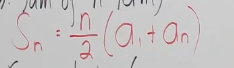
formula for finding the sum of an arithmetic sequence
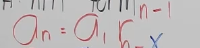
a sub 1 can be replaced by any other known position
formula for finding the nth term of a geometric sequence
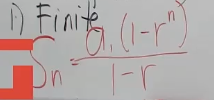
formula for finding the sum of a finite geometric sequence
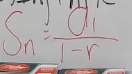
formula for finding the sum of an infinite geometric sequence