Final exam
 Call Kai
 Learn
Learn Practice Test
 Spaced Repetition
 Match
Match Flashcards
 Knowt Play
1/55

There's no tags or description
Looks like no tags are added yet.
Name | Mastery | Learn | Test | Matching | Spaced | Call with Kai |
|---|
No analytics yet
Send a link to your students to track their progress
56 Terms
bond order equation
(# of e’s in bonding MOs - # of e’s in antibonding MO)/2

linear
AX2E0
no LP
sp hybridized
180 degrees
ex: CO2
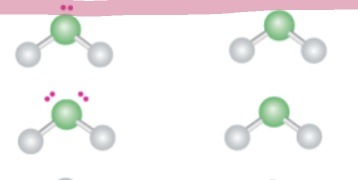
bent
AX2E1 or AX2E2
1 or 2 lone pairs around central atom
sp2 hybridized
1 LP ex: SO2
2 LP ex: H2O
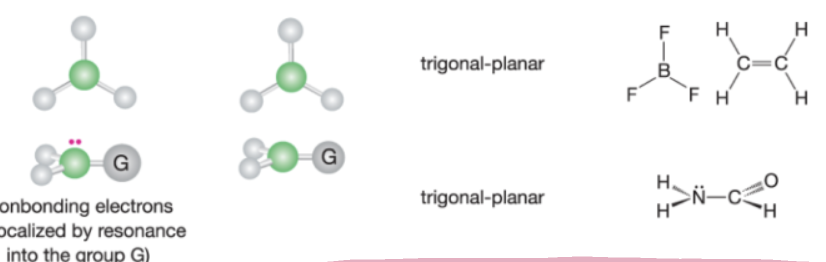
trigonal planar
AX3E0 or AX3E1
0 LP
1 LP
electron geometry is trigonal planar
molecular geometry is bent
sp2 hybridized
120 degrees
0 LP ex: BF3
1 LP ex: SO2
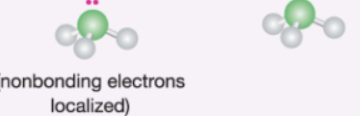
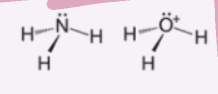
trigonal pyramidal
AX3E1
1 lone pair
sp3 hybridized
ex: NH3 or H3O
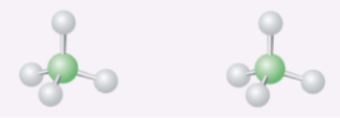
tetrahedral
AX4E0
zero lone pairs
sp3 hybridized
109.5 degrees
example: NH4+, CH4
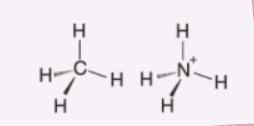
resonance structure pneumonic
Octet: contributor with full octet of all atoms is MOST important
En: the more Electronegative gets the electrons and negative formal charge. Use only if rule 1 can’t be satisfied
Cs: minimize Charge and minimal Separation of opposite charges
opposite charges should be as close together as possible because it lowers the systems energy, making the resonance structure more stable
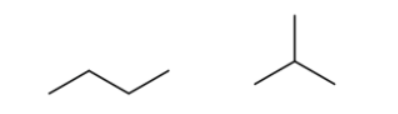
constitutional isomers
different compounds with the same molecular formula but a different connectivity
both are C4H10
isopropyl (i-Pr)
(CH3)2CH

isobutyl (i-Bu)
(CH3)2CHCH2

sec-butyl (s-Bu)

tert-butyl (t-bu)
(CH3)3C

neopentyl
(CH3)3CCH2

cyclopropane
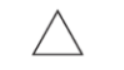
cyclobutane

cyclopentane
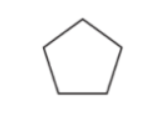
cyclohexane
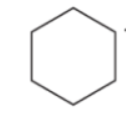
primary carbon
carbon bonded to one carbon atom
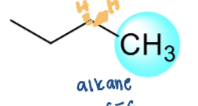
secondary carbon
carbon bonded to two other carbon atoms
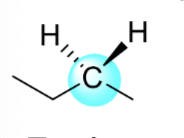
tertiary carbon
carbon bonded to three other carbon atoms
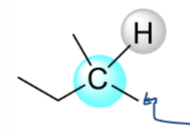
quaternary carbon
carbon bonded to four other carbon atoms
primary hydrogen
hydrogen bonded to a primary carbon
secondary hydrogen
hydrogen bonded to a secondary carbon
tertiary hydrogen
hydrogen bonded to a tertiary carbon
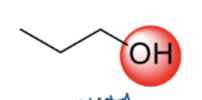
primary alcohol
the carbon attached to the alcohol is attached to one other carbons
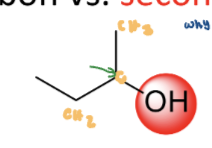
secondary alcohol
the carbon attached to the alcohol is attached to two other carbons
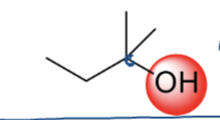
tertiary alcohol
the carbon attached to the alcohol is attached to three other carbons
primary amine
the carbon attached to the amine is attached to one other carbons
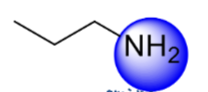
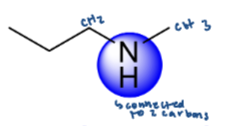
secondary amine
the carbon attached to the amine is attached to two other carbons
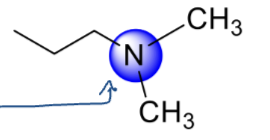
tertiary amine
the carbon attached to the amine is attached to three other carbons
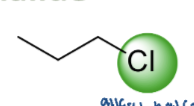
primary halide
the carbon attached to the halide is attached to one other carbons
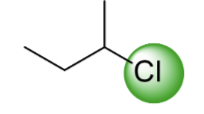
secondary halide
the carbon attached to the amine is attached to two other carbons
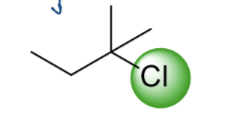
tertiary halide
the carbon attached to the amine is attached to three other carbons
torsional straing
arises when nonbonded atoms separate by three bonds are forced from a staggered conformation to an eclipsed
hyperconjugation
stabilization arises from a small donor-acceptor interaction between a filled C-H bonding MO of one carbon and the empty or unfilled C-H antibonding MO on an adjacent carbon
dihedral angle
angle created by two intersecting planes on Newman projection
strain
measure of the energy stored in a compound due to structural distortion
type: torsional strain, steric strain, and angle strain
bronsted acids
proton donors
lose an H
e sink: donating H+ without electron
arrow head
bronsted bases
proton acceptors
gain an H
e sources: negative charge or lone pair
arrow tail
lewis acids
accept electrons
e sink
arrow head
lewis bases
donate electrons
e source: lone pairs and negative charge
arrow tail
nucleophiles
lewis bases
electron rich (-)
use their electrons to ATTACK the nucleus
arrow tail
electrophiles
lewis acids
electron poor (+)
arrow head
factors the affect acid/base strength
charge
lack of electrons increases acidity (plus charge)
Atom size/ polarizability
greater atom size means greater electron delocalization and increased acidity
trumps electronegativity
electronegativity
hydrogens on electronegative atoms are more acidic and easier lose since the more electronegative atom has greater affinity for electrons
think: how greedy is this atom for electrons?
inductive effect
electronegative atoms increase acidity by pulling electron density away through a sigma bond.
This stabilizes the negative charge on the conjugate bases.
The closer the electronegative atom is to the acidic H, the stronger the effect
think: how does an electronegative atom affect the rest of the molecule?
resonance stabilization
conjugate base will be stabilized with greater electron delocalization due to resonance
the more contributors the conjugate base has, the more acidic it is
orbital hybridization
due to high s character in the hybrid orbital bonded to the acidic hydrogen increases acidity because the electrons in the conjugate base are held closer to the nucleus making it more stable
stability of alkenes
more alkyl group substitution around the pi-bond the more stable the alkene
trans is MORE stable than cis meaning lower (less exothermic) hydrogenation
reason: hyper-conjugation: sigma bonding electrons can delocalize or enter pi-star orbitals
reaction rate for ELIMINATIONS is tertiary substrate>secondary>primary
because greater substitution generates a more stable alkene
Markovnikov’s rules
hydrogen adds to the carbon with the more hydrogens
anti addition via bridged intermediates
electrophile and nucleophile add from opposite sides
addition of halogens (Cl2, Br2 additions)
oxymercuration/reduction (Markovnikov addition): hydration of pi bond
syn addition
electrophile and nucleophile add from the same face/side
hydroboation/oxidation (anti-Markovnikov addition): hydration of pi bond
regioselectivity
whee does H go?
anti-markovnikov addition
stereospecificity
syn addition
add from the same face - H and OH end up cis to each other)