NEURO2O20 WEEK 11
 Call Kai
 Learn
Learn Practice Test
 Spaced Repetition
 Match
Match Flashcards
 Knowt Play
1/36

There's no tags or description
Looks like no tags are added yet.
Name | Mastery | Learn | Test | Matching | Spaced | Call with Kai | Chat |
|---|
No analytics yet
Send a link to your students to track their progress
37 Terms
AMNESIA
Retrograde
Backward acting
Deficits in memory prior to surgery/trauma
Anterograde
Forward acting
Deficits in the ability to form new memories after surgery/trauma
deficits in storing new memories in short-term memory
deficits in transfer of information to long term storage that can be retrieved after attention has been diverted from it
CASE OF H.M
H.M.
Severe epilepsy and seizures resulted in removal of medial temporal lobes, hippocampus and amygdala
Surgery reduced his seizures but caused amnesic effects
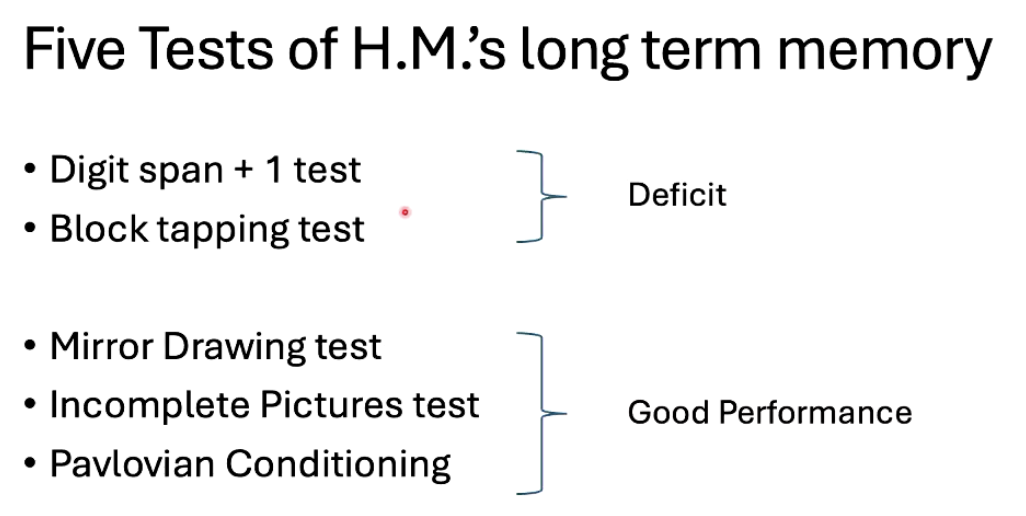
DIGIT SPAN +1 TEST
test of long-term memory
5 digits read to patient at a rate of 1 per second
Next trial – same 5 digits + 1 more at the end…etc
H.M.'s best performance was 7 digits after 25 trials
Most people can do 15 digits after 25 trials
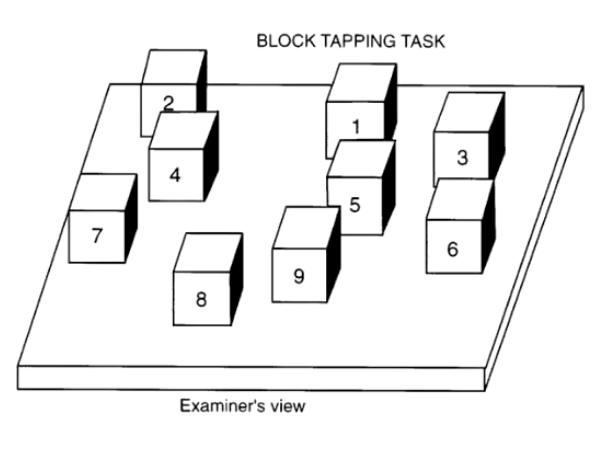
BLOCK TAPPING TEST
9 blocks spread out on a board
The psychologist taps the blocks in the order numbered on their side of the block
Patient repeats sequence
H.M could not match the normal performance of about 6 taps
MIRROR DRAWING TEST
Implicit memory
Trace boundaries of a star without going outside the track
Patient has to watch their hand in the mirror
Trace the pattern 10 times per day for 3 days
Reduction in the number of errors indicated H.M. retained something from the task
He did not have explicit memory of doing the task the previous day

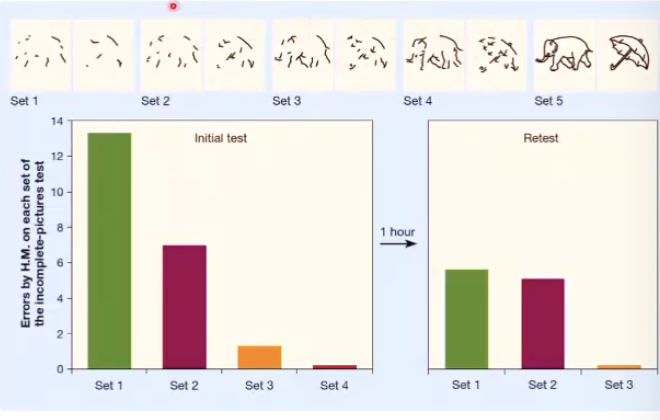
INCOMPLETE PICTURES TEST
Implicit memory
five sets of pictures – containing 20 objects, but the sets differ in their degree of completion
Step 1 = determine the level of completeness required to reliably identify the pictures
Wait 1 hour and test again
Non-impaired people identify pictures at a lower level of completeness on the second run – as did H.M.
PAVLOVIAN CONDITIONING TEST
A tone played just before puff of air administered to his eye
Trials repeated until the tone elicited the eye blink
H.M.'s rate of learning was slower than normal and lasted two years.
SCIENTIFIC CONTRIBUTIONS OF H.M
Revealed the role of medial temporal lobes in memory
Provided support for the theory that there are modes of storage for short term, long term and remote memory
First to reveal that an amnesic patient might report no memory of an experience but demonstrates memory by showing improved performances
Lead to distinction between two memory types:
Explicit – conscious, long-term memory. Allows flexible use of information.
Implicit – long-term memory demonstrated by improved performance without conscious awareness. Simpler and likely older.
H.M DEFICITS IN…
Explicit memory
MEDIAL TEMPORAL LOBE AMNESIA
Refers to patients who have preserved intellectual functioning with evident damage to the medial temporal lobe
Difficulty forming explicit memories
Retain ability to form implicit memories
impair long delay (long -term memory)
SEMANTIC VS EPISODIC MEMORY
People with temporal lobe damage have difficulty with episodic memory
Semantic
Explicit memories for general facts or information
Episodic
Explicit memories for specific moments in one's life
AMNESIA OF KORSAKOFF’S SYNDROME
Memory disorder in people who consume large amounts of alcohol for a prolonged period (>35 drinks per week for 5-10 years)
Associated with Thiamine deficiency
In advanced stages:
Confusion
Personality change
Organ dysfunction
Damage to medial thalamus, neocortex, hippocampus, cerebellum
Amnesia is similar to medial temporal lobe amnesia
hard to specify the structure that is responsible for observed deficits, but damage to mediodorsal nuclei of the thalamus is nearly universally observed
WORD STEM IMPROVEMENT IS AN EXAMPLE OF…
Working memory
X KNEW FACTS ABOUTY THE WORLD BUT NOT WHO HE HAD BREAKFAST WITH, THIS SHOWS:
Impaired semanic memory
AMNESIA OF ALZHEIMERS
As disease progresses, deterioration to dementia where the patient cannot recognize family, speak, eat, etc.
Deficits in tests of anterograde and retrograde explicit memory
Short term memory deficits
Degradation in implicit memory for verbal and perceptual information
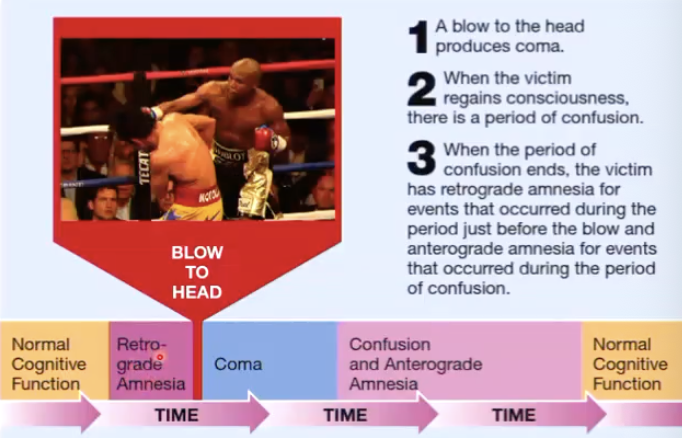
POST-TRAUMATIC AMNESIA
Closed head traumatic brain injury is most common cause
Stages:
Coma: state of unconsciousness following head blow
Retrograde amnesia for events leading up to head blow
Confusion and Anterograde amnesia for events that occurred during the state of confusion
ELECTROCONVULSIVE SHOCK AND CONSOLIDATION
Brief but intensive seizure inducing current administered to the brain via electrodes on scalp
Tests memory consolidation because it disrupts Hebb's reverberation
Erases memories that have not undergone consolidation
Squire et al. Showed consolidation can last several years
HIPPOCAMPUS AND ISCHEMIA
Patients that suffer global cerebral ischemia (interrupted blood flow to the entire brain) often suffer from medial temporal lobe amnesia
Damage to the pyramidal cell layer of the hippocampus
Suggests the hippocampus was important in memory (PARTICULARLY SPATIAL MEMORY + EPISODIC MEMORY)
DELAYED NON-MATCHING TO SAMPLE TEST
Tested the idea that amnesia due to temporal lobe damage is entirely due to hippocampus damage
Easier to test in rats because the hippocampus is easier to isolate
The tested proved not true
Instead:
The hippocampus's role seems to be less thought of for object recognition memory and more for performance on tasks that involve memory for spatial location
HIPPOCAMPAL PLACE CELLS
Cells that respond only when an individual is in a particular place/location
Each place cell has a place field that corresponds to a different part of each environment
JENNIFER ANISTON NEURONS; CONCEPT CELLS
One neuron was discovered that fired in response to images of Jennifer Aniston.
Concepts cells are cells that are found to respond to more than one object that are similar
Related concepts are thought to trigger activity in circuits of concepts cells in the medial temporal lobes
ENGRAM CELLS
Neurons that undergo a persistent change in response to experiences, such that when they are activated/inhibited, the retrieval of the original experience is triggered or suppressed.
Structures that are active during encoding of memories are also active during recall.
FIVE BRAIN AREAS IN MEMORY
INFEROTEMPORAL CORTEX
Is responsible for complex visual function
Responsible for memories of visual input
AMYGDALA
Encodes emotionally charged memories
Does not store memories itself, but strengthens emotionally charged memories
PREFRONTAL CORTEX
Memories for tasks that involve a series of responses
Ex. Recipes
CEREBELLUM
Memory for sensorimotor tasks
STRIATUM
Memory for relationships between stimuli and their responses
Changes gradually over time
Thought to be the basis of habit formation
LONG TERM POTENTIATION
Occurs when two or more neurons are excited at the same time
The synapse is repeatedly activated and the chemistry of the synapses changes such that the connection is strengthened
'neurons that fire together, wire together'
Long term learning based on the development and growth of further synaptic connections
STAGES OF LONG TERM POTENTIATION
Induction
If the postsynaptic neuron is depolarised when glutamate binds to its receptors, the NMDA receptors permits the entry of many calcium ions and a LTP is induced
Maintenance
Ensuring those preferential links are sustained
Expression
Using links to recall your memories
LTP causes structural changes such as increase in the number + size of synapses, number of dendridic spines, changes in pre and post-synaptic membranes, and changes to dendritic branching
MYELINATION
Myelination
Oligodendrocytes modulate the myelination of axons in response to experience
Myelin sheath is not static, rather dynamic and ongoing throughout lifespan
FIVE MECHANISMS THAT CHANGE MYELINATION
Unmyelinated axons can be myelinated by oligodendrocytes
Myelinated axons can have their myelin sheaths removed
Myelin can be replaced when it degrades
Myelin sheaths can be thinned or thickened
Myelin sheaths can be lengthened or shortened
INFANTILE AMNESIA
Lack of explicit memory during infancy
Children were shown photos of their preschool classmates. They reported remembering a low number, but they had heightened skin response to classmates vs control photos.
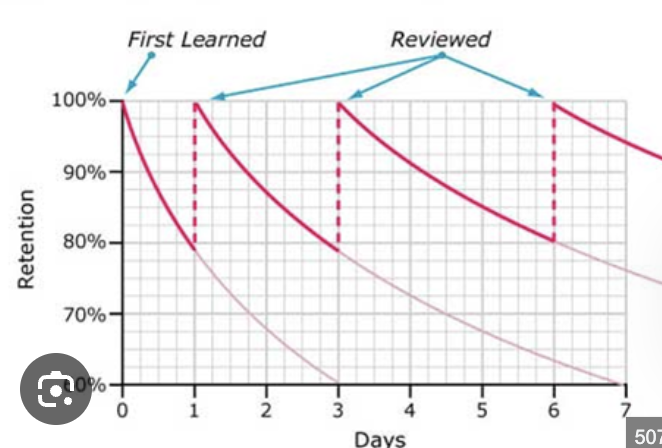
SPACING EFFECT
Memory is better with repeated spaced learning than massed learning. Over time retention and length of retention increases.
LEITNER SYSTEM
Flashcards are sorted by difficulty
promoted or demoted based on performance
lower numbers studied more frequently
spaced repitition
NEUROSCIENCE OF SPACED LEARNING
increase in volume and no. of postsynaptic dendritic spines recruited
long term potentiation relies on mechanisms that take time to recover
therefore, LTP has a refractory period where effects are diminished during massed learning
Molecular refractory period theory
LEVELS OF PROCESSING
Deeper processing at encoding leads to better retrieval.
STRUCTURAL - spelling/visual qualities of word
PHONEMIC - Phonetic/auditory qualities of word
SEMANTIC - meaning of word
Shallowest to deepest.
TRANSFER-APPROPRIATE PROCESSING
recall is determined by match between encoding processes and recall processes
semantic does not always equal best recall
SERIAL POSITION EFFECT
Recall of items are influenced by order.
PRIMARY EFFECT - remember things @ start better
RECENCY EFFECT - remember things @ end better
SERIAL POSITION EFFECT COGNITIVE EXPLANATION
SINGLE STORE MODEL
effect best explained by a single memory process
early items recieve more attention
late items are temporally closer to recall test
DUAL STORE MODEL
effect best explained by short and long term memory
earlier items are quickly encoded into long term because there are fewer competing items
late items are still active in short term memory at recall
DRM FALSE MEMORY PARADIGM
Using a series of related words to produce a false memory/report of the ‘lure’ word.
FALSE MEMORY COGNITIVE EXPLANATION
FUZZY TRACE THEORY
people develop two types of memory traces
gist, verbatim
ACTIVATION-MONITORING THEORY
words spread activation to lure the word through semantic associations.
Semantic vs episodic memories are predictive of more vs less false memories respectively.