Basic Dental Anatomy (Preclinic Theory/Dental Anatomy)
 Call Kai
 Learn
Learn Practice Test
 Spaced Repetition
 Match
Match Flashcards
 Knowt Play
1/106

There's no tags or description
Looks like no tags are added yet.
Name | Mastery | Learn | Test | Matching | Spaced | Call with Kai | Chat |
|---|
No analytics yet
Send a link to your students to track their progress
107 Terms
Jaws
Maxilla and Mandible
Maxillae
2 paired upper jaw bones
points of reference
maxillary arch, mandibular arch, median line, quadrants, anterior vs posterior, sextants, occlusion, malocclusion
What is the median line?
the midline/vertical line dividing the right and left halves
What are the 4 quadrants in clockwise order?
1: maxillary right, 2: maxillary left, 3: mandibular left, 4: mandibular right
What teeth are anterior?
the incisors and canines (12)
What teeth are posterior?
premolars and molars (20)
What are the sextants?
1: maxillary right posterior, 2: maxillary anterior, 3: maxillary left posterior, 4: mandibular left posterior, 5: mandibular anterior, 6: mandibular right posterior
what is an occlusion?
the relationship of the maxillary and mandibular teeth, where they come together to touch
what is a malocclusion?
abnormal occlusion of the teeth, like an open bite or crossbite
What are the incisors used for?
cutting food
What are the canines (cuspids) used for?
piercing or tearing
What are the premolars (bicuspids) used for?
crushing
What are the molars used for?
crushing, milling and grinding
What teeth are not seen in primary dentition?
the premolars and third molars
What is the enamel?
The hard, calcified tissue that covers the dentin of the crown of the tooth
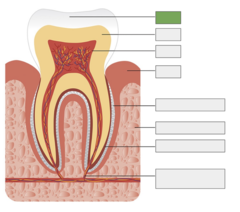
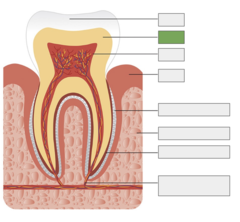
What is the dentin?
The hard, calcified tissue formed on the inside body of the tooth underneath the enamel and cementum surrounding the pulp
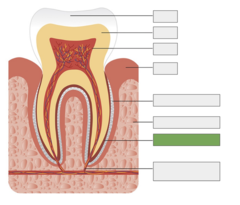
What is the cementum?
very thin layer of calcified tissue covering the root
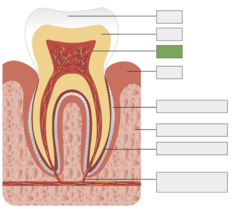
What is the pulp?
In the center of the tooth, the highly vascular area full of blood vessels and nerves
What is the dentinoenamel junction (DEJ)?
line between the dentin and the enamel
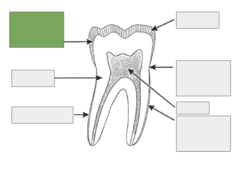
What is the dentinocemental junction (DCJ)?
line between the dentin and cementum
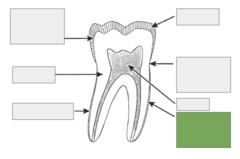
What is the cementoenamel junction (CEJ)?
line between the cementum and enamel, a lot of people have calculus built up around this area, it is horizontal around the tooth and also called the cervical line
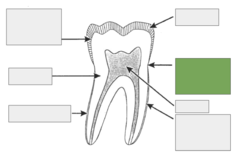
What is the crown?
The portion of the tooth covered with enamel
what is the cusp?
the pointed or rounded eminence on or near the occlusal surface

What is the root?
the portion of the tooth embedded in bone and covered with cementum
What is the root apex?
the extremity/very base of the root of the tooth
What is the cervix?
constricted junction of the crown and the root (neck of the tooth), indentation where the CEJ is located
What is a furcation?
a point where the tooth has 2+ root branches
What is bifurcation?
the division of 2 roots (mandibular molars)
What is trifurcation?
the division of 3 roots (maxillary molars)
What is the root trunk?
the area between the cervical line and the furcation on a multirooted tooth
What is dentition?
the kind, size, and arrangement of teeth
how many teeth are in primary dentition?
20
How many teeth in secondary dentition?
28-32, depending on presence of third molars
What is mixed dentition and when is this seen?
dentition containing both primary and secondary teeth in dental arches at the same time, seen around age 6-12
What are teeth functions?
mastication/aid digestion (chewing), facilitate communication (speech), esthetics (appearance)
How is primary dentition useful?
maintenance of space for permanent teeth
act as a guide for erupting teeth
What teeth are in primary dentition?
central and lateral incisors, canines, first and second molars
What are nonsuccedaneous teeth?
permanent molars in the permanent dentition that do not replace primary teeth
What are succedaneous teeth?
permanent teeth that replace primary teeth
Lingual surfaces
surface of the maxillary and mandibular teeth nearest the tongue
Facial surfaces
surfaces next to the face (labial, buccal)
Labial surface
type of facial surface of anterior teeth next to the lips
Buccal surface
type of facial surface of posterior teeth next to the cheeks
proximal surfaces
next to an adjacent tooth in the same arch (mesial, distal)
mesial surfaces
surfaces nearest/toward the midline of the arch
central incisors have mesial sides touching (8/9, 24/25)
distal surfaces
surfaces furthest/away from the midline of the arch
occlusal surfaces
biting surfaces of posterior teeth
incisal surfaces
biting edge of anterior teeth
contact area/point
small spot or area on the mesial or distal surfaces of a tooth which touches or contacts the adjacent tooth in the same arch, usually a space at the top and bottom since they are rounded
embrasure
open space between proximal surface of two teeth where they diverge facially, lingually, or occlusally from the contact area; triangular spaces coming out from the tooth

concavity
depression in a surface
convexity
bulge in a surface
interproximal space
triangular space between adjacent teeth (gingival embrasure)
long axis
imaginary line that divides an object in half lengthwise
cervico-occlusally divided
crown only, horizontal cuts across the tooth into
cervical third, middle third, occlusal/incisal third depending on posterior/anterior
mesiodistally divided
crown or root, only on the facial and lingual
mesial third, middle third, distal third
faciolingually divided
crown or root, vertical cuts only on the proximal/side view
facial third, middle third, lingual third
cervicoapically divided
root
cervical third, middle third and apical third
What are the five tooth surfaces?
facial (buccal, labial), lingual, mesial, distal, occlusal/incisal
What does the green represent?
pulp horns
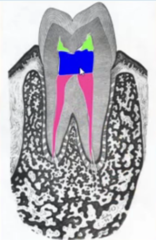
What does the blue represent?
pulp chamber

What does the pink represent?
pulp canals
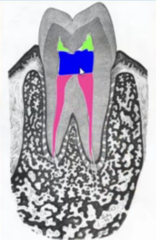
What are alveolus?
supporting bone structures (grainy bits)
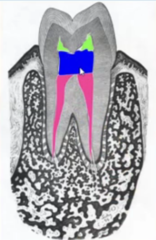
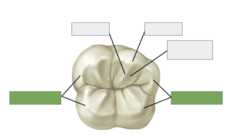
Types of crown depressions
fossa, grooves, pits
Fossa
rounded depression found on the lingual of anterior teeth and occlusal of posterior teeth

Grooves
lightly depressed lines, marking junction of two loaves
Pits
small pinpoint depression
Types of crown elevations
cusps, cingulum, tubercles, mamelons, ridges
Cusps
mass or elevation on the occlusal surface of a posterior tooth or the incisal surface of a canine
Cingulum
point of calcification forming the lingual lobe and parts of the height of contour
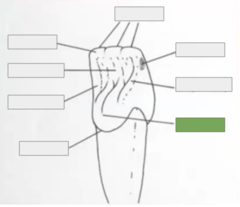
Tubercles
rounded or pointed projections found on the crowns of teeth, atypical
Mamelons
rounded extensions of the labial loads
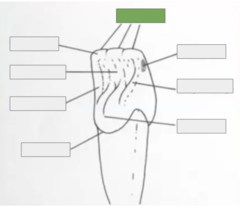
Ridges
linear and usually convex elevations on the crowns of the teeth named according to their location
Palmer system
quadrant bracket
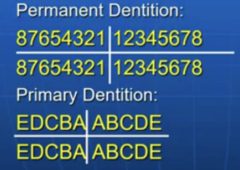
FDI system
more complicated bracket system naming permanent and primary alongside quadrants

Crown components
96% inorganic, 4% organic
Root components
50% inorganic, 50% organic
Dentin components
70% inorganic, 30% organic
tertiary/reparative
formed in response to trauma
anterior have 8 line angles
mesio labial/lingual/incisal
linguo/labio incisal
disto incisal/lingual/labial
posterior have 8 angles
mesio buccal/lingual/occlusal
disto linguo/bucco occlusal
disto lingual/buccal
point angles
point at which 3 tooth surfaces meet
anterior teeth have 4 point angles:
mesiolabioincisal
mesiolingualincisal
distolabioincisal
distolinguoincisal
posterior teeth have 4 point angles
mesiolinguoocclusal
mesiobuccoocclusal
distolinguoocclusal
distobuccoocclusal
anterior teeth have ___ lobes
4
posterior teeth have __ or __ lobes
4 or 5
lobes are formed by a
separate point of calcification
occlusal curvatures
curve of spee, curve of wilson
curve of spee
begins at the tip of the canines and follows the cusp tips of the premolars and molars, curving upward from anterior to posterior
curve of wilson
medial-lateral curvature of the occlusal plane of posterior teeth complimenting the path of the condyles during movements of the mandible
crown form of facial or lingual aspect is
trapezoidal
crown form of anterior teeth is
triangular
crown form of posterior teeth on the mandible is
rhomboidal
crown form of posterior teeth on the maxilla is
trapezoidal
embrasures function as a
spillway for food and protect the gums
facial line angles are formed by the
junction of two crown surfaces
heights of contour are on the (3) surfaces
facial, lingual, proximal
these are critical to the health of the periodontium
contours
continuity of the central groove of the posterior teeth is for (2)
effective food flow, proper occlusion