6.1. Nuclear medicine - Scintigraphy
 Call Kai
 Learn
Learn Practice Test
 Spaced Repetition
 Match
Match Flashcards
 Knowt Play
1/19

Earn XP
Description and Tags
Name | Mastery | Learn | Test | Matching | Spaced | Call with Kai | Chat |
|---|
No analytics yet
Send a link to your students to track their progress
20 Terms
What is nuclear medicine?
A medical specialty that uses radioactive tracers (radiopharmaceuticals) to assess bodily functions and to diagnose and treat disease, using specially designed cameras to track the tracers
What is scintigraphy?
A diagnostic test in nuclear medicine (also called a gamma scan) that uses radiopharmaceuticals to produce 2D images using gamma cameras
How does scintigraphy work?
Radiopharmaceuticals travel to a specific organ or tissue, emit gamma radiation, which is detected by gamma cameras to form 2D images
What type of radiation does scintigraphy use?
Ionising radiation
What are the advantages of scintigraphy?
Shows functionality not just structure, shows a sequence of functions over time, painless, non-invasive, minimal side effects, highly sensitive, can reduce need for exploratory surgery
What are the disadvantages of scintigraphy?
Uses radioactivity, complex safety procedures and regulations, issues around pregnancy and lactation, non-specific hot spots, rare allergic reactions, potentially long scan times, relatively costly, produces 2D not 3D images, complex patient preparation may be required
Why may patients need to avoid close contact with children or pregnant people after scintigraphy?
Because they may be slightly radioactive after the scan — iodine isotopes are particularly risky
What complex patient preparation may be required for scintigraphy?
Fasting, hormone administration, pre-medication, or urinary catheter — depending on the function being visualised
What is hepatobiliary scintigraphy used for?
To investigate conditions of the liver, gallbladder, and bile ducts
What symptoms indicate hepatobiliary scintigraphy?
Severe right-sided abdominal pain, pain or fever after gallbladder surgery or liver transplant, severe jaundice in newborns
What is acute cholecystitis and its most common cause?
Gallbladder inflammation, most commonly caused by a blockage from a gallbladder stone
What is chronic cholecystitis?
Intermittent blockage of the gallbladder by stones
What is sphincter of Oddi dysfunction?
A condition where the sphincter of Oddi fails to open when it should
What is biliary atresia?
A rare newborn disorder where bile is blocked from moving from the liver to the duodenum
What is a biliary leak?
Leakage of bile, typically occurring after surgery or trauma
What does bone scintigraphy show increased uptake in for thyroid cancer metastasis?
Proximal humerus, thyroid, and apex of skull
What can bone scintigraphy diagnose?
Metastasis associated with thyroid cancer
What is scintigraphy also known as?
Gamma scan
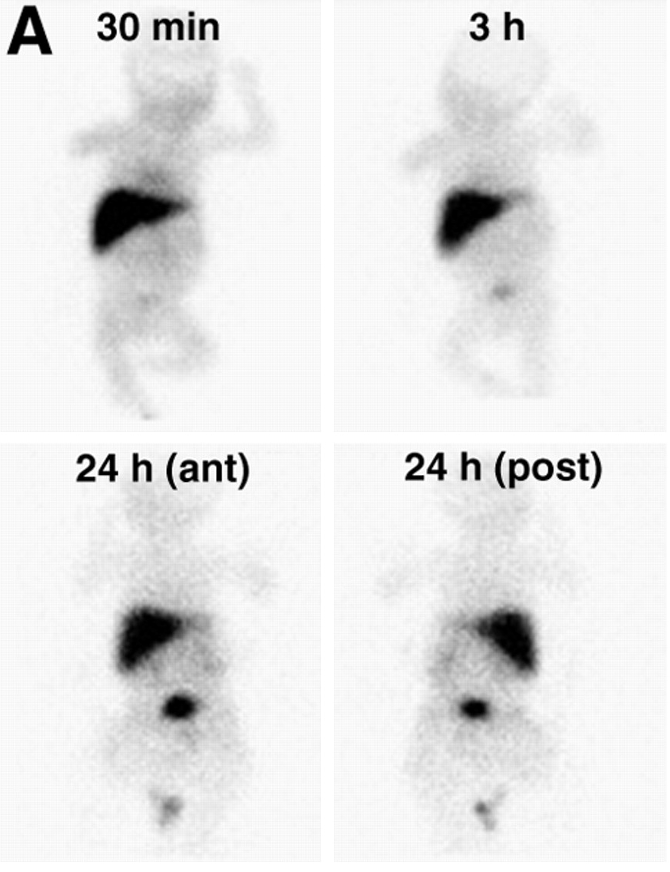
The following scintigraphy image is indicative of:
Bilary atresia
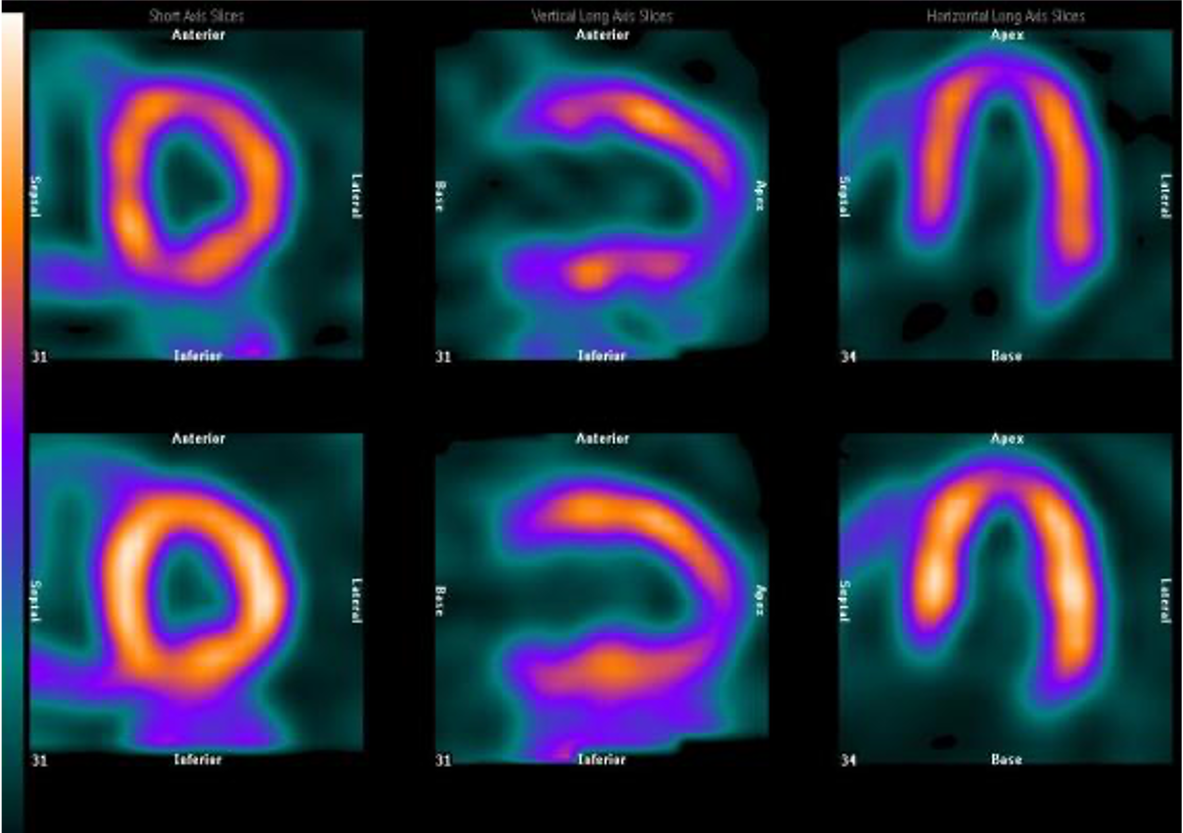
The following image shows normal functionality/metabolic activity of the heart
False