Pelvic Inflammatory Disease
 Call Kai
 Learn
Learn Practice Test
 Spaced Repetition
 Match
Match Flashcards
 Knowt Play
1/35

There's no tags or description
Looks like no tags are added yet.
Name | Mastery | Learn | Test | Matching | Spaced | Call with Kai | Chat |
|---|
No analytics yet
Send a link to your students to track their progress
36 Terms
Pelvic inflammatory disease (PID) is an —
infection of the upper genital tract.
The origin of the majority of upper genital tract infections is —
ascension of an infection from the lower genital tract.
— have all been established as risk factors for developing PID.
Previous history of PID, the utilization of an intrauterine contraceptive device (IUD), postabortion, post childbirth, douching, multiple sexual partners, and early sexual contact
A common cause of PID is —
sexually transmitted diseases like chlamydia and gonorrhea
half of PID cases have non–sexually transmitted disease causes, such as —
vaginal flora, anaerobic gram-negative rods, and Mycoplasma bacteria

Pelvic inflammatory disease. Transverse transabdominal image of the female pelvis revealing bilateral complex adnexal masses (arrows) in the setting of an extensive pelvic infection.
evolution of PID
vaginitis → cervicitis → endometritis → salphingitis → tubo-ovarian complex → tubo-ovarian abscess
— can lead to continual pelvic or abdominal pain, infertility (resulting from adhesions and scaring of the fallopian tubes), possible palpable adnexal mass, and irregular menses
Chronic PID
clinical findings of acute pelvic inflammatory disease
Possible history of a sexually transmitted disease (chlamydia or gonorrhea)
Fever
Chills
Pelvic pain and/or tenderness
Purulent vaginal discharge
Vaginal bleeding or itchiness
Dyspareunia
Leukocytosis
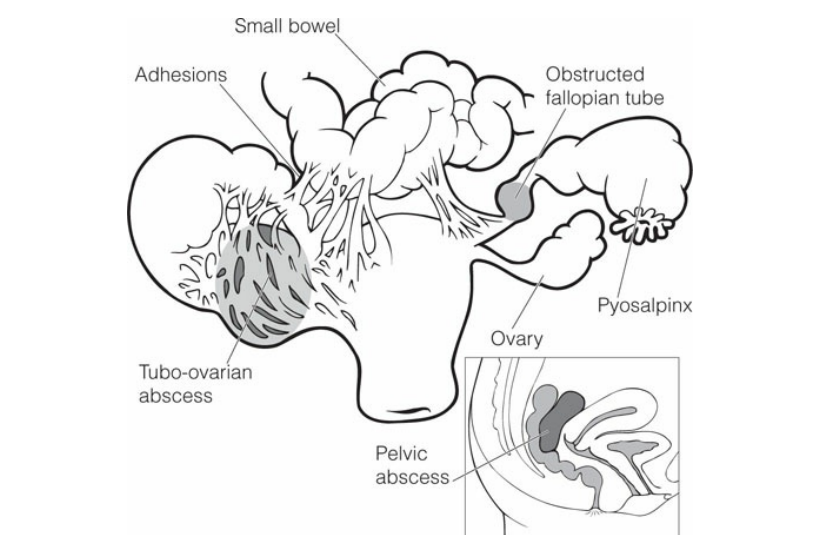
Results of chronic pelvic inflammatory disease.
sonographic findings of acute pelvic inflammatory disease
Thickened, irregular endometrium (endometritis)
Ill-defined uterine borders
Tubular structures representing dilated fallopian tubes containing echogenic material (pyosalpinx)
Tubular structures representing dilated fallopian tubes containing simpleappearing, anechoic fluid (hydrosalpinx)
Cul-de-sac fluid
Multicystic and solid complex adnexal mass(es) (see “Tubo-ovarian Complex and Tubo-ovarian Abscess” section)
clinical findings of chronic pelvic inflammatory disease
Continual pelvic or abdominal pain
Infertility (resulting from adhesions and scaring of the fallopian tubes)
Possible palpable adnexal mass
Irregular menses
Purulent vaginal discharge
sonographic findings of chronic pelvic inflammatory disease
Dilated fallopian tubes containing simple-appearing, anechoic fluid (hydrosalpinx)
Scars may be noted within the dilated tube and appear as echogenic bands within the tube
Development of adhesions may obliterate distinct borders of organs because they become fixated to each other
Multicystic and solid complex adnexal mass(es) (see “Tubo-ovarian Complex and Tubo-ovarian Abscess” section)
— is the most common initial clinical presentation in the early stages of PID
Vaginitis
Vaginitis can lead to—
excessive vaginal discharge, and in cases of PID, patient may present with a purulent, foul-smelling discharge
The progression of the infection into the cervix is termed —
cervicitis
Infections that do ascend into the endometrium may lead to inflammation of the endometrium—termed —.
endometritis
clinical findings of endometritis
History of recent abortion, postpartum, D&C, PID, surgery, or intrauterine device
Pelvic tenderness
Fever
Leukocytosis
sonographic findings of endometritis
Thickened echogenic or irregular-appearing endometrium
Endometrial fluid
Ring-down artifact from gas or air within the endometrium
The spread of the infection beyond the endometrium can lead to inflammation of the fallopian tubes, commonly referred to as —.
salpingitis
The liver capsule can become inflamed, thus leading to a clinical presentation much like gallbladder disease. This event is called —
Fitz-Hugh– Curtis syndrome.
Pelvic infections, such as chlamydia or gonorrhea, can actually lead to a —
perihepatic infection and the subsequent development of adhesions located between the liver and the diaphragm.

Pyosalpinx. This dilated tube (between calipers), seen posterior to the urinary bladder (Bl), contains pus and has a thickened wall.
PID has been linked with—
infertility and ectopic pregnancy.
— can disrupt the motility and function of the tube and/or inhibit the likelihood of conception.
Scar formation
clinical findings of salphingitis
findings consistent with PID
Pelvic tenderness
Fever
Leukocytosis
sonographic findings of salphingitis
Distended fallopian tube filled with echogenic material (pus) or anechoic fluid
Hyperemic flow within or around the affected fallopian tube depicted with color Doppler
Nodular, thickened wall of the fallopian tube
As PID progresses and reaches beyond the fallopian tubes, the ovaries and peritoneum become involved. Consequently, adhesions develop within the pelvis that lead to the fusion of the ovaries and the dilated tubes, a condition known as —
tubo-ovarian complex
when an — is present within the pelvis, there will be a complete loss of borders of all adnexal structures, and the development of a conglomerated adnexal (possibly bilateral) mass.
tubo-ovarian abscess
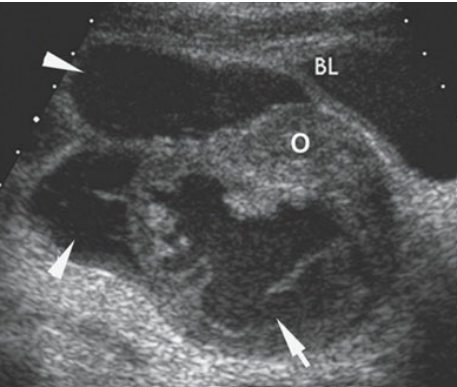
Tubo-ovarian complex. Longitudinal transabdominal image of the adnexa revealing a complex adnexal mass (arrow) composed of a dilated fallopian tube (arrowheads) and enlarged ovary (O) seen posterior to the bladder (BL).

Tubo-ovarian abscess. Transvaginal image of a complex adnexal mass (arrows) with poorly defined borders and complex fluid.
With tubo-ovarian complex, — are more readily recognized as distinct structures, but the ovaries will not be able to be separated from the tube by pushing with the vaginal probe
the ovaries and tubes
clinical findings of tubo-ovarian complex and tubo-ovarian abscess
Findings associated with PID
sonographic findings of tubo-ovarian complex
Thickened, irregular endometrium
Pyosalpinx or hydrosalpinx
Cul-de-sac fluid
Multicystic and solid complex adnexal mass(es)
Ovaries and tubes recognized as distinct structures, but the ovaries will not be separated from the tube by pushing with the vaginal probe
sonographic findings of tubo-ovarian abscess
Thickened, irregular endometrium
Pyosalpinx or hydrosalpinx
Cul-de-sac fluid
Multicystic and solid complex adnexal mass(es)
Complete loss of borders of all adnexal structures, and the development of a conglomerated adnexal (possibly bilateral) mass
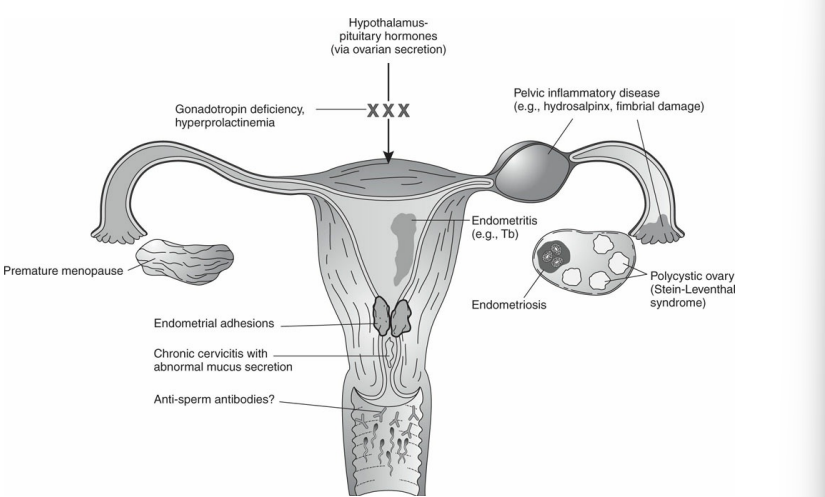
Acquired causes of female infertility