EAI - Anderl
 Call Kai
 Learn
Learn Practice Test
 Spaced Repetition
 Match
Match Flashcards
 Knowt Play
1/33

There's no tags or description
Looks like no tags are added yet.
Name | Mastery | Learn | Test | Matching | Spaced | Call with Kai | Chat |
|---|
No analytics yet
Send a link to your students to track their progress
34 Terms
Please discuss some key concepts of Shang and Zhou religious practices. How would you define the relation between the divine and the human world? What is the significance of ancestors?
Rituals are usually directly connected to the KING (He communicated with ancestors and deities on behalf of the people.) recieves madate of heaven
Shang: Jiaguwen -> inscripties op beenderen (schouderblad rund of schildpad)
Zhou: Jinwen -> inscripties op brons
-> DIVINATIE
ancestor worship and sacrifices to them: this is very crucial in both dynasties; performing the sacrifices correctly gives control over the spirits (but not over tian)
references to Shangdi (later in the Zhou replaced by tian as highest deity)
animal and human sacrifices
Human sacrifices dissapear during the Zhou and there is a change in methodes of fortune telling
What do Oracle Bone Inscriptions tell us about the religious life during the Shang Dynasty. What practices were related to them?
=jiaguwen 甲骨文
inscriptions made on bones
based on little cracks or bu 卜 that formed after throwing them in the fire
method of divination where: king first asked a question and then he would interpret the crack to see what he should do.
The bones where also the proof that the Shang-dynasty excisted.
It also tells us about the relation between shangdi or the supreme deity and the people, they had to agree with the ways of government otherwise the ruler’s mandate would be taken away.
Apart from shangdi their was also ancestor worship where offerings were used to please the andcestors.
Discuss the concepts of shangdi “Supreme Deity” and tian “Heaven” in ancient Chinese philosophy. What is the significance of the “Mandate of Heaven” (tianming)?
Shangdi
Mainly worshipped during the Shang dynasty, but was also important in later periods
Oracle bones with references to Shangdi are found
Supreme deity
Shangdi must approve the ways of the government as such also transcends royal lineages
Transcendal deity
Beyond our perception
Communicates through the king → no direct acces for the worshipper, only for the king
Tian
During the Zhou dynasty the term Shangdi was often replaced by Tian
Mandate of heaven
Tian/heaven must approve the ruler
When the ruler is not behaving well, he can loose the mandate of heaven
There is an uprising against the ruler/the ruler is overthrown
The mandate of heaven can be used as a justification for the change of dynasties
Used to legitimize rule and power
Can you give an account of some mythological figures important in Chinese religion / philosophy? What kind of ideas do they convey?
Shangdi上帝 = highest deity in Shang religion (transcendental)
Legitimises royal authority (not Tianming yet)
→ oracle bones for divination with Shangdi+ ancestors
Yellow River Deity → control of large rivers and their deities
Five sacred Mountains+ deities (f.e. MT. Song Deity)
Huangdi 皇帝= ancestor of all Chinese (Zhou Traditions)
→ legitimises royal authority → 天命
Nüwa 女娲= ancestor of Mankind (she made humans from clay)
Pangu盘古= creator of the world
Shennong 神农= “Heavenly Farmer” (inventor of agricultural techniques)
Xiwangmu 西王母= “Koningin-Moeder van het Westen”
Onsterfelijkheid
尧 (Yáo) and 舜 (Shùn)= ideal mythical rulers (perfect 德) (confucianism)
Discuss some of the main ideas of the Analects (Lunyu) of Confucius.
Discuss the notion of filial piety (xiao) in Confucianism, as well as more generally in terms of the significance for Chinese society.
= collection of sayings and ideas attributed to Confucius and his followers
compiled Warring States period + finalized in Han dynasty
originally a commentary on the Five Classics=> later a central text
in Song one of the 四书
emphasizes moral cultivation as foundation of a stable society.
key ideas
Humaneness (Rén 仁)
Being a man amongst men.
ruler must possess rén because the moral character of the ruler influences the entire society
Inner qualities of a person such as sincerity, genuine care or humility are needed in order to perform rituals correctly. To prevent rituals become empty actions.
filial piety (xiao 孝)
Respect parents, Care for them while alive, Continue honouring them through ancestral rites.
Ritual Propriety (Lǐ 禮)
Religious ceremonies, Respectful behaviour., Social etiquette, Manners, Ancestor worship
moral leadership (de德)
rulers should govern through virtue (dé) rather than through punishments and coercion.
Moral example inspires genuine virtue
ethically refined persons (junzi)
Pursues virtue rather than personal gain, Acts according to righteousness (yì 義), Is trustworthy, modest, and sincere, Constantly cultivates moral character.
<-> xiǎorén 小人
The Way (Dào 道)
the correct path of human conduct
reflects the wisdom of the ancient sage-kings.
creates harmony within society.
Which elements of Confucius’ thinking were integrated into the state ideology during the Han Dynasty? Are there also non-Confucian elements you can discern?
confucian
Filial Piety (Xiao, 孝) as Political Loyalty
The Five Constants (Wuchang, 五常)
= The state enforced the core Confucian virtues: Benevolence (Ren), Righteousness (Yi), Propriety (Li), Wisdom (Zhi), and Trustworthiness (Xin). These were used to cultivate a moral citizenry that would self-regulate rather than constantly rebel.
Ritual and Propriety (Li, 礼)
Meritocracy and the Examination System
some legalist elements
Centralized Bureaucracy and Absolute Autocracy
Codified Law and Penalties
Why is Confucius sometimes seen as “transmitter” rather than an innovator? Why is “ritual” so important in his worldview?
Confucius was both, he saw himself as a transmitter of the ideas of the Zhou kings. Confucius doesn’t claim to create a new philosophical system
saw himself as someone who restores the moral and political order of a “golden age” in the past
In his view, the problem wasn’t a lack of knowledge, but loss/corruption or proper moral cultivation and ritual practice.
Everyone has a different understanding with this word ‘ritual’. Confucius thought about ritualistic that were performed in the community by the elite and he thought these rituals/rites/ways of behavior were very important to keep the society together and to relate to the ancestors. It’s a system of proper behaviour that structures social life, hierarchy and moral development.
Rituals regulate relationships between ruler and subject, parent and child, elder and younger. They make hierarchy visible and legitimate, but also make it function smoothly.
Repeated ritual practice shapes character. By performing the correct forms of behavior, individuals internalize virtues like respect, restraint and responsibility. Rituals train moral sensibility, not just external obedience
In confucius’ view, rulers are not inherently moral. Power alone doesn’t guarantee virtue. Ritual constrains and “humanizes” authority by requiring rulers to behave according to shared norms of product and propriety. ó Legalist thinking relies more on punishment and control than moral formation. For Confucius, the ruler had the responsibility to perform the rituals and to have the right attitude to perfom these as well. Question: Maybe this was the redesign why he was so often rejected? (Rulers just wanted power)
Discuss the notion of “humaneness” (ren) in Confucius’ and Mencius’ thoughts
confuciu’s ideas:
ideally governs relationships between humans
innate but must be practiced
social harmony begins with inner moral charachter rather than laws
rulers must have ren in order for the subjects to have it (inhumane ruler loses Mandate of Heaven)
Mengzi:
仁 is one of the perfections of the Four Beginnings (四段):
Compassions (root of Ren)→ 仁 humaneness
feeling of “shame” → 義appropriateness
intuitive politeness → 禮ritual perfection
ntuitive moral → 智wisdom
promotes “ government through humaneness/compassion”
Little emphasis on rewards & punishment
Reduction of taxes for the population & equal land distrobution
Filial piety, loyalty, trustfulness govern relations in society
→ such a society will survive attacks by stronger states
A.Discuss the concept of Tao/Dao in the various ancient Chinese schools of thought. B.What are the differences?
A. Confucianisme: Dao vertegenwoordigt de juiste manier van leven en morele orde. It’s the source of everything, it defines the normative sociopolitical order. Its used together with the de 德 to develop a sense of shame that holds people back from doing bad stuff.
B. Daoïsme: In de werken van Laozi en Zhuangzi is Dao het natuurlijke, onderliggende principe van het universum, met de nadruk op eenvoud, spontaniteit en niet-handelen (wu wei). De dao is de weg, het is de bron van alles, its transedentaal but the creator of everything, it cannot be described. You are supposed to follow your nature to get close to the dao.
C. Legalism: Hanfeizi needed something to justify his “laws” and the principle of Dao was the perfect concept. Dao causes all things to be as they are (since it’s the ultimate principle of everything), and is where all “patterns” (li理) converge. Everything has its own pattern, so ofcourse the state should also have its own patterns and rules.
=Han Feizi absorbed the Daoist metaphysics (such as dao and li and qi) and deconstructed them of their metaphysical sense to transform them into his constructive philosophy of social and political control. (hij neemt die concepten en onspiritualiseerd ze om zo op te nemen in zijn rationeel model van staatsbestuur)
D. Mohism: the dao refers to a set of objective, pragmatic, and ethical norms for human behavior and statecraft. Unlike the mystical, ineffable dao of Daoism, Mohist dao is a knowable, earthly standard grounded in utility, universal love, and the will of Heaven
How would Confucius define the “perfect person” (jun / shanren / shengren). What kind of qualities must he/she have?
Ren 仁: humaneness or benevolence, the inner moral foundation. A junzi is genuinely caring, compassionate, and morally serious, not just outwardly polite.
Li 禮: ritual propriety, meaning correct conduct, manners, and respect for roles. For Confucius, ritual must be matched by sincerity; empty performance is not enough.
Yi 義: righteousness or rectitude, acting because something is morally right rather than personally useful.
Xiao 孝: filial piety, especially care and respect toward parents and ancestors. Confucius treats this as a basic root of moral life.
Zhong 忠 and xin 信: loyalty and trustworthiness, especially in ruler-subject and friend relationships.
A perfect person is someone who continuously self-cultivates and aligns inner character with outward action. In the Analects, Confucius insists that virtue must shape conduct, so a person should not merely perform ritual correctly but do so with sincerity and moral seriousness. This person also avoids self-interest and corruption. Rather than chasing benefit, the junzi follows the Way (dao), keeps shame as a moral guide, and tries to improve both self and society through example
Junzi: the cultivated ethical person, the main Confucian ideal in social life.
Shanren: a morally excellent person, someone already notably good.
Shengren: the sage, the highest and rarest level of moral perfection.
<-> xiaoren : the opposite => ‘immoral’ man
Shortly discuss the Confucian classics.
Lunyu = “Analects”
20 chapters were compiled by disciples of Confucius
Parts were added after his death
Central text for Chinese philosophy and political thinking
Thoughts are often written in the form of dialogues
Yijing = “Book of Changes”
64 hexagrams = original Yijing, everything else are commentaries
Parts were added by Confucian scholars during the Han dynasty
Concept of the “Mandate of Heaven” tianming was withdrawn from the ruler in a chapter about this concept
↔ Ideal ruler
Avoids war and brings order based on his harmonious acts
Acts like a father with a regard to “all under Heaven” (tianxia)
Shujing = “Book of documents”
Collection of “documents” starting with mythical rulers
First notion of Tianxia
Shijing = “Book of songs”
Collection of poetry, both “popular” and from the aristocratic stratum of society
3 types of songs: ballads, odes and offer songs
Liji
Ritual book
Describes the performance of rites
Rituals are the reenactment of cosmic order
Are important for both ruler and subjects
Chunqiu = Spring and autumn annals
Term: spring and autum → refers to one year
Earlyest and most important history book of China
Chronicles describing historical events during the Zhou dynasty
A listing of events, quite short
Later commentaries were added
Yuejing = “Book of Music
Give an overview of important legalist thinkers.
Guanzi (管子) ca. 7e–4e BCE
Many chapters on governing a state (combines legalist + confucius rituals/norm), similarities Xunzi
early discriptions daoist meditative practices
about
centralization
limit power aristorcrats
tax reforms
goal for ruler to become hegemon
Shen Buhai (申不害) ca. 400–337 BCE
used 无为 (ruler does not interfere, if he is not capable he hides his flaws
very important to find competent officials (controled + regulated + evaluated
shu 術= refers to these techniques of control
System of rewards to motivate lower officials
Shang Yang / Shangzi (商子 / 商君书) ca. 390–338 BCE
Serves in the state of Qin
Reforms the administravtive and legal system of the state (Centralization, standards…)
Emphasis on fixing the 法( Equality before the law, Loyalty to the ruler is more important than loyalty to family, System of strict punishments)
Despite his succes, he was often hated by the aristocrats and even the emperor→ executed & his family was killed
Shen Dao (慎到) ca. 350–275 BCE
Rulers should govern by “无为” (→ influence daoism & buddhism)
Promotes objective standards 法 as the basis of judgement (to avoid subjective deciscions)
Emphasis on shi 勢, power base/ methods/ advantage to stay in power
Han Feizi (韩非子) ca. 280–233 BCE, synthese van legalisme (法 fǎ, 術 shù, 势 shì)= belangrijkste werk
took Shangmings’s critisism: ruling by rules instead of ethics
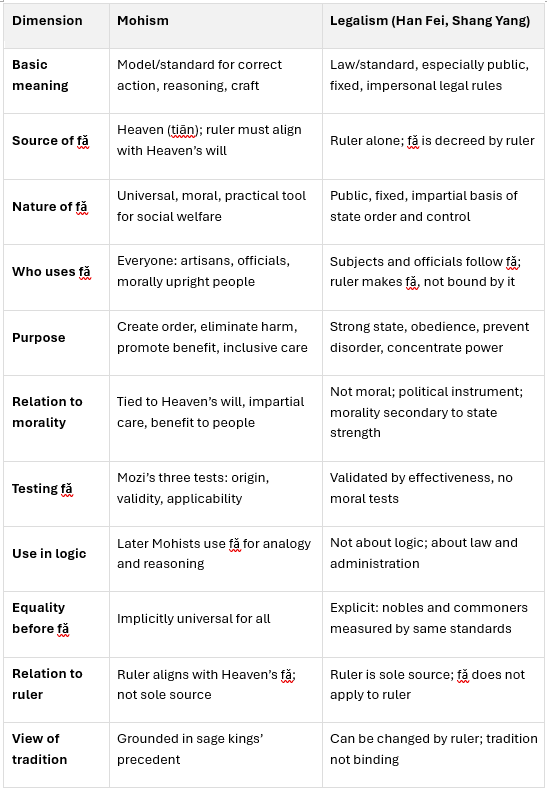
rules do not apply to ruler
laws are not absolute
human nature is bad (xunzi)
uses daoism to give the metaphysics
Compare the view on human nature by legalists, as compared to Mencius.
Mencius:
people are good by nature
from the moment they are born they are good and the wrong or no education will make them bad.
Education is needed to keep them on the right path, and people should be rewarded for the right behaviour.
Xunzi,
teacher of Hanfei => big influence on legalism,
people were born with a bad nature or xing性
they need education to be put on the right path
strict punishment is essential,
a need for suppression by regulation and control.
Discuss the concept of fa in the various ancient Chinese schools, with an emphasis on Legalism and Mohism.
Discuss the following concepts in Legalism: “essence” (qing), “powerbase” (shi), and “methods” (shu).
Qing (情) – "Essence" or Human Reality
The Selfish Essence of Man
exploit this essence people using the "Two Handles" : reward and punishment
Shi (势) – "Powerbase" or Positional Authority
Authority Belongs to the Office, Not the Person
ruler holds absolute institutional leverage over their subjects, order will be maintained.
Monopoly on Power
Shu (术) – "Methods" or Bureaucratic Technique
A core shu (method) of the ruler is to remain entirely hidden and inscrutable. The ruler must conceal their personal desires, likes, dislikes, and opinions.
Han Feizi masterfully synthesized these three concepts into a unified theory of totalitarian statecraft:
The ruler looks at the $qing$ (human reality) and accepts that people are selfish and motivated only by carrots and sticks.
The ruler takes up their $shi$ (positional powerbase), ensuring they have total control over the state's rewards and punishments.
The ruler covertly applies $shu$ (administrative methods) from behind a curtain of secrecy to pull the bureaucratic strings, keeping ministers terrified, compliant, and strictly accountable.
Would you say that there any resemblances between Daoism and Legalism? How would you define those?
ontology, in Hanfeizi’s work he used Daoism to explains the origins of the universe and he gives the metaphysical workings of the universe using the dao. This is also one of the reasons that daoistic books weren’t burnt during the Qin dynasty.
It was also advantageous for the ruling class of the legalists to use Daoism since it kept the people in a state of ignorance (because the focus should be on oneself and self-cultivation and not on state building.
Lastly Hanfei tried to integrate the concept of wuwei into his theories because in this case the ruler isn’t supposed to do anything (except rule).
I
How does Mencius explain the relation between Heaven and man? Why does he conclude that human beings have a good nature?
Relationship Heaven and man
Heaven is not a personal deity
Heaven is the origin of men’s nature
Nature is a reflection of heaven that is given humans by birth
The idea that humans are a reflection of heaven is important for Mengzi’s philosophy
Human nature is good
There was a lot of discussion on human nature during the Zhou dynasty
A human being is born perfect
4 beginnings → should be realised → develops into perfection
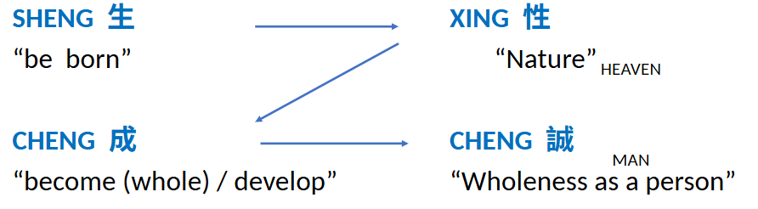
Education is important to confirm your good nature
Important on the philosophical level
Confucius: important on the practical level
If you expierence something non beneficial it will not help you to make your human nature better
) Give a short overview of the “Four Books” of Confucianism.
Lunyu= “Analects”
20 chapters were compiled by disciples of Confucius
Parts were added after his death
Central text for Chinese philosophy and political thinking
Thoughts are often written in the form of dialogues
Mengzi
Daxue (part of Liji)
begineselen van goede staat
model state based on model family
golden rule
development of knowledge is essential
zhongyong (part of Liji)
doctrine of the middle
how a junzi should behave
following the nature
staying in centre of emotional responses
How would you define some differences between the Confucian scholars Mencius and Xunzi?
Human Nature (Xing, 性)
Mencius - Innate Goodness (Xing Shan, 性善)
Xunzi – Innate Evil/Badness (Xing E, 性恶)
Self-Cultivation – Growth vs. Transformation
Mencius – Internal Cultivation, internal process of nourishing what is already there.
Xunzi – External Transformation, Moral development requires rigorous study of the Classics, submission to an enlightened teacher, and the strict internalisation of external standards.
Li (礼 - Rituals) vs. Ren (仁 - Benevolence)
Mencius – Prioritized Ren
Xunzi – Prioritized Li
Do you see some resemblances between Mohism and Confucianism? Where do they divert?
Resemblances
both seek social harmony and political order: They both arose during the chaotic Warring States Period and were concerned with restoring order to society. Both believe that good government and moral behavior are necessary to overcome social disorder.
Both emphasize morality rather than force: Neither school believes that society should be governed primarily through coercion or military power. Moral conduct and ethical leadership are central in both traditions.
They both stress self-improvement and virtuous rulers: Confucius argues that rulers should cultivate virtue (仁; benevolence). Mozi also expects rulers to be morally upright and act for the benefit of the people.
Both believe Heaven as a moral dimension: Confucianism sees Heaven (Tian) as a source or moral order. Mohism likewise holds that Heaven cares about human welfare and rewards or punishes behavior.
Differences
Family vs universal concern:
Social hierarchy vs meritocracy:
Self-cultivation vs action:
Rituals
Fate
What is the Mozi’s vision of an ordered society?
Importance of a well-ordered society:
The most important is having a good capable ruler => meritocracy
Without government people will only think about their own advantage→ no order
Invention of a centralized governmenting system= important step since it limits the “variety of individual interests”
This is also true for the family; families are no model for society ( ↔ confucius)
Chaos is programmed based on the lack of a ruler→ Son of Heaven should be the wisest and most capable (↔ legalism), Ruler should align his own will with Heaven’s will because Heaven provides the “model” for the rule 法
Different use of 法!
Has their own military organization
Discuss the central term of “profit” (li) in the Mozi. Provide some examples.
For Mozi, moral and political actions should be judged according to whether they produce benefit for the people and society as a whole. Pursuing universal benefit is the basis of morality and good government.
The ideal is a state where maximal “profit” is gained for everybody:
Personal profit comes with universal profit
The notion of “righteousness/propriety (yi義 (traditionally means moral correctness/righteousness)) => what is righteous is what produces benefit.
Doing good is more important than being good: Confucius emphasizes inner virtue, self-culivation (becoming a morally refined person).
Notion of 仁 (benevolence) is defined as love (not emotional)/concern for others: Mozi writes “To be benevolent is to love”. It means caring for others, acting for their benefit, treating people impartially => becomes basis of his famous doctrine of jian ai (兼爱), translated as universal love/impartial care
The notion of “destiny” is rejected: Fatalism discourages action and so is rejected, and practical action creates benefit 利.
How would you explain the idea of “universal concern/love” in Mozi’s thinking?
Mozi argued that many social problems (such as conflict, theft, oppressions and war) arise because people care too much about themselves, their families, or their own states while neglecting others.
His solution was jian’ai 兼爱 (universal concern/impartial care), which means extending the same concern for others’ welfare that one has for oneself. If individuals consider the interests of others alongside their own, people will stop harming one another, and society will become harmonious.
Importantly, this is not necessarily an emotional love or affection for everyone. It’s a practical and moral principle of treating others impartially and acting in ways that benefit all.
Discuss key issues of Zhuangzi’s worldview. What are the main differences to other philosophers?
The Value of "Uselessness" (Wuyong 无用)
Wuwei (Effortless Action) & The Fasting of the Mind
Confucianism
Social harmony through moral self-cultivation, rigid rituals (li), and family obligations.
vs.
Zhuangzi’s View: He saw Confucian moralizing and strict social rituals as an artificial straightjacket that mutilates human nature. To Zhuangzi, true harmony comes from disentangling oneself from social expectations and returning to spontaneity.
Xunzi
Human nature is inherently warped; it must be reshaped through conscious effort and ritual.
vs.
Zhuangzi’s View: While Xunzi believed humanity must consciously conquer and distinguish itself from nature, Zhuangzi believed we should fully dissolve the barrier between the human and the natural world
Laozi
Aligning with the Dao to govern effectively and achieve political harmony.
vs.
Zhuangzi shifts the focus entirely away from politics and onto personal, existential freedom and psychological liberation.
What was Zhuangzi’s attitude towards death?
Discuss the notion of “sage/saint” of Zhuangzi, in contrast to Confucius’ junzi.
The saint: the true sage transcends distinctions and moves freely between Heaven and human society, without being bound by either, embodying spontaneity and unity with the Dao. (= De daoïstische wijze overstijgt tegenstellingen, leeft spontaan in harmonie met de Dao, en beweegt vrij 自然tussen natuur en samenleving zonder zich door één van beide te laten beperken.) = free man
Junzi: has perfect 利 and 仁 (is perfectly morally cultivated)= strict man
Why is it important? Society is guided through moral example rather than punishment. Leaders should serve as ethical models.
Discuss the notion of naturalness / spontaneity / non-action in Daoism.
Naturalness or ziran 自然 is the natural state of things, that which is so just by itself. It can be achieved by cultivating qi 氣 and being one with the dao. Spontaneity is closely related to naturalness since it is the following of the natural flow of things, there is no need to choose between ‘this’ and ‘that’, which will cause one to loose himself, there is a need for non-action or wuwei 无为 that indicates that a person should just follow his dao.
How is the ideal ruler defined in the Laozi / Daode jing? Contrast it to other Chinese schools of thought
Laozi:
Rule by “non-doing” wuwei 無為
Rulers their actions should pass so unnoticed that their very existence remains unknown
Rulers shouldn’t be competitive, as to not invite more competition
Keep people in a state of ignorance
Keep people in the dark about certain matters
→ easier to rule!
Legalism:
The ideal ruler shouldn’t be the smartest person but the person with the most power. He rules by wuwei: do not interfere with the job of the officials, just looks at the results.
Mohism:
The ruler should be the smartest and most competent person. He should align his own wil with heaven’s wil because Heaven provides the ‘model’ for the ruler 法 (here is fa a model/standerd, not laws). He should care for everyone (inclusive care).
Confucianism:
The ruler should not rule by laws or methods of punishments but by his good virtue. His morally behavior should be perfect aswell as his 德 and 信. He gets the 天命 from Heaven as a legitimization to rule .
Both Zhuangzi and Laozi criticize “dualism”. What are your thoughts about that?
Zhuangzi rejects practices of debates about dualism (this or that, right or wrong).
truth of the world is beyond the dualism of these things
experience more important
Laozi thinks the Dao is beyond all dualities (and also linguistic expression).
He says that if you imply/acknowledge the existence of one extreme, you immediately know the opposite also exists.
There is no beauty without knowing what ugliness is. Things come into existence out of contrast with one another. Low does not exist without height and vice versa. (bv: het idee van het ene dat op het andere volgt, onstaat uit het idee van het ene dat op het andere volgt.)
Discuss Han Dynasty syncretism.
= blending/ merging of legalism (legal), confucianism (ethical) and daoistic 9metaphysical) ideas into a new unified system
Han thinkers developed an ontology based especially on the Yìjīng (Book of Changes).
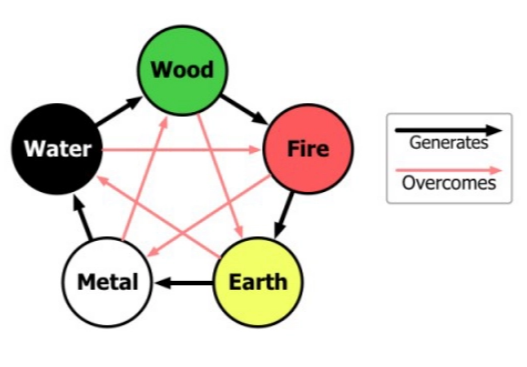
The Dào or “Great Ultimate” as the main principle. => Two opposite forces: Yīn (shadow) and Yáng (light), which act in cycles like creation and destruction. => From yin‑yang, the five phases (wǔxíng) emerge, which produce and overcome each other.
Correlative cosmology= All phenomena were seen as following one natural order and thus correlatable with each other.
How would you define “correlative thinking”? Provide some examples.
“Correlative thinking” = linking everything together in a cosmic cyclus (seeing everything in the world as an interconnected pattern)
→ They just try to find an explanation for everything by linking everything to Dao, Yin&yang, 5 elements , ganying(and linking these in a pattern)
Zou Yan
Dong Zhongshu
Discuss the significance of Dong Zhongshu for Han Dynasty philosophy.
179-104BCE
He was an important thinker in de correlative cosmology
a conceptual framework, that views the universe as an interconnected web of relationships. ipv physical causation, it links phenomena across different domains (the cosmos, the human body, and society) through shared patterns, resonances, and symbolic categories
numerology as important tool to explain unity of universe + humans
eg. There are 366 small joints in the body = 366 days in a year, there are 12 large joints = #months
tried to merge Confucianism with correlative thinking
天is the心 of the universe
Ruler is the 心of the sociopolitical order
The bodily 心is the ruler of the body
tried to discover the causative principles of the past as a guidance for the futere/present
put a big emphasis on cultural heritage to find workings of the heavens
“The king’s love, hate, joy and anger are like Heaven’s seasons. If the ruler expresses his emotions in accord with moral principles, then the world will be well governed, but if not, the age will be chaotic.”
Was important in the new text school
nature of human beings is good, but because of feelings that a human being becomes bad
Shortly discuss the ideas of Zou Yan.
Related to the Yin yang school
Flourishes in the early Han
Important for the development of the “philosophy of nature”
Connect heavenly/natural phenomena to the human world → correlative cosmology
Member of the Jixia academy
Adviser to several rulers
Known for merging the cyclical patterns with human history
He uses the term wude 五德 “5 powers”
The concept of the 5 Elements were maybe originally related to agriculture
Cosmologists like Zou Yan are sometimes associated with the idea of a “proto-science” since they observe natural phenomena (Joseph Needham)
In terms of the development of Daoism after the Han, what would you point out as important?
Daoism developed in two directions:
Xuanxue (Neo-Daoist philosophy), represented by Wang Bi
Innovation came with Neo-daoism
religious Daoism, which became an organized religion with rituals, priests, and beliefs in immortality.
Religious/popular Daoism is an amalgamation of philosophical Daoism, old legends, shamanism and cosmology.
Daoism had the opportunity to develop the religious aspect more
Mainly Laozi and Zhuangzi were important in this period. (through commentaries written on the Laozi and Zhuangzi ) + philosophical debates.
Because of the fragmented states, the ideas in popular Daoism were sometimes very anti-authoritarian and anarchistic
=> led to revolts (like yellow turban movement) and several sects (like the celestial masters tianshi).
Daoism and Buddhism mutually influenced each other.
Daoism → the formation on Chinese Buddhism doctrines
Buddhist institutions → Buddhist deities by Daoism.